Students can use NCERT Class 9 Advanced Science Solutions Chapter 5 Work and Energy Question Answer to understand complex concepts with ease.
Work and Energy Class 9 Questions and Answers
Work and Energy Question Answer Class 9
Quick Check
Question 1.
Define a conservative force with one example.
Answer:
A force is conservative if the work done by it in moving an object between two points is independent of the path taken.
Example: Gravitational force.
Question 2.
Why is gravitational force called a conservative force?
Answer:
Gravitational force is called a conservative force because the work done against gravity depends dnly on the initial and final vertical positions (height) of the object, not on the path taken to get there. Furthermore, the net work done by gravity over a closed loop is always zero.

Question 3.
Why is friction called a non-conservative force?
Answer:
Friction is a non-conservative force because the work it performs depends on the path taken. The longer the distance an object slides, the more work friction does. This energy is dissipated as heat and cannot be recovered to restore the object to its original state of motion.
Question 4.
What happens to energy when a non-conservative force acts on an object?
Answer:
When a non-conservative force acts, mechanical energy (the sum of kinetic and potential energy) is not conserved. It is typically converted into non-mechanical forms, such as thermal energy (heat), sound, or permanent deformation.
Question 5.
If there were no friction on Earth, how would motion be different? Explain.
Answer:
On a frictionless Earth, motion would be characterised by a total lack of control and persistence:
- Perpetual Motion: An object set in motion would continue moving at a constant velocity forever unless it hit another object.
- Lack of Traction: Walking would be impossible because there would be no grip to push against the ground.
- Inability to Stop: Cars or bicycles would be unable to brake or turn, as both actions require friction between the wheels and the surface.
Check Your Understanding
Question 1.
Explain the conversion of potential energy to kinetic energy when a ball is thrown upward.
Answer:
When a ball is thrown upward, its Kinetic Energy (KE) is at its maximum at the point of release. As it rises, gravity (a conservative force) does negative work on it, slowing it down and converting its KE into Gravitational Potential Energy (GPE). At the peak of its flight, its velocity is zero (KE = 0), and its GPE is at its maximum. As it falls back down, the GPE is converted back into KE.
Question 2.
Why is gravitational potential energy considered a conservative force?
Answer:
It is considered a conservative force because the work done in moving an object between two points depends only on the vertical displacement (height) and not on the path taken. Additionally, the net work done by gravity over any closed loop (returning to the start point) is zero.
Question 3.
Calculate the potential energy of a 5 kg object kept on the top of a 30 m high building. (Considering potential energy to be zero at the base of the building.)
Answer:
Given,
Mass (m) = 5 kg
Acceleration due to gravity (g) ≈ 9.8 m/s2
Height (h) = 30 m
Using the formula U = mgh:
U = 5 × 9.8 × 30 = 1470 J
Question 4.
What is the increment in its potential energy?
Answer:
The “increment” refers to the change in potential energy from the reference point. Since the potential energy at the base was zero, the increment is simply the total potential energy at the top, i.e., 1470 J.
Question 5.
A 10 kg weight is hung from a 5 m wire, causing it to stretch by 1 mm. Calculate the energy stored.
Answer:
The work done is given by
W = \(\frac{1}{2}\) Fx
Force (F – mg) = 10 kg × 9.8 m/s2 = 98 N
Extension (x) = 1 mm = 0.001 m
W = \(\frac{1}{2}\) × 98 × 0.001 = 0.049 J
This work done is stored as the potential energy of the object.
Question 6.
Calculate the work done by an external force to lift a 2 m long rod from a horizontal to a vertical position.
Answer:
When lifting a uniform rod from horizontal to vertical, we calculate the work done based on the displacement of its Centre of Mass (CM).
The CM of a 2 m rod is at its midpoint (1 m).
Initial height of CM = 0 m (horizontal on the ground).
Final height of CM = 1 m (vertical).
Work Done (W) = mghcm = m.g.1
(Note: Without the mass m, the answer is expressed as 9.8 m joule).
Reflect on the following:
Question 1.
If there were no friction, would a moving object ever stop?
Answer:
According to Newton’s First Law, if there were no friction (or any other non-conservative external force like air resistance), a moving object would never stop. It would maintain a constant velocity indefinitely because there would be no force to dissipate its kinetic energy.
Question 2.
Why do pendulums slowly stop after some time?
Answer:
While gravity is a conservative force that keeps the pendulum swinging, non-conservative forces- specifically air resistance (drag) and friction at the pivot point-gradually convert the mechanical energy into heat. This loss of energy causes the amplitude of the swing to decrease until the pendulum eventually stops.
Question 3.
Why do machines require lubrication?
Answer:
Machines consist of moving parts that interact. Lubrication is required to reduce frictional forces between these surfaces. By minimising friction, lubrication prevents excessive wear and tear and reduces the amount of energy lost as heat, thereby increasing the machine’s efficiency.
Work and Energy Class 9 Extra Questions and Answers
Short Answer Type Questions
Question 1.
A bullet weighing 10 g is fired with a velocity of 800 ms-1. After passing through a mud wall 1 m thick, its velocity decreases to 100 ms-1. Find the average resistance offered by the mud wall.
Answer:
Using work-energy theorem
F . s = \(\frac{1}{2}\)mv2 – \(\frac{1}{2}\)mu2
Where,
m = 10 g = \(\frac{10}{1000}\) = 0.01 kg
υ = 100 ms-1, u = 800 ms-1
s = 1 m,
F = \(\frac{1}{2}\) × 0.01 × (1002 – 8002)
= -3150N
Question 2.
A spring with spring constant 300 N/m is stretched by 0.1 m. Calculate:
(a) the force applied, and
(b) the elastic potential energy stored in the spring
Answer:
Given:
k = 300 N/m, x = 0.1 m
(a) Force applied:
F = kx = 300 N/m × 0.1 m = 30 N
(b) Elastic potential energy:
PE = \(\frac{1}{2}\) kx2
PE = \(\frac{1}{2}\) × 300 N/m
(0.1 m)2 = 1.5 J
Question 3.
A pendulum released from a certain height never reaches the same height after every oscillation. Explain the reason in terms of energy transformation.
Answer:
A pendulum does not reach the same height after every oscillation because some of its mechanical energy is lost due to air resistance and friction at the pivot.’
This energy is converted into heat and sound, so the pendulum’s height gradually decreases.
Question 4.
Explain why gravitational force is called a conservative force, while friction is called a non-conservative force.
Answer:
Gravitational force is called a conservative force because the work done by gravity depends only on the initial and final positions of the object, not on the path followed.
Friction is called a non-conservative force because the work done by friction depends on the path travelled and it converts mechanical energy into heat energy.
Question 5.
A student hangs various masses from a vertical spring and records the corresponding extension. The collected data is plotted on the force-extension graph provided below.
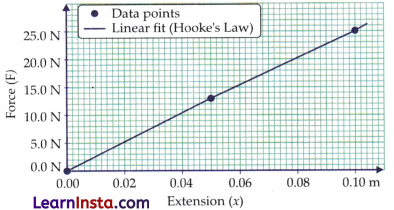
Assuming the spring does not exceed its limit of proportionality, calculate:
(a) The spring constant (k) of the spring.
(b) The force (F) required to produce an extension of 0.08 m.
(c) The total work done (or elastic strain energy stored) in stretching the spring from 0.0 m to 0.10 m.
Answer:
(a) The spring constant is the gradient (slope) of the linear region of a force-extension graph.
k = \(\frac{\Delta F}{\Delta x}\)
Using the data points, k = \(\frac{25.0 \mathrm{~N}-0 \mathrm{~N}}{0.10 \mathrm{~m}-0 \mathrm{~m}}\)
k = \(\frac{25.0}{0.10}\) = 250 N/m
(b) Since the spring obeys Hooke’s law, then
F = k × x
F = 250 N/m × 0.08 m
F = 20N
(c) Work Done (Energy Stored) = area under the graph of Force-extension
= \(\frac{1}{2}\) × base × height
= \(\frac{1}{2}\) × extension × force
Using the values at 0.10 m extension:
W = \(\frac{1}{2}\) × 0.10m × 25.0N
W= \(\frac{1}{2}\) × 2.50
W = 1.25J
Question 2.
Derive the relation between linear momentum and kinetic energy.
Answer:
We know that, KE of a particle,
K = \(\frac{1}{2}\) mv2
where m is the mass of particle and υ is the velocity
K = \(\frac{1}{2} \frac{m v^2 \times m}{m}\)
K = \(\frac{1}{2} \frac{(m v)^2}{m}\)
K = \(\frac{p^2}{2 m}\) (∵ p = mυ)
∴ p = \(\sqrt{2 m K}\)
Question 3.
State if each of the following statements is true or false. Give reasons for your answer.
(a) Mechanical energy is conserved only when conservative forces act on a system.
(b) Total energy of a system is always conserved, no matter what internal and external forces on the body are present.
(c) Work done in the motion of a body over a closed loop is zero for every force in nature.
Answer:
(a) True
Reason: Mechanical energy is conserved only when conservative forces, such as gravitational or spring force, act on the system. If non-conservative forces like friction act, some mechanical energy is converted into heat.
(b) True
Reason: The total energy of a system is always conserved according to the law of conservation of energy. Energy may change from one form to another, but it cannot be created or destroyed.
(c) False
Reason: Work done over a closed loop is zero only for conservative forces. For non-conservative forces like friction, the work done over a closed path is not zero because energy is dissipated as heat.
Long Answer Type Questions
Question 1.
A student uses a force-extension graph to calculate the energy stored in a bungee cord. The graph is a straight line that reaches a maximum force of 400 N at an extension of 2.0 m.
(a) Calculate the elastic potential energy stored in the cord at maximum extension. Show your working.
(b) The cord is released and used to launch a 0.5 kg projectile. Assuming 100% energy transfer, calculate the initial velocity of the projectile.
Answer:
(a) The energy stored (Work Done) is the area under the force-extension graph.
Energy = \(\frac{1}{2}\) × Force × Extension
Energy = \(\frac{1}{2}\) × 400 N × 2.0 m
Energy = 400 joule (J)
Equate Elastic Potential Energy (Ee) to Kinetic Energy (Ek)
400J = \(\frac{1}{2}\) mυ2
400 = \(\frac{1}{2}\) × 0.5 × υ2
400 = 0.25 × υ2
υ2 = \(\frac{400}{0.25}\) = 1600 ⇒ υ = \(\sqrt{1600}\)
Velocity = 40 m/s
Question 2.
A scientist is testing a new metal wire for use in a bridge. They plot a force-extension graph but notice the line does not pass through the origin (0,0); instead, it shows a small extension even when the force is zero.
(a) Suggest one possible systematic error in the experimental setup that could cause the graph to miss the origin.
(b) Describe how the scientist can use the graph to find the spring constant despite this error.
(c) Explain why it is important to take multiple readings and plot a graph rather than relying on a single calculation of k = \(\frac{F}{x}\)
Answer:
(a) This is likely a Zero Error. It occurs if the ruler was not set to zero at the natural length of the wire, or if the “pointer” used to read the extension was already displaced before weights were added.
(b) The scientist should calculate the gradient (slope) of
the straight line. Since k = \(\frac{\Delta F}{\Delta x}\), the constant vertical shift does not change the steepness of the line.
(c) Plotting a graph allows fqr the identification and exclusion of anomalous results (outliers). It also reduces the impact of random errors by providing an “average” line of best fit across all data points.
Question 3.
A small 2.0 kg laboratory cart is moving along a frictionless horizontal track. A variable braking force is applied to the cart to bring it to a stop. The relationship between the applied force and the distance the cart travels while braking is shown in the graph below.
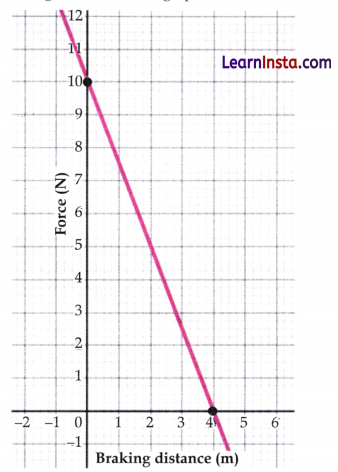
Graph Data:
- Force (F): Starts at 10 N (at 0 m) and decreases linearly to 0 N (at 4.0 m ).
- Distance (d): The total braking distance is 4.0 m .
(a) Use the data given in the graph to calculate the total work done by the braking force on the cart.
(b) State the Work-Energy Theorem in words and write a mathematical equation.
(c) Calculate the initial velocity (υ) of the cart just before the braking force was applied.
Answer:
(a) The work done by a variable force is represented by the area under the force displacement (F – d) graph.
The shape is a triangle: Area = \(\frac{1}{2}\) × base × height
Work Done = \(\frac{1}{2}\) × 4.0 m × 10 N
Work Done = 20 joule (J)
(Note: Since it is a braking force, the work is technically negative as it removes energy, but the magnitude is 20 J).
(b) Work-Energy Theorem
The Work-Energy Theorem states that the net work done
on an object is equal to its change in kinetic energy (Ek).
Equation: Wnet = ∆Ek = \(\frac{1}{2} m v_f^2-\frac{1}{2} m v_i^2\)
(c) Since the cart comes to a stop, the final velocity (υf) is 0 m/s. The work done removes all the initial kinetic energy.
Work Done = Initial Kinetic Energy
20 J = \(\frac{1}{2}\) × m × υ12
20 = \(\frac{1}{2}\) × 2.0 kg × υ12
20 = 1.0 × υ12
υ = \(\sqrt{20}\) = 4.47 m/s
Case-Based MCQs
Question 1.
In a traditional clock, time is kept by a swinging pendulum. A technician lifts the 2.0 kg pendulum bob to Position A, which is at a vertical height of 0.2 m above its lowest point (Position B, the equilibrium position). When released from rest, the bob swings back and forth in a circular arc.
Assume the air resistance and friction at the pivot are negligible, meaning the total mechanical energy of the system remains constant. Take the acceleration due to gravity g = 10 m/s2.
(i) At Position A (the highest point), what is the primary form of energy possessed by the pendulum bob?
(A) Purely Kinetic Energy
(B) Purely Gravitational Potential Energy
(C) Equal parts Kinetic and Potential Energy
(D) Internal Thermal Energy
Answer:
Option (B) is correct.
Explanation: At the highest point, the bob momentarily stops (υ = 0 ), so the kinetic energy is zero.
(ii) As the bob swings from Position A to Position B, which of the following energy transformations occurs?
(A) Kinetic Energy transforms into Potential Energy
(B) Potential Energy transforms into Kinetic Energy
(C) Chemical Energy transforms into Kinetic Energy
(D) Potential Energy transforms into Heat Energy
Answer:
Option (B) is correct.
Explanation: Height decreases (losing Ep) and speed increases (gaining Ek).
(iii) What is the maximum Kinetic Energy (Ek) the bob will possess when it reaches the lowest point (Position B)?
(A) 0.4 J
(B) 2.0 J
(C) 4.0 J
(D) 40.0 J
Answer:
Option (C) is correct.
Explanation: Ep at top = mgh = 2.0 × 10 × 0.2 = 4.0 J.
By conservation of energy, max Ek = initial Ep.
(iv) What will be the velocity of the 2.0 kg bob as it passes through the equilibrium position (Position B)?
(A) 1.0 m/s
(B) 2.0 m/s
(C) 4.0 m/s
(D) 10.0 m/s
Answer:
Option (B) is correct.
Explanation: Ek = \(\frac{1}{2}\) mυ2 ⇒ 4.0 = \(\frac{1}{2}\) × 2.0 × υ ⇒ 4.0 = υ2
⇒ υ = 2 m/s.
Case-Based Subjective Questions
Question 1.
A warehouse worker is moving a heavy crate across a flat, horizontal floor. The worker applies a constant horizontal force of 250 N to push the crate a distance of 8 meters.
Once the crate reaches the end of the floor, the worker uses a small crane to lift it vertically onto a shelf that is 2 meters high. The crate has a mass of 50 kg.
(Assume g = 10 m/s2)
(i) A second worker helps by pushing down vertically on the crate with a force of 100 N while it is being moved horizontally. Does this second worker perform any work on the crate? Explain why.
(ii) State the condition under which the work done by a force is considered negative. Give a real-world example from the case above.
(iii) Calculate the total work done by the first worker while pushing the crate across the 8 m horizontal floor. Show your formula and units.
Answer:
(i) No, the second worker does zero work.
Reason: For work to be done, there must be displacement in the direction of the force. Since the force is vertical and the displacement is horizontal (90° angle), no work is performed.
(ii) Condition: Work is negative when the force acts in the opposite direction to the displacement.
Example: Friction acting on the crate as it slides across the floor performs negative work because it opposes the motion.
(iii) The work done is given by
W = F × d
W = 250 N × 8 m
W = 2,000 joule (J)
Question 2.
A quality control engineer is testing a new steel alloy spring designed for a vehicle’s suspension system. The engineer gradually increases the load on the spring and measures the resulting extension. The collected data shows that the spring follows a linear path until a force of 600 N is reached at an extension of 0.15 m.
Beyond this point, the graph begins to curve. When the engineer increases the force to 800 N , the extension becomes 0.25 m. Upon removing the 800 N load, the spring does not return to its original length, remaining , stretched by 0.02 m.
(i) Identify the Limit of Proportionality for this spring based on the data provided. Explain what happens to the relationship between force and extension once this point is passed.
(ii) Based on the case study, has the spring exceeded its Elastic Limit? Provide evidence from the text to support your answer.
(iii) Calculate the Spring Constant (k) for this alloy while it is within its linear range. Ensure you include the correct SI units.
Answer:
(i) Point: The limit is at 600N (or 0.15 m).
Reason: Beyond this point, the spring no longer obeys Hooke’s Law; the extension is no longer directly proportional to the force, causing the graph to curve.
(ii) Yes, it has exceeded its elastic limit.
The text states that when the load was removed, the spring “remained stretched by 0.02 m, indicating permanent plastic deformation.
(iii) Formula for the spring constant k = \(\frac{F}{x}\)
k = \(\frac{600 \mathrm{~N}}{0.15 \mathrm{~m}}\) = 4000 N/m
Work and Energy Class 9 MCQ
Question 1.
A cyclist comes to a skidding stop in 20 m. During this process, the force on the cycle due to the road is 100 N and is directly opposed to the motion. Work done by the road on the cycle is:
(A) -2000 J
(B) 2000 J
(C) 1000J
(D) 100J
Answer:
Option (A) is correct.
Explanation: W = Fs cos 180°
= 100 N × 20 m × (-1) = -2000 J
Question 2.
A body of mass 100 g falls from a height of 10 m. Its increase in kinetic energy is:
(A) 9800 J
(B) 9.8 J
(C) 980 J
(D) 100 J
Answer:
Option (B) is correct.
Explanation: Loss of PE = Gain in KE
Loss in PE = mgh = \(\frac{100}{1000}\) × 9.8 × 10 = 9.8 J
So, increase in KE = 9.8 J
Question 3.
A 50-watt bulb operates for 10 second. How much energy is consumed?
(A) 50 J
(B) 500 J
(C) 5,000 J
(D) 50,000 J
Answer:
Option (B) is correct.
Explanation: Energy E = P × t.
Substituting P = 50 W, t = 10 s:
E = 50 W × 10 s = 500 J
Question 4.
The slope of a force-extension graph represents:
(A) Work done
(B) Potential energy
(C) Spring constant
(D) Mass of the spring
Answer:
Option (C) is correct.
Explanation: According to Hooke’s law, F = kx
If we plot a graph between Force (F) and Extension (x),
we get a straight line passing through the origin.
The slope (gradient) of this graph is:
Slope = \(\frac{F}{x}\) = k (Spring constant)
Question 5.
The force exerted by a stretched spring always acts:
(A) In the direction of motion
(B) Away from equilibrium position
(C) Perpendicular to displacement
(D) Opposite to displacement
Answer:
Option (D) is correct.
Explanation: A stretched or compressed spring exerts a restoring force. This force always acts opposite to the displacement to bring the spring back to its original position.
Question 6.
Which of the following is a conservative force?
(A) Frictional force
(B) Air resistance
(C) Gravitational force
(D) Muscular force
Answer:
Option (C) is correct.
Explanation: A conservative force is a force whose work does not depend on the path taken, only on the initial and final positions.
Gravitational force is conservative because the work done by gravity depends only on the change in height, not on the path followed.
Assertion-Reason Questions
Directions: In the following questions, a statement of Assertion (A) is followed by a statement of Reason (R). Mark the correct choice as:
(A) Both Assertion (A) and Reason (R) are true, and Reason (R) is the correct explanation of Assertion (A).
(B) Both Assertion (A) and Reason (R) are true, but Reason (R) is not the correct explanation of Assertion (A).
(C) Assertion (A) is true, but Reason (R) is false.
(D) Assertion (A) is false, but Reason (R) is true.
Question 1.
Assertion (A): The kinetic energy of the body of mass 2 kg and momentum of 2 Ns is 1J.
Reason (R): The relation between kinetic energy and linear momentum of an object is given by K = \(\frac{p}{2 m}\)
Answer:
Option (C) is correct.
Explanation:
K = \(\frac{p^2}{2 m}\)
K = \(\frac{2^2}{2 \times 2}\)
K = 1J
So, the assertion is true. But the reason is false.
Question 2.
Assertion (A): Friction is called a non-conservative force.
Reason (R): Friction converts mechanical energy into heat energy.
Answer:
Option (A) is correct.
Explanation: Friction is a non-conservative force because it causes loss of mechanical energy. This energy is converted mainly into heat energy.
Question 3.
Assertion (A): A pendulum keeps swinging forever in air.
Reason (R): Air resistance and friction oppose the motion of the pendulum.
Answer:
Option (D) is correct.
Explanation: The assertion is false because a pendulum does not keep swinging forever in air. Due to air resistance and friction, it gradually loses energy and stops.
Question 4.
Assertion (A): A stiffer spring has a larger spring constant.
Reason (R): More force is required to produce the same extension in a stiff spring.
Answer:
Option (A) is correct.
Explanation: A stiff spring has a large spring constant (k) because it requires more force to produce the same extension compared to a soft spring.