Practicing Class 8 Social Science MCQ and Class 8 SST Part 2 Chapter 5 Citizenship Rights and Duties MCQ Online Test with Answers daily helps in time management.
Class 8 Citizenship Rights and Duties MCQ with Answers
MCQ on Citizenship Rights and Duties Class 8
A Citizenship Rights and Duties MCQ Class 8
Question 1.
Citizenship mainly refers to
(a) living in a country temporarily
(b) belonging legally to a country and being a recognised member of its political community
(c) working in any country of choice
(d) travelling freely between countries
Answer:
(b) belonging legally to a country and being a recognised member of its political community
Question 2.
The difference between a resident and a citizen is
(a) A resident has political rights, but a citizen does not.
(b) A resident may be a foreigner living in the country.
(c) A citizen cannot live in another country.
(d) A resident must pay taxes to the government.
Answer:
(b) A resident may be a foreigner living in the country.
Question 3.
What are the main concepts of citizenship?
(a) Power, authority, law and order
(b) Rights, duties, discrimination and inclusion
(c) Wealth, status, education and power
(d) Law, punishment, courts and police
Answer:
(b) Rights, duties, discrimination and inclusion
Question 4.
Which statement describes rights?
(a) Rights are unlimited wishes of individuals.
(b) Rights are what people need to live with dignity, safety, and respect.
(c) Rights are only for adults.
(d) Rights can be used even if they harm others.
Answer:
(b) Rights are what people need to live with dignity, safety, and respect.

Question 5.
How many main categories of Fundamental Rights are provided by the Constitution of India?
(a) Four
(b) Five
(c) Six
(d) Eight
Answer:
(c) Six
Question 6.
Which Fundamental Right ensures equality before the law and equal opportunities?
(a) Right to Freedom
(b) Right to Equality
(c) Right against Exploitation
(d) Right to Freedom of Religion
Answer:
(b) Right to Equality
Question 7.
The practice of untouchability is
(a) allowed in private spaces only
(b) discouraged but not illegal
(c) abolished and punishable by law
(d) permitted under certain traditions
Answer:
(c) abolished and punishable by law
Question 8.
What does the Idea of equity focus on?
(a) Giving the same support to everyone
(b) Giving extra support to those who need it more
(c) Supporting only economically rich groups
(d) Ignoring social inequalities
Answer:
(b) Giving extra support to those who need it more
Question 9.
Identify the option that is included under the Right to Life
(a) Right to livelihood, education, healthcare, and a clean environment
(b) Right to luxury
(c) Right to unlimited wealth
(d) Right to ignore laws
Answer:
(a) Right to livelihood, education, healthcare, and a clean environment
Question 10.
Select the practice that is banned under the Right against Exploitation.
(a) Voluntary community service
(b) Adult employment with wages
(c) Family work during vacations
(d) Child labour in hazardous places
Answer:
(d) Child labour in hazardous places
Question 11.
Choose the statement that correctly explains the Right to Freedom of Religion.
(a) The state promotes one official religion
(b) People can be forced to follow a religion
(c) People are free to practice and follow any religion
(d) Only adults can practice religion
Answer:
(c) People are free to practice and follow any religion
Question 12.
Determine which Fundamental Right allows citizens to approach the Supreme Court when their rights are violated.
(a) Right to Constitutional Remedies
(b) Cultural and Educational Rights
(c) Right to Freedom
(d) Right to Equality
Answer:
(a) Right to Constitutional Remedies
Question 13.
Which of the following best defines Inclusion?
(a) Giving opportunities only to selected groups
(b) Creating an environment where everyone feels welcomed, respected, and valued
(c) Separating people based on language and culture
(d) Focusing only on reservations without acceptance
Answer:
(b) Creating an environment where everyone feels welcomed, respected, and valued
Citizenship Rights and Duties Class 8 Assertion and Reason Questions
Question 1.
Assertion (A) Every citizen has the right to be treated equally under the law.
Reason (R) Discrimination based on religion, race, caste, gender, or place of births prohibited.
Codes
(a) Both A and R are true, and R is the correct explanation of A.
(b) Both A and R are true, but R is not the correct explanation of A.
(c) A is true, but R is false.
(d) A is false, but R is true.
Answer:
(a) Both A and R are true, and R is the correct explanation of A.
Question 2.
Assertion (A) Fundamental Duties were part of the Constitution of India from 1950.
Reason (R) Fundamental Duties were added later through a constitutional amendment in 1976.
Codes
(a) Both A and R are true, and R is the correct explanation of A.
(b) Both A and R are true, but R is not the correct explanation of A.
(c) A is true, but R is false.
(d) A is false, but R is true.
Answer:
(d) A is false, but R is true.
Question 3.
Assertion (A) The Right to Life ensures that people live only physically.
Reason (R) The Right to Life includes living with dignity, education, healthcare, and a clean environment.
Codes
(a) Both A and R are true, and R is the correct explanation of A.
(b) Both A and R are true, but R is not the correct explanation of A.
(c) A is true, but R is false.
(d) A is false, but R is true.
Answer:
(d) A is false, but R is true.
Question 4.
Assertion (A) Cultural and Educational Rights protect the cultural identity of communities.
Reason (R) Religious and linguistic minorities can establish and manage their own educational institutions.
Codes
(a) Both A and R are true, and R is the correct explanation of A.
(b) Both A and R are true, but R is not the correct explanation of A.
(c) A is true, but R is false.
(d) A is false, but R is true.
Answer:
(a) Both A and R are true, and R is the correct explanation of A.
Question 5.
Assertion (A) Discrimination helps in creating a fair and Inclusive society.
Reason (R) Discrimination treats people unfairly based on caste, religion, gender, or economic background.
Codes
(a) Both A and R are true, and R is the correct explanation of A.
(b) Both A and R are true, and R is the not correct explanation of A.
(c) A is true, but R is false.
(d) A is false, but R is true.
Answer:
(d) A is false, but R is true.
Question 6.
Assertion (A) The Right to Constitutional Remedies allows citizens to approach the courts when their rights are violated.
Reason (R) Dr. B. R. Ambedkar called this right the soul and heart of the Constitution.
Codes
(a) Both A and R are true, and R is the correct explanation of A.
(b) Both A and R are true, but R is not the correct explanation of A.
(c) A is true, but R is false.
(d) A is false, but R is true.
Answer:
(a) Both A and R are true, and R is the correct explanation of A.
Citizenship Rights and Duties Class 8 Fill in the Blanks
1. The law that lays down rules for gaining and losing Indian citizenship is the ……………………… .
Answer:
The Citizenship Act, 1955
2. Citizenship not only provides legal identity but also creates a sense of ……………………. among people.
Answer:
Belonging
3. Citizens are expected to follow certain responsibilities listed in the Constitution called ……………………… .
Answer:
Fundamental Duties
4. The Right to Constitutional Remedies allows citizens to approach the ……………………. when their Fundamental Rights are violated.
Answer:
Supreme Court of India
5. The helpline number run by the government to help children in distress is ………………………… .
Answer:
Childline 1098
6. The campaign started to promote the education and safety of girls is called ………………………… .
Answer:
Beti Bachao Beti Padhao
Citizenship Rights and Duties Class 8 True or False
1. Citizenship gives people rights as well as duties towards society.
Answer:
True
2. A resident of a country always has political rights such as voting.
Answer:
False
3. Fundamental Rights protect people from unfair actions by the government and by other individuals.
Answer:
True
4. Children below the age of 14 are generally allowed to work in hazardous places.
Answer:
False
5. Discrimination can be both visible and invisible.
Answer:
True
6. Fundamental Duties remind citizens that enjoying rights also means fulfilling responsibilities.
Answer:
True.
Citizenship Rights and Duties Class 8 Match the Following
Question 1.
| List I (Rights) | List II (Description) |
| A. Right to Equality | 1. Allows citizens to move freely and choose a profession |
| B. Right to Freedom | 2. Ensures equal treatment before the law |
| C. Right against Exploitation | 3. Protects people from forced labour and child labour. |
| D. Right to Constitutional Remedies | 4. Allows citizens to approach courts to protect their rights |
Codes
A B C D
(a) 2 1 3 4
(b) 1 2 4 3
(c) 3 1 2 4
(d) 4 2 1 3
Answer:
(a) 2 1 3 4
| List I (Rights) | List II (Description) |
| A. Right to Equality | 2. Ensures equal treatment before the law |
| B. Right to Freedom | 1. Allows citizens to move freely and choose a profession |
| C. Right against Exploitation | 3. Protects people from forced labour and child labour. |
| D. Right to Constitutional Remedies | 4. Allows citizens to approach courts to protect their rights |
Question 2.
| List I (Concepts of Citizenship) | List II (Meaning) |
| A. Right | 1. Treating people unfairly based on identity |
| B. Duties | 2. Responsibilities of citizens towards society |
| C. Discrimination | 3. Fair claims that people can make in society |
| D. Inclusion | 4. Creating an environment where everyone feels welcomed |
Codes
A B C D
(a) 3 2 1 4
(b) 23 1 4
(c) 1 2 4 3
(d) 4 1 3 2
Answer:
(a) 3 2 1 4
| List I (Concepts of Citizenship) | List II (Meaning) |
| A. Right | 3. Fair claims that people can make in society |
| B. Duties | 2. Responsibilities of citizens towards society |
| C. Discrimination | 1. Treating people unfairly based on identity |
| D. Inclusion | 4. Creating an environment where everyone feels welcomed |
Citizenship Rights and Duties Class 8 Picture based Questions
Question 1.
Observe the image given and answer the question below.
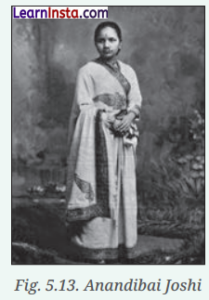
Which statement best explains the historical importance of Anandi Gopal Joshi?
(a) She proved that foreign education was compulsory for all Indians.
(b) She symbolised the struggle of Indian women for education and professional identity.
(c) She represented only elite women of colonial society.
(d) She promoted traditional home-based education for women.
Answer:
(a) She proved that foreign education was compulsory for all Indians.
Question 2.
Observe the image given and answer the question below.
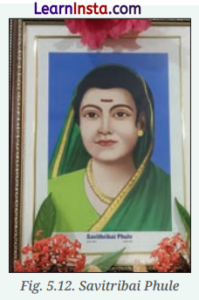
Which of the following best explains the significance of her contribution?
(a) She promoted education only for men.
(b) She worked to spread education among girls and oppressed communities.
(c) She focused mainly on political reforms.
(d) She opposed modern education for women.
Answer:
(b) She worked to spread education among girls and oppressed communities.
Citizenship Rights and Duties Class 8 Case Based Questions
Question 1.
Read the passage given below and answer the following questions.
Rights are the freedoms and benefits that every citizen enjoys. Duties are the responsibilities that we must follow as members of a community. They are not opposites but go together. Rights allow us to live with dignity, while duties remind us to use our freedom wisely and respectfully. Rights are protected by law.
If someone’s rights are violated, even by the government, they can go to court for help. Duties, on the other hand, are moral and social responsibilities. We are expected to follow them, but not doing so may not always lead to legal action. Fulfilling our duties helps protect everyone’s rights and keeps society fair and peaceful.
(i) Which of the following best explains the relationship between rights and duties?
(a) They are opposite to each other.
(b) Rights are more important than duties
(c) Rights and duties go together and support each other.
(d) Duties exist only when rights are denied.
Answer:
(c) Rights and duties go together and support each other.
(ii) If someone’s rights are violated, even by the government, what can they do?
(a) Ignore the violation
(b) Take help from the court
(c) Break the law in protest
(d) Depend only on society for help
Answer:
(b) Take help from the court
(iii) Which of the following best describes duties according to the passage?
(a) They are legal rules that always lead to punishment if not followed.
(b) They are moral and social responsibilities expected from citizens.
(c) They are freedoms enjoyed by people.
(d) They apply only to government officials.
Answer:
(b) They are moral and social responsibilities expected from citizens.