Practicing Class 8 Social Science MCQ and Class 8 SST Part 2 Chapter 4 The Role of the Judiciary in Our Society MCQ Online Test with Answers daily helps in time management.
Class 8 The Role of the Judiciary in Our Society MCQ with Answers
MCQ on The Role of the Judiciary in Our Society Class 8
A Journey Through Indian Architecture MCQ Class 8
Question 1.
Which of the following best explains why governments make laws?
(a) To increase the powers of the executive only
(b) To regulate society and ensure justice through enforceable rules
(c) To settle only political disputes
(d) To replace the role of courts
Answer:
(b) To regulate society and ensure justice through enforceable rules
Question 2.
Which of the following colonial laws was repealed because it treated certain communities as criminals by birth?
(a) Rowlatt Act
(b) Vernacular Press Act
(c) Criminal Tribes Act, 1871
(d) Arms Act
Answer:
(c) Criminal Tribes Act, 1871
Question 3.
Identify which of the following situations illustrates procedural Justice?
(a) A guilty person is punished immediately without a hearing.
(b) Every person is given an opportunity to present their case before a decision is made.
(c) The court focuses only on the fInal outcome.
(d) The government changes an existing law.
Answer:
(b) Every person is given an opportunity to present their case before a decision is made.
Question 4.
What is the primary focus of substantive justice?
(a) Ensuring that every case is heard in open court .
(b) Ensuring that the final decision is fair, just and reasonable
(c) Following legal procedures regardless of the outcome
(d) Providing legal advice to citizens
Answer:
(b) Ensuring that the final decision is fair, just and reasonable

Question 5.
Arrange the courts of India in the correct hierarchical order from the highest to the lowest.
(a) High Court → Supreme Court → District Court
(b) Supreme Court → District Court → High Court
(c) Supreme Court → High Court → District Court
(d) District Court → High Court → Supreme Court
Answer:
(c) Supreme Court → High Court → District Court
Question 6.
The Supreme Court of India came into existence on the day when
(a) India became independent
(b) The Constitution of India came into effect
(c) The first general election was held
(d) The Constituent Assembly was formed
Answer:
(b) The Constitution of India came into effect
Question 7.
A person wishes to become a Judge of the Supreme Court. Which of the following alone is not sufficient under Article 124?
(a) Being a distinguished jurist in the opinion of the President
(b) Serving as a High Court Judge for five years
(c) Practising as an advocate of a High Court for ten years
(d) Being a District Judge for five years
Answer:
(d) Being a District Judge for five years
Question 8.
A citizen’s Fundamental Right has been violated only within the limits of one State. Where can tile citizen directly file a writ petition? (Competency Based Questions)
(a) Supreme Court under Article 131
(b) High Court under Article 226
(c) District Court under Article 233
(d) National Green Tribunal
Answer:
(b) High Court under Article 226
Question 9.
The first reported Public Interest Litigation (Pli) filed by Kapila Hingorani primarily sought the release of
(a) Political prisoners
(b) Under-trial prisoners detained longer than their possible sentence
(c) Freedom fighters imprisoned during British rule
(d) Juvenile offenders
Answer:
(b) Under-trial prisoners detained longer than their possible sentence
Question 10.
Which of the following disputes falls under the exclusive original jurisdIction of the Supreme Court?
(a) A dispute between two neighbouring villages
(b) A dispute between two private companies
(c) A river water dispute between two States
(d) A property dispute between two citizens
Answer:
(c) A river water dispute between two States
Question 11.
The President of India is faced with a complex constitutional Issue Involving a matter of great public Importance. Before taking any decision, the President seeks the opInion of the Supreme Court on the legal question. Under which jurIsdIction does the Supreme Court provide such an opinion? (Competency Based Questions)
(a) Appellate jurisdiction
(b) Original jurisdiction
(c) Advisory jurisdiction
(d) Writ jurisdiction
Answer:
(c) Advisory jurisdiction
Question 12.
Which statement correctly distinguishes the retirement age of judges?
(a) Supreme Court Judges retire at 62 years, while High Court Judges retire at 65 years.
(b) Both Supreme Court and High Court Judges retire at 65 years.
(c) Supreme Court Judges retire at 65 years, while High Court Judges retire at 62 years.
(d) Both retire at 60 years.
Answer:
(c) Supreme Court Judges retire at 65 years, while High Court Judges retire at 62 years.
Question 13.
A tribunal established to decide disputes related to environmental protection Is the
(a) Armed Forces Tribunal
(b) National Green Tribunal
(c) Consumer Fora
(d) Central Administrative Tribunal
Answer:
(b) National Green Tribunal
Question 14.
A government employee challenges an issue related to service conditions and promotion. Which body Is most appropriate to hear the case? (Competency Based Questions)
(a) National Green Tribunal
(b) Consumer Fora
(c) Central Administrative Tribunal
(d) National Company Law Tribunal
Answer:
(c) Central Administrative Tribunal
Question 15.
Which alternative mode of dispute resolution results in a decision that ¡s final, legally binding and enforceable by a court of law?
(a) Mediation
(b) Negotiation
(c) Lok Adalat
(d) Arbitration
Answer:
(d) Arbitration
The Role of the Judiciary in Our Society Class 8 Assertion and Reason Questions
Question 1.
Assertion (A) The judiciary plays an important role in ensuring that the executive functions within the limits of the Constitution.
Reason (R) The judiciary examines whether the actions of the executive and the laws passed by the legislature conform to the Constitution.
Codes
(a) Both A and R are true and R is the correct explanation of A.
(b) Both A and R are true, but R is not the correct explanation of A.
(c) A is true, but R is false.
(d) A is false, but R is true.
Answer:
(a) Both A and R are true and R is the correct explanation of A.
Question 2.
Assertion (A) Procedural justice focuses on ensuring that every person gets an opportunity to be heard before a decision is taken.
Reason (R) Procedural justice is based on the principle that every accused person is presumed innocent until proved guilty.
Codes
(a) Both A and R are true and R is the correct explanation of A.
(b) Both A and R are true, but R is not the correct explanation of A.
(c) A is true, but R is false.
(d) A is false, but R is true.
Answer:
(a) Both A and R are true and R is the correct explanation of A.
Question 3.
Assertion (A) A citizen may directly approach the Supreme Court through a writ petition for the enforcement of Fundamental Rights.
Reason (R) The Constitution empowers the Supreme Court under Article 32 to enforce Fundamental Rights.
Codes
(a) Both A and R are true and R is the correct explanation of A.
(b) Both A and R are true, but R is not the correct explanation of A.
(c) A is true, but R is false.
(d) A is false, but R is true.
Answer:
(a) Both A and R are true and R is the correct explanation of A.
Question 4.
Assertion (A) The Supreme Court has exclusive original jurisdiction to resolve disputes between the Centre and the States.
Reason (R) Onginal jurisdiction means that such disputes can be heard directly by the Supreme Court without first being decided by a lower court.
Codes
(a) Both A and R are true and R is the correct explanation of A.
(b) Both A and R are true, but R is not the correct explanation of A.
(c) A is true, but R is false.
(d) A is false, but R is true.
Answer:
(a) Both A and R are true, and R is the correct explanation of A.
Question 5.
Assertion (A) Every State in India has a separate High Court.
Reason (R) The Constitution permits two or more States or Union Territories to share a common High Court.
Codes
(a) Both A and R are true, and R is the correct explanation of A.
(b) Both A and R are true, but R is not the correct explanation of A.
(c) A is true but R is false.
(d) A is false but R is true.
Answer:
(d) A is false but R is true.
Question 6.
Assertion (A) Mediation and arbitration are both methods of resolving disputes outside the regular court process.
Reason (R) In both mediation and arbitration, the neutral person has the authority to impose a legally binding decision on the parties.
Codes
(a) Both A and R are true, and R is the correct explanation of A.
(b) Both A and R are true, but R is not the correct explanation of A.
(c) A is true, but R is false.
(d) A is false, but R is true.
Answer:
(c) A is true, but R is false.
Question 7.
Assertion (A) Digital initiatives have made the judicial system more transparent and accessible.
Reason (R) Litigants can access case details and court orders online through digital platforms.
Codes
(a) Both A and R are true, and R is the correct explanation of A.
(b) Both A and R are true, but R is not the correct explanation of A.
(c) A is true, but R is false.
(d) A is false, but R is true.
Answer:
(a) Both A and R are true, and R is the correct explanation of A.
The Role of the Judiciary in Our Society Class 8 Fill in the Blanks
1. The judicial system that exists at the ………………………………. level forms the closest point of contact between the
judiciary and the people.
Answer:
District (Subordinate Court)
2. The Supreme Court can give its opinion to the President of India under its……………………….. jurisdiction.
Answer:
Advisory
3. The …………………………….. is known as the final interpreter of the Constitution of India.
Answer:
Supreme Court
4. The writ jurisdiction of the High Courts is provided under Article ………………….. of the Constitution.
Answer:
226
5. A neutral person who helps disputing parties arrive at a mutually acceptable settlement is called a ……………………. .
Answer:
Mediator
6. The ……………………………… Act, 2023 replaced the Indian Penal Code, 1860.
Answer:
Bharatiya Nyaya Sanhita
The Role of the Judiciary in Our Society Class 8 True or False
1. The judiciary ensures that the laws passed by the legislature are consistent with the Constitution.
Answer:
True
2. Substantive justice focuses on providing every person with an opportunity to be heard before a decision is taken.
Answer:
False
3. The Supreme Court has the power to hear disputes between the Centre and a State under its original jurisdiction.
Answer:
True
4. Every High Court in India has jurisdiction over the entire country.
Answer:
False
5. The National Green Tribunal deals with disputes relating to environmental issues.
Answer:
True
6. In mediation, the mediator has the authority to impose a final and legally binding decision on the parties.
Answer:
False
7. Digital initiatives such as e-Filing and the National Judicial Data Grid have been introduced to improve the accessibility and transparency of the judicial system.
Answer:
True
The Role of the Judiciary in Our Society Class 8 Match the Following
Question 1.
| List I (Jurisdiction) | List II (Function) |
| A. Original Jurisdiction | 1. Opinion sought by the President |
| B. Appellate Jurisdiction | 2. Decides disputes between the Centre and States |
| C. Advisory Jurisdiction | 3. Hears appeals from High Courts |
| D. Writ Jurisdiction | 4. Protects Fundamental Rights |
Codes
A B C D
(a) 2 3 1 4
(b) 2 1 3 4
(c) 3 2 1 4
(d) 4 3 2 1
Answer:
(a) 2 3 1 4
| List I (Jurisdiction) | List II (Function) |
| A. Original Jurisdiction | 2. Decides disputes between the Centre and States |
| B. Appellate Jurisdiction | 3. Hears appeals from High Courts |
| C. Advisory Jurisdiction | 1. Opinion sought by the President |
| D. Writ Jurisdiction | 4. Protects Fundamental Rights |
Question 2.
| List I (PIL Case) | List II (Significance) |
| A. Kapila Hingorani case | 1. Guidelines against workplace sexual harassment |
| B. M.C. Mehta v. Union of India | 2. Release of under-trial prisoners |
| C. Vishaka v.State of Rajasthan | 3. Environmental protection |
| D. Article 21 | 4. Right to Life strengthened through PILs |
Codes
A B C D
(a) 2 3 1 4
(b) 3 2 1 4
(c) 2 1 3 4
(d) 1 3 2 4
Answer:
(a) 2 3 1 4
| List I (PIL Case) | List II (Significance) |
| A. Kapila Hingorani case | 2. Release of under-trial prisoners |
| B. M.C. Mehta v. Union of India | 3. Environmental protection |
| C. Vishaka v.State of Rajasthan | 1. Guidelines against workplace sexual harassment |
| D. Article 21 | 4. Right to Life strengthened through PILs |
Question 3.
| List I (Tribunal) | List II (Dispute) |
| A. National Green Tribunal | 1. Consumer complaints |
| B. Consumer Forum | 2. Environmental issues |
| C. Central Administrative Tribunal | 3. Service matters of government employees |
| D. National Company Law Tribunal | 4. Insolvency and company disputes |
Codes
A B C D
(a) 2 1 3 4
(b) 1 2 4 3
(c) 2 3 1 4
(d) 3 1 2 4
Answer:
(a) 2 1 3 4
| List I (Tribunal) | List II (Dispute) |
| A. National Green Tribunal | 2. Environmental issues |
| B. Consumer Forum | 1. Consumer complaints |
| C. Central Administrative Tribunal | 3. Service matters of government employees |
| D. National Company Law Tribunal | 4. Insolvency and company disputes |
Question 4.
| List I (Mode) | List II (Characteristic) |
| A. Arbitration | 1. Village-level courts with simplified procedures |
| B. Mediation | 2. Neutral person helps parties reach a mutual settlement |
| C. Lok Adalat | 3. Decision is legally binding on the parties |
| D. Gram Nyayalaya | 4. Settles disputes amicably, often without formal court proceedings |
Codes
A B C D
(a) 3 2 4 1
(b) 2 3 1 4
(c) 3 4 2 1
(d) 4 2 3 1
Answer:
(a) 3 2 4 1
| List I (Mode) | List II (Characteristic) |
| A. Arbitration | 3. Decision is legally binding on the parties |
| B. Mediation | 2. Neutral person helps parties reach a mutual settlement |
| C. Lok Adalat | 4. Settles disputes amicably, often without formal court proceedings |
| D. Gram Nyayalaya | 1. Village-level courts with simplified procedures |
The Role of the Judiciary in Our Society Class 8 Picture based Questions
Question 1.
The given Image shows separate water facilities marked for ‘White’ and ‘Coloured’ people under the Jim Crow laws. What does this picture primarily illustrate?
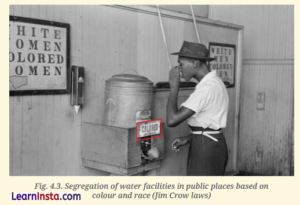
(a) Equal access to public facilities for all citizens
(b) Segregation and racial discrimination in public places
(c) Improvement in public health services for everyone
(d) Introduction of modern water supply systems
Answer:
(b) Segregation and racial discrimination in public places
Question 2.
The given image shows the logo of the Supreme Court of India, which bears the Sanskrit motto ‘yato dharmastato jayah’. Which of the following statements is correct about this motto?
(a) It means ‘Where there is dharma, there is victory’ and is derived from the ancient Indian epic, the Mahabharata, reflecting the Court’s role in upholding justice.
(b) It means ‘Truth alone triumphs’ and is the official motto of the Republic of India, inscribed on the national emblem.
(c) It means ‘Let noble thoughts come from all sides’ and is inscribed on the gates of the Parliament House of India.
(d) It means ‘Work is worship’ and was the personal motto adopted by Mahatma Gandhi during the freedom struggle.
Answer:
(a) It means ‘Where there is dharma, there is victory’ and is derived from the ancient Indian epic, the Mahabharata, reflecting the Court’s role in upholding justice.
The Role of the Judiciary in Our Society Class 8 Case Based Questions
Question 1.
Read the passage given below and answer the following questions.
Public Interest Litigation (PIL) filed under Articles 32 and 226 PIL is an innovation introduced by the Supreme Court to address issues of public concern and give meaning to the Right to Life under Article 210f the Constitution of India. The first reported case of a PIL was a complaint made by a lawyer called Mrs. Kapila Hingorani. She had read in the newspaper that there were prisoners who were undergoing a trial, and who had been in jail for a period longer than what their punishment would have been if they were found guilty.
She filed a writ petition to secure the release of ail such under-trial prisoners in Bihar. The Supreme Court immediately ordered the release of such prisoners, and also issued guidelines to release almost 40,000 under-trial prisoners throughout India.
(i) A person notices through a newspaper report that a group of people Is being denied justice. Which constitutional mechanism would be most appropriate to seek relief for them?
(a) Filing a Public Interest Litigation (PIL) before the Supreme Court
(b) Requesting Parliament to amend the Constitution
(c) Approaching the Election Commission
(d) Filing a police complaint against the newspaper
Answer:
(a) Filing a Public Interest Litigation (PIL) before the Supreme Court
(ii) If the Supreme Court had ignored the Issue raised by Mrs Kapila Hingorani, which constitutional objective associated with PIL would have been most affected?
(a) Conducting free and fair elections
(b) Giving practical meaning to the Right to Life under Article 21
(c) Increasing the number of prisons in the country
(d) Strengthening the powers of State governments
Answer:
(b) Giving practical meaning to the Right to Life under Article 21
(iii) What is the most appropriate reason for choosing a Public Interest Litigation?
(a) The issue concerns the welfare and rights of a larger section of society.
(b) The lawyer wants financial compensation for herself.
(c) The case involves a dispute between two private individuals.
(d) The matter can only be decided by a Consumer Forum.
Answer:
(a) The issue concerns the welfare and rights of a larger section of society.
Question 2.
Read the passage given below and answer the following questions.
The High Court consists of a Chief Justice and other Judges. The number ofjudges in a High Court varies from State to State. Judges of the High Court are appointed by the President of India in consultation with the Chief Justice of India, the Governor of the State, and the Chief Justice of the concerned High Court. The qualifications for appointment as a judge of a High Court are provided in Article 217(2) of the Constitution of India. It provides that a High Court Judge should be a citizen of India, and must have held a judicial office in India, or been an advocate of a High Court or more than one High Court for ten years. High Court Judges retire at the age of sixty-two years [Article 217(1) and 224(3)].
(i) Why are the Chief Justice of India, the Governor of the State, and the Chief Justice of the concerned High Court consulted before appointing a High Court Judge?
(a) To ensure that the appointment process involves more than one constitutional authority
(b) To allow the State Legislature to approve the appointment
(c) To conduct a public election for the post
(d) To determine the salary of the judge
Answer:
(a) To ensure that the appointment process involves more than one constitutional authority
(ii) Four lawyers apply for appointment as a High Court Judge. Which applicant satisfies the experience requirement mentioned in the Constitution?
(a) An Indian citizen with nine years of practice in a High Court
(b) An Indian citizen with ten years of practice as an advocate in more than one High Court
(c) A foreign citizen with twelve years of practice in a High Court
(d) An Indian citizen with ten years of practice in a District Court only
Answer:
(b) An Indian citizen with ten years of practice as an advocate in more than one High Court
(iii) Why does the number of Judges in a High Court differ from one State to another?
(a) Because each State has different judicial requirements
(b) because every State has the same number of pending cases
(c) Because the President appoints judges only when vacancies arise in Parliament
(d) Because all High Courts must have an equal number of judges
Answer:
(a) Because each State has different judicial requirements