Practicing Class 8 Social Science MCQ and Class 8 SST Part 2 Chapter 3 A Journey Through Indian Architecture MCQ Online Test with Answers daily helps in time management.
Class 8 A Journey Through Indian Architecture MCQ with Answers
MCQ on A Journey Through Indian Architecture Class 8
A Journey Through Indian Architecture MCQ Class 8
Question 1.
Which Harappan city is noted for its precise urban planning and extensive use of stone?
(a) Mohenjo-daro
(b) Dholavira
(c) Lothal
(d) Kalibangan
Answer:
(b) Dholavira
Question 2.
What is the name of the hemispherical dome at the top of a stupa?
(a) Vedika
(b) Torana
(c) Anda
(d) Mandapa
Answer:
(c) Anda
Question 3.
A group of students is studying the concept of ‘pradakshina’ in Indian architecture. Which of the following structures is not designed to facilitate this practice?
(a) The path around the main stupa at Sanchi
(b) The aisle around the stupa in Ellora’s Cave 10
(c) The corridor around the garbhagriha in the Lingaraja Temple
(d) The central courtyard of a traditional Chettinadu house
Answer:
(d) The central courtyard of a traditional Chettinadu house

Question 4.
The famous rock-cut caves of Ajanta and Ellora are located in which modern-day state?
(a) Madhya Pradesh
(b) Odisha
(c) Maharashtra
(d) Gujarat
Answer:
(c) Maharashtra
Question 5.
Rani ki Vav, a famous stepwell, is located in which state?
(a) Rajasthan
(b) Gujarat
(c) Madhya Pradesh
(d) Uttar Pradesh
Answer:
(b) Gujarat
Question 6.
The Brihadishvara Temple in Thanjavur was built by which king?
(a) Rajaraja Chola I
(b) Ashoka
(c) Kharavela
(d) Shah Jahan
Answer:
(a) Rajaraja Chola I
Question 7.
A student is describing a monument: it has a towering vimana over 60 metres high, a massive Nandi statue in a separate pavilion, and was built by Rajaraja Chola I around 1010. Which monument is the student describing?
(a) Lingaraja Temple, Bhubaneswar
(b) Brihadishvara Temple, Thanjavur
(c) Kailasha Temple, Ellora
(d) Dilwara Temple, Mount Abu
Answer:
(b) Brihadishvara Temple, Thanjavur
Question 8.
Which material are the Dilwara Temples at Mount Abu primarily made of?
(a) Red Sandstone
(b) Granite
(c) White Marble
(d) Brick
Answer:
(c) White Marble
Question 9.
The Jama Masjid in Delhi, India’s largest mosque. was built by which Mughal emperor?
(a) Akbar
(b) Aurangzeb
(c) Humayun
(d) Shah Jahan
Answer:
(d) Shah Jahan
Question 10.
Which of the following pairs is not correctly matched?
(a) Rani ki Vav – A stepwell with multiple pillared levels in Gujarat
(b) Shringaverpur – Sìte of interconnected reservoirs fed by the Ganga
(c) Mehrangarh Fort – A fort in Rajasthan made from locally sourced red sandstone
(d) St. Thomas Orthodox Church – A church in Kerala with a distinctly European Gothic architectural style
Answer:
(d) St. Thomas Orthodox Church – A church in Kerala with a distinctly European Gothic architectural style
Question 11.
The Taj Mahal was built as a mausoleum for which queen?
(a) Jodha Bai
(b) Mumtaz Mahal
(c) Nur Jahan
(d) Bega Begum
Answer:
(b) Mumtaz Mahal
Question 12.
Which of the following features is not a common characteristic of the traditional houses?
(a) A central courtyard.
(b) Elaborate decorations like painted frescoes or carvings.
(c) Design adapted to the local climate.
(d) Multiple minarets for religious calls.
Answer:
(d) Multiple minarets for religious calls.
Question 13.
An architectural style is defined by its “blend of Islamic, Hindu, and Gothic elements, featuring domes, pointed arches, and minarets.” This style is known as (Competency Based Question)
(a) Mughal Architecture
(b) Dravidian Architecture
(c) Indo-Saracenic Architecture
(d) Nagara Architecture
Answer:
(c) Indo-Saracenic Architecture
Question 14.
Consider the following statements about the Harappan civilisation’s architectural features. (Competency Based Questions)
I. Dholavira’s extensive use of stone in its construction was a unique adaptation to the local availability of materials.
II. The houses in Mohenjo-daro were designed with living quarters on the upper floors, possibly to avoid street dust and noise.
III. The invention of interlocking trapezoid-shaped bricks was primarily for constructing decorative gateways.
Which of the above statements ls/are correct?
(a) I and II only
(b) II and III only
(c) I and III only
(d) I, II, and III
Answer:
(a) I and II only
Question 15.
Consider the following architectural features and the structures they are associated with (Competency Based Questions)
I. Anda – The hemispherical dome of a stupa
II. Vimana – The tower above the garbhagriha in a North Indian temple
III. Prakara – The circumambulatory path around the main shrine
IV. Torana – A ceremonial entrance in some North Indian temples
How many of the above pairs are correctly matched?
(a) Only I
(b) Only II
(c) Only III
(d) All of these
Answer:
(b) Only II
Question 16.
Arrange the following architectural developments in the correct chronological order as they emerged in India.
1. Construction of the Brihadishvara Temple
2. Carving of the Udayagiri caves
3. Building of the Sanchi Stupas initial phase
4. Creation of the terracotta temples of Bishnupur
Select the correct answer using the code below.
(a) 2, 3, 1, 4
(b) 3, 2, 1, 4
(c) 3, 1, 2, 4
(d) 2, 1, 3, 4
Answer:
(b) 3, 2, 1, 4
A Journey Through Indian Architecture Class 8 Assertion and Reason Questions
Question 1.
Assertion (A) The Jama Masjid in Ahmedabad is considered a fine example of Indo-Islamic architecture.
Reason (R) It was constructed using only local Hindu and Jam artisans who incorporated Islamic building traditions with Indian craftsmanship, such as temple-style pillars (without decorations) and intricate stone jalis.
Codes
(a) Both A and R are true, and R is the correct explanation of A.
(b) Both A and R are true, but R is not the correct explanation of A.
(c) A is true, but R is false.
(d) A is false, but R is true.
Answer:
(a) Both A and R are true, and R is the correct explanation of A.
Question 2.
Assertion (A) While the Harappans, Buddhists, and Hindus created extensive architectural heritage, no tombs of ancient rulers from these faiths exist in India.
Reason (R) In these traditions, the dead were generally cremated, whereas burial is a common practice in Islam and Christianity, leading to the construction of mausoleums like the Taj Mahal and Humayun’s Tomb.
Codes
(a) Both A and R are true, and R is the correct explanation of A.
(b) Both A and R are true, but R is not the correct explanation of A.
(c) A is true, but R is false.
(d) A is false, but R is true.
Answer:
(c) A is true, but R is false.
Question 3.
Assertion (A) The architects of classical Indian temples, such as the one at Thanjavur, required a sophisticated understanding of mathematics and geometry.
Reason (R) Temple construction followed the principles of shilpashastra and involved elaborate techniques, large-scale planning, and the creation of complex, towering structures like the vimana.
Codes
(a) Both A and R are true, and R is the correct explanation of A.
(b) Both A and R are true, but R is not the correct explanation of A.
(c) A is true, but R is false.
(d) A is false, but R is true.
Answer:
(a) Both A and R are true, and R is the correct explanation of A.
Question 4.
Assertion (A) The drainage system was a highly advanced feature of Harappan cities like Mohenjo-daro.
Reason (R) Almost every home had a bathing area, and used waters were taken out of the city through an efficient network of drains.
Codes
(a) Both A and R are true, and R is the correct explanation of A.
(b) Both A and R are true, but R is not the correct explanation of A.
(c) A is true, but R is false.
(d) A is false, but R is true.
Answer:
(b) Both A and R are true, but R is not the correct explanation of A.
Question 5.
Assertion (A) Rock-cut architecture, such as the caves at Ajanta and Ellora, required mind-boggling technologies and immense labour.
Reason (R) Builders had to chip away many thousands of tonnes of rock to create structures like the monolithic Kailasha Temple.
Codes
(a) Both A and R are true, and R is the correct explanation of A.
(b) Both A and R are true, but R is not the correct explanation of A.
(c) A is true, but R is false.
(d) A is false, but R is true.
Answer:
(a) Both A and R are true, and R is the correct explanation of A.
A Journey Through Indian Architecture Class 8 Fill in the Blanks
1. The site of …………………………. in the Rann of Kachchh is noted for its precise urban planning and the extensive use of stone, unlike many other Harappan cities.
Answer:
Dholavira
2. The upper and lower circumambulatory paths around the main structure at Sanchi are known as ………………….. .
Answer:
pradakshina
3. The architecture of the Jama Masjid in Delhi, built by Shah Jahan, uses red sandstone with decorations made of ……………………………. .
Answer:
white marble
4. The threat of air pollution, particularly from local industries, was highlighted in the 1970s concerning the discolouration of the ……………………………. .
Answer:
Taj Mahal
5. The central ……………………………….. in traditional Chettinadu houses served as a place for rituals, community
gatherings, and for sun-drying food items.
Answer:
courtyard
A Journey Through Indian Architecture Class 8 True or False
1. The initial phase of Buddhist architecture, as seen at Sanchi, often depicted the Buddha in his human form through intricate sculptures and panels.
Answer:
False
2. The Kailasha Temple at Ellora is an example of rock-cut architecture, created by carving a massive, freestanding monolithic structure out of a hillside.
Answer:
True
3. The design of the Shringaverpur water structures allowed the first reservoir to settle silt from the Ganga’s floodwaters, a common hydrological design.
Answer:
True
4. The Victoria Memorial Hall in Kolkata is a prime example of the Indo-Saracenic style of architecture, blending Islamic and Hindu elements with Gothic ones.
Answer:
True
5. The preservation of India’s architectural heritage is solely the responsibility of government bodies like the
ASI, as citizens have no role to play.
Answer:
False
A Journey Through Indian Architecture Class 8 Match the Following
Question 1.
| List I (Monuments) | List II (Materials) |
| A. Dilwara Temples, Mount Abu | 1. Red Sandstone |
| B. Red Fort, Agra | 2. Brick with Terracotta Panels |
| C. Terracotta Temples of Bishnupur | 3. Granite |
| D. Brihadishvara Temple, Thanjavur | 4. White Marble |
Codes
A B C D
(a) 4 1 2 3
(b) 4 3 1 2
(c) 1 4 2 3
(d) 2 1 4 3
Answer:
(a) 4 1 2 3
Question 2.
| List I (Terms) | List II (Description) |
| A. Vav / Baori | 1. A cenotaph in the shape of a parasol |
| B. Chhatri | 2. A traditional mansion with a central courtyard |
| C. Haveli | 3. A stepwell, often an engineering marvel |
| D. Stambha | 4. A flag post, a feature borrowed from temple architecture |
Codes
A B C D
(a) 3 1 2 4
(b) 1 3 4 2
(c) 2 4 1 3
(d) 3 2 1 4
Answer:
(a) 3 1 2 4
A Journey Through Indian Architecture Class 8 Picture based Questions
Observe the image and answer the question given below.
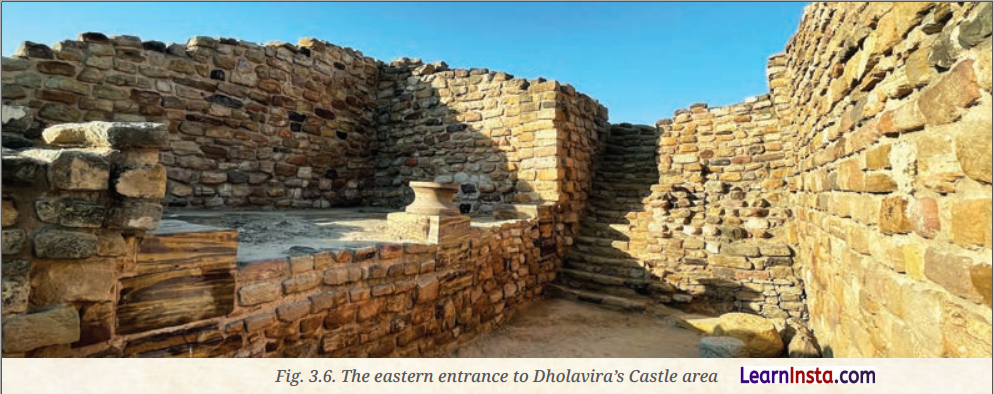
Question 1.
The picture given above represents which feature of the Harappan civilisation?
(a) Religious temple complex
(b) Fortified urban planning with gateways
(c) Agricultural storage pits
(d) Nomadic settlement pattern
Answer:
(b) Fortified urban planning with gateways
Question 2.
The image given below shows Rani ki Vav, a famous stepwell built with a series of descending steps leading to a water reservoir, designed for water storage and conservation in a semi-arid region.
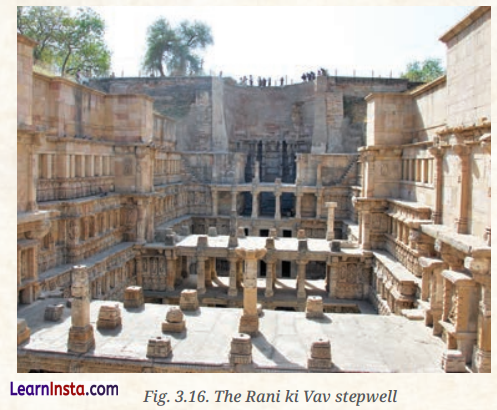
Which of the following conclusions can be best drawn from the structure shown in the image?
(a) Ancient societies depended only on rivers for water supply.
(b) Traditional water management systems combined utility with architectural excellence.
(c) Water conservation was not a concern in early settlements.
(d) Stepwells were used only for religious ceremonies.
Answer:
(b) Traditional water management systems combined utility with architectural excellence.
A Journey Through Indian Architecture Class 8 Case Based Questions
Question 1.
Apart from a large manpower and accomplished sculptors, the architecture of classical temples required highly skilled architects, engineers and craftsmen, as it involved elaborate construction techniques. Recent studies have shown that their planning involved a good deal of mathematics, especially some advanced geometry. All this, of course, is also true of many large sacred structures in other parts of the world, whether Egypt’s pyramids and temples, Athens Parthenon, or medieval Europe’s Gothic cathedrals.
(i) Which of the following best explains why the temples of Bishnupur display both mythological stories and scenes from daily life on their walls?
(a) Temples were used mainly as marketplaces
(b) Art reflected both religious beliefs and social activities of people
(c) Only rulers were allowed to create artworks
(d) Decoration had no cultural meaning
Answer:
(a) Temples were used mainly as marketplaces
(ii) How do the terracotta decorations of Bishnupur temples indicate technological advancement during that period?
(a) By showing the absence of permanent building materials
(b) By using simple unfired clay structures
(c) By demonstrating skilled carving and controlled kiln-firing techniques
(d) By avoiding artistic detailing
Answer:
(c) By demonstrating skilled carving and controlled kiln-firing techniques
(iii) Which conclusion can be drawn about the construction of large sacred structures such as Bishnupur temples, pyramids, and Gothic cathedrals?
(a) They were built without planning or measurement
(b) They required organised labour, specialised skills, and mathematical knowledge
(c) They were constructed only for decoration
(d) They depended entirely on natural landforms
Answer:
(b) They required organised labour, specialised skills, and mathematical knowledge
Question 2.
From the 4th or 3rd century BCE onward, with the rise of Buddhism, several new architectural forms emerged in northern India, slowly spreading to other regions. Thousands of stupas (dome-shape is structures housing relics of the Buddha or revered monks) were constructed with bricks or stone. The larger ones became complex ritual centres with railings, gateways, and elaborate panels.
Often, at this early stage, narrating episodes in the Buddha’s life. At this early stage, the Buddha was represented symbolically-through objects such as footprints, the wheel of dharma, or the stupa itself-rather than in human form.
(i) Which of the following best explains the purpose of constructing stupas in early Buddhist architecture?
(a) To serve as military watchtowers
(b) To preserve sacred relics and create centres of worship
(c) To function mainly as royal residences
(d) To store agricultural produce
Answer:
(b) To preserve sacred relics and create centres of worship
(ii) How was the Buddha commonly represented in the earliest phase of Buddhist art?
(a) Through large human statues only
(b) Through symbolic forms such as footprints and the wheel of dharma
(c) Through painted portraits inside palaces
(d) Through metal coins showing his image
Answer:
(b) Through symbolic forms such as footprints and the wheel of dharma
(iii) Which architectural feature of the Sanchi Stupa suggests that worship involved ritual movement by devotees?
(a) Tall defensive walls
(b) Circumambulatory path enclosed by railings (vedika)
(c) Underground chambers
(d) Residential quarters for monks
Answer:
(b) Circumambulatory path enclosed by railings (vedika)