Experts have designed these Class 8 Social Science Notes and Class 8 SST Part 2 Chapter 5 Citizenship Rights and Duties Notes for effective learning.
Class 8 Citizenship Rights and Duties Notes
Citizenship Rights and Duties Notes Class 8
→ Active Citizenship: Participating responsibly in society and standing up against injustice.
→ Childline 1098: A free 24-hour helpline in India that provides support and protection to children in need.
→ Citizen: A legal member of a country who has certain rights and responsibilities.
→ Cultural and Educational Rights: Rights that protect the language, culture, and educational interests of minorities.
→ Discrimination: Unfair treatment of a person or group based on caste, religion, gender, race, or other differences.
→ Duties: Responsibilities that citizens must perform towards their country, society, and environment.
→ Equality: Treating everyone equally, regardless of differences.
→ Equity: Providing support based on individual needs to ensure fairness.
→ Exploitation: Taking unfair advantage of someone by denying them their basic rights or dignity.
→ Fundamental Duties: Duties listed in the Constitution that guide citizens to act responsibly.
→ Fundamental Rights: Basic rights guaranteed by the Indian Constitution to protect citizens from unfair treatment.
→ Inclusion: Creating an environment where everyone feels welcomed, respected, and valued.
→ Invisible Discrimination: Hidden or subtle unfair treatment, such as ignoring or excluding someone quietly.
→ Resident: A person who lives in a place but may not be a legal citizen of that country.
→ Right Against Exploitation: The right that protects people from forced labour, human trafficking, and child labour.
→ Right to Constitutional Remedies: The right to approach the courts if Fundamental Rights are violated.
→ Right to Equality: The right that ensures all people are treated equally before the law.
→ Right to Freedom: The right that allows people to express themselves, move freely, and choose their occupation, with reasonable restrictions.
→ Right to Freedom of Religion: The right to practise, profess, and manage one’s religion freely.
→ Right to Life: The right to live with dignity, including access to health, education, and a clean environment.
→ Rights: Basic freedoms and protections that allow people to live with dignity, such as equality, freedom of speech, and education.
→ Visible Discrimination: Open and direct unfair treatment, such as teasing or exclusion.

Who is A Citizen?

- A citizen is a person who is legally recognised as a member of a country and has a legal and formal association with it.
- Citizenship provides privileges such as voting, expressing opinions, and participating in the decision-making of the country.
- Rights come with responsibilities, so every citizen should act responsibly by treating others with respect, following the law, paying taxes, and helping create a peaceful society.
- Citizenship is more than just being legally connected to a country. It also means playing your part in society and strengthening unity through shared responsibilities and values.
- A responsible citizen should stand against injustice and question unfair practices in a peaceful and legal manner.
- Citizenship is different from residency—a resident only lives in a place, while a citizen is legally recognised as a member of a country. A citizen may live abroad, while a resident is not necessarily a citizen.
- The Constitution guarantees equal status and equal treatment to every Indian citizen, regardless of their cultural background, language and religion.
- The Citizenship Act, 1955 lays down the rules for acquiring and losing citizenship in India.
→ Four Key Concepts:
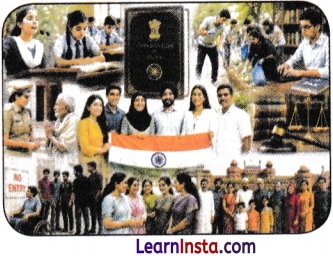
- Rights: Freedoms like the right to speak openly, access to education, equality, and the freedom to practice one’s faith, are essential as they allow people to live with respect and dignity.
- Duties: Duties like following the law, paying taxes, keeping our surroundings clean, and supporting others are important responsibilities that help society run smoothly.
- Discrimination: Discrimination or unjust treatment because of someone’s identity must be opposed by all citizens.
- Inclusion: Making sure that no one is excluded because of their religion, language, culture, ethnicity, gender or caste.
Rights
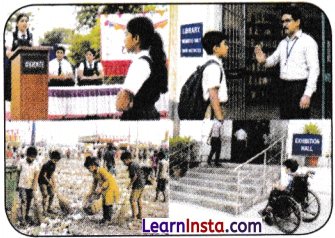
- During a town festival, some children faced discrimination—Meena was excluded from a debate, Ravi was denied entry to the library due to his family background, some children were cleaning near the fair ground instead of going to school, and Gaganjit could not enter the exhibition hall due to lack of a ramp.
- When the children shared their concerns with their teacher, they learnt that the Constitution guarantees Fundamental Rights, including the freedom of religion, freedom of speech and expression, right to equality, the right to life and dignity, and the right to education. They also learnt that citizens can approach the courts if these rights are violated.
- After understanding their rights, the children approached the organisers, changes were made – everyone was included, facilities like ramps were added, and equal treatment was ensured.
- The festival ended on a positive note, showing that respecting rights leads to a fair and inclusive society.
- The example reflects that in India, all citizens are equal under the Constitution despite differences in language, religion, or culture.
→ What are Rights?
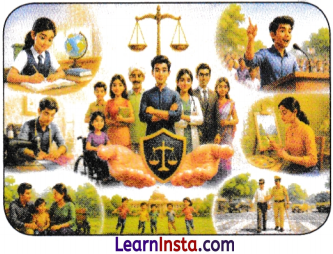
- Rights are basic claims available to every individual in society. They help people live with dignity and safety and ensure that they are respected by others.
- Rights include individual freedoms such as the right to education, freedom of expression, and the right to earn a livelihood.
- These rights help people grow and live freely and independently.
- Not all desires can be called rights. Only lawful claims that promote dignity for all and do not harm others are considered rights.
→ Fundamental Rights in the Indian Constitution
The Constitution provides six broad categories of Fundamental Rights to every Indian citizen. If these rights are violated, people can seek justice through the courts.
- Right to equality (Articles 14-18)
- Right to freedom (Articles 19-22)
- Right against exploitation (Articles 23-24)
- Right to freedom of religion (Articles 25-28)
- Cultural and educational rights (Articles 29-30)
- Right to constitutional remedies (Article 32)
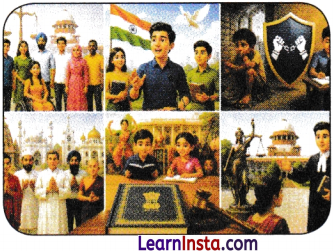
- Fundamental rights protect individuals from unjust treatment by both other people and the government.
- They ensure fairness, safeguard freedom and dignity and prevent the misuse of power.
→ Right to Equality
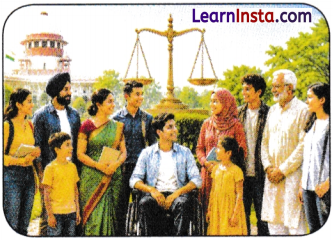
- The Right to Equality is a Fundamental Right given under Articles 14 to 18 of the Indian Constitution. It gurantees equality before the law and equal treatment for everyone.
- It prohibits discrimination on the grounds of race, religion, caste, place of birth or gender and provides equal opportunities in education and employment.
- It also abolishes untouchability and does not allow the government to grant titles to individuals, except military and academic honours.
Equality and Equity:
- Equality means giving the same support or opportunities to everyone.
- Equity means providing support according to each person’s needs so that everyone has a fair chance to succeed.
- Giving everyone the same support does not always lead to equal outcomes because people’s needs and circumstances are different.
- These differences often arise from inequalities and discrimination that have existed over time.
- The principle of equity focuses on providing the support each person needs to ensure fairness.
- To promote equity, both the government and civil society organisations carry out various initiatives and programmes.
Right to Freedom:
- The Right to Freedom is one of the most important Fundamental Rights. It allows people to express their views freely, move across the country, and choose their work and way of life. However, this freedom is not absolute.
- The Constitution places reasonable limits on these so they are not misused and do not harm other people or the nation.
Right to Life:
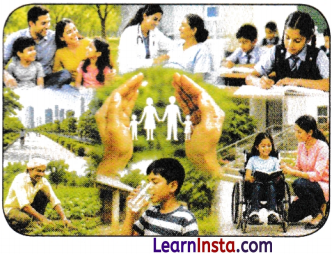
- The Right to Life safeguards a person’s life and personal liberty. It ensures that everyone can live with dignity and includes the right to livelihood, healthcare, education, a clean environment and equal protection under the law.
- It also protects children with disabilities by helping them access education, healthcare, a safe environment and equal opportunities to participate in society.
- A few countries have recognised rivers as having legal status, giving them protections similar to those enjoyed by people.
- For instance, New Zealand considers the Whanganui River a legal person, while Costa Rica has included the protection of nature in its Constitution.
- In 2017, the Uttarakhand High Court recognised the Ganga and Yamuna as legal persons and assigned guardians to look after their welfare.
- Later, the Supreme Court cancelled this ruling, stating that it could not be upheld under the law.
Right Against Exploitation:
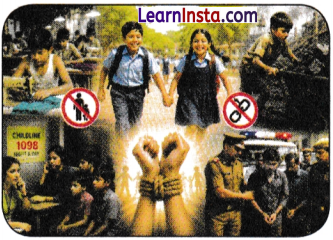
- The Right against Exploitation protects people from unfair treatment that affects their dignity, freedom and safety.
- It prohibits practices such as human trafficking, bonded labour, child labour in hazardous occupations and the exploitation of women and children.
- As children depend on adults, they need additional protection from unfair treatment. This allows them to study, play, and grow up in a secure and healthy environment.
- Children under 14 cannot be employed. They may only help in non-hazardous family work after school hours or during vacations and cannot work in restaurants, mines, or factories.
- In 2015, a call to Childline 1098 helped save 20 children from forced labour in an embroidery factory. The children were cared for, and the offenders were arrested.
- Childline 1098 is a government helpline for children in need, available throughout India. It started as a project at an educational institution in the late 1990s and later grew into a nationwide helpline.
Right to Freedom of Religion:
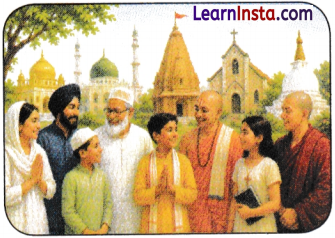
- India is home to people who follow many different religions, making it a diverse country.
- The Right to Freedom of Religion is a Fundamental Right given under Articles 25 to 28 of the Indian Constitution.
- It gives every citizen the freedom to practise and share their religion according to their beliefs. No one can be forced to follow, promote or financially support any religion.
- Schools run or funded by the government must remain neutral and cannot This ensures that every faith is given the same importance.
Cultural and Educational Rights:
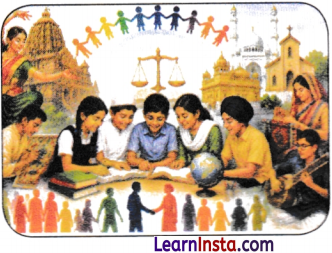
- The Cultural and Educational Rights provide equal opportunities in education and protect India’s cultural heritage. They also enable communities to safeguard their script, language and traditions.
- They also ensure that no student is refused admission to government or government-aided educational institution on the basis of race, religion, caste, or language.
- Religious and linguistic minorities are allowed to open and run their own educational institutions to protect their language and culture.
- These rights help communities preserve their identity while encouraging equal treatment and preventing discrimination.
- The Constitution protects the interests of minorities and also promotes equal opportunities in education without discrimination based on religion.
- Sometimes, these two objectives are seen as conflicting, and some people believe that the special safeguards given to minorities do not fully match the principle of secularism.
Right to Constitutional Remedies:
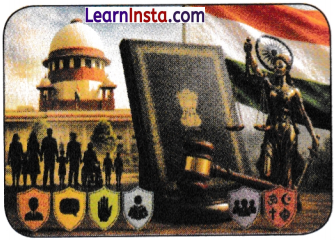
- The Right to Constitutional Remedies is given under Article 32 of the Indian Constitution. It allows citizens to seek justice from the Supreme Court if their Fundamental Rights are denied.
- This right ensures that Fundamental Rights are legally protected and can be enforced, rather than remaining only written provisions.
- The following Articles of the Constitution explain the Fundamental Rights guaranteed to every Indian citizen.
- Article 14: Guarantees equality before the law.
- Article 15: Prohibits discrimination based on caste, gender, religion, race, or place of birth.
- Article 16: Ensures equal opportunities in government employment.
- Article 17: Abolishes the practice of untouchability.
- Article 18: Prohibits titles, except military and academic honours.
- Article 19: Guarantees freedom of movement, speech and expression, and peaceful assembly.
- Article 21: Protects the right to life and personal liberty.
- Article 21 A: Provides free and compulsory education for children aged 6-14 years.
- Articles 23-24: Prohibit forced labour, human trafficking and child labour.
- Articles 25-28: Guarantee the freedom to practise, choose and share one’s religion.
- Articles 29-30: Protect script, culture and language, and allow minorities to establish and manage educational institutions.
- Article 32: Allows citizens to approach the Supreme Court to protect their Fundamental Rights.
Together, these Articles help protect the dignity, equality and rights of every citizen through the Constitution and the judiciary.
Duties

- The story of Green Park Colony shows that duties are essential for maintaining a clean, healthy and happy community.
- People of all age groups took part by cleaning the surroundings, planting trees, caring for stray animals, painting positive messages to encourage responsible behaviour, and spreading awareness about saving water and electricity.
- The little girl’s reply showed that looking after our surroundings is a responsibility that every citizen should fulfil.
- Duties are not limited to following rules; they also include fulfilling our responsibilities towards our family, society, country, and the environment.
- When everyone performs their duties sincerely, it helps build a healthier, happier and more united society.
→ What are Duties?
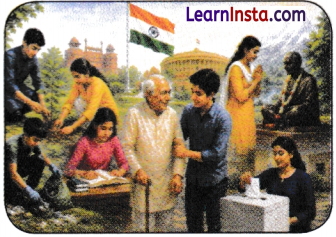
- Along with giving rights, the Constitution also lays down certain responsibilities for every citizen. These responsibilities are called Fundamental Duties.
- Fundamental Duties were added to the Constitution to encourage citizens to carry out their responsibilities while exercising their Fundamental Rights.
- The original Constitution of 1950 did not include Fundamental Duties.
- In 1976, an amendment introduced Fundamental Duties into the Constitution, and Article 51A (Part IV-A) initially contained 10 duties.
- Another duty was added in 2002, making it the 11th Fundamental Duty.
- Parents and guardians were given the responsibility of ensuring that children between 6 and 14 years of age receive education.
→ Understanding Duties
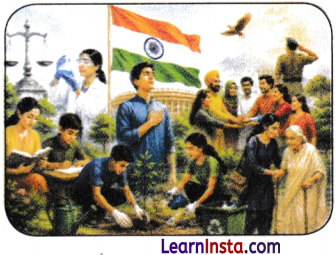
- Fundamental Duties encourage citizens to actively contribute to democracy and work for the country’s progress. They remind us that along with rights, every citizen also has responsibilities.
- These duties help ensure good governance, encourage scientific thinking and learning protect the environment, promote unity, and build a society where everyone lives with dignity.
Article 51A of the Constitution lists the following Fundamental Duties:
- To respect the Constitution, National Anthem and the National Flag.
- To follow the noble ideals that inspired India’s freedom struggle.
- To protect the sovereignty, unity and integrity of India.
- To defend the country and serve the nation when required.
- To promote harmony and brotherhood among all people and to respect the dignity of women.
- To value and preserve India’s rich cultural heritage.
- To protect the natural environment and show compassion towards animals.
- To develop scientific thinking, humanism, and a questioning attitude.
- To safeguard public property and stay away from violence.
- To strive for excellence in all areas to help the nation progress.
- For parents or guardians to provide educational opportunities to children between the ages of 6 – 14 years.
Ancient Indian Ideas of Duties and Rights:
- Dharma (Duty): Unlike the modern meaning of “duty,” the ancient concept of dharma encompassed everything beneficial to individuals and society.
- Rina (Debt): Duty was also viewed as Rina—a set of debts owed to deities, ancestors, teachers, parents, fellow human beings, and nature simply by being born. Repaying these “debts” fostered deep connections with the world.
- Adhikara (Rights): In ancient times, rights (Adhikara) were linked to personal capacity or authority rather than being universal. A person had the right to perform a task only if they were capable of doing it.
- Universal Justice: While most rights depended on an individual’s ability, the concept of dharma recognised justice as a right available to everyone, at least in principle.
Rights And Duties: Two Sides of the Same Coin
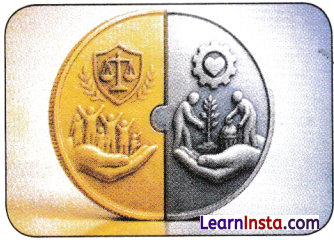
- Rights and duties go hand-in-hand. They are not opposite concepts but complement each other.
- Rights give us the freedom to live with dignity, while duties guide us to use that freedom respectfully and responsibly.
- Rights are protected by law, whereas duties are moral and social responsibilities expected from every citizen.
- Every right, is linked to a duty. For example, if I have the right to be respected, I also have the duty to respect others. Similarly, the right to express our views comes with the responsibility to respect others’ opinions without causing harm.
- By performing our duties sincerely, we help protect the rights of others and contribute to a fair, peaceful, and orderly society.
Discrimination

Sanya wanted to audition for the school play, but some students said she did not look like a lead actor. Although she felt discouraged, she still auditioned and impressed the teachers with her confidence and performance. She was selected for an important role. Later, the teacher explained that judging or excluding people by their looks is unfair and is a form of discrimination and that talent and effort matter more than looks.
→ Understanding Discrimination
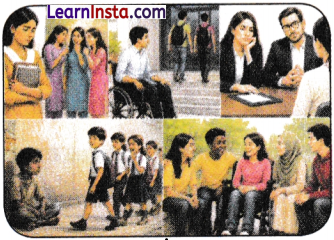
- Discrimination means treating a person or group unfairly because of their religion, caste, gender, race, disability, appearance, or economic background.
- Discrimination is both morally wrong and against the law.
- Treating people unfairly because of their background can cause emotional and physical harm and also affects society negatively.
- It may appear in everyday situations, such as leaving someone out of activities or treating them differently because of their social or economic background.
- Discrimination prevents people from fully enjoying their Fundamental Rights by creating barriers in society.
- A person who discriminates against others fails to uphold the Constitutional values of respect and unity and cannot be considered a responsible citizen.
Examples of Courage Against Discrimination:
- In the mid-19th century, Savitribai Phule opened a school for girls when educating girls was widely discouraged.
- As a woman from the Mali community, she faced discrimination, abuse, and even had mud thrown at her, but she remained committed to girls’ education.
- Along with her husband, Jyotiba Phule, she worked to make education accessible to girls and children from every background.
- In 1874, Anandibai Joshi was married at the age of nine and became a mother by 15, but her baby died because proper medical care was unavailable.
- This inspired her to study medicine so she could care for mothers and children.
- Despite facing discrimination, social opposition, and many hardships for pursuing medical studies at the Woman’s Medical College of Pennsylvania, she remained determined to fulfil her dream.
- Although she completed her studies, she passed away soon afterwards due to illness, leaving her dream unfinished.
→ Visible and Invisible Discrimination

- Visible discrimination involves open and easily recognised unfair treatment towards a person or group.
- Invisible discrimination refers to subtle and hidden forms of unfair treatment, which are harder to detect or prove. It includes actions such as ignoring someone, not involving them in group activities, judging someone’s abilities based on their physical traits rather than their talent, or overlooking individuals because of their social or economic background.
- Since invisible discrimination is difficult to identify and prove, it is also harder to take action against it.
Inclusion
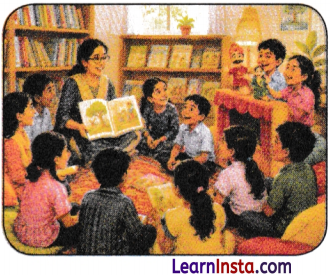
- Smt. Amita noticed that fewer students were borrowing books from the library. She started a reading club, but only a few students who were comfortable reading in English joined.
- To make the club more inclusive, she introduced books in regional languages. Soon, more children joined the club, activities like story-telling and puppetry were also included. This encouraged everyone to participate regardless of their fluency in any language.
→ Understanding Inclusion
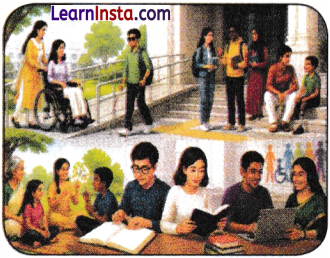
- Inclusion means ensuring that all individuals, regardless of social, economic, or cultural background, are respected, treated fairly, and given equal opportunities.
- Special attention is given to groups that have faced exclusion in the past. Inclusion goes beyond reservations by ensuring that everyone is accepted and supported.
- Inclusion is promoted through the Fundamental Rights and Fundamental Duties provided by the Constitution.
- It involves removing physical, social, and language barriers by providing support such as ramps, braille books, and regional language materials, helping people from different backgrounds participate equally.