Practicing Class 8 Social Science MCQ and Class 8 SST Part 2 Chapter 8 Cultural Currents 13th to 17th Centuries MCQ Online Test with Answers daily helps in time management.
Class 8 Cultural Currents 13th to 17th Centuries MCQ with Answers
MCQ on Cultural Currents 13th to 17th Centuries Class 8
Cultural Currents 13th to 17th Centuries MCQ Class 8
Question 1.
Statement I Indian culture remained completely isolated from outside influences.
Statement II Visitors from Greece, Persia, and Central Asia contributed to cultural exchange in India.
Choose the correct option
(a) Both statements are correct
(b) Only Statement I is correct
(c) Only Statement II is correct
(d) Neither statement is correct
Answer:
(c) Only Statement II is correct
Question 2.
The Greek scholar who visited India in the 4th Century BCE was
(a) Faizi
(b) Megasthenes
(c) Rumi
(d) Nizamuddin Auliya
Answer:
(b) Megasthenes
Question 3.
A devotee believes that sincere prayer is more important than elaborate rituals. Which tradition does this idea most closely reflect?
(a) Charbagh tradition
(b) Bhakti Marga
(c) Persian court culture
(d) Greek philosophy
Answer:
(b) Bhakti Marga
Question 4.
Which of the following Bhakti saints is specifically mentioned in the chapter as belonging to a family of leather-workers?
(a) Tukaram
(b) Ravidas
(c) Namdev
(d) Dnyaneshwar
Answer:
(b) Ravidas

Question 5.
Which Bhakti saint travelled widely and whose teachings are preserved in the Guru Granth Sahib?
(a) Kabir
(b) Ravidas
(c) Guru Nanak
(d) Tukaram
Answer:
(c) Guru Nanak
Question 6.
Which practice was adopted by several Sufi saints as a means of achieving spiritual union with God?
(a) Yajna
(b) Zikr
(c) Hayan
(d) Pranayama
Answer:
(b) Zikr
Question 7.
A saint gives up his diamond business and devotes his life to Krishna through music. Who is he?
(a) Amir Khusro
(b) Purandaradasa
(c) Tansen
(d) Chaitanya Mahaprabhu
Answer:
(b) Purandaradasa
Question 8.
The devotional hymns of the Alvars are collectively known as
(a) Tiruvachakam
(b) Divya Prabandham
(c) Raatarangini
(d) Lilavati
Answer:
(b) Divya Prabandham
Question 9.
Pattachitra painting was traditionally practiced In
(a) Punjab and Haryana
(b) Odisha, West Bengal, and Andhra Pradesh
(c) Gujarat and Rajasthan
(d) Kashmir and Ladakh
Answer:
(b) Odisha, West Bengal, and Andhra Pradesh
Question 10.
Statement I Hindustani music developed in North India.
Statement II Carnatic music developed ¡n South India.
Choose the correct option
(a) Both statements are correct
(b) Only Statement I is correct
(c) Only Statement II is correct
(d) Neither statement is correct
Answer:
(a) Both statements are correct
Question 11.
The modern Tabla evolved mainly from the ancient
(a) Veena
(b) Pakhawaj
(c) Sarangi
(d) Flute
Answer:
(b) Pakhawaj
Question 12.
Which monument is famous for mirror work that creates a star-like effect?
(a) Konark Sun Temple
(b) Ranakpur Jam Temple
(c) Sheesh Mahal
(d) Sri Ranganathaswamy Temple
Answer:
(c) Sheesh Mahal
Question 13.
The Jam temple dedicated to Rishabhanatha is
(a) Konark Sun Temple
(b) Ranakpur Jam Temple
(c) Hampi Temple
(d) Amer Fort
Answer:
(b) Ranakpur Jam Temple
Question 14.
A queen issues royal orders, has coins minted in her name, and supports architecture and trade. Who is she?
(a) Razia Sultan
(b) Mirabai
(c) Nur Jahan
(d) Varadambika
Answer:
(c) Nur Jahan
Question 15.
Under Muslim rule, madrasas commonly taught
(a) Greek and Latin
(b) Arabic, Persian, Hindavi, and Islamic studies
(c) Only Sanskrit
(d) Only mathematics
Answer:
(b) Arabic, Persian, Hindavi, and Islamic studies
Question 16.
Statement I Banarasi sarees are famous for zari and brocade work.
Statement II They have a Geographical Indication (GI) tag.
Choose the correct option
(a) Both statements are correct
(b) Only Statement I is correct
(c) Only Statement II is correct
(d) Neither statement is correct
Answer:
(a) Both statements are correct
Question 17.
The Persian teardrop-shaped design commonly found on Pashmina shawls is called
(a) Charbagh
(b) Buta (Paisley)
(c) Mandapa
(d) Dhamali
Answer:
(b) Buta (Paisley)
Question 18.
Which scholar proposed a planetary model in which Mercury and Venus orbit the Sun?
(a) Madhava of Sangamagrama
(b) Naravana Pandita
(c) Nilakantha Somayaji
(d) Faizi
Answer:
(c) Nilakantha Somayaji
Question 19.
A cook prepares naan in a tandoor and serves jalebi made from a Persian-inspired recipe. This best shows
(a) Complete rejection of foreign food traditions
(b) Cultural exchange in Indian cuisine
(c) Decline of regional cooking
(d) Exclusive use of local ingredients
Answer:
(b) Cultural exchange in Indian cuisine
Cultural Currents 13th to 17th Centuries Class 8 Assertion and Reason Questions
Question 1.
Assertion (A) Carnatic music developed largely independent of Persian influence.
Reason (R) Carnatic music adopted many Persian musical instruments and styles.
Codes
(a) Both A and R are true, and R is the correct explanation of A.
(b) Both A and R are true, but R is not the correct explanation of A.
(c) A is true, but R is false.
(d) A is false, but R is true.
Answer:
(c) A is true, but R is false.
Question 2.
Assertion (A) Urdu developed as a new language in North India.
Reason (R) It was created only by replacing Sanskrit completely.
Codes
(a) Both A and R are true, and R is the correct explanation of A.
(b) Both A and R are true, but R is not the correct explanation of A.
(c) A is true, but R is false.
(d) A is false, but R is true.
Answer:
(c) A is true, but R is false.
Question 3.
Assertion (A) Temple building completely stopped during wars in the Vijayanagara Empire.
Reason (R) Sacred architecture reflected prosperity and religious faith.
Codes
(a) Both A and R are true, and R is the correct explanation of A.
(b) Both A and R are true, but R is not the correct explanation of A.
(c) A is true, but R is false.
(d) A is false, but R is true.
Answer:
(d) A is false, but R is true.
Question 4.
Assertion (A) Pashmina shawls were only used within Kashmir and never exported.
Reason (R) They were admired in parts of Asia and Europe.
Codes
(a) Both A and R are true, and R is the correct explanation of A.
(b) Both A and R are true, but R is not the correct explanation of A.
(c) A is true, but R is false.
(d) A is false, but R is true.
Answer:
(d) A is false, but R is true.
Question 5.
Assertion (A) The Kerala School made no significant mathematical contributions.
Reason (R) Scholars like Madhava of Sangamagrama developed infinite series.
Codes
(a) Both A and R are true, and R is the correct explanation of A.
(b) Both A and R are true, but R is not the correct explanation of A.
(c) A is true, but R is false.
(d) A is false, but R is true.
Answer:
(d) A is false, but R is true.
Cultural Currents 13th to 17th Centuries Class 8 Fill in the Blanks
1. The Path of Devotion is known as ………………………. .
Answer:
Bhakti Marga
2. …………………. was known as the father of Carnatic music.
Answer:
Purandaradasa
3. Mughal miniature paintings were also called ……………………. paintings.
Answer:
Persian-style
4. The Mughal garden style was inspired by the Persian ……………………….. design.
Answer:
Charbagh
5. …………………………………… translated 52 Upanishads into Persian.
Answer:
Dara Shikoh
6. The Kerala School made major advances in …………………………… and astronomy.
Answer:
Mathematics
7. Pashmina shawls were made from the wool of goats found in ………………………….. .
Answer:
Kashmir
8. Banarasi sarees are recognised under a …………………….. tag.
Answer:
Geographical Indication (GD
9. Nilakantha Somayaji proposed a new ……………………….. model.
Answer:
Planetary
Cultural Currents 13th to 17th Centuries Class 8 True or False
1. Bhakti required elaborate rituals for salvation.
Answer:
False
2. Amir Khusro contributed to Sufi music.
Answer:
True
3. Carnatic music remained largely unaffected by Persian influence.
Answer:
True
4. Nuriahan issued royal orders during Jahangir’s reign.
Answer:
True
5. The Charbagh design symbolizes the rivers of Paradise.
Answer:
True
6. Rajput paintings avoided natural elements.
Answer:
False
7. The Kerala School continued till the 19th century.
Answer:
True
8. Persian translations enriched Indian literary culture.
Answer:
True
9. Samosa was originally an Indian invention.
Answer:
False
10. Vijayanagara rulers supported temples and education.
Answer:
True
Cultural Currents 13th to 17th Centuries Class 8 Match the Following
Question 1.
| List I (Personalities) | List II (Contribution) |
| A. Kabir | 1. Father of Carnatic music |
| B. Guru Nanak | 2. Developed qawwali tradition |
| C. Amir Khusro | 3. Founder of Sikhism |
| D. Purandaradasa | 4. Criticised rituals and preached one |
Codes
ABCD
(a) 4 3 2 1
(b) 3 4 1 2
(c) 4 2 3 1
(d) 2 1 4 3
Answer:
(a) 4 3 2 1
| List I (Personalities) | List II (Contribution) |
| A. Kabir | 4. Criticised rituals and preached one |
| B. Guru Nanak | 3. Founder of Sikhism |
| C. Amir Khusro | 2. Developed qawwali tradition |
| D. Purandaradasa | 1. Father of Carnatic music |
Question 2.
| List I (Monuments) | List II (Features) |
| A. Konark Sun Temple | 1. Rebuilt after early 14th-century damage |
| B. Ranakpur Jam Temple | 2. Mirror work creating a star-like effect |
| C. Sheesh Mahal | 3. Dedicated to Rishabhanatha |
| D. Sri Ranganatha Swamy | 4. Famous for 24 carved Temple stone wheels |
Codes
ABCD
(a) 4 3 2 1
(b) 3 4 1 2
(c) 4 2 3 1
(d) 2 1 4 3
Answer:
(a) 4 3 2 1
| List I (Monuments) | List II (Features) |
| A. Konark Sun Temple | 4. Famous for 24 carved Temple stone wheels |
| B. Ranakpur Jam Temple | 3. Dedicated to Rishabhanatha |
| C. Sheesh Mahal | 2. Mirror work creating a star-like effect |
| D. Sri Ranganatha Swamy | 1. Rebuilt after early 14th-century damage |
Question 3.
| List I (Scholars/Texts) | List II (Contribution) |
| A. Dara Shikoh | 1. Proposed planetary model before Copernicus |
| B. Madhava of Sangamagrama | 2. Translated Lilavati into Persian |
| C. Nilakantha Somayaji | 3. Translated Upanishads into Persian |
| D. Faizi | 4. Developed infinite series in mathematics |
Codes
ABCD
(a) 3 4 1 2
(b) 4 3 2 1
(c) 2 1 4 3
(d) 1 2 3 4
Answer:
(a) 3 4 1 2
| List I (Scholars/Texts) | List II (Contribution) |
| A. Dara Shikoh | 3. Translated Upanishads into Persian |
| B. Madhava of Sangamagrama | 4. Developed infinite series in mathematics |
| C. Nilakantha Somayaji | 1. Proposed planetary model before Copernicus |
| D. Faizi | 2. Translated Lilavati into Persian |
Cultural Currents 13th to 17th Centuries Class 8 Picture based Questions
Question 1.
Observe the picture carefully and answer the following question.
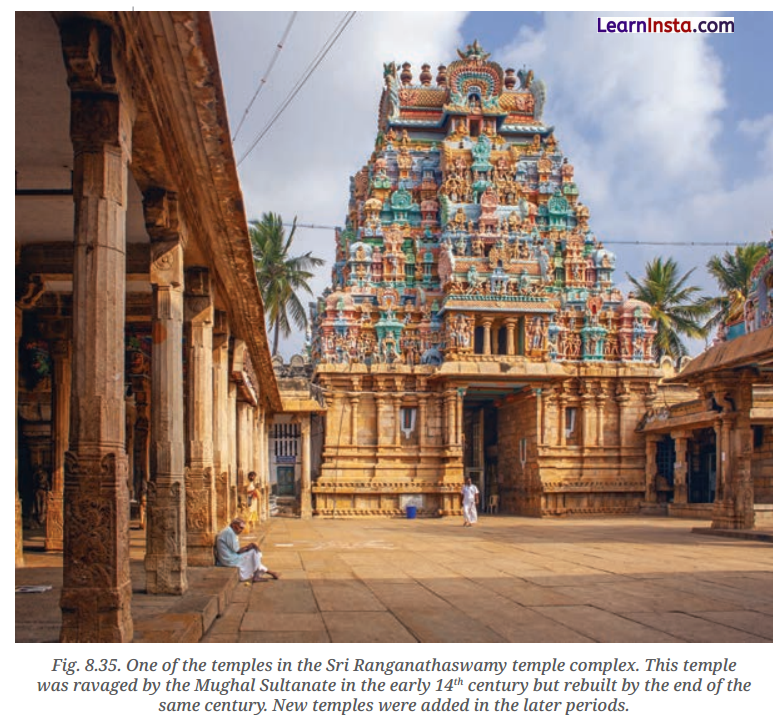
The picture shows the remains of which famous historical city?
(a) Pataliputra
(b) Vijayanagara (Hampi)
(c) Dhoiavira
(d) Madurai
Answer:
(b) Vijayanagara (Hampi)
Question 2.
Study the picture carefully and answer the following question.
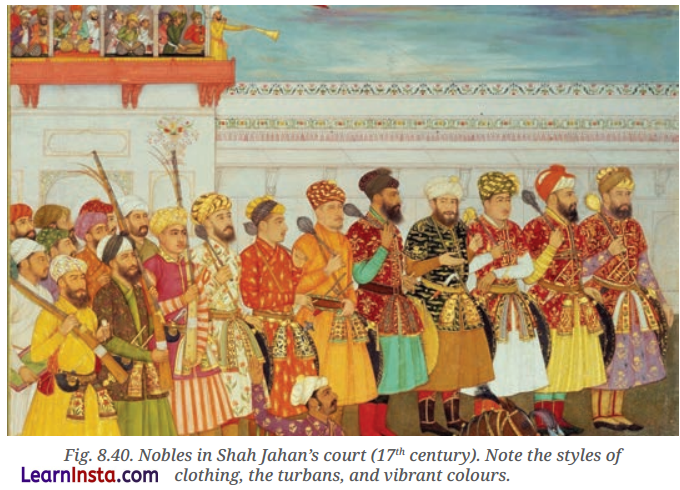
What does this painting mainly reflect about the Mughal period?
(a) Agricultural practices of villages
(b) The rich clothing, turbans, and court culture of Mughal nobles
(c) The spread of Buddhism in India
(d) Trade through Indian Ocean ports
Answer:
(b) The rich clothing, turbans, and court culture of Mughal nobles
Cultural Currents 13th to 17th Centuries Class 8 Case Based Questions
Question 1.
Read the passage given below and answer the following questions.
An Italian traveller named Pietro Della Valle mentioned in letters (written in 1623) about schools where children were learning reading, writing, and arithmetic in the coastal regions of Karnataka. We must remember that schools at that time were quite unlike what we have today. They were most likely places like a priest’s house or the mandapa of a temple where students would gather.
(i) What can be inferred about the organisation of education in 17th-century India?
(a) Education was provided only in large government buildings.
(b) Learning often took place in community or religious spaces.
(c) Schools functioned only in royal palaces.
(d) Formal classroom systems with benches and blackboards were common.
Answer:
(b) Learning often took place in community or religious spaces.
(ii) The mention of arithmetic being taught suggests that education at the time
(a) was limited only to religious instruction.
(b) ignored practical skills.
(c) included subjects useful for daily life and trade.
(d) was meant only for priests.
Answer:
(c) included subjects useful for daily life and trade.
(iii) The account of a foreign traveler like Pietro Delia Valle is important because it
(a) shows that Indians did not value education.
(b) provides an external observation about Indian society.
(c) proves that schools were identical to modern institutions.
(d) suggests that education began only in the 17th century.
Answer:
(b) provides an external observation about Indian society.