Experts have designed these Class 8 Social Science Notes and Class 8 SST Part 2 Chapter 7 India’s Urban Landscape Notes for effective learning.
Class 8 India’s Urban Landscape Notes
India’s Urban Landscape Notes Class 8
→ Affordable Housing: Housing programs, like the Pradhan Mantri Aawaas Yojana, meant for economically weaker households.
→ Amenities: Features or facilities that provide comfort or convenience to the residents of an area.
→ AQI (Air Quality Index): A numerical scale used to report air quality and the level of risk it poses to public health.
→ Blue Zones: Cities or regions where people live significantly longer and healthier lives due to community-centred design.
→ BPO (Business Process Outsourcing): A business practice where a company hires another provider to handle specific business processes to reduce costs.
→ Demographer: An expert who studies the characteristics of populations.
→ Economic Inequality: The gap between different income groups.
→ Economic Activities: Diverse businesses, trade, and manufacturing processes that drive the financial life of a city.
→ E-governance: The use of digital technologies and online platforms to provide improved urban services to citizens.
→ Financial Capital: A city, like Mumbai, that serves as the primary centre for a nation’s banking and financial institutions.
→ Gram Panchayat: The local government body that governs and manages rural areas.
→ Grid Pattern: A city design using rectangular blocks and streets that align with cardinal directions.
→ Heat Islands: Urban areas that experience rising temperatures due to the high concentration of buildings and vehicles.

→ Infrastructure: The basic physical systems of a city, such as roads, water, and sewerage, which require development and maintenance by local bodies.
→ Intangible Cultural Heritage: The festivals that are recognised for their global significance.
→ IT Hub: A city or region characterized by a high concentration of software firms and technology startups.
→ Lucrative: A term for cities that are profitable for companies due to lower operating costs.
→ Master Plan: A long-term planning document updated regularly to guide the conceptual layout of fiiture city growth.
→ Metropolitan Area: A large, densely populated region formed when cities expand to include surrounding areas.
→ NCR (National Capital Region): A planning region created to include areas like NOIDA and Ghaziabad to ease population pressure on Delhi.
→ Population Density: The number of people living per unit of area, typically expressed as people per square kilometre.
→ Potpourri: A mixture or variety of different cultures, languages, traditions, and foods shared in city spaces.
→ Promenade: A public walking area, such as those found along the Sabarmati Riverfront.
→ Rural: Areas consisting of villages that usually have lower populations, close-knit communities, and a larger number of agriculture-based occupations.
→ Satellite View: A visual data of the earth’s surface captured by satellites orbiting the planet.
→ Silicon Valley: A nickname used for Bengaluru.
→ Slums: Overcrowded city settlements characterised by poor housing and limited municipal services like sanitation.
→ Specialised Industries: Businesses that group together in clusters to focus on specific products, like brass work or textiles.
→ Urban: Areas having a concentration of human populations, various businesses, government institutions, and elaborate transportation and communication systems.
→ Urbanisation: The population shift from rural to urban areas and the resulting decrease in the proportion of people living in rural areas.
→ Urban Planner: A professional who designs how city land is used to optimise infrastructure and quality of life.
→ Vastu Shastra: A traditional Indian system of architecture used in the planning of houses and cities.
→ Vertical Gardens: A method of growing plants on vertical surfaces like walls to maximise limited urban land.
→ Water Scarcity: A crisis caused by overuse of groundwater and encroachment of lake beds.
Introduction
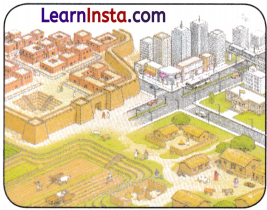
- India has a very old urban history that began with Harappan cities like Kalibangan, Dholavira, and Rakhigarhi.
- Historical cities like Varanasi, Vijayanagara, and Ujjain were also part of this rich legacy, and they are still flourishing today.
- Today, cities are defined as areas with a high concentration of human populations and different types of businesses.
- Cities also have government institutions and elaborate systems for transportation and communication.
- These “urban” areas are managed by elected local bodies that develop infrastructure and provide amenities like parks and street lights.
- Rural areas, or villages, usually have lower populations and very close-knit communities.
- Villages have a larger number of agriculture-based occupations and fewer businesses than cities.
- Transport and communication systems in villages are generally less complex compared to cities.
- Rural areas are governed by local government bodies like gram panchayats at the grassroots level.
- The definition of what makes a place a “city” differs across the world.
- In Denmark, a place is urban if it has more than 220 people, while in Japan it needs 50,000 people.
- In India, a place becomes urban if its population exceeds 5,000.
Population Density in Cities
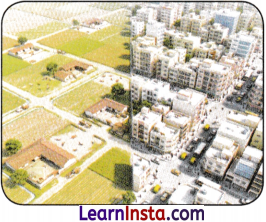
- Population distribution shows how densely or sparsely crowded a particular place is.
- Demographers are experts who study the size, age, and distribution of populations.
- Population density is the specific number of people living in one unit of area.
- It is usually expressed as the number of people living in one square kilometre.
- To find the population density, you divide the total population of a region by its total area.
- Satellite images of villages show large blocks of green and brown land which represent open areas, meaning the rural areas have less population density as compared to urban areas.
- Two of the most populated cities in the world in 2025 are located in India: New Delhi and Kolkata.
- In 2025, New Delhi’s population is estimated at 3.02 crore, and Kolkata’s is 2.25 crore.
How Do Cities Become Centres of Economic Activities?
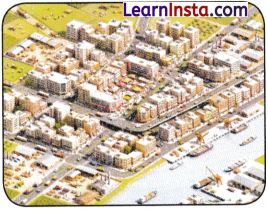
- Historically, cities grew near rivers because they provided an easy way to transport goods and people.
- Some cities developed at the crossroads of trade routes because these spots were perfect for access to agricultural produce and raw materials.
- Easy access to farm products and raw materials ensured artisan communities and manufacturing to thrive sustainably.
- These areas eventually became centers for money-making activities as well as political and administrative power.
- As per the United Nation’s assessment, by 2050, 68 per cent of the world’s population is expected to live in cities, compared to 55 per cent at present.
- In India, the urban population grew from 17 per cent in 1951 to around 40 per cent in 2025.
What Leads to Urbanisation?

- Urbanisation is the shift of population from rural to urban areas, decreasing the proportion of people in villages.
- Even though urban areas are crowded and have an expensive lifestyle, they provide better social and economic conditions due to the concentration of diverse resources and opportunities.
- Jamshedpur was originally a small village called Sakchi before it became a major industrial centre.
- It was chosen for Asia’s first steel plant because it was very close to rich iron ore deposits.
- Sir Dorabjee Tata built a hospital in the village even before the steel factory started its production.
- Sakchi was renamed Jamshedpur in 1919 and is now the largest industrial city in Jharkhand.
- The city was carefully planned with wide streets, gardens, and modern houses for the workers which captivated people from other states for significant work opportunities.
- Mumbai’s location along the Arabian Sea made it a vital port for trade within India and across the world.
- Almost every prominent city in India originated as a small or large town settlement. Over time, their location and relevant factors contribute to the advancement of urbanisation.
- Mumbai became the financial capital of the nation after the Bombay Stock Exchange (BSE) started in 1875.
- The film industry in Mumbai started in the 1910s and was very successful by the 1930s.
- Today, Mumbai has a profound physical infrastructure that ensures a diverse set of economic activities.
- Bengaluru is called the “Silicon Valley of India” because of its many software firms and startups.
- IT businesses grow in Bengaluru because of higher education institutions and specialised industrial clusters.
- In Bengaluru, industries and educational institutions are closely associated, fostering innovation and contributing to the development of new technologies like AI (Artificial Intelligence).
- Hyderabad has also thrived into a prominent hub for technology-oriented business. It has established itself as one of India’s leading IT hubs, nurturing innovative and sustainable startups.
- Among the thriving cities like Mumbai, Bengaluru, Delhi and Chennai, there are other smaller cities specialise in certain goods, like brass work in Moradabad and textiles in Ludhiana and Tirupur.
- Jaipur is famous for handicrafts and jewellery, Channapatna for toys, and Kanchipuram for silk sarees.
- Rapidly growing cities like Indore, Kochi, Nagpur and Lucknow, attract companies because operating costs are lower than in the megacities.
- Many companies have established their offices and warehouses in these highly profitable cities, serving customers across the globe.
- Cities like Agra, with historical and cultural prominence such as the Taj Mahal, attract more than 80 lakhs tourists every year.
- Varanasi in Uttar Pradesh and Amritsar in Punjab attract large numbers of pilgrims, and their visits fuel local businesses like transport, hotels, food stalls and handicrafts, creating jobs and supporting livelihoods.
- Medieval rulers such as the Rajputs, Mughals and Turks developed trade routes and marketplaces while the British later established Delhi as their capital and brought modern facilities like railways, and electricity.
- After India gained Independence, New Delhi became the nation’s capital, growing into a hub of government offices, universities and research institutes, drawing people from across the country for work and education.
- Delhi has been a major centre for trade, culture, and government since the Iron Age.
- The National Capital Region (NCR), including NOIDA and Ghaziabad, was created to help manage Delhi’s population growth.
- Gurugram became a major global hub for IT and business services (BPO) starting in the 1990s, drawing countless global companies and contributing to the development of commercial spaces.
Cities as Cultural Hubs
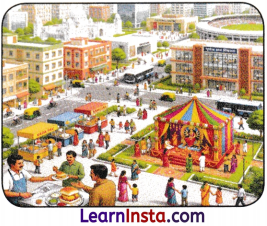
- Cities act as a “potpourri” where people from different regions share their languages, traditions, and food.
- For example, Mumbai’s Vada pav is a snack that blends Maharashtrian potato dumplings with Portuguese-style bread called pav.
- This snack became popular because it was very easy for workers in Mumbai’s textile mills to carry and eat.
- Likewise, Kolkata was the capital of British-ruled India and still has prominent, historical buildings like the Victoria Memorial.
- Kolkata is world-famous for its annual five-day Durga Puja festival held every autumn.
- In 2021, UNESCO included Kolkata’s Durga Puja on the list of Intangible Cultural Heritage of Humanity.
- Cities create special facilities like libraries, museums, and stadiums for various sports to help people enrich their cultural lives.
- These spaces allow people to interact, share knowledge, and build new social networks.
Challenges Faced by Cities
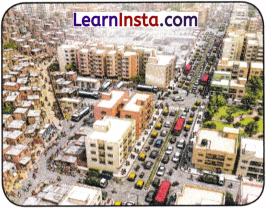
- When a large population moves to a city, it puts extreme pressure on resources like food, water, energy, and housing.
- Urban areas often have narrow roads and unplanned housing with poor access to water and waste management.
- Cities create “heat islands” where temperatures rise because there are too many buildings and vehicles.
- Pollution is a major problem; the National Capital Region (NCR) often has an Air Quality Index (AQI) over 400.
- A safe AQI level is only 50, so high pollution poses a very serious health risk to city residents.
- High population density and economic inequality can lead to higher crime rates in cities compared to villages, affecting the safety and wellbeing of citizens.
- Slums are overcrowded areas with very poor housing and very limited municipal services like toilets or water.
- Slums grow because there is not enough affordable housing for all the people moving to the city in search of better occupational opportunities.
- Slum residents usually perform important informal work like selling vegetables, laundry services, plumbing, and construction.
- Government programs like Pradhan Mantri Aawaas Yojana help provide cheaper homes to poor families.
- Water Scarcity has become a major issue for urban areas as increasing population density, pollution, and poor housing planning worsen shortages.
Power of Collective Action in the Revival of Bengaluru Lakes:

- Bengaluru has developed itself as a modern metropolitan city, facing flooding during summer. The monsoon and water scarcity during summer.
- Due to extreme population density, overuse of groundwater, and inadequate rainwater harvesting, the water crisis has worsened.
- Bengaluru’s lakes have shrunk from nearly 1000 to about 200, mainly due to rapid urbanisation, pollution and the continuous dumping of toxic chemicals by the factories.
- Polluted lakes like Varthur, Yelahanka and Bellandur became so full of chemicals that they released toxic foam and even caught fire.
- Local communities and Resident Welfare Associations (RWAs) are now cleaning these lakes by removing silt and planting native trees.
Planning Our Cities
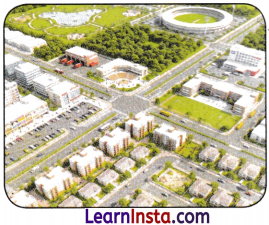
- Urban planners are people who design how city land should be used to make life better for everyone.
- They decide the best locations for residential areas, businesses, parks, schools, hospitals, sports stadiums, community centres and fire stations etc.
Here are some examples of Indian cities that have been planned remarkably well:
→ India’s ‘Pink City’
- Jaipur, known as the “Pink City,” was designed in 1727 by an architect named Vidyadhar Bhattacharya who was appointed by Maharaja Sawai Jai Singh II.
- He used his profound knowledge vastu shastra and shilpa shastra to design Jaipur.
- He used a grid pattern to divide the city into rectangular blocks called chowkris.
- The designes of the city included open spaces like gardens, nine public squares, and wide streets. These nine squares were centres of trade.
- The city, Jaipur, has elegant buildings and huge temples. A 20-foot wall with seven gates surrounded the city, ensuring its security.
- All buildings on major streets were made from pink sandstone to give the city a uniform and beautiful look. Thus, the city gained its name “The Pink City”.
- The beautiful design of the city ensured fresh air. ample sunlight, reliable water management system through canals and reservoirs.
- Shaded porches, in the markets, provided the traders and travellers with comfort and ease.
- At present, Jaipur is known for its marvelous original design, and aesthetic and sustainable planning.
→ Dynamic Urban Planning of Singapore
- Singapore is a famous example of good planning because it uses a Concept Plan that looks 40 years into the future.
- They update their Master Plan every 5 years to adjust to the changing needs of the city’s residents.
- Singapore was just an overcrowded port in the 1960s, that has now transformed into a well-developed modern city with phenomenal transportation, water supply, waste management, and electricity.
- The city is designed as a mixed space where offices, residential areas, parks, gardens, and museums are located close.
- The city promotes public transport like rail and buses rather than private like cars and bikes.
- It has beautiful green walking corridors and cycling paths, fostering walking and creating vibrant public places.
- Singapore is a small island, to sustainably utilise the land, it has high-rise buildings with vertical gardens on rooftops that help reduce heat during summer and support biodiversity.
- The city has also earned the title of a “Green City”. The planning focuses on making areas highly walkable for its residents.
- The city integrates senior citizen housing with medical services, childcare centres, diverse neighbourhoods, and public parks.
- This design serves as an excellent model for multi-generational living because it addresses various community needs within compact spaces. The community-focused design encourages people to interact and build strong social networks.
- Because of this focus on overall health and well-being, Singapore is recognised as a blue zone city where citizens live longer and healthier lives.
- Singapore serves as a major example of how creative city planning can successfully combine financial growth with a high quality of life.
- Several redevelopment projects in India, like the Sabarmati Riverfront in Ahmedabad, have created new public spaces.
- The Sabarmati project includes parks, markets, and the Atal Bridge for people to walk or cycle across the river.
- Gangtok’s Mahatma Gandhi Road is a clean, pedestrian-only shopping hub with many shops and restaurants.
- Sustainable cities of the future must balance economic growth with care for nature and the environment.
- Cities are like living organisms that constantly grow, change, and adapt over time rather than just being collections of buildings and roads. They drive financial growth by serving as major centers where goods are both made and consumed.
- Cities act as places where new ideas begin, traditional and modern cultures mix, and diverse groups of people cooperate to build a common future.
- Good city planning goes beyond basic infrastructure to support creativity, varied cultures, and social connections.
- Modern cities should use Information and Communication Technology (ICT), like smart traffic control, digital safety systems, online complaint platforms, and solar energy, to make life easier and more sustainable.
- Fast urban growth creates serious problems, including pollution, traffic jams, social inequality, and fewer natural spaces, which hurt both city residents and nearby villages.
- Future cities must manage financial progress carefully while protecting citizens and the environment.