Experts have designed these Class 8 Social Science Notes and Class 8 SST Part 2 Chapter 8 Cultural Currents 13th to 17th Centuries Notes for effective learning.
Class 8 Cultural Currents 13th to 17th Centuries Notes
Cultural Currents 13th to 17th Centuries Notes Class 8
→ Apprenticeship: A system of training where a young person learns a craft or trade through hands-on practice under a master.
→ Atelier: The studio of an artist or designer.
→ Ayurveda/Unani/Siddha: Traditional systems of medicine practiced in India, relying on herbal remedies and holistic health.
→ Bhakti Marga: A spiritual movement emphasising a personal, loving bond between the devotee and God.
→ Brocade: A rich fabric woven with a raised pattern, typically using gold or silver thread (often associated with Banaras).
→ Darbar: A royal court or a formal meeting where a ruler gathers with subjects and officials.
→ Dhrupad: An ancient and rigorous genre of Hindustani classical music.
→ Fresco: A technique of mural painting executed upon freshly laid lime plaster.
→ Ghunghat: A traditional veil or head covering worn by women in parts of North India.
→ Gurukula: A traditional type of residential school in India where students lived and studied with their Guru (teacher).
→ Hindavi: An early linguistic blend of Indian dialects with Persian and Arabic vocabulary; the ancestor of modern Hindi and Urdu.
→ Indian saltpetre: It refers to potassium nitrate (KNO3), which is a naturally occurring chemical compound.
→ Itr: A natural perfume oil derived from botanical sources, such as the rose-based Itr Jahangiri.
→ Jauhar: A historical practice of self-immolation by women in certain Indian kingdoms to avoid capture during war.
→ Kirtana: Devotional songs or hymns.
→ Madrasa: An Islamic educational institution offering instruction in religious and secular subjects.
→ Mandapa: A pillared hall or pavilion in an Indian temple, often used for public gatherings or as a classroom.
→ Matha: A monastic institution or centre for religious and philosophical learning.
→ Miniature Painting: Small, highly detailed paintings on paper or cloth.

→ Moksha: The spiritual goal of liberation from the cycle of birth and death.
→ Pathashala: A traditional local school, often found in villages, providing primary education.
→ Purdah: The practice of secluding women or requiring them to wear a veil.
→ Purvamaryade: A Kannada term meaning “following previously established practices,” used by Vijayanagara rulers to maintain social norms.
→ Qawwali: A form of Sufi devotional music.
→ Ram (Rama) and Rahim: Ram represents Lord Rama, a revered deity in Hinduism and Rahim refers to one of the names of Allah in Islam, meaning merciful.
→ Sambuseh: The Persian ancestor of the Indian Samosa, originally filled with meat and nuts.
→ Shreni: An ancient Indian professional guild or association of merchants and artisans.
→ Sufism: A spiritual branch of Islam focusing on an inner, spiritual search for God through meditation and devotion.
→ Varna/Jati: The traditional social hierarchy and caste system in India.
→ Vihara/Palli: Residential quarters for Buddhist (Vihara) or Jain (Palli) monks that also served as centres of learning.
→ Whirling dermish: A member of Sufi Muslim order who performs a special spinning dance as a form of meditation and prayer.
→ Zardozi: A type of intricate embroidery using gold or silver threads, introduced and popularised during the Mughal era.
→ Zikr: A Sufi practice involving the repetitive chanting of God’s name to achieve spiritual focus.
→ Zinc Distillation: A specialised metallurgical process for producing pure zinc, in which medieval India was a global leader.
Introduction
- Culture is the shared way of life passed down across generations that shapes how a group of people view the world and live daily.
- It includes values, morals, traditions, as well as art, literature, philosophy, and science.
- Indian culture is one of the oldest in the world, developing over thousands of years across its languages, food, architecture, and beliefs.
- Unlike other ancient civilisations that dissolved over time, Indian culture has survived and remained active due to its deep roots and adaptability.
- The period between the 13th and 17th centuries was one of the most dynamic and transformative eras in Indian history.
- Despite political instability, invasions, and shifting kingdoms, Indian civilisation displayed remarkable resilience . and cultural continuity.
- Unlike many ancient civilisations that weakened or disappeared, Indian culture remained vibrant by staying open to external influences.
- India welcomed diverse “cultural currents” brought by merchants, scholars, and diplomats from regions such as Greece, Persia, and Central Asia.
- Rather than rejecting foreign influences, Indian society selectively adopted and adapted new ideas into local traditions.
- Three major characterised patterns of this era:
- Continuation of traditional practices and beliefs
- Patronage of arts, music, architecture, and philosophy by rulers of diverse backgrounds
- Active participation of common people in shaping cultural life.
- Persian and Arabic influences blended with indigenous traditions, creating entirely new forms of art, literature, music, and knowledge systems.
- Thus, this period was not merely about survival during political turmoil, but also about cultural growth, synthesis, and innovation.
Belief Systems
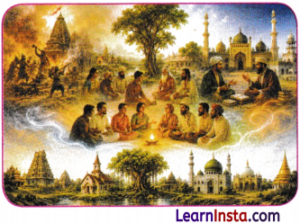
- The arrival of monotheistic Islam introduced a significant contrast to indigenous Indian belief systems, which were diverse and lacked a single holy book or uniform doctrine.
- Early interactions sometimes led to conflicts and destruction of sacred places like temples, but Indian society gradually developed spiritual resilience and cultural adaptation.
- Over time, ideas from different traditions interacted and influenced one another, creating a climate of spiritual exchange.
- Despite severe political and social turmoil, native religions survived alongside Islam, leading to long-term peaceful coexistence in India.
→ The Power of the Bhakti Tradition
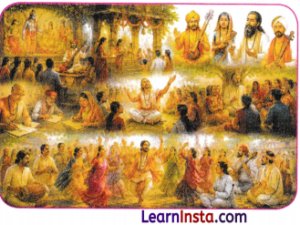
- Long before the 13th century, ancient epics and the Puranas were integrated into daily life through traditional art forms, festivals, and temple culture.
- Bhakti Marga (the path of devotion) emerged as a way to achieve moksha (liberation) directly without relying on complex rituals or priests.
- During the 13th -17th centuries, the Bhakti movement experienced a major resurgence and became a source of spiritual resilience for ordinary people.
- Bhakti saints rejected rigid social barriers and emphasised on love, compassion, equality, and personal devotion to God.
- Instead of using Sanskrit alone, saints composed devotional poetry and songs in local languages, making spiritual teachings accessible to common people.
- Shared singing, dance, and devotional gatherings helped unite communities across caste and social divisions.
→ Regional Saints and their Messages
During this period many regional saints rose to prominence and people followed them as they composed songs and hymns in local languages in which people were familiar.
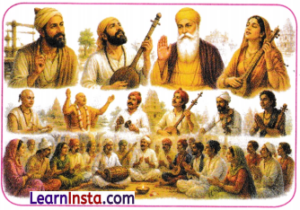
Kabirdas (14th Century)
- Kabirdas was raised in a weaver family and became one of the most influential Bhakti poets.
- He strongly believed in the oneness of God and criticised empty rituals and blind practices followed in both Hinduism and Islam.
- His verses focused on simplicity, devotion, and humanity, making his teachings extremely popular among ordinary people.
Ravidas (16th Century)
- Ravidas was born into a family of leather-workers.
- Through his poetry, he spread the message of equality, human unity, and spiritual oneness.
- He openly challenged the rigid hierarchy of varna and jati, promoting dignity for all individuals regardless of their caste.
Guru Nanak
- Guru Nanak travelled widely to spread the message of human equality, and devotion to one God.
- His teachings emphasised compassion, honesty, and service to humanity.
- His hymns, along with compositions of Hindu and Bhakti saints, were later compiled in the Guru Granth Sahib.
Saints from Other Regions
- Prominent leaders included Mirabai in Rajasthan, Chaitanya Mahaprabhu in the East, Tukaram, Dnyaneshwar and Namdev in the West, as well as Purandaradasa and Kanakdasa in South.
- Social Impact: People from all backgrounds participated together in musical devotional gatherings (bhajans), which promoted cultural unity and the concept of one God across different faiths.
Sufism:
- Sufism was a mystical branch of Islam focused on a personal and spiritual search for God. Sufi music marked a significant place in the spiritual life of India.
- Sufi saints believed in inner purity, love, and devotion rather than rigid religious formalities.
- Sufi saints used devotional songs called qawwalis, which blended local Indian traditions, Persian musical styles, and classical influences.
- Prominent saints like Khwaja Moinuddin Chishti and Nizamuddin Auliya promoted music as a medium for spiritual connection.
- Sufis adopted Indian yogic and Vedantic practices such as meditation and zikr (repetitive chanting).
- Figures such as Dara Shikoh supported the unity of these traditions by translating several Upanishads into Persian.
- Overlapping Bhakti and Sufi traditions enriched Indian Literature with shared themes of devotion and harmony.
Purandaradasa (15th – 16th Century):
- Purandaradasa is remembered as the “Father of Carnatic Music.”
- Originally a wealthy diamond merchant, he renounced material wealth and became a devotee of Krishna.
- He composed around 4,75,000 devotional kirtanas, greatly influencing South Indian classical music.
- He traveled through the Vijayanagara empire and was eventually invited to the court of King Krishnadevaraya.
- In Tamil Nadu, the traditions of the Alvars and Nayanars continued, with people reciting the Divya Prabandham and Tiruvachakam in homes and temples.
- Active participation from the common people helped keep these spiritual and cultural traditions alive despite political changes.
Musical Traditions – Continuation And Evolution
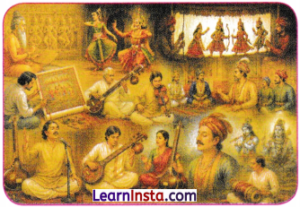
- Music and dance-drama were deeply woven into Indian cultural life.
- The ancient text Natyashastra formalised traditions of music, drama, and aesthetics.
- Its flexible framework allowed regional styles and artistic variations to flourish.
- Traditional storytelling methods such as puppetry in Rajasthan, pattachitra in Odisha, were used by travelling bards to narrate stories from epics like Ramayana, and Mahabharata.
- Classical music gradually developed into two major traditions:
- Hindustani music in North India
- Carnatic music in South India
- Under Raja Mansingh Tomar, the ancient dhrupad style was refined and elevated.
- Tansen (Ramtanu Pandey) became one of the greatest musicians of the Mughal court. He was one of the nine gems (nawaratnas).
- Tansen incorporated Sufi influences into his music while continuing to write compositions dedicated to Hindu deities like Krishna and Shiva.
- Carnatic music grew independently in South India, remaining largely uninfluenced by Persian or Arabic styles.
- Musical instruments evolved through experimentation; for example, modem instruments like the sitar and tabla developed from older traditional instruments such as the pakhawaj.
Amir Khusro:
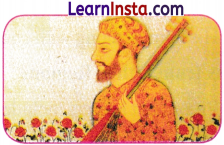
- Amir Khusro was an Indo-Persian Sufi Poet from the 13th to 14th century.
- Amir Khusro blended Indian, Persian, and Arabic traditions to develop qawwali music, symbolising cultural synthesis.
From Walls To Paper – Miniature Paintings
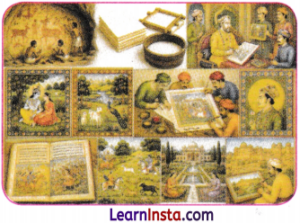
- Indian art transitioned from large cave murals and frescoes to paper 11 th century.
- The Rajput painting tradition flourished between the 15th and 19th centuries, focusing on Hindu themes and nature such as animals, plants, and human figures.
- In the Ain-i-Akbari, Abul Fazl praised the exceptional skill and imagination of Hindu painters of that era.
- Mughal miniature painting developed as a distinct art form influenced by Persian styles.
- These court paintings depicted non-religious subjects such as portraits, landscapes, and daily court scenes.
- Under Emperor Akbar’s patronage, artists collaborated in workshops where different painters specialised in outlining, colouring, and adding final details.
- Miniature art was also used to illustrate manuscripts, including Persian translations of Hindu epics like the Mahabharata.
- Mughal and Rajput artistic traditions influenced each other in terms of techniques, colour choices, and subjects like gardens and hunting scenes.
- As some Mughal painters relocated to regional centers like Bikaner, local styles blended with imperial Mughal art.
- Despite these cross-cultural influences, traditional Hindu themes in Rajput painting continued to thrive.
Changing Landscapes – Gardens
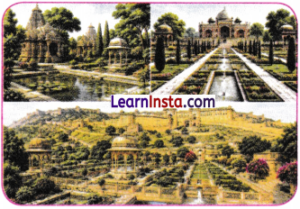
- Gardens have a long history in India, with ancient texts like the Rigveda, Mahabharata, and Ramdyana referring to them as udyana, vatika, and nandana.
- Early Indian gardens were usually established near temples and included ponds or water tanks.
- The Mughals introduced the Persian charbagh design, which divided gardens into four sections using water channels, fountains, and terraces to represent the rivers of Paradise.
- These structured gardens were constructed around forts, tombs, and mosques, inspiring similar designs across regions like Amer Fort in Jaipur.
Women in Society – Contextual Variations in Their Role And Status
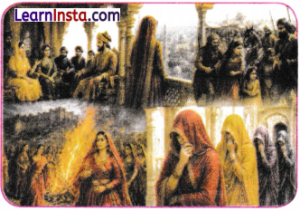
- Between the 13th and 17th centuries, women’s status changed significantly due to warfare, invasions, and regional customs.
- Chroniclers like Abu Zaidu-1 Hasan noted that earlier Indian courts allowed women to appear unveiled and participate publicly.
- However, invasions during the 12th century led to increased insecurity, resulting in practices like Purdah and Ghunghat due to increasing trade of children and women as slaves in the market.
- Women commited Jauhar to avoid capture, enslavement and violence when their fort or Kingdom faced inevitable defeat.
- These customs became common especially among aristocratic women in North India to protect them during periods of conflict.
- Such restrictive veiling practices were not equally common across all regions of India.
- Women in Islam were usually isolated and followed the purdah culture.
- In the 13th century, Razia Suita 1 became one of the few women rulers of the Delhi Sultanate.
- She established educational institutions along with prioritising a merit-based administration during her reign.
- Moreover, these acts of bravery led to a conspiracy that ended her brief reign.
- She appeared unveiled in court and personally led military campaigns, challenging gender norms of the period.
- Nur Jahan played a powerful role in Mughal administration during the 17th century by issuing royal orders, and attending court.
- Even coins were minted in her name, showing her political influence.
- In South India, especially in the Vijayanagar Empire, women participated actively in public life.
- Royal and upper-class women received education in arts and literature, with some actively writing poetry.
- Historical inscriptions record that wealthy women and queens issued land grants and funded wells, temple halls, and community structures.
- Many women were highly educated and skilled in poetry, music, and arts.
- Thus, women contributed actively to the social, cultural, and economic prosperity of the period.
Education and Knowledge Traditions
Although military invasion disrupted educational system, India remained an important global centre of learning during this period and attracted scholars from Greece, Persia, and Central Asia.
→ Institutions of Learning
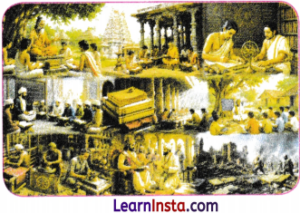
- Education flourished through institutions such as gurukulas, mathas, temple schools, and Buddhist and Jain learning centres.
- Students often stayed with teachers and studied subjects including grammar, astronomy, medicine, and sacred texts.
- Villages depended on local pathashalas for elementary education.
- Southern centres, such as Kanchipuram became an important centre of Philosophy.
- The Kerala School of Mathematics and Sringeri respectively made pioneering contributions to calculus and Philosophy.
- Under Muslim rule, madrasas introduced studies in Arabic, Persian, and Hindavi and Islamic studies.
- Although great universities like Nalanda University were destroyed in the 12th century, learning continued in decentralised spaces like temple mandapas.
- Occupational skills and craft knowledge were passed down through the jati and shreni (guild) systems which remained largely unaffected by political changes.
- Rulers followed the principle of purvamaryade, which protected traditional educational and social institutions.
- A famous Italian traveller, Pietro Dello Valle, mentioned about schools of Karnataka where children were learning writing, reading and arithmetic.
- In the late 12th century, the destruction of large universities like Nalanda and Vikramshila disrupted an enitre learning ecosystem, causing dispersal of learned scholars.
→ Vocational Education and Knowledge Sharing
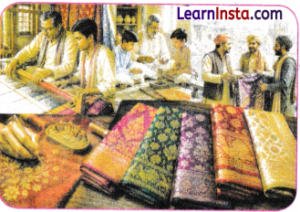
- Every region in India has its own unique wearing culture and extraordinary textiles.
- Textile communities like the Koshtis preserved regional weaving traditions while adopting new influences.
- Skills were passed from masters to apprentices, often within families.
- This ensured continuity of crafts despite political instability.
- Under Mughal patronage, Gujarati weavers migrated to Banaras and combined their skills with local traditions.
- The Mughals introduced zardozi, zari and brocades that became signature elements of Banaras silk saris.
- These saris feature geometric patterns as well as design motifs inspired by flora and fauna.
Banarasi Saris:

- Banarasi saris hold a Geographical Indication (GI) tag restricting the use of the name ‘Banarasi’ to brocades produced in specific districts.
- Due to water pollution in the Ganga caused by chemical dyes, institutions of higher education are helping weavers switch to natural vegetable dyes.
Pashmina Shawls:

- Pashmina shawls are famous for their warmth and softness, woven from cashmere wool obtained from goats in Ladakh and Kashmir.
- Supported by Mughal emperors, Pashmina shawls became a symbol of royalty and were exported across Asia and Europe.
- Pashmina embroidery displays noticeable Persian influence, particularly through floral patterns.
Growth of Literature and Language
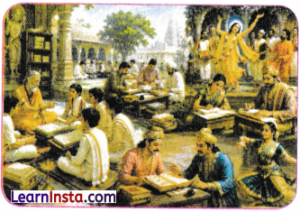
- During this period, regional languages such as Sanskrit, Tamil, Telugu, Kannada, Odia, Hindavi, Bengali, and Marathi flourished in daily communication and literature.
- Bhakti literature made spiritual ideas accessible through regional poetry and music.
- Chaitanya Mahaprabhu influenced 16th-century Bengali literature, promoting biographies and a new style of folk songs called Dhumali.
- Dhumali songs focused on the life and stories of Lord Krishna, which also influenced Kathak dance performances.
- Court poet Kavindra Paramesvara translated the Mahabharata into Bengali during the early 16th century.
- Literature in this era expanded to include translations of Persian poetry into Bengali as well as non-religious themes.
- Literature was patronised by regional rulers, including Krishnadevaraya in South India and the Gajapati kings in Odisha.
- In the Vijayanagara kingdom, several rulers and queens were poets themselves.
- Tirumalamba, a scholar and poet in the court of Achyutadevaraya, authored Varadambika Parinaya, a Sanskrit kavya describing the royal wedding.
- Persian served as the official language of administration and court culture under the Mughals, helping preserve historical and cultural texts.
- The Mughal court attracted many scholars, poets, and astronomers from Persia, leading to extensive cultural exchanges.
- Sanskrit texts were translated into Persian, such as Bhaskaracharya’s Lilavati by Faizi and Kalhana’s Rajatarangini.
The Case of Dara Shikoh:
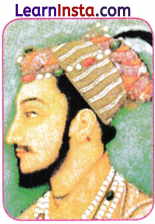
- Dara Shikoh, the eldest brother of Aurangzeb, was a scholar who actively promoted harmony between Hindu and Muslim traditions.
- With the assistance of scholars from Varanasi, Dara Shikoh translated 52 Upanishads from Sanskrit into Persian.
- These Persian translations later reached Europe, influencing several 19,h-century European philosophers.
- Dara Shikoh was later accused of heresy, imprisoned, and executed by his brother Aurangzeb.
→ The Development of Urdu
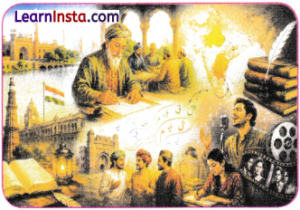
- Urdu originated in the Ganga-Yamuna region from Hindi or Hindavi by incorporating vocabulary from Arabic and Persian.
- It replaced Persian as an official language during British rule in India and is included in the Eighth Schedule of the Indian Constitution.
- In the southern region of the Deccan, Urdu evolved into Dakhini by adopting words from local languages such as Telugu and Marathi.
- Amir Khusrau is recognised as the father of Urdu literature, writing in Hindavi, Punjabi, and Braj Bhasha alongside having knowledge of Sanskrit.
- The blending of words from different languages enriched Indian literature and remains prominent in modem poetry, songs, and cinema.
Developments in Science and Technology
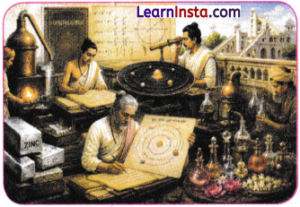
- India witnessed major scientific and technological progress between the 13th and 17th centuries due to a strong culture of enquiry and openness to knowledge.
- India became globally renowned for advances in metallurgy, especially the distillation process used to produce pure zinc.
- Narayana Pandita wrote the Ganitakaumudi, a massive treatise of mathematics that included important original developments in the 14th century.
- Madhava laid early foundations of calculus by discovering series expansions for trigonometric functions and calculating the exact value of n (pi) using an infinite series.
- Madhava and his followers established the Kerala School of Astronomy and Mathematics, which produced key scientific works until the 19th century.
- In 1500, Nilakantha Somayaji developed an advanced planetary model for Mercury and Venus which went round the sun in an orbit several decades before Copernicus proposed heliocentrism in Europe in 1553.
- Applied Chemistry was utilised for creating new perfumes as well as techniques for refrigeration.
- Indian saltpetre was used during Akbar’s reign to make gunpowder and also to cool water and beverages.
- During Jahangir’s period, the perfume Itr Jahangir was developed using rose extracts.
- Medical systems were practiced widely during this period included Ayurveda, Siddha and Unani.
- Medical knowledge survived through written texts and oral traditions.
Regional Architectural Developments
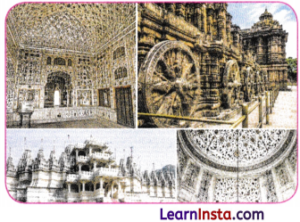
- Indian architecture between the 13th and 17th centuries displayed a powerful combination of indigenous traditions and new influences.
- Structures reflected royal patronage, artistic excellence, and engineering skills.
- Important examples include Sheesh Mahal built by Raja Man Singh I, Ranakpur Jain Temple in Rajasthan built by a Jain businessman,
- Dhanna Seth, and Konark Sun Temple famous for its 24 stone wheels.
- Even mosque architecture displayed intricate craftsmanship, including decorative ceilings at the Taj Mahal complex.
→ Temple Building and Reconstruction
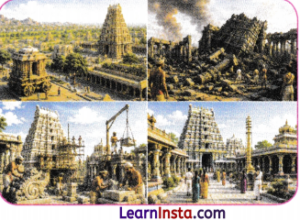
- Under Krishnadevaraya, the Vijayanagara Empire witnessed a cultural and architectural golden age.
- Hampi became famous for advanced urban planning and temple architecture.
- Despite invasions and wars, Indian temple traditions remained resilient through reconstruction efforts.
- Example: Sri Ranganathaswamy Temple was destroyed in the early 14th century but later restored and expanded.
Cultural Exchange in Daily Life
- Cultural interaction during this period strongly influenced everyday life, especially in:
- Food
- Clothing
- Lifestyle
- Indian traditions blended with Persian and West Asian influences to create new cultural practices.
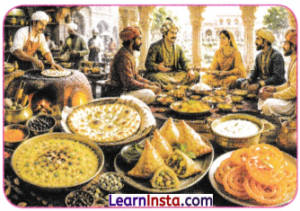
→ Food
- Culinary traditions evolved through exchanges between imperial kitchens and ordinary households. Commonly used spices included cardamom, clove, turmeric, and black pepper.
- The use of curd for marination and ghee in cooking became increasingly popular.
- Traditional dishes such as Khichri, a mix of rice and lentils, acquired new flavours and styles.
- Hindu and Jain culture influenced the mughal king, Akbar, to try to reduce consumption of meat for himself and his countries as well.
- Naan was introduced from Persia and baked in clay ovens.
- Samosa evolved from the Persian sambuseh. Indians modified its filling using potatoes and peas.
- Jalebi developed from the Persian dish zalabiyeh.
→ Clothing
- India had long been famous for fine textiles, jewellery, and dyes, admired even by Greek travellers.
- Production of cotton, muslin, and silk increased significantly during this period.
- Garments like the jama (a tunic like dress) and pyjama became popular in royal courts.
- Different variations were designed specifically for women.
- Clothing styles blended old and new traditions.
- Fine muslin dupattas inspired by sari traditions became fashionable additions.
- Although new garments gained popularity, the sari continued to flourish in diverse regional styles across India.
- Nobles in Shah Jahan’s court were new style of clothing, turbans and vibrant colours.
- Angarkha was popular garment both among men and women with was a robe-type upper garment.