Practicing Class 8 Social Science MCQ and Class 8 SST Part 2 Chapter 7 India’s Urban Landscape MCQ Online Test with Answers daily helps in time management.
Class 8 India’s Urban Landscape MCQ with Answers
MCQ on India’s Urban Landscape Class 8
India’s Urban Landscape MCQ Class 8
Question 1.
Areas with dense population, diverse jobs, and better facilities are called
(a) Rural areas
(b) Urban areas
(c) Forest areas
(d) Tribal areas
Answer:
(b) Urban areas
Question 2.
Rural areas in India are governed by
(a) Municipal Corporation
(b) Zila Parishad
(c) Gram Panchayat
(d) Parliament
Answer:
(c) Gram Panchayat
Question 3.
Which of the following is an ancient Harappan city?
(a) Dholavira
(b) Jaipur
(c) Chennai
(d) Lucknow
Answer:
(a) Dholavira
Question 4.
Population density is calculated as the number of people living per
(a) District
(b) Square kilometre
(c) State
(d) Country
Answer:
(b) Square kilometre

Question 5.
Experts who study population distribution are called
(a) Historians
(b) Geographers
(c) Demographers
(d) Economists
Answer:
(c) Demographers
Question 6.
Which of the following developments is a characteristic feature of urbanisation?
(a) Increase in agricultural activities
(b) Growth of residential, commercial and industrial areas
(c) Reduction in transport facilities
(d) Expansion of grazing land
Answer:
(b) Growth of residential, commercial and industrial areas
Question 7.
In India, a settlement is considered urban if it has more than
(a) 220 people
(b) 50,000 people
(c) 5,000 people
(d) 1,000 people
Answer:
(c) 5,000 people
Question 8.
Mumbai developed as an important port because of its location along the
(a) Bay of Bengal
(b) Arabian Sea
(c) Indian Ocean
(d) River Ganga
Answer:
(b) Arabian Sea
Question 9.
The Bandra-Worli Sea Link helps reduce
(a) Pollution
(b) Water shortage
(c) Traffic congestion
(d) Crime
Answer:
(c) Traffic congestion
Question 10.
Bengaluru is known as the
(a) Textile City
(b) Pink City
(c) Silicon Valley of India
(d) Steel City
Answer:
(c) Silicon Valley of India
Question 11.
The Taj Mahal attracts visitors mainly for
(a) Sports events
(b) Industrial exhibitions
(c) Tourism
(d) Trade fairs
Answer:
(c) Tourism
Question 12.
Which pair of towns forms part of the National Capital Region (NCR)?
(a) Kochi and Indore
(b) Noida and Ghaziabad
(c) Jaipur and Amer
(d) Nagpur and Bhopal
Answer:
(b) Noida and Ghaziabad
Question 13.
Kolkata’s Durga Puja was inscribed on UNESCO’s Intangible Cultural Heritage list ¡n
(a) 2010
(b) 2015
(c) 2021
(d) 2023
Answer:
(c) 2021
Question 14.
The Pradhan Mantri Awas Yojana provides
(a) Free education
(b) Affordable housing
(c) Free transport
(d) Free electricity
Answer:
(b) Affordable housing
Question 15.
The Sabarmati Riverfront project ¡s located in
(a) Ahmedabad
(b) Surat
(c) Jaipur
(d) Indore
Answer:
(a) Ahmedabad
Question 16.
Mahatma Gandhi Road in Gangtok ¡s developed as a
(a) Industrial corridor
(b) Pedestrian-only Street
(c) Highway
(d) Railway station
Answer:
(b) Pedestrian-only Street
Question 17.
Effective urban planning primarily contributes to
(a) Higher economic output alone
(b) Increased industrial concentration
(c) Balanced and inclusive urban development
(d) Rapid population growth
Answer:
(c) Balanced and inclusive urban development
India’s Urban Landscape Class 8 Assertion and Reason Questions
Question 1.
Assertion (A) Cities often grow at the crossroads of trade routes.
Reason (R) Cities are located near rivers mainly for cultural reasons.
Codes
(a) Both A and R are true, and R is the correct explanation of A.
(b) Both A and R are true, but R is not the correct explanation of A.
(c) A is true, but R is false.
(d) A is false, but R is true.
Answer:
(c) A is true, but R is false.
Question 2.
Assertion (A) Smaller urban centres attract companies with lower operating costs.
Reason (R) Larger metropolitan cities offer cheaper land and labour than smaller cities.
Codes
(a) Both A and R are true, and R is the correct explanation of A.
(b) Both A and R are true, but R is not the correct explanation of A.
(c) A is true, but R is false.
(d) A is false, but R is true.
Answer:
(c) A is true, but R is false.
Question 3.
Assertion (A) Cities like Agra and Varanasi generate employment through tourism.
Reason (R) Tourism only benefits government revenue and not local employment.
Codes
(a) Both A and R are true, and R is the correct explanation of A.
(b) Both A and R are true, but R is not the correct explanation of A.
(c) A is true, but R is false.
(d) A is false, but R is true.
Answer:
(c) A is true, but R is false.
Question 4.
Assertion (A) Slums develop near industrial areas, railway tracks, and city edges.
Reason (R) Affordable housing is not available for many migrants, forcing them to settle in informal areas.
Codes
(a) Both A and R are true, and R is the correct explanation of A.
(b) Both A and R are true, but R is not the correct explanation of A.
(c) A is true, but R is false.
(d) A is false, but R is true.
Answer:
(a) Both A and R are true, and R is the correct explanation of A.
Question 5.
Assertion (A) Jaipur was planned with a grid pattern and wide streets.
Reason (R) Jaipur’s layout developed randomly over time without planning.
Codes
(a) Both A and R are true, and R is the correct explanation of A.
(b) Both A and R are true, but R is not the correct explanation of A.
(c) A is true, but R is false.
(d) A is false, but R is true.
Answer:
(c) A is true, but R is false.
Question 6.
Assertion (A) Cities act as centres of production, consumption, culture and innovation.
Reason (R) Cities are only meant for cultural activities, not economic or technological development.
Codes
(a) Both A and R are true, and R is the correct explanation of A.
(b) Both A and R are true, but R is not the correct explanation of A.
(c) A is true, but R is false.
(d) A is false, but R is true.
Answer:
(c) A is true, but R is false.
India’s Urban Landscape Class 8 Fill in the Blanks
1. The gradual change from villages to towns and cities is called ………………………… .
Answer:
Urbanisation
2. The ………………… Bridge in Ahmedabad allows pedestrians and cyclists to move along the Sabarmati River.
Answer:
Atal
3. In Denmark, a settlement is considered urban if it has more than ……………………… people.
Answer:
220
4. Dorabji Tata built a ………………………………. in Sakchi before steel production began.
Answer:
Hospital
5. The National Capital Region (NCR) was created to reduce pressure on …………………………. .
Answer:
Delhi
6. Bengaluru once had about ………………………. lakes in the past.
Answer:
1000
7. Jaipur was designed according to principles of ………………………… shastra.
Answer:
Vastu
8. Singapore updates its Master Plan every ……………………….. years.
Answer:
Five
9. The exchange of ideas and innovation made Mumbai the financial capital after the establishment of the Bombay Stock Exchange in the year ………………………….. .
Answer:
1875
India’s Urban Landscape Class 8 True or False
1. Rural areas mainly depend on agriculture for livelihood.
Answer:
True
2. Urban areas usually have weaker transport and communication networks than rural areas.
Answer:
False
3. Cities near rivers often developed due to easy transportation.
Answer:
True
4. High population density always reduces crime in cities.
Answer:
False
5. Slums often develop because affordable housing is not available to migrants.
Answer:
True
6. The urban heat island effect causes cities to become cooler than nearby rural areas.
Answer:
False
7. Tourism and pilgrimage can create employment opportunities in cities.
Answer:
True
8. Vertical gardens in Singapore help reduce heat and support biodiversity.
Answer:
True
9. Future cities must balance growth with sustainability and inclusiveness.
Answer:
True
India’s Urban Landscape Class 8 Match the Following
Question 1.
| List I (Cities) | List II (Specialty/Industry) |
| A. Moradabad | 1. Wooden toys |
| B. Ludhiana | 2. Textile production |
| C. Jaipur | 3. Handicrafts and gem jewellery |
| D. Channapatna | 4. Brass work |
Codes
A B C D
(a) 4 2 3 1
(b) 2 4 3 1
(c) 2 1 4 3
(d) 3 2 4 1
Answer:
(a) 4 2 3 1
| List I (Cities) | List II (Specialty/Industry) |
| A. Moradabad | 4. Brass work |
| B. Ludhiana | 2. Textile production |
| C. Jaipur | 3. Handicrafts and gem jewellery |
| D. Channapatna | 1. Wooden toys |
Question 2.
| List I (City) | List II (Urban Feature) |
| A. Jamshedpur | 1. Planned industrial city |
| B. Singapore | 2. Efficient public transport and vertical greenery |
| C. Jaipur | C. Jaipur |
| D. Delhi | 4. Capital city with historic and administrative importance |
Codes
A B C D
(a) 1 2 3 4
(b) 1 2 4 3
(c) 2 1 3 4
(d) 4 3 2 1
Answer:
(a) 1 2 3 4
| List I (City) | List II (Urban Feature) |
| A. Jamshedpur | 1. Planned industrial city |
| B. Singapore | 2. Efficient public transport and vertical greenery |
| C. Jaipur | C. Jaipur |
| D. Delhi | 4. Capital city with historic and administrative importance |
Question 4.
| List I (City) | List II (Growth Factor) |
| A. Mumbai | 1. IT and technology hub |
| B. Bengaluru | 2. Financial capital, port city |
| C. Hyderabad | 3. Technology and education institutions |
| D. Agra | 4. Tourism and cultural heritage |
Codes
A B C D
(a) 2 1 3 4
(b) 2 3 1 4
(c) 1 2 3 4
(d) 4 2 3 1
Answer:
(a) 2 1 3 4
| List I (City) | List II (Growth Factor) |
| A. Mumbai | 2. Financial capital, port city |
| B. Bengaluru | 1. IT and technology hub |
| C. Hyderabad | 3. Technology and education institutions |
| D. Agra | 4. Tourism and cultural heritage |
India’s Urban Landscape Class 8 Picture based Questions
Question 1.
The Image shows Bellandur Lake with foam and pollutants on its surface. Nearby, local residents are participating in cleaning, planting native plants, and restoring the lake ecosystem.
Which of the following conclusions can be best drawn from the actions shown in the Image?
(a) Urban lakes naturally recover without human effort.
(b) Collective action by communities and organisations is essential to restore polluted urban water bodies.
(c) Industrial growth is more important than environmental care in cities.
(d) Polluted lakes have no impact on city life.
Answer:
(b) Collective action by communities and organisations is essential to restore polluted urban water bodies.
Question 2.
The image shows the Bandra-Worli Sea Link connecting two parts of Mumbai. Vehicles move smoothly on the bridge while the surrounding city faces heavy traffic congestion.
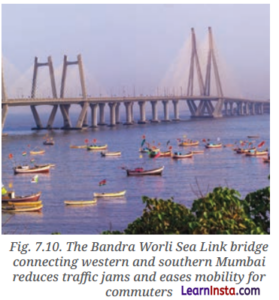
Which of the following statements best explains the advantage of the infrastructure shown in the image?
(a) It reduces travel time and eases traffic, improving urban connectivity.
(b) It is mainly built for tourist sightseeing.
(c) Bridges are a replacement for all public transport in cities.
(d) It increases air pollution by encouraging more cars.
Answer:
(a) It reduces travel time and eases traffic, improving urban connectivity.
India’s Urban Landscape Class 8 Case Based Questions
Question 1.
Read the given source below and answer the following questions.
Cities also remind us of our responsibilities. Rapid urbanisation brings challenges such as pollution, traffic congestion, inequality, and the loss of green spaces, affecting not only those who live in cities but also the rural areas connected to them.
A sustainable city of tomorrow must balance growth with care for people and nature. It must offer opportunities without excluding the vulnerable and provide comfort without exhausting resources. As urban landscapes evolve and expand, balancing growth with sustainability will shape the cities of tomorrow.
(i) Which of the following challenges is directly caused by rapid urbanisation?
(a) Sustainable city planning
(b) Pollution and traffic congestion
(c) Planting native trees
(d) Community participation
Answer:
(b) Pollution and traffic congestion
(ii) A sustainable city of tomorrow should aim to
(a) Focus only on industrial growth.
(b) Offer opportunities while protecting people and nature.
(c) Reduce public spaces to build more housing.
(d) Encourage unlimited use of natural resources.
Answer:
(b) Offer opportunities while protecting people and nature.
(iii) What is the main purpose of balancing growth with sustainability in urban areas?
(a) To increase population density rapidly.
(b) To protect resources, ensure comfort and include vulnerable groups.
(c) To prioritise only commercial and industrial development.
(d) To limit urban expansion entirely.
Answer:
(b) To protect resources, ensure comforfand include vulnerable groups.