Students can use NCERT Class 9 Advanced Science Notes and Chapter 5 Work and Energy Class 9 Notes to understand complex concepts with ease.
Work and Energy Notes Class 9 Advanced Science
Class 9 Work and Energy Notes
Conservative and Non-Conservative Forces
In our daily environment, various physical phenomena illustrate the presence and effects of different types of forces:
- Vertical Motion of a Projectile: When a ball is projected vertically upward, it eventually reverses its trajectory and returns to the hand. This occurrence is attributed to the gravitational force of the Earth, which acts as a restoring influence by continuously pulling the object toward the Earth’s centre.
- Elastic Deformation: A stretched rubber band returns to its original configuration once the external tension is removed. This is due to elastic forces (restoring forces) inherent in the material.
- Deceleration of a Sliding Object: A book sliding across a horizontal surface eventually comes to rest. This is caused by the frictional force, which opposes the relative motion between the book and the table.

Conservative Forces
A force is categorised as conservative if it satisfies specific mathematical and physical criteria:
- The work- done by the force in moving a particle between two points is independent of the path taken.
- The net work done by a conservative force on a particle moving around any closed loop is zero.
- For these forces, work done (W) is equal to the negative change in potential energy (∆U):
W = -∆U = -(Ufinal – Uinitial) = Uinitial – Ufinal
Eventually,
∆U = Ufinal – Uinitial = -W
Examples:
- Gravitational Force: The Earth’s pull on objects.
- Spring/Elastic Force: Forces exerted by a compressed or stretched spring or rubber band.
Non-Conservative Forces
A force is non-conservative if the work it performs depends on the specific trajectory or path followed between two points.
- Energy Dissipation: Unlike conservative forces, the work done by non-conservative forces typically results in the conversion of mechanical energy into non-recoverable forms, such as thermal energy (heat) or sound.
- Path Dependence: Moving an object over a longer path will result in more work done by the non-conservative force compared to a shorter path between the same two points.
Examples:
- Friction: Both kinetic (sliding) and static friction.
- Drag/Air Resistance: Resistance encountered by an object moving through a fluid.
Potential Energy of a Spring Activity 5.1:
Collect the following items: A spring, a stand, a weight hanger, slotted weights, a ruler.
- Suspend a spring vertically from a rigid support.
- Attach a weight hanger to the free end of the spring and note the initial length of the spring.
- Add a known weight to the hanger and measure the extension produced in the spring.
- Increase the weight gradually and note the corres-ponding extension each time.
- Repeat the experiment using springs made of different materials or of different thickness.
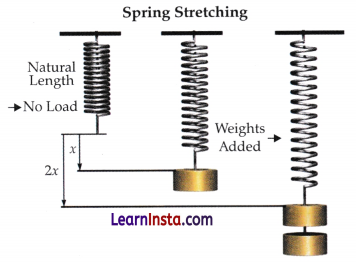
Observations:
The extension of the spring is directly proportional to the applied force (F ∝ x), confirming Hooke’s Law.
Constant of Stiffness: The ratio of force to extension \(\left(\frac{F}{x}\right)\) remains constant, which is the spring constant (k).
- Material Dependency: Different springs have different k values; thicker or tougher materials result in a higher k (stiffer spring), while thinner materials result in a lower k (softer spring).
- Elastic Limit: The relationship holds true only as long as the spring returns to its original length after the weights are removed.
Hooke’s Law and Spring Forces
Hooke’s Law states that the extension (or compression) of an elastic object is directly proportional to the force applied to it, provided the elastic limit is not exceeded. Mathematically, it is expressed as:
F ∝ x
F = kx
Where:
F: Applied force
x: Extension or displacement from the equilibrium position ‘
k: Spring Constant, a measure of the spring’s stiffness (measured in N/m or Nm-1).
The Restoring Force
In physics, Hooke’s Law is often written as F = -kx.
The negative sign signifies that the force exerted by the spring is a restoring force.
This force acts in the opposite direction of the displacement to bring the spring back to its original “natural” length.
Characteristics of the Spring Constant (k)
The value of k depends on the material and the physical design of the spring:
- Stiff Spring: Characterised by a large k value; it requires a significant amount of force to produce a small extension
- Soft Spring: Characterised by a small k value; it is easily stretched or compressed.
Graphical Representation: Force vs. Extension
When the data for Force (F) and Extension (x) are plotted on a Cartesian plane:
- X-axis: Extension
- Y-axis: Force
- Results in a straight line passing through the origin.

- The slope of the line represents the spring constant (k).
Slope = \(\frac{\Delta F}{\Delta x}\) = k
Observation Table (Potential energy of a Stretched Spring) These values give a straight-line graph passing through the origin.
Sample Values for k = 100 N/m
| Force (F) in N | Extension (x) (in cm) | Extension (x) (in m) |
| 0 | 0 cm | 0 m |
| 20 | 20 cm | 0.2 m |
| 40 | 40 cm | 0.40 m |
| 60 | 60 cm | 0.60 m |
| 80 | 80 cm | 0.80 m |
| 100 | 100 cm | 1 m |

Calculation of Average Force:
For a spring stretched from 0 to maximum force:
Average Force = \(\frac{F_{\text {initial }}+F_{\text {final }}}{2}\)
When the spring is stretched gradually from zero extension to a maximum extension x, the force acting on it does not remain constant.
- At the beginning, force = 0
- At extension x, force = kx
So, the average force (spring force changes linearly from 0 to maximum as extension increases.) acting on the spring is given by:
Faverage = \(\frac{0+k x}{2}=\frac{k x}{2}\)
Work done in stretching the spring = Average force x Extension
W = \(\frac{k x}{2}\) × x = \(\frac{1}{2}\) kx2
Conclusion
The work done in stretching the spring is stored in it as elastic potential energy.
U = \(\frac{1}{2}\) kx2
Example: A spring obeys Hooke’s law with a spring constant of 30 N m-1). If a force of 100 N is applied to the spring, calculate the extension produced in the spring. The Force-extension graph of a spring of constant 100 N m-1 is given in the figure:
(a) Using the graph, determine the work done in stretching the spring from 2 cm to 6 cm .
(b) If the spring is released from the stretched position of 6 cm, calculate the maximum speed of a body of mass 0.5 kg attached to the spring, assuming no loss of energy.

Answer:
(a) Work done = area under the force-extension graph
W = \(\frac{1}{2}\)k(x22 – x12)
W = \(\frac{1}{2}\) × 100 × (0.062 – 0.022)
W = 50 × (0.0036 – 0.0004)
W = 50 × 0.0032 = 0.16 J
(b) Given, k = 100 N/m, x = 0.06 m.
Elastic PE = \(\frac{1}{2}\) × 100 × 0.062 = 0.18 J
At maximum speed, all PE converts to KE:
0.18 = \(\frac{1}{2}\) × 0.5 × υ2
υ2 = 0.72
υ ≈ 0.85 m/s