Students can use Kaveri Book Class 9 Solutions and Class 9 English Book Kaveri Chapter 3 Question Answer Winds of Change as a quick reference guide.
Winds of Change Class 9 Question Answer
Class 9 English Kaveri Chapter 3 Question Answer
Kaveri Book Class 9 Chapter 3 Winds of Change Question Answer
Check Your Understanding (NCERT Page 73)
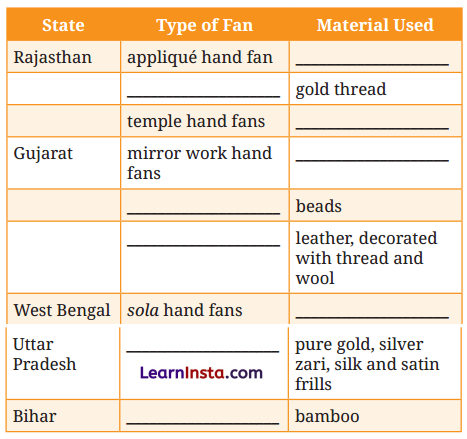
I. Work in pairs to complete the table on pankha. Share your answers with your classmates and teacher.
Answer:
| State | Type of Fan | Material Used |
| Rajasthan | appliqué hand fan | pieces of fabric sewn onto another cloth |
| Rajasthan | zardozi hand fan | gold thread |
| Rajasthan | temple hand fans | engraved on brass |
| Gujarat | mirror work hand fans | cotton based embellished with mirrors |
| Gujarat | Beads hand fans | beads |
| Kutch (Gujarat) | Leather hand fans | leather, decorated with thread and wool |
| West Bengal | sola hand fans | milky white spongy centre of sola |
| Uttar Pradesh | phadh hand fans | Pure gold, silver zari, silk and satin frills |
| Bihar | bamboo hand fans | bamboo |
Critical Reflection (NCERT Pages 74-76)
I. Read the extracts given below and answer the questions that follow.
Extract 1
Over time, pankhas became significant cultural goods distributed through trade routes. They were considered exotic and stylish. Although there was substantial commonality in their use across India, different villages and towns developed their own varieties of traditional pankhas. Each place developed pankhas with distinct materials and elaborate designs, which set them apart from one another.
(i) State whether the following sentences are true or false. Pankhas were one of the most popular items of commerce.
Answer:
True
(ii) Why has the word ‘traditional’ been used to describe pankhas?
Answer:
The word ‘traditional’ has been used because pankhas have been used in India for a long time. Each region developed its own distinctive styles, materials and designs. These features were passed down through generations.

(iii) Complete the following statement.
The sentence ‘They were considered exotic and stylish’ is an opinion and not a fact because _______ .
Answer:
The statement expresses a personal judgement and cannot be objectively proved
(iv) Infer one reason for commonality in the use of pankhas across India.
Answer:
Pankhas were commonly used across India because they served the same basic purpose of providing air and comfort in everyday life, temples and royal courts.
(v) Select which one of the two statements is the correct assertion for the given reason.
Reason: Pankhas were made of indigenous materials, unique to the region, with elaborate designs.
A. Each kind of pankha could be distinguished from the other.
B. Pankhas were used by many people.
Answer:
A. Each kind of pankha could be distinguished from the other.
Extract 2
With time and the advent of technology and innovative creations, the beautiful culture of pankhas runs the risk of slowly losing its presence among IndiAnswer: Once made for personal use, over time this handicraft has transformed into a commercial business and now provides some form of livelihood to India’s artisAnswer: The slight increase in popularity and demand is significantly factored by the different versions of the pankha being crafted.
(i) Infer one negative impact of technological advancement on pankhas.
Answer:
Technological advancement has reduced the everyday use of pankhas, causing them to slowly lose their presence in daily Indian life.
(ii) Complete the statement with an appropriate reason.
The writer refers to ‘pankhas’ not just as an object but as a ‘culture’ because _______.
Answer:
They represent traditional skills, regional identity, rituals, and the livelihood of artisans passed down through generations.
(iii) Select a line from the extract which depicts how the role of the pankha has changed over the years.
Answer:
“Once made for personal use, over time this handicraft has transformed into a commercial business.”
(iv) List one way in which the increase in demand for pankhas might benefit artisans.
Answer:
The increase in demand for pankhas benefits artisans by providing them with a regular source of income.
(v) Select the factor that has contributed to the commercialisation of pankhas.
A. Cultural preservation
B. Economic demand
C. Technological
D. Artisan initiative
Answer:
B. Economic demand
II. Answer the following questions.
Question 1.
How does the title ‘Winds of Change’ capture the essence of the chapter?
Answer:
The title ‘Winds of Change’ reflects the literal function of pankhas, which create wind. It also highlights the changing role of pankhas over time. They have shifted from essential everyday and ritual objects to decorative and commercial craft items in modern India.
Question 2.
Support the following statement with any two relevant examples from the chapter.
‘The structure and design of pankhas are testimony to the cultural identity of the region’.
Answer:
Rajasthan’s applique and zardozi fans are made using gold thread and ornamental needlework. Bengal’s sola pankhas are made from the spongy sola plant and are delicate household items. In conclusion, Rajasthan reflects economic sustainability and showcases royalty through its crafts, whereas Bengal highlights its skill in the sustainable use of natural resources by employing sola plants. Hence, the structure and design of pankhas are a testimony to the cultural identity of the region, as each area uses locally available materials that reflect its traditions.
Question 3.
The chapter mentions pankhas running the risk of slowly losing their presence in India. Evaluate how the balance between preserving traditional craftsmanship and incorporating innovative designs in the creation of pankhas will help in this regard.
Answer:
Balancing traditional craftsmanship with innovative designs can help prevent pankhas from losing their presence among Indians. This balance keeps the craft relevant to changing tastes.
Preserving traditional materials, techniques, and regional styles maintains their cultural value. At the same time, innovative designs increase appeal and demand. This supports artisans’ livelihoods and helps ensure the craft continues to survive.
Question 4.
How might initiatives such as pankha-making workshops contribute to the preservation of this traditional craft?
Answer:
Initiatives such as pankha-making workshops contribute to the preservation of this traditional craft by spreading awareness about the cultural value of pankhas.
They provide artisans with platforms to demonstrate their skills, encourage learning and appreciation, and help ensure the continued practice of the craft.
Question 5.
The writer mentions celebrating pankhas in the concluding part of the chapter. Assess how this could be beneficial to artisans and the craft.
Answer:
Celebrating pankhas can be beneficial to both artisans and the craft by highlighting their cultural value and fine craftsmanship.
It allows artisans to showcase their skills, increases public awareness and demand, provides commercial opportunities, and supports sustainable livelihoods, thereby helping to preserve the traditional craft.
Question 6.
How does the restriction of the use of pankha for decorative purposes reflect the changing cultural role of these traditional fans in modern India?
Answer:
The restriction of pankhas to decorative purposes reflects a change in their cultural role in modern India. Earlier used for practical cooling in daily life, temples, and royal courts, pankhas have now become symbolic and aesthetic objects due to technological advancements reducing their everyday utility.
Vocabulary and Structures in Context (NCERT Pages 76-79)
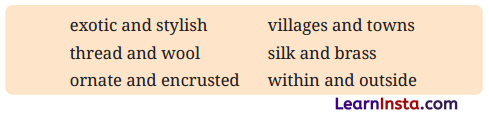
I. Read the following pairs of words from the text.
Question 1.
Classify the pairs of words given above in the following categories. One example has been done for you.

Now, find more such word pairs from the text and share them with your classmates and teacher.
Answer:
| Appearance | Place | Material |
| exotic and stylish | within and outside | thread and wool |
| ornate and encrusted | villages and towns | silk and brass |
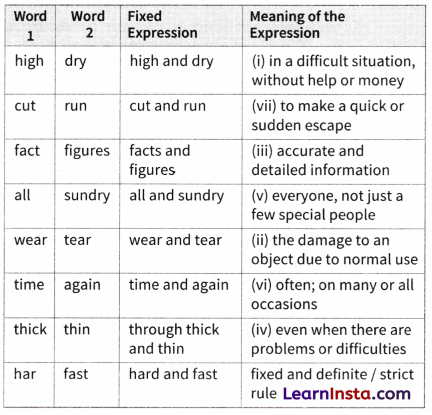
II. Find the word pairs for the following fixed expressions.
Write the meanings of these expressions by selecting them from the box given below. One example has been done for you.
Some common expressions with ‘and’ have a fixed order which cannot be changed. The shorter expression comes first. For example, bread and butter (*not butter and bread)

Now, match the fixed expressions with their meanings.
(i) in a difficult situation, without help or money
(ii) the damage to an object due to normal use
(iii) accurate and detailed information
(iv) even when there are problems or difficulties
(v) everyone, not just a few special people
(vi) often; on many or all occasions
(vii) to make a quick or sudden escape
Answer:
III. Read the following word combinations from the text.
sustainable livelihood – aesthetically pleasing
appreciating the culture
The given phrases are conventional combinations, just like fixed expressions. Such combinations are called collocations.
Question 1.
Choose the appropriate word collocations for the following sentences.
(i) The students have to (take/give) the English exam tomorrow.
Answer: take
(ii) The interviewer asked the candidate to (take/have) a seat.
Answer: take
(iii) My scooter (dashed against/ran into) a car.
Answer: ran into
(iv) I must (take/own) responsibility for my success.
Answer:take
(v) I would like to (tone up/improve) my grammar.
Answer: improve
IV. Read the following sentences. Underline the verbs.
1. In modern times, pankhas have become traditional craft items in India.
2. Gujarat’s industrious home-based women workers have worked tirelessly in the handicraft of pankha-making.
3. Many tribes in India have adopted this handicraft.
4. Once made for personal use, this handicraft has transformed into a commercial business.
Answer:
1. In modern times, pankhas have become traditional craft items in India.
2. Gujarat’s industrious home-based women workers have worked tirelessly in the handicraft of pankha-making.
3. Many tribes in India have adopted this handicraft.
4. Once made for personal use, this handicraft has transformed into a commercial business.
The underlined verbs refer to the past, but have relevance to the current or present time. This form of tense is called the present perfect tense. Recently completed actions also take the present perfect form of tense.
Now, fill in the blanks with the present perfect form of verbs in the following paragraph. One example has been done for you.
Puppets have long fascinated (fascinate) audiences worldwide. Puppeteers (i) _______ (create) intricate characters and captivating stories with their skillful artistry. They (ii) _______ (master) the delicate movements that bring these lifeless figures to life, entertaining both children and adults. Over the years, puppetry (iii) _______ (evolve), using modern technology while preserving traditional techniques. Many puppeteers (iv) _______ (pass) down their craft through generations, ensuring its continuity. They (v) _______ (perform) in theatres, on television, and at festivals, conveying important cultural narratives.
Answer:
(i) have created
(ii) have mastered
(iii) has evolved
(iv) have passed
(v) have performed
Writing Task (NCERT Page 80)
I. Describe an artefact you have made in your craft class or learnt from someone.
Begin with collection and organisation of the facts with the help of the pointers given above. Do not include your opinion in the factual description.
Answer:
In my craft class, I made a hand fan using simple materials.
First, I collected the required materials such as cardboard, coloured paper, glue, scissors, and wooden sticks. I cut the cardboard into a semi-circular shape. Then, I pasted coloured paper on it neatly.
After that, I fixed two wooden sticks at the sides to make a handle. I decorated the fan using simple patterns and colours. I allowed it to dry properly.
The hand fan is light in weight and easy to use. It can be used for cooling and also as a decorative item. The artefact shows simple craft skills and careful work.
Learning Beyond the Text (NCERT Pages 80-82)
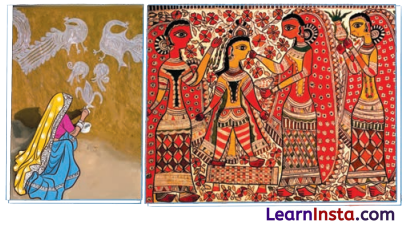
I. Identify any art or craft item from your region and make a presentation describing its features, materials, and process involved in making it, its usage, etc. You may refer to the points given on the next page.
- Name of the object and its physical characteristics – appearance, shape, size, colour, etc.
- What is it made up of?
- Which region does it belong to? How has it been used traditionally?
- Is there an origin story associated with it? How has it evolved?
- How can it be used effectively and safely in today’s time?
Answer:
Name of the Craft Item: The craft item is the Sola Hand Fan (Tal Patar Pankha).
Physical Characteristics
- The sola hand fan is light in weight and easy to carry.
- It is usually white or cream in colour.
- The fan is flat and round or semi-circular in shape.
- It is medium in size and can be held easily by hand.
Materials Used
- The fan is made from the milky-white soft centre of the sola plant.
- Sometimes thin bamboo sticks are used to give support.
Region and Traditional Use
- This hand fan belongs to West Bengal.
- Traditionally, it has been used in homes for cooling.
- People also keep it as a household item because it is light and useful.
Origin and Evolution
- The sola hand fan has been made in Bengal for many years.
- Earlier, it was used only for daily cooling.
- Over time, it has also become a decorative and craft item.
Use in Today’s Time
- Today, the sola hand fan is used for light cooling.
- It is also used as a decorative craft item.
- It can be used safely by keeping it dry and handling it carefully.
II. You can also make your own hand fan. Take ideas from the pictures given in your NCERT Textbook on page no. 81 and in groups of four, make your own hand fan. Display the hand fans in the class and describe the process used to make it.
Answer:
Do it yourself.
III. You must have read stories about the impact of art, painting, etc. in your life, in English and in your own languages. Now, read and enjoy the story given in your NCERT Textbook on page no. 82.
Answer:
Do it yourself.