These Our Wondrous World Class 5 Worksheet and Class 5 EVS Chapter 1 Water The Essence of Life Worksheet with Answers Pdf are excellent for board exam practice.
Water The Essence of Life Class 5 EVS Worksheet Chapter 1
Class 5 EVS Water The Essence of Life Worksheet
Class 5 EVS Chapter 1 Worksheet – Class 5 Water The Essence of Life Worksheet
This chapter introduces students to the various forms and sources of water, like freshwater and saltwater. Importance of water for various activities in our society is also highlighted in this chapter. Students learn how water changes its form and moves continuously in nature through the water cycle. The chapter also explores how water shapes the land, supports life in freshwater habitats, and highlights the importance of using water wisely and conserving it for the future.
Multiple Choice Questions
Question 1.
Which of the following is NOT a freshwater source?
a. Pond
b. River
c. Groundwater
d. Ocean
Question 2.
What help in recharging groundwater?
a. Cement roads
b. ‘Soak pits
c. Concrete buildings
d. Parking areas
Question 3.
Which of the following is NOT a form of water?
a. Ice
b. Steam
c. Sand
d. Rain
Question 4.
Which body part helps fish swim in water?
a. Wings
b. Beak
c. Fins
d. Paws
Question 5.
What happens when water is heated?
a. It freezes.
b. It turns into vapour,
c. It becomes salty.
d. It disappears forever.

Question 6.
Which river ends up in the marshy lands of the Rann of Kutch?
a. Ganga
b. Krishna
c. Brahmaputra
d. Luni
Question 7.
Which one is an example of a rooted floating plant?
a. Lotus
b. Reeds
c. Water Hyacinth
d. Algae
Question 8.
If you pour mustard seeds from the top of a sloped paper, what will most likely happen?
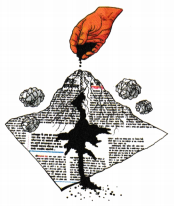
a. Seeds stay at the top
b. Seeds flow down the folds, gather in low areas
c. Seeds jump off the paper
d. Seeds disappear
Question 9.
What would likely happen if it did not rain for two years in your region?
a. No change will occur
b. Water shortage, affecting people, plants, and animals
c. Only cities will be affected
d. Only factories will stop working
Question 10.
Which of the following actions helps in water conservation?
a. Fixing leaking taps at home
b. Taking long showers
c. Using collected rainwater for gardening
d. Both (a) and (c)
Question 11.
Read the statements given below and choose the correct option.
Statement I: Rivers usually start in the mountains and flow down across the land.
Statement II: All rivers in India flow into the Arabian Sea.
a. Statement I is true.
b. Statement II is true.
c. Both statements I and II are true.
d. Both statements I and II are false.
Fill in the blanks.
1. _______ is a fast-growing plant that floats and spreads on water.
2. Most of the water on Earth is _______ and cannot be used for drinking.
3. _______ are the flatlands in Gujarat where salt is collected.
4. The Sun’s heat changes water into _______.
5. The continuous movement of water in nature is called _______.
6. The plants that float freely on the water surface are called _______ plants.
7. When water vapour cools down, it changes into _______.
8. A low, flat area between mountains, often with a river flowing through it, is called _______.
State True (T) or False (F).
1. All living beings depend on freshwater to survive.
2. Water is found only in liquid form in nature.
3. The Sun plays no role in the water cycle.
4. Rivers only flow in straight lines.
5. Reeds are plants that grow along the edges of water bodies.
6. Plants like water lilies have floating leaves and rooted stems.
7. Groundwater is recharged better when land is open and not cemented.
Match the Following
Match the images in column 1 with their correct description in column II and also write the names of the animals in the given space.

Unscramble the letters with the help of the given hints.
1. DANPHUPM ______________
A device used to draw groundwater.
2. ARTEW RAVUOP _______
It forms the clouds.
3. WSON _______
The solid form of water.
4. S F H I _______
It swims with its fins and lives in water.
5. E R V R I _______
It flows from the mountains and carries freshwater.
6. E C I P A C _______
A thick layer of ice covering the polar regions.
7. S E D E R T _______
A dry, arid region with very little rainfall.
8. . G C A I R E L _______
A slow-moving mass of ice.
Look at the picture and answer the following questions.

Question 1.
What do you see in the picture?
Answer:
____________________________
Question 2.
Which animal is eaten by an otter?
Answer:
____________________________
Question 3.
Who eats the otter in this food chain?
Answer:
____________________________
Question 4.
What might happen if all the small fish disappeared?
Answer:
____________________________
Question 5.
Which animal in the picture is at the top of the food chain?
Answer:
____________________________
Read the paragraph and answer the following questions.
Aman noticed that after heavy rain, the school’s cemented playground had puddles of water for many hours, while the garden area dried quickly. His teacher explained that the garden helps water seep into the ground, but the cement does not.
Question 1.
What happens to rainwater in the garden area after rainfall?
a. It forms water vapour immediately.
b. It seeps into the ground through the soil.
c. It forms puddles.
d. It flows away without soaking in.
Question 2.
What can be done to help rainwater seep into the ground in cities?
a. Cover all open areas with cement
b. Remove trees from open areas
c. Use more water for cleaning streets
d. Create more gardens, soak pits, and open soil patches
Answer the following questions.
Question 1.
Name the three forms of water.
Answer:
____________________________
Question 2.
Why can we not drink ocean water?
Answer:
____________________________
Question 3.
Name two rivers that flow towards the Arabian Sea.
Answer:
____________________________
Question 4.
What are the main sources of freshwater?
Answer:
____________________________
Question 5.
Why is freshwater important to us?
Answer:
____________________________
Question 6.
What is groundwater, and how is it formed?
Answer:
____________________________
Question 7.
Why is it important to have open and uncovered areas in cities?
Answer:
____________________________
Learn With Fun
Read the following story and choose the most appropriate options. Provide a suitable title of your choice for the paragraph and rewrite the paragraph in the provided space.
One morning, Mira went to the garden to water her favourite plant/ animal. She poured some oil/water on it and noticed something interesting. The water stayed on the stem/leaf and did not soak in. She saw tiny water droplets/marks sitting on top of the leaf like little beads. Mira was surprised. Her mom explained, “Leaves have a waxy/soft coating. This makes it waterproof/leaky. It further helps protect them and keeps too much water from getting outside/inside the plant.” Now, Mira knows why the water stayed on the leaf. It helps keep the plant muddy/healthy.
_________________________________________________
_________________________________________________
_________________________________________________
_________________________________________________
Look at pictures of animals and write their names in the correct columns. Also, write one feature of each of them in the space given below.

| Animals on Land | Animals in Water |
Observe the map of India and write the names of the rivers. Also, segregate them in the box given below based on the direction of their flow.

Identify the changes in the forms of water and write your observations. Also, give one real-life example for each change. (One example has been done for you)

Identify the images and write the names of different sources of water in the space given below.

Draw a colourful diagram of the water cycle with labelling in the space provided.

Word Puzzle
Find ten words related to this chapter in the given word search puzzle.
