Students prefer Class 5 English Santoor Solutions Unit 5 Work is Worship Chapter 9 Vocation Class 5 Questions and Answers that are written in simple and clear language.
Class 5 English Chapter 9 Vocation Question Answer
Class 5 English Vocation Question Answer
Class 5 Vocation Questions and Answers
Let us Think (Page 108)
A. Answer the following questions.
Question 1.
Who is the speaker in the poem?
Answer:
A little school going boy is the speaker of the poem.
Question 2.
Why does the speaker want to be a hawker?
Answer:
The speaker wants to be a hawker because the life of the hawker seems pretty exciting and full of freedom to him. The hawker is not bounded by time, has no school to attend and no one to scold him for not coming back home on time.
Question 3.
What does he like about the gardener?
Answer:
He likes the freedom of the gardener. The gardener can do what he enjoys and no one will stop him.
Question 4.
What does the speaker compare the street lamp to?
Answer:
The speaker compares the street lamp with a giant who had one red eye on its head.

Question 5.
On the basis of the poem that you have read, share the daily schedule of the speaker.
Answer:
According to the poem we have read, the speaker seems to be a very punctual lad. He goes to school every day at 10 a.m. and returns from school at 4 p.m. in the afternoon. In the evening he finishes his homework, plays, has his dinner and then his mother sends him to bed on time.
B. Think and discuss.
Question 1.
Why does the speaker admire people with different vocations?
Answer:
In the poem, the speaker follows a particular routine and has fix time to do almost everything. When he sees people with different vocations and observes that they have a great amount of freedom in their lives, it leaves the speaker amazed. He likes how the hawker, gardener, and watchman are free to do whatever they like and however they like.
Question 2.
What are the things that you observe on your way to school and your way back home?
Answer:
(Suggestive answer) On my way back home, I see my other friends from my society playing in the compound. I notice several local vendors selling street food like golgappe and bhelpuri in front of our society, and I see older people heading to the park for exercise and yoga.
Let us Learn (Pages 109-111)
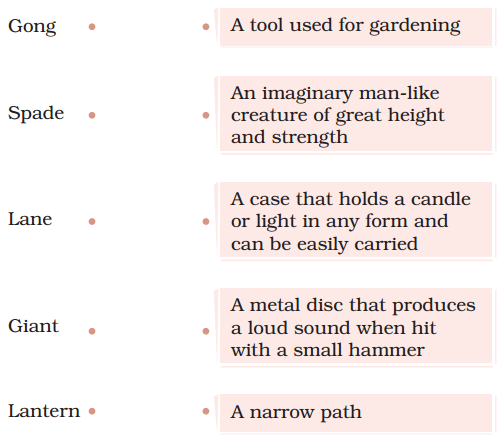
A. Here are some of the words from Vocation. Read the poem and match each word with its meaning.
Answer:
| Gong | A metal disc that produces a loud sound when hit with a small hammer |
| Spade | A tool used for gardening |
| Lane | A narrow path |
| Giant | An imaginary man-like creature of great height and strength |
| Lantern | A case that holds a candle or light in any form and can be easily carried |
B. There is one mistake in each sentence given below. Underline the mistakes and rewrite the correct sentences in the given space. One example has been done for you.
1. I has recently read a new book.
Answer:
I have recently read a new hook.
2. The speaker goes for school at ten in the morning.
Answer:
The speaker goes to school at ten in the morning.
3. The fox ran fast than the others.
Answer:
The fox ran faster than the others.
4. Mita was slept when the doorbell rang.
Answer:
Mita was sleeping when the doorbell rang.
5. The old elephant walked slow to the river.
Answer:
The old elephant walked slowly to the river.
6. Radhika is tall than Suman.
Answer:
Radhika is taller than Suman.
7. Sudhanshu ran faster of all the runners.
Answer:
Sudhanshu ran faster than all the runners.
8. My mother are cooking.
Answer:
My mother is cooking.
9. He go to school everyday.
Answer:
He goes to school everyday.
10. The birds is flying.
Answer:
The birds are flying.
C. Look at the pictures and read the words written under them.

Have you seen these objects? Where have you seen them? What are they used for?
Answer:
Yes, I have seen these objects at different places:
Telescope: I have seen it in the National Science Museum, New Delhi. The assistant working there, told me it is used to observe planets and stars etc.
Hammer: I have seen it in the emergency toolkit box in my house. It is used to drive screws in wall or wooden furniture.
Camera: I have seen it in many weddings functions. Photographers use it to click pictures or record videos.
Screwdriver: I have seen it on an electronics shop. It is used to tighten or loosen the screws.
Sickle: I have seen it with gardeners or grass cutting women. It is used to cut crops and grass in the fields.
Stethoscope: I have seen it at my family doctor’s clinic. It is used to check on the patient’s heartbeat.
Grater: We have it in our kitchen. It is used to grate ginger, carrot, or cheese etc.
Tongs: I have seen them in my kitchen. They are used to hold hot things like chapatis.
Compass: I have seen it in a geometry box. It is used to draw circles.
Mouse: I have seen it in my school’s computer lab. It is used to move the pointer (curser) or click on the icons in the computer.
Saw: I have seen it with a carpenter. It is used to cut wooden blocks to shape them into a useful furniture.
Let us Listen (Pages 112-113)
- Sit in groups of five.
- Each group will discuss and create two questions on the poem Vocation using the question words from the WH-family. Note down the questions.
- Now, put your textbooks back in your bags,
- Each group will get to share their questions with the class.
One group will present their questions, and the remaining groups will answer the questions. This will continue till all the groups have shared their questions.
Answer:
Students to do it themselves with the help of their teacher.
Let us Speak (Page 112)
A. Listen and repeat
Your teacher will say aloud the following words. Listen carefully and repeat after the teacher.

Answer:
Students to do it themselves in the guidance of their teacher.
B. Listen and speak
The speaker of the poem wants to do many things.
- Think of a time when you wanted to do many things but could not.
- What were the things you wanted to do?
- What difficulties did you face in doing many things at once?
- How did it make you feel?
- Share your views with your classmates.
Answer:
(Suggestive answers)
- In the start of my summer vacations this year, I made a whole list of things I wanted to do or learn.
- I wanted to throw a snack party, invite all my cousins and play so many fun games. I planned to excel doodling, adding atleast hundred words to my vocabulary, play outdoor games almost everyday and finish my holiday homework on time.
- I could not manage the time properly for doing everything I planned. I spent most of time playing outside or watching cartoon.
- I felt very sad and frustrated as I wanted to do all the things I planned. I wish I could manage my time more actively.
- Next time when I plan my vacations, I will be more careful and finish important works like my homework first.
Let us Write (Page 114)
Question 1.
What’s missing?
The child sees only the fun part of each job. What do you think might be the difficult or boring part of being a hawker, a gardener or a watchman?
Write a paragraph to express your thoughts.
Answer:
In the poem, the child notices only freedom and excitement in the lives of the hawker, gardener, and watchman instead of their needs to work hard everyday in the sun or in the rain. The hawker works so hard, walking miles everyday still he makes very less money to fulfill his responsibilities and basic needs. Taking care of each plant in garden and keeping the grass in perfect shape must be very difficult for the gardener. Who does not want to sleep peacefully in night? Staying awake and roaming on the streets lonely must be very tough and boring for the watchman. The child skipped all these parts in the poem.
Question 2.
In the poem, the speaker tells us about the vocations of different people. Write the vocations of any three of your family members, in 50-60 words each, from the list below.

Answer:
(Suggestive answer)
My Mother: My mother is a forty-five-year-old, intelligent and strong woman. She started a small business during Covid-19. She runs a cloud kitchen. She cooks very delicious food and works very hard in the kitchen everyday. She helps me with my homework later. No doubt she is a superwoman, and I am so proud of her.
My Uncle: He is married and have two kids who are my age. He owns an electronic shop where he sells and repairs all types of electronic items. He is very responsible. He goes to his shop every single day, even on Sundays. He wakes up early in the morning around 5 a.m., helps my aunty prepare breakfast, packs his own and then leaves for work. Thanks to him, we have every machine working perfectly in our house.
My Aunt: She is a teacher. She goes to school every day and teaches EVS to Grade 1st to 5th children. She helps them understand topics easily and learn good manners. She works hard to make learning fun for her students. At home, she helps my cousins with their doubts in study. I am proud of her because she teaches many children with love and care.
Question 3.
What vocations are the following people associated with?
- A.P. J. Abdul Kalam
- M. Visvesvaraya
- Janaki Ammal
- M.S. Subbulakshmi
- Salim Ali
Answer:
- A.P.J. Abdul Kalam – Aerospace Scientist (Agni, Prithvi Missile)
- M. Visvesvaraya – Engineer (Krishna Raja Sagara Dam)
- Janaki Ammal – Botanist (Chromosome Studies)
- M.S. Subbulakshmi – Carnatic Classical Singer
- Salim Ali – Bird Scientist
Let us Do (Page 115)
Job Mix-Up!
A. There is something unusual in the given pictures. Notice carefully the things that you find strange. One has been done for you.

For example: A chef’s job is to cook delicious meals, not to drive a fire engine. That’s something firefighters do.
Write two sentences in your notebookfor each picture, following the example provided for you.
Answer:
2. A doctor’s job is to treat sick people, not to manage the traffic. That’s something traffic police officers do.
3. A policewoman is treating the boy. Her job is to ensure safety of everyone in society and make sure people follow law and order, not to treat children. That’s something a doctor does.
4. A lawyer is cutting wood, probably to shape it into some furniture. This is not part of his profession. It is supposed to be done by a carpenter.
5. A miner’s job is to dig out the minerals from the earth, not to teach kids in the classroom. That’s something teachers do.
6. An engineer is making boots which is actually done by a shoemaker. An engineer’s job is to build infrastructure, not to mend or make new shoes.
Let us Explore (Pages 116-118)
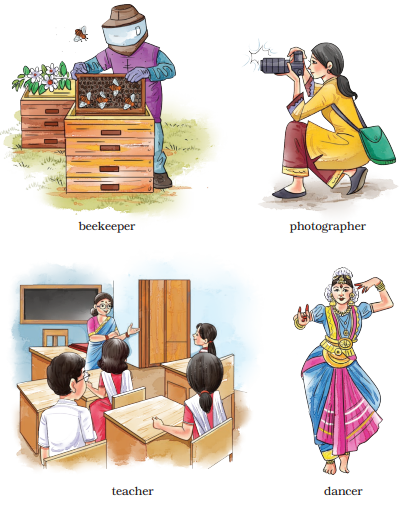

A. Which vocation from the above illustrations would you choose for yourself? And why?
Answer:
(Suggestive answer) If we talk about the vocations illustrated above, I would like to be a photographer because I enjoy capturing monuments, insects, animals, and many other interesting things.
B. Is there any other vocation not shown in the pictures that you would like to take up as your dream job? Support your answer with a reason.
Answer:
(Suggestive answer) I would like to become a doctor even though it is not illustrated in the pictures above, because I always wanted to serve people who are sick and need treatment. I see it as a very important vocation because having the ability to treat people when they are unwell is a true virtue.
C. Draw yourself in the selected vocation in the blank space provided.
Answer: