Students can use Kaveri Book Class 9 Solutions and Class 9 English Book Kaveri Chapter 4 Question Answer Vitamin M as a quick reference guide.
Vitamin M Class 9 Question Answer
Class 9 English Kaveri Chapter 4 Question Answer
Kaveri Book Class 9 Chapter 4 Vitamin M Question Answer
Reflect and Respond (NCERT Pages 97-98)
I. From your experience with an elderly person at home or in your neighbourhood, complete the following graphic organiser.
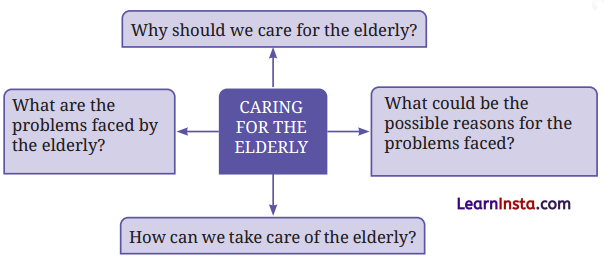
Now, discuss the points written in the organiser with your classmates and teacher.
Answer:
- We should care for the elderly because they cared for us when we were young. They have valuable life experience and need love and support to feel respected and happy.
- Elderly people face physical weakness, health issues, and memory problems. They often feel lonely and uncomfortable, especially in busy city life.
- Elderly people often face problems because of poor health, financial struggles and social isolation. Many also feel neglected or dependent on others for daily needs, which adds to their difficulties.
- We can take care of the elderly by spending time with them, helping in daily activities, and speaking politely. Respecting their feelings and choices, making them feel valued.
II. Fill in the table given below. You may check your answers with the help of a dictionary.
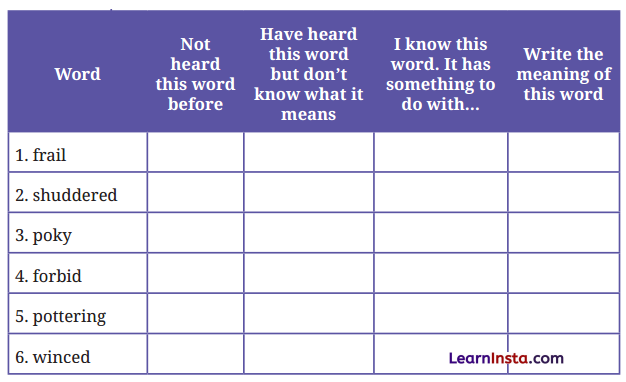
Answer:
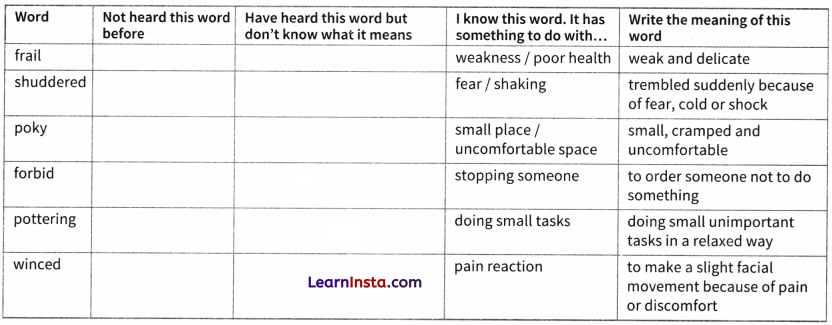
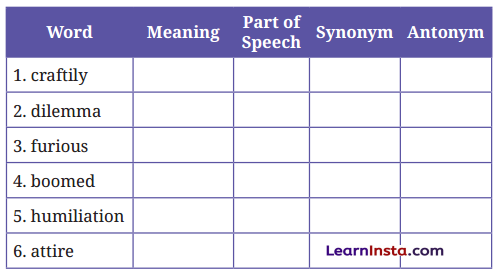
[Students should complete the remaining columns on their own based on their familiarity with each word before checking the meanings in a dictionary.]
III. Think of a tradition, story, or recipe passed down by grandparents or an elderly relative in your family. What does it mean to you? How does it connect you to your growing-up years? Share with your classmates and teacher.
Answer:
One tradition passed down by my grandparents is listening to bedtime stories about their childhood and values like honesty and kindness. These stories make me feel close to them and help me understand how life was simpler earlier. They connect me to my growing-up years and teach lessons that are still important today.
Check Your Understanding (NCERT Page 102)
I. Why did Grandpa dislike living in the city with his daughter?
Answer:
Grandpa disliked living in the city because it was noisy, crowded, and uncomfortable. The small house made him feel confined and he missed the freedom and peace of his village life.

II. Why did Vidya not want her father to go out alone?
Answer:
Vidhya did not want her father to go out alone because he had become old and forgetful. He had taken a double dose of medicine and once got lost during a walk. She feared he might get hurt or be unable to find his way back home safely.
III. Was Ravi in favour of his mother treating Grandpa like a child? How can you say so?
Answer:
No, Ravi was not in favour of his mother treating Grandpa like a child. He winced at the over-loud tone she used while speaking to him, as though he could not hear or understand properly. This showed Ravi’s discomfort.
IV. Would Ravi be able to keep up his promise to his mother?
Answer:
Ravi tried to keep his promise but could not do so completely. He allowed Grandpa to go out alone because he did not want to hurt his feelings. Instead, he secretly followed him to ensure his safety, balancing responsibility and respect for Grandpa’s independence.
Check Your Understanding (NCERT Pages 106 & 107)
I. Complete the flow chart by describing Grandpa’s day out.
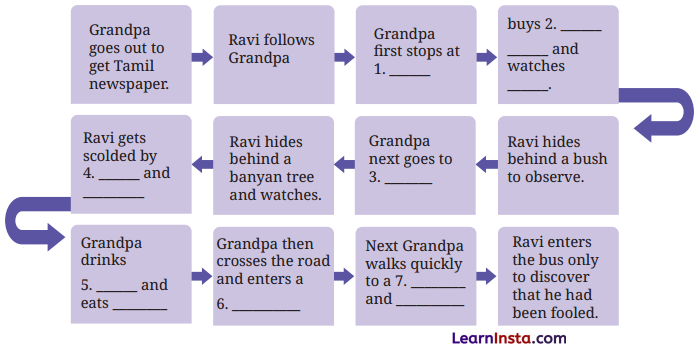
Answer:
1. children’s park.
2. peanuts; children play
3. tea stall
4. a child’s mother; the vendors
5. sugary tea; bananas and ice cream
6. barber shop
7. bus stop; boards a bus
II. Was Grandpa lost as feared by Ravi’s mother?
Answer:
No, Grandpa didn’t get lost as Ravi’s mother feared. Instead, he returned safely and went to sleep.
III. How would Ravi feel after seeing Grandpa?
Answer:
Ravi would feel relieved, happy, and slightly embarrassed after seeing Grandpa safely at home.
IV. Do you think Ravi’s mother will get to know about what had happened?
Answer:
Ravi’s mother will probably not know because Ravi keeps the secret and Grandpa hides the truth playfully.
Check Your Understanding (NCERT Page 109)
I. Describe how Ravi’s emotional reaction upon finding Grandpa safe at home reveals his feelings towards his grandfather.
Answer:
Ravi feels immense relief and affection when he finds Grandpa safe at home. He hugs him gently and notices his familiar smell and wrinkled face. This emotional reaction shows Ravi deeply loves and cares for his grandfather and had been genuinely worried about his safety.
II. What might be the significance of Grandpa’s habit of giving gifts to everyone on his birthday rather than receiving them?
Answer:
Grandpa’s habit of giving gifts on his birthday shows his generous and loving nature. Instead of expecting attention, he enjoys making others happy. It also shows he still considers his children as his ‘babies’, highlighting his caring personality and the joy he finds in giving rather than receiving.
III. Why do you think Grandpa gave Ravi a detective story book as a gift? What might this suggest about Grandpa’s awareness of Ravi’s actions earlier in the day?
Answer:
Grandpa gave Ravi a detective story book because he was aware that Ravi had secretly followed him throughout the day. By choosing this gift, Grandpa indirectly acknowledged Ravi’s cleverness and concern. It suggests that Grandpa was fully aware of Ravi’s actions and appreciated his care, while calmly showing that his own mind was still sharp.
Critical Reflection (NCERT Pages 109-111)
I. Read the extracts given below and answer the questions that follow.
Extract 1
Grandpa hated the noise and bustle of city life, and when they were on their own, he often spoke longingly of his small brick house in town. “Such a wonderful place…! With that big mango tree in the garden! It is so quiet that at dusk you can even hear a leaf fall!” But then Grandpa had slipped and fallen in the garden late one evening while he was pottering around and lay outside all night because there was no one at home to help him up.
(i) Choose the emotion displayed by the Grandfather.
A. regretful
B. apologetic
C. nostalgic
D. wistful
Answer:
C. nostalgic
(ii) Complete the following sentence with a reason.
Grandpa hated the busy and noisy city life because ________ .
Answer:
He preferred the quiet and peaceful surroundings of his small house and garden in town
(iii) Why did Grandpa come to the city despite his dislike for city life?
Answer:
Grandpa came to the city because his daughter was deeply worried about his safety after his accident and wanted to take proper care of him.
(iv) Choose an expression similar in meaning to “you can even hear a leaf fall”.
A. end of one’s life
B. arrival of autumn
C. sign of good luck
D. pin-drop silence
Answer:
D. pin drop silence
(v) State one advantage and one disadvantage of living in the city.
Answer:
Living in a city affects people’s daily life in many ways.
Advantage: Better medical facilities and services.
Disadvantage: Noise and crowded surroundings.
Extract 2
“I had a quiet morning, but I don’t know about Ravi. He just disappeared instead of staying at home to look after me like you told him to,” answered Grandpa coolly, while Ravi just looked confused and embarrassed. Grandpa had another surprise for Ravi. A gift-wrapped parcel!
“But, Papa, Ravi’s birthday was three months ago. Have you forgotten?” exclaimed Ravi’s mother, impatiently.
(i) Choose the option that displays the tone of the Grandfather’s response.
A. apologetic
B. hurtful
C. calm
D. puzzled
Answer:
C. calm
(ii) Why was Ravi confused and embarrassed?
Answer:
Ravi was confused and embarrassed because Grandpa told his mother that Ravi had disappeared instead of looking after him, while Ravi knew he had secretly followed Grandpa and did not want the truth to come out.
(iii) Complete the sentence with a suitable reason.
Ravi’s mother was impatient because ________.
Answer:
She thought Grandpa had forgotten Ravi’s birthday
(iv) State whether the following sentence is true or false.
Grandfather forgot that Ravi’s birthday was three months ago.
Answer:
False
(v) Why did Grandpa say he didn’t know what kind of morning Ravi might have had?
Answer:
Grandpa said this playfully because he knew Ravi had followed him and wanted to tease him without revealing the truth openly.
II. Answer the following questions.
Question 1.
Grandpa is portrayed as a person with failing memory in the beginning of the story. Give two evidences to disprove the statement.
Answer:
Grandpa is shown as forgetful at first, but later events prove his memory is still strong. The two evidences to disprove the statement are
- He clearly remembers famous chess matches and players in detail, showing sharp memory.
- He remembers his birthday and his tradition of giving gifts to everyone, proving he is not truly forgetful.
Question 2.
Give two characteristic traits of each of the following characters.
Answer:
(i) Grandfather
(a) Independent and Clever Grandpa dislikes being treated like a child and insists on going out alone. He plans his outing smartly and even tricks Ravi by giving away his cap, showing his independence and sharp, playful intelligence.
(b) Loving and Generous He celebrates his birthday by giving gifts to everyone in the house. This shows his caring nature and the happiness he finds in giving rather than receiving attention.
(ii) Ravi
(a) Responsible and Caring Ravi promises his mother to look after Grandpa and secretly follows him to ensure his safety. His worry and relief later show how deeply he cares for his grandfather.
(b) Curious and Determined Ravi behaves like a detective while following Grandpa everywhere. Despite embarrassment and difficulty, he keeps trying to track him carefully.
(iii) Ravi’s Mother
(a) Protective and Concerned She worries about her father’s safety because of his forgetfulness and past incidents. She strictly instructs Ravi not to let Grandpa go out alone.
(b) Busy but Loving Though occupied with work, she cares deeply about her father’s well-being and tries to ensure he is safe and looked after at home.
Question 3.
Why was Ravi worried about what Grandfather had at the tea stall?
Answer:
Ravi was worried because his grandfather was drinking a sugary cup of tea, though he was forbidden sugar at home.
Question 4.
Do you think it was easy for Ravi to follow his Grandfather? If yes, why? If no, why not?
Answer:
No, it was not easy for Ravi to follow his grandfather. He had to hide behind bushes, trees, cars and shops, got scolded by strangers, and even lost track of him on the bus. Grandpa cleverly tricked him, making the task difficult.
Question 5.
“Ravi is a good detective”. Give one argument in favour of and against the given statement.
Answer:
For: Ravi carefully followed Grandpa everywhere, hid at different places, and stayed alert, showing determination and observation skills. Against: Ravi was easily fooled when Grandpa tricked him by giving away his cap, proving he still lacked real detective skills.
Question 6.
Was Grandfather aware that Ravi was following him? How do you know?
Answer:
Yes, Grandfather was aware that Ravi was following him. He cleverly tricked Ravi by giving away his yellow cap and later gifted him a detective storybook, hinting that Ravi should learn better detective skills and avoid being fooled while trailing someone.
Question 7.
In your opinion, who needs Vitamin-M? And why?
Answer:
Elderly people need Vitamin M because it symbolises care, patience, emotional support, and understanding. Old age often brings memory loss and physical weakness, but what the elderly need most is love, respect, and dignity. Vitamin M represents society’s responsibility to support the elderly with compassion rather than control.
Question 8.
Some people believe society shows bias based on age (being young or old). Give an example where you might have experienced or observed such discrimination, when opinions were disregarded because of age.
Answer:
Sometimes, older people’s opinions are ignored because others think they are outdated. For example, elders may give advice based on experience, but younger people may dismiss it quickly, believing modern ideas are better. This shows age-based bias and a lack of respect for their wisdom.
Vocabulary and Structures in Context (NCERT Pages III-116)
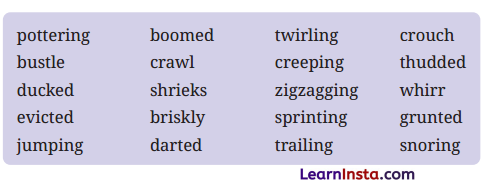
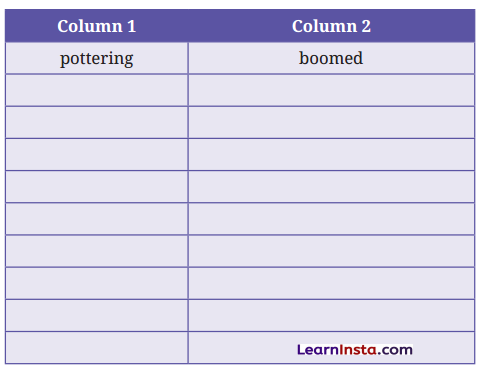
I. Classify the words given in the box on the next page into movement words in Column 1 and sound words in Column 2. One example has been done for you.
Words in the box.
Answer:
Column 1 (Movement Words) – pottering, ducked, evicted, jumping, crawl, briskly, darted, twirling, creeping, zigzagging, sprinting, trailing, crouch
Column 2 (Sound Words) – boomed, bustle, shrieks, thudded, whirr, grunted, snoring
Now, fill in the blanks with appropriate words from Column 1 or Column 2.
Detective Shankar 1. ________ the mysterious suspect through the dimly lit side lanes, away from the 2. ________ of the city, quickened his pace 3. ________ The suspect’s heavy footsteps 4. ________ across the street, unaware of the pursuit. Shankar 5. ________ his magnifying glass had to 6. ________ behind the market stalls, 7. ________ through the lanes to avoid being seen. Shankar 8. ________ when he hit himself against a pole. This alarmed the suspect and he 9. ________ into the night leaving only the distant 10. ________ of the sleeping city behind.
Answer:
1. trailed
2. bustle
3. briskly
4. thudded
5. ducked
6. crouch
7. zigzagging
8. grunted
9. sprinted
10. snoring
II. Study the highlighted word in the given sentence from the text and fill in the boxes with synonymous words. You may refer to a dictionary. Off he went, twirling his walking stick jauntily, leaving Ravi in a dilemma.

1. QU_ND _ _ Y
Answer:
QUANDARY
2. PR_D_C_M_NT
Answer:
PREDICAMENT
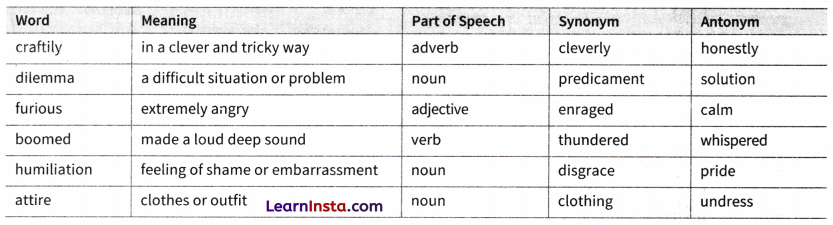
III. Fill in the table given below. Check your answers with the help of a dictionary.
Answer:
IV. Match the emotions/expressions in Column 1 with their meanings in Column 2. One meaning is extra.
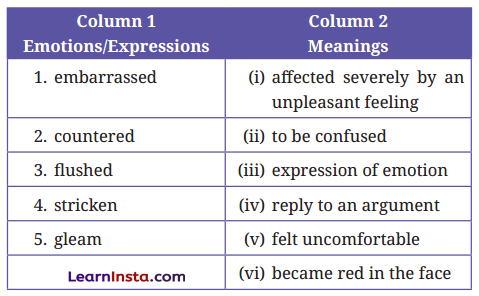
Answer:
| Column 1 | Column 2 |
| embarrassed | felt uncomfortable |
| countered | reply to an argument |
| flushed | became red in the face |
| stricken | affected severely by an unpleasant feeling |
| gleam | expression of emotion |
V. Read the highlighted words in the following phrases from the story. Now, revisit the story and underline the prepositions.
1. I’ll just walk across to the corner shop…
2. …he felt a shadow fall over him…
3. …the vendors sitting under the tree…
4. Ravi took position behind a big banyan…
Prepositions are words used to show the relationship of a noun or pronoun to other words in a sentence, often indicating direction, location, time or manner.
Now, fill in the blanks with appropriate prepositions.
I walked (i) ________ (through, between, against) the village, crossed a bridge (ii) ________ (over, under, beside) a brook, and found a quiet garden (iii) ________ (among, near, across) a cottage. Sitting on a bench (iv) ________ (on, at, in) the garden, I enjoyed the peaceful surroundings. Later, I strolled (v) ________ (beside, through, along) a riverbank, exploring the forest and heading (vi) ________ (into, towards, beyond) the unknown.
Answer:
(i) through
(ii) over
(iii) near
(iv) in
(v) along
(vi) towards
VI. Read the following dialogues from the story.
1. “Shall we play chess or watch the cricket match on TV, Grandpa?” asked Ravi.
2. “Who are you?” said the little boy’s mother.
3. “What did you both do today?” asked Ravi’s mother.
4. “Have you forgotten?” countered Grandpa.
5. A small child came up to him and asked, “Are you playing hide and seek?”
Now, choose the correct answer.
A. The words in the quotes are (i) ________ (exclamatory/interrogative) sentences.
Answer:
interrogative
B. Sentences 1, 4, and 5 are (ii) ________ (Wh-/Yes, No type) interrogative sentences.
Answer:
Yes/No type
C. Sentences 2 and 3 are (iii) ________ (Wh-/Yes, No type) interrogative sentences.
Answer:
Wh-type
So, there are (iv) ________ (two/three) types of interrogative sentences.
Answer:
two
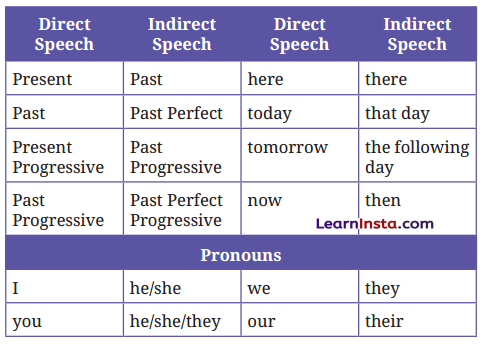
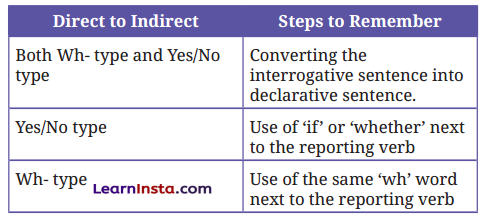
The words in quotes are the exact words of the speaker, hence known as direct speech. In indirect speech or reported speech, somebody else reports these words at some other time and at some other place.
Answer:
D. Let us have a glance at a few guidelines to remind you of the changes while transforming from direct form of speech to indirect. You can ask your teacher for more input.
VII. Read the following conversation.
ARVIND: Do you help in taking care of your grandparents at home?
PRIYA Yes, I do. We take turns making sure they’re alright. Do you have grandparents with you?
ARVIND No. My parents and I visit my grandpa every weekend. How do you manage your grandparents’ medical needs?
PRIYA We have a schedule for giving medications and visits to the doctor.
Now, complete the following sentences in reported speech.
Arvind asked Priya if she 1. ________ for which Priya replied in the affirmative and said that they 2. ________ . Priya further asked Arvind 3. ________ . Arvind replied in the negative and said that 4. ________ every weekend. He further enquired 5. ________ Priya responded by saying that they 6. ________ .
Answer:
- helped in taking care of her grandparents at home
- took turns making sure they were alright
- if he had grandparents with him
- they visited his grandpa
- how they managed their grandparents’ medical needs
- had a schedule for giving medications and visits to the doctor
Writing Task (NCERT Page 119)
I. As you read in the story, we have a lot to learn from our elderly. Based on the lessons learned from them, write an article for your school magazine on the topic ‘Our Inspiring Elderly’.
Organise the article in the manner given below.
Follow the steps given below to write an article about your skills and passions.
- Write the title at the top and your name and grade below it.
- Paragraph 1: Give a brief introduction to the topic. Focus on the main idea, but do not give any details.
- Paragraph 2: Give details to support the main idea-how the elderly inspire. Include examples, facts, and quotations.
- Paragraph 3: Elaborate on how they overcame challenges and the inspiring impact on you.
- Paragraph 4: Conclude with a final comment on the topic and leave the reader with the most important ideas to think about.
Answer:
Our Inspiring Elderly
By XYZ, Grade IX
The elderly are the pillars of our families and society. Their wisdom, life experiences, and values guide younger generations and shape our character. Spending time with them teaches us patience, gratitude, and respect, reminding us of the importance of family bonds and traditions.
Elderly people inspire us through their knowledge, discipline, and positive outlook on life. They share stories, traditions, and valuable lessons that help us make better decisions. Their kindness, generosity, and simple way of living teach us compassion, responsibility, and the importance of respecting others.
Many elderly people have faced hardships and challenges throughout their lives, yet they remain strong and hopeful. Their resilience motivates us to stay determined and face difficulties with courage. Watching them appreciate simple joys inspires us to value what we have and never give up.
Our elderly deserve love, care, and respect for everything they have done for us. By learning from their experiences and valuing their presence, we can build a kinder and more understanding society. Their wisdom continues to guide us toward a brighter and better future.