Students revise important topics using Class 8 SST Extra Questions and Class 8th SST Chapter 5 Universal Franchise and India’s Electoral System Important Extra Question Answer before exams.
Class 8 SST Chapter 5 Universal Franchise and India’s Electoral System Extra Questions
NCERT Class 8 Social Science Chapter 5 Extra Questions on Universal Franchise and India’s Electoral System
Universal Franchise and India’s Electoral System Class 8 Very Short Question Answer
Question 1.
What is the main aim of the Election Commission of India?
Answer:
The main aim of the Election Commission of India is to conduct free, fair, and impartial elections in the country.
Question 2.
Why was a youth-managed polling booth introduced in 2024?
Answer:
A youth-managed polling booth was introduced in 2024 to encourage active participation of young voters and increase electoral awareness among the youth.
Question 3.
What is home voting and who can avail it?
Answer:
Home voting is a facility provided by the Election Commission to senior citizens above 85 years and persons with disabilities, allowing them to vote from their homes.
Question 4.
How do Braille EVMs help visually impaired voters?
Answer:
Braille EVMs help visually impaired voters by enabling them to cast their votes independently through specially designed Braille keypads.

Question 5.
Name the mobile app launched by the ECI to report poll-related complaints.
Answer:
The mobile app launched by the Election Commission of India to report election-related complaints is called cVIGIL.
Question 6.
Why are political parties assigned symbols?
Answer:
Political parties are assigned symbols so that voters, especially those who are illiterate, can easily identify and vote for the party of their choice.
Question 7.
What does the Model Code of Conduct prevent during elections?
Answer:
The Model Code of Conduct prevents the misuse of government resources, hate speech, and unethical campaigning practices during elections.
Question 8.
Which two countries have adopted Indian EVM and VVPAT technology?
Answer:
The two countries that have adopted Indian EVM and VVPAT technology are Bhutan and Namibia.
Universal Franchise and India’s Electoral System Class 8 Short Question Answer
Question 1.
How does the Election Commission ensure peaceful and fair voting at polling stations?
Answer:
The Election Commission deploys security forces, monitors polling booths with observers and cameras, and sets up separate queues for women and senior citizens. It ensures that every voter can cast their vote safely and freely.
Question 2.
What are some steps taken to make elections more inclusive in India?
Answer:
India has introduced Braille EVMs, home voting, ramps at polling stations, and youth booths. These steps help ensure that people with disabilities, senior citizens, and first-time voters can participate confidently in the democratic process.
Question 3.
Why is it important for citizens to vote without pressure or bribes?
Answer:
Voting freely ensures that people choose leaders based on merit, not money or influence. When citizens vote honestly, they help build a stronger, more accountable government that truly reflects public needs and voices.
Question 4.
How are voters educated before elections in India?
Answer:
The Election Commission runs awareness campaigns through TV, radio, posters, and street plays. It educates citizens about how to vote, the importance of voting, and how to identify fake promises or illegal practices.
Question 5.
Why is the secrecy of voting considered important in a democracy?
Answer:
Secrecy protects each voter’s choice and prevents fear or influence. It ensures that people can vote for whoever they believe in without facing pressure, judgment, or consequences from others around them.
Universal Franchise and India’s Electoral System Class 8 Long Question Answer
Question 1.
Explain how elections in India have become more accessible for different sections of society.
Answer:
India has taken several steps to make elections inclusive. Facilities like Braille EVMs for the visually impaired, ramps for wheelchair users, home voting for elderly and disabled voters, and all-women polling booths ensure that every eligible citizen can vote with dignity. These efforts reflect the true spirit of democracy by including those who may have been left out earlier due to physical or social barriers.
Question 2.
What role does the Model Code of Conduct play during elections?
Answer:
The Model Code of Conduct is a set of ethical guidelines that all political parties and candidates must follow once elections are announced. It ensures that no unfair advantage is taken, public money isn’t misused, and hate speech or false proipises are avoided. This code helps maintain fairness, discipline, and public trust during the election period, reminding candidates to act responsibly and respectfully.
Question 3.
Why is it important for young voters to participate in elections, and how is this encouraged?
Answer:
Young voters bring fresh energy and perspectives to democracy. Their participation helps shape policies that concern their future-like education, jobs, and climate. To encourage them, the Election Commission organizes awareness drives, sets up youth-managed polling booths, and simplifies the voter registration process. Involving youth early helps create responsible, informed citizens who care about their rights and duties.
Question 4.
Describe the significance of VVPAT in the Indian election system.
Answer:
VVPAT (Voter Verifiable Paper Audit Trail) is a transparent tool that allows voters to verify their vote on a printed slip before it’s recorded electronically. It increases voter confidence and ensures the integrity of the election process. If there’s any doubt about the EVM results, VVPAT slips can be cross-checked. This technology shows India’s commitment to a transparent and trustworthy democracy.
Question 5.
What measures are taken to protect the secrecy of voting in India and why is it necessary?
Answer:
Secrecy is ensured by private voting compartments, sealed EVMs, and trained officers who prevent interference. No one can know whom a person votes for-not even the election staff. This privacy is necessary so that people can vote without fear, pressure, or social judgement. It protects the dignity of every citizen’s voice and is a pillar of free and fair elections in a democratic country like India.
Universal Franchise and India’s Electoral System Class 8 Source Based Questions
Question 1.
Read the below passages and answer the following questions:
Electoral officials travel to remote locations to ensure eveiy citizen can exercise their democratic right. In 2024, for the first time, the elderly and people with disabilities could cast their votes from home, and the postal voting option was available for a specific category of voters. Assistive technologies like braille enabled voter cards and app-based requests for assistance, including wheelchairs and ramps, were also made possible.
(i) Why do electoral officials travel to remote locations during elections??
Answer:
Electoral officials travel to remote areas to make sure that even the most distant citizens can participate in the voting process and exercise their democratic right.
(ii) What major voting facility was introduced in 2024 for elderly and disabled citizens?
Answer:
In 2024, home voting was introduced for the first time for senior citizens and persons with disabilities, making it easier for them to vote safely and comfortably.
(iii) Name any two assistive technologies or services mentioned in the passage that helped make elections more accessible.
Answer:
Two assistive services mentioned are:
• Braille-enabled voter cards, and
• App-based requests for wheelchairs and ramps at polling stations.
Question 2.
Managing elections in India is a mammoth task. The ECI has been upgrading its capacities to keep pace with the needs of modern India in conducting free and fair elections. The electoral system is massive and needs to work efficiently. We take the example of the Lok Sabha elections to illustrate this. Note that the elections to the state assemblies follow a similar process. All elections take place at different times but with some periodicity; so every year, several polls are conducted in various parts of the country based on when they are due.
(i) Why is managing elections in India considered a mammoth task?
Answer:
Managing elections in India is considered a mammoth task because of the country’s vast population, diversity, and geographical spread, which make organizing free and fair elections highly complex.
(ii) How has the Election Commission of India (ECI) adapted to the changing needs of elections?
Answer:
The Election Commission of India has been upgrading its capacities to keep pace with the evolving requirements of modern India, ensuring the conduct of efficient, free, and fair elections.
(iii) What is the significance of the Lok Sabha elections in India’s electoral system?
Answer:
The Lok Sabha elections illustrate the scale and efficiency required in India’s electoral system, as they involve electing representatives at the national level; state assembly elections follow a similar process.
Universal Franchise and India’s Electoral System Class 8 Picture Based Questions
Observe the pictures and answer the following questions:
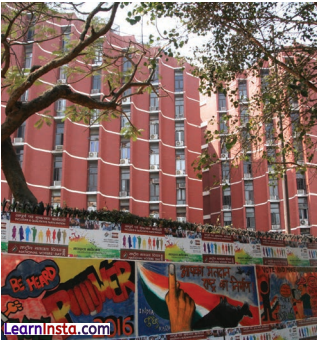
(i) What does this building symbolise in the context of Indian democracy?
Answer:
The building symbolises the authority and independence of the Election Commission, which safeguards the democratic process by conducting free and fair elections in India.
(ii) Mention the Article of the Constitution that gives it authority. Also, state one major responsibility it performs during elections.
Answer:
The Election Commission derives its authority from Article 324 of the Constitution. One major responsibility it performs is organising and supervising elections to the Lok Sabha, State Assemblies, and the offices of the President and Vice President.
(iii)Name any two ways this institution ensures transparency and fairness in the electoral process.
Answer:
The Election Commission ensures transparency through the use of EVMs with VVPATs and by enforcing the Model Code of Conduct to regulate political parties’ behaviour during elections.
Question 2.
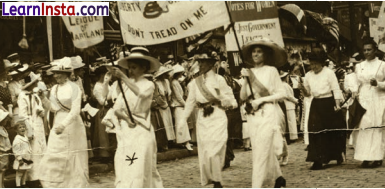
(i) What does the picture of the 1913 women’s suffrage parade in the USA show about the role of women in the fight for voting rights?
Answer:
The picture shows women actively participating in a public march, highlighting their strong efforts and unity in demanding the right to vote, which was not easily given to them in many countries like the USA.
(ii) When did women in Switzerland get the right to vote, and how does that compare with India?
Answer:
Women in Switzerland got the right to vote in 1971, much later than India, where women were granted voting rights from the very beginning of independence.
(iii) What factors helped Indian women get the right to vote early?
Answer:
A progressive constitutional vision and deep democratic values rooted in India’s ancient traditions helped ensure that women received voting rights from the start in India.
Class 8 Universal Franchise and India’s Electoral System Extra Questions for Practice
I. Multiple Choice Questions
Question 1.
Which of the following is NOT a condition to be eligible to vote in India?
(a) Being 18 years or above
(b) Being a registered voter
(c) Having a permanent government job
(d) Not convicted of serious crimes
Question 2.
The Election Commission of India was established in the year:
Question 3.
What does the term “First-Past-the-Post” refer to?
(a) A candidate securing 50% of total votes
(b) The first person to reach the polling station
(c) The candidate with the highest votes wins
(d) A person who wins through NOTA option
Question 4.
Assertion (A): Rajya Sabha is called the Permanent House.
Reason (R): Members of Rajya Sabha retire every year.
(a) Both A and R are true, and R is the correct explanation of A
(b) Both A and R are true, but R is not the correct explanation of A
(c) A is true, but R is false
(d) Both A and R are false
Question 5.
What is the role of VVPAT in Indian elections?
(a) To print election symbols
(b) To ensure secure transport of EVMs
(c) To provide paper trail verification of electronic votes
(d) To register voter’s fingerprint
II. Very Short Answer Type Questions
Question 1.
What does universal adult franchise mean in the Indian context?
Question 2.
Who conducts elections to the Lok Sabha and State Legislative Assemblies?
Question 3.
What age must an Indian citizen attain to vote?
Question 4.
Why is NOTA important in an election?
Question 5.
What type of election is used to elect the President of India?
III. Short Answer Type Questions
Question 1.
Why is universal adult franchise considered a cornerstone of Indian democracy?
Question 2.
What role does the Election Commission of India play in ensuring free and fair elections?
Question 3.
How is accessibility ensured during elections for people with disabilities or the elderly?
Question 4.
Why was the voting age reduced from 21 to 18 years in 1988?
Question 5.
How are elections to the Rajya Sabha different from those to the Lok Sabha?
IV. Long Answer Type Questions
Question 1.
Explain the structure and functions of the Election Commission of India.
Question 2.
Describe how a Lok Sabha election is conducted from voter registration to vote counting.
Question 3.
What measures are taken to ensure fair elections in remote or geographically difficult areas of India?
Question 4.
Discuss the significance of the Model Code of Conduct and the kinds of violations the ECI checks.
Question 5.
How do elections to the President and Vice President of India ensure representation of both Centre and State?