Students can use NCERT Class 9 Advanced Science Notes and Chapter 2 Understanding Motion through Experience Class 9 Notes to understand complex concepts with ease.
Understanding Motion through Experience Notes Class 9 Advanced Science
Class 9 Understanding Motion through Experience Notes
Motion
- In physics, motion is defined as the change in the position of an object over time with respect to a fixed observation point called a reference point. It is a relative concept, meaning an object can be in motion for one observer while appearing at rest to another.
- To fully describe motion, we use quantities like distance and displacement to track path and direction, speed and velocity to measure how fast that change occurs, and acceleration to identify any changes in speed or direction.
- Understanding motion allows us to predict everything from the simple path of a falling ball to the complex orbits of planets in space.

Activity 2.1: Let’s observe
Materials: Notebook, stopwatch (mobile timer), measuring tape
Steps:
- Mark two points 5 metres apart in the classroom corridor or playground.
- Ask one student to walk normally from one point to another while another student measures the time taken using a stopwatch.
- Repeat the experiment with the student running.
- Record the distance and time in a table.
Answer:
Let the fixed distance be 5 metres.
Note: The values below are sample data for a typical student.
| Type of Motion | Distance (d) | Time Taken (t) | Speed (K) |
| Walking | 5 metre | 4.0 second | 1.25 m/s |
| Running | 5 metre | 1.5 second | 3.33 m/s |
Question 1.
Compare the time taken for walking and running.
Answer:
The time taken for running is significantly less than the time taken for walking. In our sample data, running took only 1.5 seconds, whereas walking took 4 seconds to cover the same 5-metre stretch.
Question 2.
Which motion is faster?
Answer:
The running motion is faster. Speed is inversely proportional to time when distance is constant; therefore, the motion that takes the least amount of time is the fastest.
Question 3.
How can you calculate speed?
Answer:
Speed is calculated by dividing the total distance travelled by the total time taken to travel that distance. The mathematical formula is: speed = distance / time.
Question 4.
Can motion be described using measurable quantities such as distance and time?
Answer:
When distance / time is greater than 0, then the object is in motion.
When distance / time is equal to zero, then the object is at rest.
Frame of Reference
Inertial Frame: A frame of reference that is either at rest or moving with a constant velocity. In these frames,
Newton’s laws of motion work perfectly without any changes.
Non-Inertial Frame: A frame that is accelerating. To describe motion accurately in these frames, special corrections called pseudo-forces are required.
The Reference Point: To describe whether an object is moving or at rest, we must specify a reference point. Without it, the state of motion cannot be defined.
Relative Nature: Motion is always described relative to the observer’s chosen frame of reference.
Activity 2.2: Motion is Relative
Materials: Two students as props
Steps:
- Let one student stand still while another walks past him.
- Ask each student to describe the motion of the other student.
- Now let both students walk in the same direction with the same speed and describe the motion again.
Answer:
Scenario 1: One student stands still (Student A), another walks past (Student B).
Student A’s Perspective: Student B is in moving forward. Student B’s Perspective: Student A is moving backwards. Conclusion: Motion is detected with respect to the reference point.
Scenario 2: Both students walk in the same direction at the same speed.
Student A’s Perspective: Student B appears to be at rest (stationary).
Student B’s Perspective: Student A appears to be at rest (stationary).
An Outside Observer’s Perspective (The Classroom):
Both student A and student B moving across the room.
Scalar and Vector Quantity
Scalar Quantities
Physical quantities having only magnitude (size or numerical value) but no direction.
- They can be added, subtracted, multiplied, or divided using simple rules of algebra.
- A change in magnitude changes the quantity.
Examples:
- Mass: 50 kg
- Distance: 10 km
- Time: 2 hour
- Speed: 40 km/h
- Temperature: 37 °C
Vector Quantities
- Physical quantities having both magnitude and direction.
- They follow special rules of vector algebra for addition and subtraction.
- The quantity changes if either the magnitude or the direction or both change.
- Representation: Usually represented by an arrow (-») placed over the symbol (e.g., —> for velocity).
- Examples:
- Displacement: 10 km North
- Velocity: 40 km/h towards East
- Acceleration: 9.8 m/s2 downwards
- Force: 5 Newtons to the right
- Weight: (Force due to gravity acting downwards)
Activity 2.3: Direction Matters
Materials: Chalk, measuring tape
Steps:
- Draw a straight 5-metre line on the ground and mark the starting point as A and the end as B.
- Walk from A to B and note the distance covered.
- Next walk from A to B and then back to A.
- Compare the distance travelled and displacement.
Answer:
Scenario 1: Walking from Point A to Point B
- Action: You start from A and walk in a straight line to B.
- Distance Covered: 5 metre (This is the actual length of the path you walked).
- Displacement: 5 metres toward B (This is the straight-line distance from your start to your finish).
- Result: In a straight line without turning back, Distance = Displacement.
Scenario 2: Walking from A to B, then back to A
- Action: You walk 5 metres to B, turn around, and walk 5 metres back to your starting point A.
- Distance Covered: 5 m (forward) + 5 m (backward) = 10 metres.
- Distance keeps adding up because it does not care about direction.
- Displacement: 0 metres (since your start point and end point are same).
| Feature | Distance | Displacement |
| Definition | Total path length travelled. | Shortest distance between start and end. |
| Direction | Does not matter (Scalar). | Matters (Vector). |
| Value (A to B) | 5 m | 5 m |
| Value (A to B to A) | 10 m | 0m |
Vector Addition: Graphical Method
The Resultant: When two or more vectors act together, their combined effect is a single vector called the resultant.
- Triangle Method (Tip-to-Tail): The first vector is drawn, then the “tail” of the second vector is placed at the “tip” of the first. The resultant is the arrow drawn from the original start to the final tip.
- Parallelogram Method: Both vectors start from the same point. By drawing parallel lines to complete a parallelogram, the diagonal drawn from the common point of the vectors represents the resultant.
Activity 2.4: Graphical Addition of Displacements
Materials: Graph paper, ruler, pencil
Steps:
- On graph paper, draw a vector representing 4 units towards the east.
- From the head (end) of this vector, draw another vector representing 3 units towards the north.
- Now join the tail (starting point) of the first vector to the head of the second vector.
Answer:
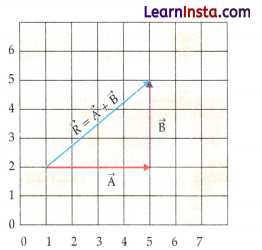
Magnitude of resultant vector = \(\sqrt{\left(3^2+4^2\right)}\) = 5 unit
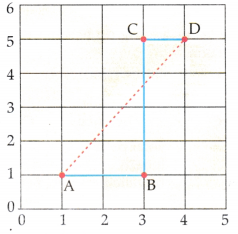
Points A at (1, 1), B at (3, 1), C at (3, 5) and D at (4, 5) (All the values mentioned in the graph are in km) represent Sita’s Flouse, bus stop, traffic signal and school, respectively. In the morning, Sita travels from A to B on foot, then B to D via C in the school bus. Then calculate:
(a) Distance travelled by Sita on foot,
(b) Distance travelled by Sita by the school bus,
(c) Total displacement of Sita from her house to the school.
Answer:
Data points (in km):
- A (Sita’s House): (1,1)
- B (Bus Stop): (3,1)
- C (Traffic Signal): (3, 5)
- D (School): (4, 5)
(a) Distance travelled by Sita on foot
Sita walks from A to B.
- Looking at the x-axis: Point A is at x = 1 km and Point B is at x = 3 km
- Calculation: 3 km -1 km = 2 km.
(b) Distance travelled by Sita by the school bus
The bus travels from B to D via C. This has two separate segments:
- B to C (Vertical): From y = 1 km to y = 5 km. Distance = 5 km – 1 km = 4 km
- C to D (Horizontal): Fromx = 3 km to x = 4 km. Distance = 4 km – 3 km = 1 km.
- Total Bus Distance: 4 km + 1 km = 5 km
(c) Total displacement of Sita from her house to the school
Displacement is the straight-line distance from the starting point (A) to the final destination (D).
A is at (1,1) and D is at (4, 5).
Using the distance formula:
d = \(\sqrt{\left(x_2-x_1\right)^2+\left(y_2-y_1\right)^2}\)
d = \(\sqrt{(4-1)^2+(5-1)^2}\)
d = \(\sqrt{3^2+4^2}=\sqrt{9+16}=\sqrt{25}\)
d = 5 km
Equations of Motion
- There are three fundamental Equations of Motion for an object moving with uniform (constant) acceleration in a straight line.
- These equations link five key variables: initial velocity (u), final velocity (v), acceleration (a), time (t) and distance/displacement (s).
- Three equations of Motion
- υ = u + at
- S = ut + 1/2 at2
- υ2 = u2 + 2as
Activity 2.5: Observing Accelerated Motion Using a Toy Car
Materials: Toy car (or small wheeled object), smooth floor, measuring tape, stopwatch (mobile timer), chalk/ tape.
Steps:
- Mark a straight line on the floor and label the starting point as O.
- Place the toy car at point O and give it continuous push so that it moves forward.
- Use a stopwatch and note the position of the car at equal time intervals (every 1 second).
- Mark these positions on the floor using chalk or tape.
- Measure the distance from the starting point to each marked position and record it in a table.
Answer:
| Time (s) | Position from Start (cm) | Distance covered in that Is interval (cm) |
| 0 | 0 | – |
| 1 | 10 | 10 |
| 2 | 30 | 20 |
| 3 | 60 | 30 |
| 4 | 100 | 40 |
This table shows acceleration as the distance travelled in successive intervals increases.
Fourth Equation of Motion
It describes the distance travelled in nth second
From the second equation of motion:
s = ut + \(\frac{1}{2}\) at2
Where,
u = initial velocity
υ = final velocity
t = time
S = displacement in time t
Now, the distance travelled in n seconds,
Sn = u(n) + \(\frac{1}{2}\) an2
Distance travelled in (n – 1) seconds,
S(n-1) = u(n-1) + \(\frac{1}{2}\) a(n-1)2
Distance travelled in the nth second,
Sn = Sn – S(n-1)
Sn = u + \(\frac{a}{2}\)(2n-1)
The fourth equation of motion calculates the distance covered during a specific one-second window (the nth second) rather than the total distance from the start. Because it targets a single, specific second, the value of n must be a positive whole number. This formula isolates the movement within that specific interval instead of providing a cumulative total.