Students often refer to Maths Mela Class 4 Solutions Chapter 12 Ticking Clocks and Turning Calendar Question Answer NCERT Solutions to verify their answers.
Class 4 Maths Chapter 12 Ticking Clocks and Turning Calendar Question Answer Solutions
Ticking Clocks and Turning Calendar Class 4 Maths Solutions
Class 4 Maths Chapter 12 Solutions
Let Us Do (Pages 175-177)
Question 1.
Notice the number of days in February in the Years 2024 and 2025.

Number of days in Feb 2024 = ______
Number of days in Feb 2025 = ______
Answer:
Number of days in February 2024 = 29
Number of days in February 2025 = 28
Question 2.
Fill in the blanks with consecutive leap years before and after 2024. ______ , ______ , 2024, ______ , ______ , ______ –
Answer:
Leap years happen every 4 years.
To find the leap year before 2024, we subtract 4: 2024 – 4 = 2020. The leap year before 2020 is 2016 (2020-4 = 2016).
To find the next leap year after 2024, we add 4:2024 + 4 = 2028.
The leap year after 2028 will be 2028 + 4 = 2032.
The leap year after 2032 is 2036 (2032 + 4 = 2036).
So, the consecutive leap years are: 2016, 2020, 2024, 2028, 2032, 2036.

Question 3.
We know that most years have 365 days. How many days would a leap year have?
Answer:
As we saw with February 2024 having 29 days instead of the usual 28, a leap year has one extra day.
So, a leap year has 365+1=366 days.
Question 4.
Write the names of the months when you celebrate your favourite festivals.

Answer:
| Name of the Festival | Name of the Month |
| Holi | March |
| Diwali | October or November |
| Eid-ul-Fitr | Varies based on the Islamic lunar calendar |
| Christmas | December |
| Raksha Bandhan | August |
Question 5.
Answer the following questions by writing the appropriate days of the week:
Answer:
(a) Today : Friday
(b) Yesterday : Thursday
(c) Tomorrow : Saturday
(d) Day after tomorrow : Sunday
(e) Day before yesterday: Wednesday
Question 6.
July 1 is a Monday. Write the dates for the next two Mondays.
Answer:
There are 7 days in a week, so the next Monday will be 7 days after July 1st.
First next Monday: July 1 + 7 = 8
Second next Monday: July 8 + 7 = 15
So, the dates for the next two Mondays are July 8 and July 15.
Question 7.
Laali is born on 04 / 07 / 2014 and Chotu is born on 04 / 12 / 2019. Who is older among the two and how much?
Laali will turn 5 years old on ______。
Chotu’s 10th birthday will be celebrated on ______ .
Answer:
Laali’s birth date: 04/07/2014
Chotu’s birth date: 04/12/2019
To find out who is older, we look at their birth years first. Laali was born in 2014, and Chotu was born in 2019. Since 2014 comes before 2019, Laali is older than Chotu.
Now, let’s calculate the age difference.
From 04/07/2014 to 04/07/2019, that’s exactly 5 years. Chotu was born on 04/12/2019, which is 5 months after July (August, September, October, November, December).
So, Laali is older than Chotu by 5 years and 5 months.
→ Now, let’s answer the other parts:
Laali will turn 5 years old on:
Laali was born on 04 / 07 / 2014. To find when she turns 5 , we add 5 years to her birth year:
2014 + 5 = 2019
So, Laali will turn 5 years old on 04/07/2019.
→ Chotu’s 10th birthday will be celebrated on:
Chotu was born on 04/12/2019. To find his 10th birthday, we add 10 years to his birth year:
2019 + 10 = 2029
So, Chotu’s 10th birthday will be celebrated on 04/12/2029.
Question 8.
Check the manufacturing and expiry dates on the wrapper of any biscuit packet.
(a) How old is the packet of biscuits?
Answer:
______ months ______ days.
(b) How many more days are the biscuits safe to eat?
Answer:
______ months ______ days.
Answer:
Get a biscuit packet and check the manufacturing and expiry dates and answer the questions accordingly.
Question 9.
Notice the day on which July 15 falls in your calendar. Now find out what day is August 15? September 15? October 15? What pattern do you notice? Share in grade.
Now choose a date and look up the day on which it falls. Challenge your friends to guess what day will the same date fall in the following month.
Answer:
15th of each Month in 2025
| Month | Date | Day of the Week |
| July | July 15, 2025 | Tuesday |
| August | August 15, 2025 | Friday |
| September | September 15, 2025 | Monday |
| October | October 15, 2025 | Wednesday |
What pattern do we notice?
The 15th of each month falls on different days of the week.
For example:
- July 15 is a Tuesday.
- August 15 is a Friday.
- September 15 is a Monday.
- October 15 is a Wednesday.
This variation occurs because months have different numbers of days, and the calendar progresses accordingly.
Let Us Explore (Page 177)
With the help of your parents and teachers, explore the names of the months in the Hindu/Islamic/Sikh or any other calendar of your community.
Question 1.
Find out when the year begins in each of these calendars.
Answer:
Exploring the Hindu calendar:
In the Hindu calendar, the year often begins in Chaitra (around March-April in the English calendar).
Question 2.
Check how the names of the months in these calendars correspond to the months in the English calendar.
Answer:
Chaitra → March-April
Vaishakha → April-May
Ashadha → June-July
Shravana → July-August
(and so on for 12 months)
Question 3.
Identify the months from the Hindu/Islamic/Sikh or any other calendar in which some of the important festivals of the community fall.
Answer:
Diwali → Kartika
Holi → Phalguna
Raksha Bandhan → Shravana
Navratri → Ashvina
Question 4.
Identify the dates of the new moon and full moon in your community’s calendar every month. Do you notice any pattern?
Answer:
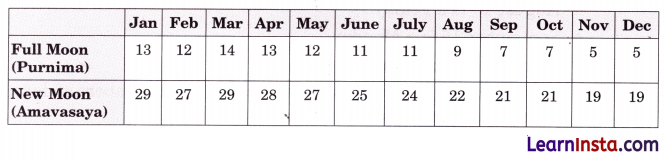
These dates align with the lunar phases observed in India.
Question 5.
How are the full moon or new moon days named in your community’s calendar?
Answer:
In Hindu calendar:
- Full moon is called Purnima.
- New moon is called Amavasya.
How many hours in a day? (Page 178)
Look at the picture below. It shows the time spent on different activities by a doctor. Write the number of hours spent on each activity in the space provided. Then, find the total number of hours between 6 o’clock morning to 6 o’clock evening and 6 o’clock morning of the next day.

The total number of hours is ______ .
Answer:
Activities and Time Spent
- Wakes up at 6:00 AM (Start of the day)
- Cooks and gets ready (6:00 AM – 8:00 AM) = 2 hours
- Leaves for hospital (8:00 AM – 9:00 AM) = 1 hour
- Reaches hospital and works (9:00 AM – 4:00 PM) = 7 hours
- Leaves for home (4:00 PM – 5:00 PM) = 1 hour
- Reaches home and rests (5:00 PM – 6:00 PM) = 1 hour
- Reading, cooking, time with children, dinner, TV (6:00 PM – 10:00 PM) = 4 hours
- Sleep (10:00 PM – 6:00 AM) = 8 hours
Total hours from 6:00 AM to 6:00 AM next day: 24 hours
(Page 180)
Fill in the blanks by writing time in the appropriate format.
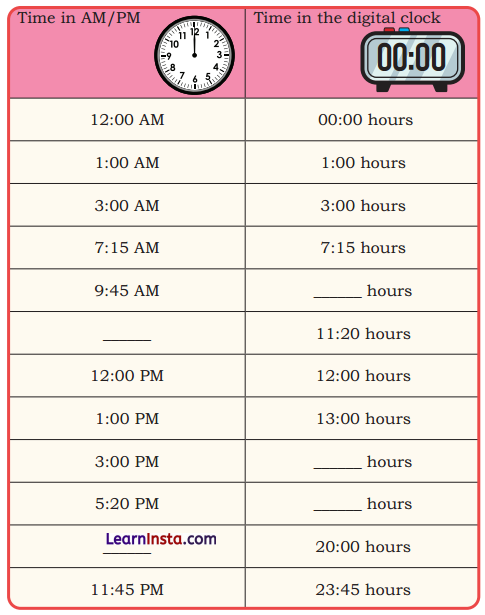
Answer:
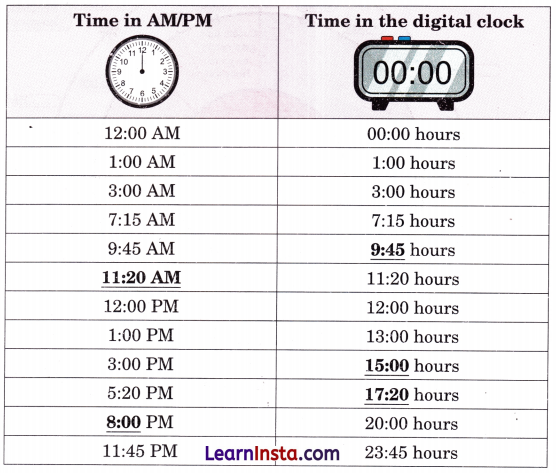
Hours and Minutes (Page 181)
Raghav brings milk from the market every morning.
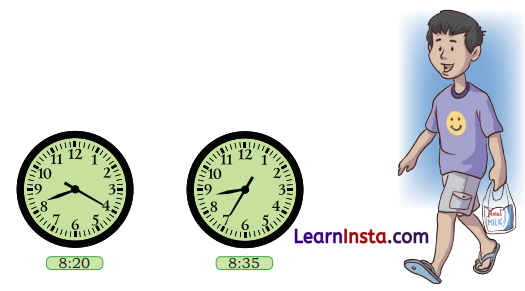
Raghav leaves home at 8:20 AM and returns back at 8:35 AM.
How much time has he taken? ____________
Answer:
To find the time taken, we need to find the difference between the return time and the leaving time.
From 8:20 AM to 8:30 AM, that’s 10 minutes.
From 8:30 AM to 8:35 AM, that’s another 5 minutes.
So, the total time Raghav has taken is 10+5=15 minutes.
Let Us Do (Pages 181-183)
Question 1.
Show the appropriate times on the clock as per instructions.
(a) Raghav started doing his homework at 10:20 AM. He took 25 minutes to finish it. Show the time that he finished his homework.
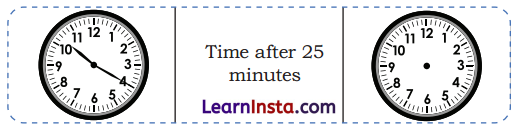
Answer:
Raghav finished his homework at 10:45 AM.

(b) Muneera starts reading a story at 4:15 PM. She finishes reading it in 45 minutes. Show the time that she finished reading the story.
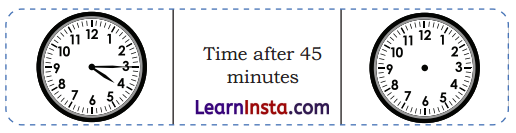
Answer:
Muneera finished reading her story at 5:00 PM.

(c) Akira leaves for school at 8:00 AM. She reaches school in 15 minutes.

Answer:
Akira reaches school at 8:15 AM.

Finishes school assembly at 8:30 AM.

Dance practice ends at 8:50 AM.

Break ends at 9:00 AM.

Who do you think is correct? Is there any relation between 1 hour and 60 minutes?
Answer:
Both of them are correct. They are just saying the same amount of time in different units.
Yes, there is a direct relationship: 1 hour is equal to 60 minutes.
So, spending one hour is exactly the same as spending 60 minutes.
Observe the shaded portions

Answer:
Half hour = 30 minutes.
Quarter or 1 / 4 of an hour = 15 minutes.
Three quarters or 3 / 4 of an hour = 45 minutes.
Find out how much time you take to
(a) boil milk
(b) fill water from tap in a bucket
What activities can you do in 5 minutes?
Answer:
(a) Boil milk: Around 5-7 minutes.
(b) Fill water from tap in a bucket: 2-4 minutes
Here are some things a person might be able to do in about 5 minutes:
- Brush your teeth thoroughly.
- Make a quick sandwich or a small snack.
- Water a few small plants.
- Do a set of simple stretches or exercises.
- Read a short story or a few pages of a book.
- Tidy up a small area, like your desk or bedside table.
- Listen to one or two songs.
- Have a short conversation with someone.
- Solve a simple puzzle or a few math problems.
Let Us Check (Page 183)
Three friends read time from a clock. Who is right? Discuss the error and explain how one reads the clock correctly.

Answer:
- Clock 1: Time shown is 04:00. Rani is correct.
- Clock 2: Time shown is 05:35. Rani is correct.
- Clock 3: Time shown is 07:15. Rani is correct.