These Our Wondrous World Class 3 Worksheet and Class 3 EVS Chapter 10 This World of Things Worksheet with Answers Pdf follow the CBSE syllabus.
This World of Things Class 3 EVS Worksheet Chapter 10
Class 3 EVS This World of Things Worksheet
Class 3 EVS Chapter 10 Worksheet – Class 3 This World of Things Worksheet
Let us Do it
A. Identify and label the objects that you often see in your immediate surroundings.

1. _________

2. _________

3. _________

4. _________
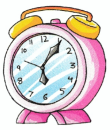
5. _________

6. _________
B. Classify the following items as either Natural (N) or Artificial (A):
1. Apple _________
2. Potato chips _________
3. Carrot _________
4. Candy bar _________
5. Mango tree _________
6. Soda (carbonated drink) _________
7. Chicken nuggets _________
8. Spinach _________
9. Ice cream _________
10. Drinking water _________

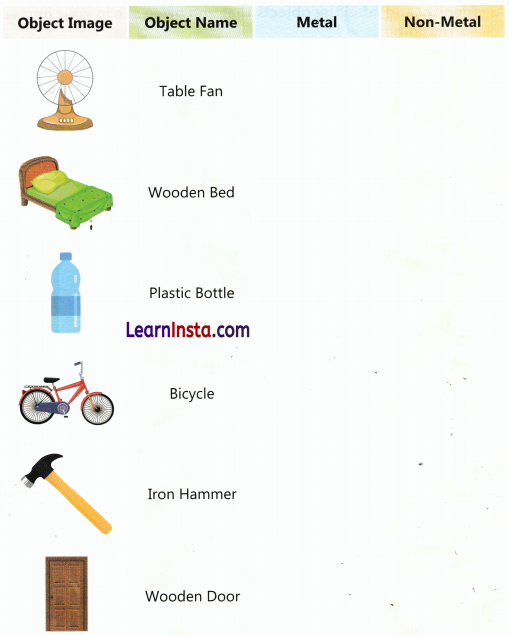
C. Look at each object and tick (✓) in Metal column if it is made of metal and tick (✓) in Non-metal column if it is made of non-metal.
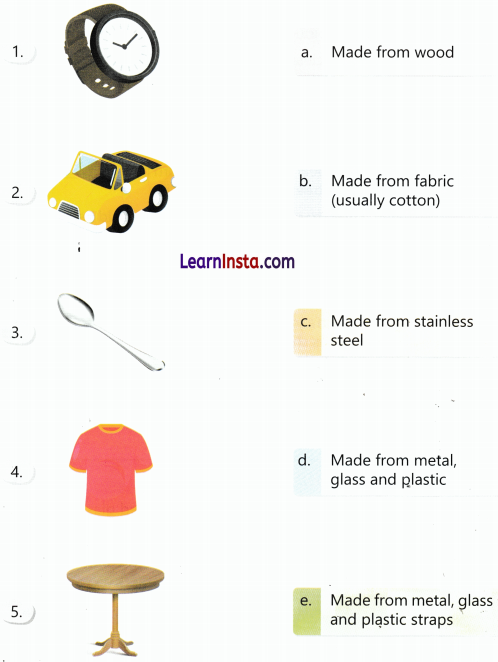
D. Match the following items with the nature of material.
E. Identify the colour through different materials.
1. Look through the clear white cellophane paper, it turns into _________ colour when red roses are seen through it.
2. Look through the clear glass sheet, it turns into _________ colour when an ocean with dolphins jumping and waves crashing is seen through it.
3. Looking through a clear polythene sheet, it turns into _________ colour when a sunny beach with golden sand is seen through it.
4. Looking through clear spectacles, they turn into _________ colour when a bunch of trees is seen through it.
5. The material used to make the above objects could be _________ (Transparent / Translucent / Opaque).
F. Situation-based questions.
1. Type of Material:
Situation: You are in a room with a window. The Sun is shining outside. You can see the “Nature View” clearly through the window.

Question: Is the window glass transparent, translucent, or opaque?
Answer: _______________________________________
2. Guess the Material:
Situation: Three objects: a clear glass, a frosted glass, and a wooden block are shown by your teacher.

Question: Which of these objects allow light to pass through completely (transparent), partially (translucent), or not at all (opaque)?
Answer: _______________________________________
3. Shadow Play:
Situation: During a sunny day, you stand near a wall. The Sun casts your shadow on the wall.

Question: My body being _________ (Transparent, Translucent, Opaque) is forming the shadow.
Answer: _______________________________________
4. Materials Investigation:
Situation: You have a box with the following materials: butter paper, polythene, and a wooden block.

Question: Which material will allow light to pass through completely, partially, or not at all?
Answer: _______________________________________
5. Foggy Window Mystery:
Situation: On a foggy morning, you look out of your window. You see blurred images of objects outside it.

Question: Which word (opaque, translucent, or transparent) best describes the foggy window?
Answer: _______________________________________
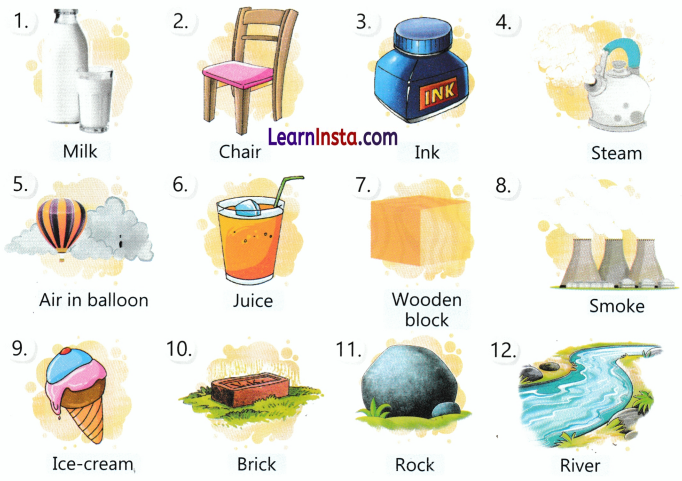
G. Classify the items as solids, liquids, and gases by writing numbers in the given space.

H. Identify the things you see in the given playground and write the material of which they are made up of. (One is done for you.)
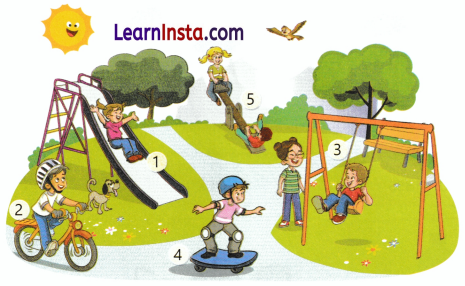
1. Slide -‘Made up of plastic, rubber and metal
2. _______________________________________
3. _______________________________________
4. _______________________________________
5. _______________________________________
I. List three objects and write a material they cannot be made from. Explain each odd pair in the space provided.
(Two examples have been done for you.)

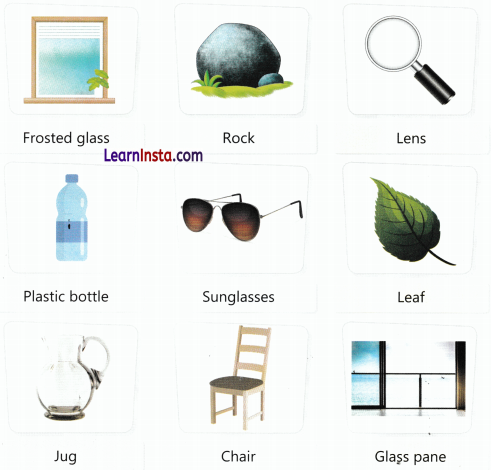
J. Classify each object into correct category by writing their names in correct column.

K. Find eight words hidden in the given maze related to this chapter.

This World of Things Class 3 Summary
In this chapter, children will come to know about the characteristics of metals and non-metals also discover how light passes through transparent, translucent and opaque materials. Children will also learn about the three states of matter: solid, liquid, and gas, observing their unique properties. You will also come to know about natural and artificial things in this chapter.
- Label – A small tag with important information
- Hinges – Special things that help doors move
- Latches – A type of lock for doors or gates
- Extracted – To remove or take out something
- Sediment – Solid material at the bottom of solution
- Ore – Special rock with valuable minerals
- Glass pane – A sheet of glass that makes up the window
- Transparent – Materials we can see through
- Opaque – Materials we cannot see through at all
- Translucent – Materials we can see through partially
- Flexibility – Ability to change easily
- Solid – State of matter with definite shape and volume
- Liquid – State of matter with definite volume
- Gas – State of matter with no definite shape or volume
- Alloys – Mixtures of metals