Experts have designed these Class 9 Maths Notes and Chapter 3 The World of Numbers Class 9 Ganita Manjari Notes for effective learning.
Class 9 Maths Chapter 3 The World of Numbers Notes
Class 9 Maths Ganita Manjari Chapter 3 Notes
Ganita Manjari Class 9 Chapter 3 Notes – Class 9 The World of Numbers Notes
This chapter introduces the properties and representation of rational and irrational numbers including proofs of irrationality and their representation on the number line. It covers key concepts like the density of rational numbers, decimal expansions and the geometric construction of the square root spiral.
Introduction of Numbers
Natural Numbers (N): Natural Numbers (N) are the counting numbers starting from 1, 2, 3 and extending infinitely i.e.N ={1,2,3They are created because humans needed to count objects (like animal, food etc).
Concept of Zero (Shunya): The idea of zero was developed in ancient India and formalised by Brahmagupta (629 CE). He established rules that allowed arithmetic operations to be performed with zero.
Brahmagupta’s Rules for Zero
- Addition Rule: When 0 is added to any number, the number remains the same i.e. a + 0 = a.
e.g. 7 + 0 = 7 - Subtraction Rule: When 0 is subtracted from any number, the number remains unchanged i.e. a – 0 = a.
e.g. 6 – 0 = 6 - Multiplication Rule: When any number is multiplied by 0, the result is always 0 i.e. a × 0 = 0.
e.g. 6 × 0 = 0 - Negative Numbers: The numbers which are less than 0 are called negative numbers. To differentiate these negative numbers from whole numbers, we use a (-) minus sign attached to the number. This indicates that number with negative sign are less than zero and they lies left of 0 on the number line.
- Integers: The collection of natural numbers, zero and negative numbers is known as integers
i. e ……….,-5, -4, -3, -2, -1, 0, 1, 2, 3, 4, 5, ……………..
Here, 1, 2, 3 are said to be positive integers and -1, -2, -3 are said to be negative integers.
Brahmagupta explained numbers using real-life situation.
Fortunes Positive numbers, showing gain or wealth
Debts Negative numbers, showing loss or amount owed
e.g. + 5 means you have 5 units of wealth and
-5 means you owe 5 units.
Arithmetic of Integers Brahmagupta gave explicit rules for adding and multiplying integers.
- The sum of two fortunes (positive numbers) is a fortune (positive number),
e.g. 5 + 6 = 11 - The sum of two debts (negative numbers) is a debt (negative number),
e.g. (-5) + (-6) = -11 - A fortune (positive number) minus zero is a fortune .and a debt (negative number) minus zero is a debt (negative number).
e.g. 7 – 0 = 7 and -6 – 0 = -6 - The product of a debt (negative number) and a fortune (positive number) is debt (negative number).
e.g. (-3) × 4 = -12 - The product of two debts (negative numbers) is a fortune (positive number).
e.g. (-3) × (-4) = 12 - The quotient of a fortune (positive number) and a debt (negative number) is a debt (negative number).
Example 1.
The temperature in Shimla is recorded as 3° C in the evening. At night, it drops by 11° C. What is the night temperature.
Solution:
Given, initial temperature = 3°C
and drop in temperature = -11°C
∴ The night temperature = 3 + (-11) = -8° C
Example 2.
Using Brahmagupta’s Law, find
(i) (-15) × 4
(ii) (-7) × (-6)
(iii ) (-14) -0
(iv) (-40) = 8
Solution:
(i) We have, (-15) × 4
According to Brahmagupta’s Law, the product of a fortune (positive number) and a debt (negative number) is a debt.
∴ (-15) × 4 = -60
(ii) We have, (-7) × (-6)
According to Brahmagupta’s Law, the product of two debts (negative numbers) is a fortune (positive number).
∴ (-7) × (-6) = 42
(iii) We have, (-14) – 0
According to Brahmagupta’s Law, when 0 is subtracted from any number, the number remains unchanged.
∴ (-14) – 0 = -14
(iv) According to Brahmagupta’s Law, the quotient of a debt and a fortune is a debt.
∴ (-40) ÷ 8 = \(\frac{-40}{8}\) = -5
Fractions and Rational Number
Numbers that represent parts of a whole called fractions. When we combine all integers and all fraction (both positive and negative), we get the set of rational numbers denoted by Q.
A number that can be expressed in the form of \(\frac{p}{q}\), where p and q are integers and q ≠ 0 is called a rational number.
e.g. \(\frac{4}{5}, \frac{-5}{7}\) and 3\(\frac{2}{7}\) etc.
In \(\frac{p}{q}\), integer p is the numerator and q(≠ 0) is the 9 denominator.
Note:
0 can be written as \(\frac{0}{1}\), which is of the form \(\frac{p}{q}\). So, 0 is a rational number.
Example 3.
Is the number \(\frac{3}{-5}\) rational? Think about it?
Solution:
Yes, \(\frac{3}{-5}\) is a rational number because 3 and -5 are integers -5 and -5 ≠ 0.
Example 4.
List any six rational numbers.
Solution:
Here, six rational numbers may be taken as follows.
\(\frac{1}{5}, \frac{2}{-3}, \frac{-3}{5}, \frac{4}{7}, \frac{11}{15}, \frac{29}{51}\)
Equivalent Rational Numbers
A rational number can be written with different numerators ‘and denominators. By multiplying the numerator and denominator of a rational number by the same non-zero integer, we obtain another rational number equivalent to the given rational number.
e.g \(\frac{-3}{7}=\frac{-3 \times 2}{7 \times 2}=\frac{-6}{14}\)
Same as multiplication, the division of the numerator and denominator by the same non-zero integer, also gives equivalent rational numbers.
e.g \(\frac{-16}{64}=\frac{-16 \div 16}{64 \div 16}=\frac{-1}{4}\)

Example 5.
Fill in the boxes.

Solution:
We have

Here, rational numbers equivalent to the rational number \(\frac{2}{4}\) are as follow.
\(\frac{2}{4}=\frac{2 \times 4}{4 \times 4}=\frac{8}{16}\)
[∵ 4 × 4 = 16, since given denominator of equivalent rational number, so multiply by 4]
\(\frac{2}{4}=\frac{2 \times 5}{4 \times 5}=\frac{10}{20}\)
[∵ 2 × 5 = 10, since given numerator of equivalent rational, so multiply by 5]
So, the missing integers in the boxes are filled as 2 \(\frac{2}{4}=\frac{8}{16}=\frac{10}{20}\)
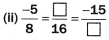
Solution:
We have,

Here, the equivalent rational number to the rational number \(\frac{-5}{8}\) are as follow.
\(\frac{-5}{8}=\frac{-5 \times 2}{8 \times 2}=\frac{-10}{16}\)
and \(\frac{-5}{8}=\frac{-5 \times 3}{8 \times 3}=\frac{-15}{24}\)
So, the missing integer in the boxes are filled as
\(\frac{-5}{8}=\frac{-10}{16}=\frac{-15}{24}\)
Example 6.
Give four rational numbers equivalent to
(i) \(\frac{-3}{7}\)
Solution:
We have, \(\frac{-3}{7}\)
On multiplying numerator and denominator of \(\frac{-3}{7}\) by
non-zero numbers 2, 3,4 and 5, respectively, we get
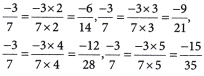
Hence, the four rational numbers equivalent to
\(\frac{-3}{7}\) are \(\frac{-3}{7}\) and
(ii) \(\frac{5}{9}\)
Solution:
We have, \(\frac{5}{9}\)
On multiplying numerator and denominator of \(\frac{5}{9}\) by
non-zero numbers 2, 3,4 and 5, respectively, we get
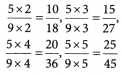
Hence, the four rational numbers equivalent to – are
\(\frac{10}{18}, \frac{15}{27}, \frac{20}{36}\) and \(\frac{25}{45}\).
Example 7.
Write four more rational number for the following \(\frac{-2}{5}, \frac{-4}{10}, \frac{-6}{15}, \frac{-8}{20},\)…………
Solution:
Given, \(\frac{-2}{5}, \frac{-4}{10}, \frac{-6}{15}, \frac{-8}{20},\)…………
i.e \(\frac{-2 \times 1}{5 \times 1}, \frac{-2 \times 2}{5 \times 2}, \frac{-2 \times 3}{5 \times 3}, \frac{-2 \times 4}{5 \times 4}, \ldots \ldots\)
Proceeding in this way next four rational numbers are
\(\frac{-2 \times 5}{5 \times 5}, \frac{-2 \times 6}{5 \times 6}, \frac{-2 \times 7}{5 \times 7}, \frac{-2 \times 8}{5 \times 8}\) i.e \(\frac{-10}{25}, \frac{-12}{30}, \frac{-14}{35}, \frac{-16}{40}\)
Positive and Negative Rational Numbers
Rational numbers are classified as positive and negative rational numbers.
When numerator and denominator of a rational number are either both positive or both negative is called positive rational number.
A rational number is said to be negative if the numerator and denominator are of opposite sign i.e. any one of them is a positive integer and the other is a negative integer.
e.g. \(\frac{5}{11}\) is a positive rational number whereas \(\frac{-5}{11}\) is a negative rational number.
The number 0 (zero) is neither a positive nor a negative rational number.
Example 8.
Is 6 a positive rational number? List five more positive rational numbers.
Solution:
Yes, 6 can be written as y, where 6 and 1 both are positive.
So, 6 is a positive rational number.
The five positive rational numbers are as follows.
\(\frac{3}{5}, \frac{4}{9}, \frac{-3}{-4}, \frac{-17}{-19}, \frac{17}{4}\)
Example 9.
Is -11 a negative rational number? List five more negative rational numbers.
Solution:
Here, 11 has negative sign.
So, –\(\frac{11}{1}\) is a negative rational number.
The five negative rational number are as follows.
\(\frac{-11}{13}, \frac{13}{-15}, \frac{-7}{25}, \frac{-15}{32}, \frac{7}{-13}\)
Example 10.
Which of these are positive and negative rational numbers?
(i) \(\frac{-3}{5}\)
Solution:
\(\frac{-3}{5}\) is a negative rational number because its numerator is negative.
(ii) \(\frac{6}{7}\)
Solution:
\(\frac{6}{7}\) is a positive rational number.
(iii) \(\frac{4}{-5}\)
Solution:
\(\frac{4}{-5}\) is a negative rational number because its denominator is negative.
(iv) 0
Solution:
0 (zero) is neither a positive nor a negative rational number.
(v) \(\frac{-3}{-7}\)
Solution:
\(\frac{-3}{-7}\) is a positive rational number because
Example 11.
Is the following pairs represent the same rational number?
(i) \(\frac{-8}{17}\) and \(\frac{2}{5}\)
Solution:
Here, \(\frac{-8}{17}\) is a negative rational number and \(\frac{2}{5}\) is a positive rational number.
So, these rational numbers cannot be equivalent. Hence, the given pair cannot represent the same rational number.
(ii) \(\frac{-21}{30}\) and \(\frac{35}{-50}\)
Solution:
Given, \(\frac{-21}{30}\) and \(\frac{35}{-50}\)
Now, convert \(\frac{-21}{30}\) into simplified form by dividing same non-zero integer i.e. 3.
\(\frac{-21}{30}=\frac{-21 \div 3}{30 \div 3}=\frac{-7}{10}\)
Similarly, convert \(\frac{35}{-50}\) into simplified form by dividing same non-zero integer i.e. 5.
\(\frac{35}{-50}=\frac{35 \div 5}{-50 \div 5}=\frac{7}{-10}=\frac{7 \times(-1)}{-10 \times(-1)}=\frac{-7}{10}\)
Thus, \(\frac{-21}{30}\) and \(\frac{35}{-50}\) are equivalent rational numbers because their simplified form are same.
Hence, given pair represent the same rational number.
Representation of Rational Numbers on the Number Line
We will understand representation of a rational number on the number line with the help of examples given below.
Example 12.
Draw the number line and represent the following rational number on it.
(i) \(\frac{3}{5}\)
Solution:
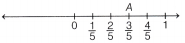
Firstly, draw a number line and mark 0 and 1 on it at unit distance, divide the gap between 0 and 1 into 5 equal parts and show 1 part as \(\frac{1}{5}\). Now, \(\frac{3}{5}\) means 3 parts out of 5 parts to the right of 0. Thus, the point A on the number line represents the rational number \(\frac{3}{5}\) as shown below.
(ii) \(\frac{-5}{7}\)
Solution:
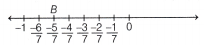
Here, \(\frac{-5}{7}\) is less than 0 and greater than -1. So, it will lie on the left of 0 on the number line at the same distance as \(\frac{-5}{7}\) from 0 to the right.
Firstly, draw the number line and mark 0 and – Ion it at unit distance. Divide the gap between 0 and -1 into 7 equal parts to the left of 0.
Thus, the point B on the number line represents the rational number \(\frac{-5}{7}\) as shown below.
(iii) \(\frac{9}{4}\)
Solution:
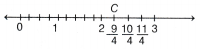
We have, \(\frac{9}{4}\) = 2\(\frac{1}{4}\) so it lies between 2 and 3.
Now, we divide the gap between 2 and 3 into 4 equal parts and move one part to right of 2. Thus, the point C on the number line represents the rational number \(\frac{9}{4}\) as shown below.
Example 13.
The points A, B, C, D, E, F, G and H on the number lines are such that AB = BC = CD and EF = FG = GH Name the rational numbers represented by F.

Solution:
Given, points A, B, C, D, E, F, G and H are on the number line such that AB = BC = CD and EF = FG = GH.
It means that distance between EH is divided into 3 equal parts and similarly, AD on the left of zero is divided into 3 equal parts.
Now, point F is on the right of zero on the number line and between 2 and 3.
So, the rational number represented by
F = 2 + \(\frac{1}{3}\)
[since, EH is divided into 3 equal parts and each part shows \(\frac{1}{3}\)]
= \(\frac{2 \times 3}{1 \times 3}+\frac{1}{3}=\frac{6+1}{3}=\frac{7}{3}\)
Standard Form of Rational Numbers
A rational number p/q is said to be in standard form if its denominator is a positive integer and, numerator and denominator have no common factor other than 1 i.e. p and q are co-prime.
e.g. \(\frac{-2}{7}, \frac{1}{3}\) etc are in standard form.
If a given rational number is not in the standard form then in order to express it in standard form, we first convert it into a rational number, whose denominator is positive and then we divide its numerator and denominator by their HCF.
Example 14.
Find the standard form of
(i) \(\frac{-9}{45}\)
Solution:
Given, \(\frac{-9}{45}\)
∵ HCF of 9 and 45 = 9
∴ \(\frac{-9 \div 9}{45 \div 9}=\frac{-1}{5}\)
[dividing the numerator and denominator by 9]
Hence, the standard form, of \(\frac{-9}{45}\) is \(\frac{-1}{5}\)
(ii) \(\frac{25}{50}\)
Solution:
Given, \(\frac{25}{50}\)
∵ HCF of 25 and 50 = 25
∴ \(\frac{25}{50}=\frac{25 \div 25}{50 \div 25}=\frac{1}{2}\)
[dividing the numerator and denominator by 25]
Hence, the standard form, of \(\frac{25}{50}\) is \(\frac{1}{2}\)
(iii) \(\frac{-36}{12}\)
Solution:
Given, \(\frac{-36}{12}\)
∵ HCF of 36 and 12 = 12.
∴ \(\frac{-36}{12}=\frac{-36 \div 12}{12 \div 12}=\frac{-3}{1}\)
[dividing the numerator and denominator by 9]
Hence, the standard form of \(\frac{-36}{12}\) is \(\frac{-3}{1}\).
Absolute value of a rational number
- The absolute value of a rational number x, denoted by | x | is its numerical value regardless of its sign.
- The absolute value of a positive number is the number it self and negative number is its positive value.
e.g \(\left|\frac{4}{5}\right|=\frac{4}{5}\) and \(\left|\frac{-4}{5}\right|=\frac{4}{5}\)
For two rational numbers a and b the distance between them on the number line is given by |a – b|.
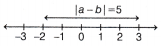
The absolute value of any rational number is always non-negative i.e. |x| ≥ 0.
Operations and Properties of Rational Numbers
Equality of Rational Number
Two rational numbers \(\frac{a}{b}\) and \(\frac{c}{d}\) are said to be equal, if ab = bc
Example 1.
Show that \(\frac{3}{5}\) and \(\frac{6}{10}\) are equal.
Solution:
Given, numbers are \(\frac{3}{5}\) and \(\frac{6}{10}\).
We know that two rational numbers are \(\frac{3}{5}\) and \(\frac{6}{10}\).
equal, if ad = bc.
Here, a = 3, b = 5, c = 6 and d = 10.
Now, ad = 3 × 10 = 30 and bc = 5 × 6 = 30
Since, ad = bc = 30
Therefore, \(\frac{3}{5}\) and \(\frac{6}{10}\) are equal.
Addition of Rational Numbers
To find sum of two rational number, firstly express the two rational numbers as fraction \(\frac{a}{b}\) and \(\frac{c}{b}\) with the same denominator.
Then, \(\frac{a}{b}+\frac{c}{b}=\frac{a+c}{b}\)
Example 2.
Find the sum of \(\frac{4}{5}\) and \(\frac{5}{4}\).
Solution:
Given, numbers are \(\frac{4}{5}\) and \(\frac{5}{4}\)
To make same denominator of both numbers, multiply both numerator and denominator of both numbers by 20 i.e. LCM of 5 and 4.
∴ \(\frac{4 \times 4}{5 \times 4}=\frac{16}{20}\) and \(\frac{5 \times 5}{4 \times 5}=\frac{25}{20}\)
Now, \(\frac{4}{5}+\frac{5}{4}=\frac{16}{20}+\frac{25}{20}=\frac{15+25}{20}=\frac{41}{20}\)
Properties of Addition of Rational Numbers
Closure
Rational numbers are closed under addition.
For any two rational numbers a and b, a + b will also be a rational number.
e.g. Let two rational numbers be a = \(\frac{3}{4}\) and b = –\(\frac{5}{7}+\left(-\frac{2}{3}\right)=\frac{1}{21}\).
∴ a + b = b + a
So, addition is commutative.
Associativity
Rational numbers are associative under addition.
For any three rational numbers a, b and c,
a + (b + c)(a + b) + c
e.g. Let three rational numbers be
a = –\(\frac{2}{3}\),b = \(\frac{3}{5}\) and c = \(\frac{-5}{6}\).
Then, a + (b + c) = – \(-\frac{2}{3}+\left[\frac{3}{5}+\left(-\frac{5}{6}\right)\right]=-\frac{2}{3}+\left(-\frac{7}{30}\right)\)
= – \(-\frac{27}{30}\)
and (a + b) + c = \(\left[-\frac{2}{3}+\frac{3}{5}\right]+\left(-\frac{5}{6}\right)=-\frac{1}{15}+\left(-\frac{5}{6}\right)=-\frac{27}{30}\)
∴ a + (b + c) = (a + b) + c
So, addition is associative.
Existance of Additive Identity
When we add O (zero) to a rational number, the sum is the number itself i.e. for any rational number \(\frac{a}{b}\)
\(\frac{a}{b}\) + 0 = 0 + \(\frac{a}{b}=\frac{a}{b}\)
e.g. \(\frac{5}{3}\) + 0 = 0 + \(\frac{5}{3}=\frac{5}{3}\)
In general, we find that c + 0 = 0 + c = c, where c is a rational number.
Thus, we can say that zero is the identity for the addition of rational numbers.
Existance of Additive Inverse
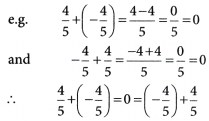
For any rational number \(\frac{p}{q}\) (q ≠ 0), there exists a rational numb (-\(\frac{p}{q}\)) such that
\(\frac{p}{q}\) +(-\(\frac{p}{q}\)) = 0
Thus, \(\frac{p}{q}\) is the additive inverse of \(\frac{p}{q}\) and vice-versa.
Note:
To find the additive inverse of any rational number change its sign.
Example 3.
For three rational numbers \(\frac{2}{3}, \frac{4}{5}\) and \(\frac{8}{15}\) show that associative property holds good for addition.
Solution:
Let a = \(\frac{2}{3}\), b = \(\frac{4}{5}\) and c = \(\frac{8}{15}\)
We know that associative property for addition,
a + (b + c) = (a + b) + c
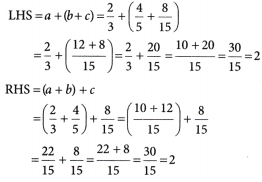
Thus, addition is associative for rational numbers.
Example 4.
Write the additive identity of the following.
(i) \(\frac{6}{5}\)
Solution:
Since, \(\frac{6}{5}\) + 0 = 0 + \(\frac{1}{2}\)
(ii) \(\frac{-9}{2}\)
Solution:
Since, \(\frac{-9}{2}\) + 0 = 0 + \(\left(-\frac{9}{2}\right)=-\frac{9}{2}\)
Therefore, additive identity of \(\frac{-9}{2}\) is 0.
Example 5.
Find the additive inverse of the following.
(a) \(\frac{-4}{5}\)
Solution:
Since, \(-\frac{4}{5}+\frac{4}{5}\) = 0
Therefore, additive inverse of \(\frac{-4}{5}\)is \(\frac{4}{5}\).
(b) 3\(\frac{4}{5}\)
Solution:
Here, 3\(\frac{4}{5}\) = \(\frac{19}{5}\)
Since, \(\frac{19}{5}+\left(-\frac{19}{5}\right)\) = 0
Therefore additive inverse of \(\frac{19}{5}\) is \(\frac{-19}{5}\).
Subtraction of Rational Numbers
To find the subtraction of two number, firstly express the two rational numbers as fraction \(\frac{a}{b}\) and \(\frac{c}{b}\). with the same denominator.
Then, \(\frac{a}{b}-\frac{c}{b}=\frac{a-c}{b}\)
Example 6.
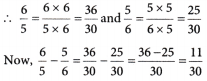
Find the difference \(\frac{6}{5}\) and \(\frac{5}{6}\)
Solution:
Give, numbers are \(\frac{6}{5}\) and \(\frac{5}{6}\)
To make same denominator of both numbers, multiply both numerator and denominator of both the numbers by 30 i.e. LCM of 5 and 6.
Properties of Subtraction of Rational Numbers
Closure
Rational numbers are closed under subtraction.
For any two rational numbers a and b, a – b is also a rational number.
e.g. Let two rational numbers be a = \(\frac{5}{3}\) and b = \(\frac{14}{6}\).
Then, a – b = \(\frac{5}{3}-\frac{14}{6}=\frac{10-14}{6}=-\frac{4}{6},\)
which is also a rational number.
Not Commutative under Subtraction
Rational numbers are not commutative under subtraction.
For any two rational numbers a and b,
a – b ≠ b – a
e.g. Let two rational numbers be a = \(\frac{2}{3}\) and b = \(\frac{5}{4}\).
Then, a – b = \(\frac{2}{3}-\frac{5}{4}=\frac{8-15}{12}=-\frac{7}{12}\)
and b – a = \(\frac{5}{4}-\frac{2}{3}=\frac{15-8}{12}=\frac{7}{12}\)
∴ a – b ≠ b – a
So, subtraction is not commutative.
Not Associative under Subtraction
Rational numbers are not associative under subtraction
For any three rational numbers a, b and c,
a – (b – c) ≠ (a – b) – c
e.g. Let three rational numbers be a = –\(\frac{2}{3}\), b = –\(\frac{4}{5}\) and c = \(\frac{1}{2}\)
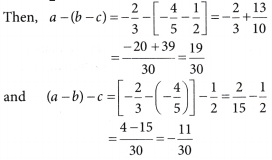
∴ a – (b – c) ≠ (a – b) – c
So, subtraction is not associative.
Example 7.
Check the commutativity of subtraction for the pair of rational numbers – \(\frac{-5}{4}\) and \(\frac{3}{8}\).
Solution:
Let a = – \(\frac{-5}{4}\) and b = \(\frac{3}{8}\).
LHS = a – b = \(-\frac{5}{4}-\frac{3}{8}=\frac{-10-3}{8}=-\frac{13}{8}\)
RHS = b – a = \(\frac{3}{8}-\left(-\frac{5}{4}\right)=\frac{3}{8}+\frac{5}{4}=\frac{3+10}{8}=\frac{13}{8}\)
Thus, \(\frac{13}{8} \neq \frac{13}{8}\)
∴ The subtraction is not commutative for rational numbers.
Multiplication of Rational Numbers
For two rational numbers \(\frac{a}{b}\) and \(\frac{c}{d}, \frac{a}{b} \times \frac{c}{d}=\frac{a \times c}{b \times d}\)
Example 8.
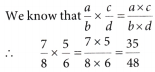
Find the product of \(\frac{7}{8}\) and \(\frac{5}{6}\)
Solution:
Given, numbers are \(\frac{7}{8}\) and \(\frac{5}{6}\)
Properties of Multiplication of Rational Numbers
Closure
Rational numbers are closed under multiplication.
For any two rational numbers a and b, a × b is also a rational number.
e.g. Let two rational numbers be a = \(\frac{5}{4}\) and b = \(\frac{6}{7}\)
Then, a × b = \(\frac{5}{4} \times \frac{6}{7}=\frac{30}{28}=\frac{15}{14}\), which is also a rational number.
Commutative
Rational numbers are commutative under multiplication.
For any two rational numbers a and b, a × b = b × a
e.g. Let two rational numbers he a = \(\frac{5}{3}\) and b = \(-\frac{4}{5}\)
Then, a × b = \(\frac{5}{3} \times\left(-\frac{4}{5}\right)=-\frac{20}{15}\) and b × a = \(\left(-\frac{4}{5}\right) \times \frac{5}{3}=-\frac{20}{15} .\)
∴ a × b = b × a
So, multiplication is commutative for rational numbers.
Associative
Rational numbers are associative under multiplication.
For any three rational numbers a, b and c,
a × (b × c) = (a × b) × c
e.g. Let three rational numbers be a = \(\frac{5}{3}\), b = \(\frac{-4}{7}\) and c = \(\frac{3}{5}\)
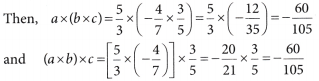
∴ (a × b) × c = (a × b) × c
So, multiplication is associative for rational numbers.
Existebce of Multiplicative identity
When we multiply any rational number with 1, the product is again that rational number.
\(\left(\frac{a}{b}\right)\) × 1 = 1 × \(\left(\frac{a}{b}\right)=\frac{a}{b}\)
e.g. Let \(\frac{5}{2}\) be any rational number then \(\frac{5}{2}\) × 1 = \(\frac{5}{2}\)
So, we can say that 1 is the multiplicative identity for rational numbers.
Existence of Multiplication Inverse (Reciprocal):
A rational number \(\frac{a}{b}\) is called the reciprocal or multiplicative inverse of another rational number \(\frac{c}{d}\),
if \(\frac{a}{b} \times \frac{c}{d}\) = 1.
e.g. Let \(\frac{a}{b}=\frac{5}{9}\) and \(\frac{c}{d}=\frac{9}{5}\) then \(\frac{5}{9} \times \frac{9}{5}\) = 1
i.e. \(\frac{5}{9}\) is called the reciprocal of \(\frac{9}{5}\) and vice-versa.
Multiplicative inverse of any non-zero rational number \(\frac{p}{q}\) can be find by interchanging the numerator and
denominator i.e. it will be \(\frac{p}{q}\).
Note:
There is no rational number, which gives 1 when muhiplied by 0. Thus, zero has no muiliplicative inverse.
Example 9.
Are the rational numbers closed under multiplication? Justify.
Solution:
Rational numbers are closed under multiplication i.e. product of any two rational number is always a rational number.
For any two rational numbers \(\frac{2}{12}\) and \(\frac{1}{12}\)
\(\frac{2}{12} \times \frac{1}{12}=\frac{2}{144}\), which is a rational number.
Example 10.
Verity the commutative property of multiplication for the pair of rational numbers –\(\frac{5}{6}\) and \(\frac{3}{5}\).
Solution:
The commutative property of multiplication for two rational numbers a and b is a × b = b × a.
Let a = –\(\frac{5}{6}\) and b = \(\frac{3}{5}\).
LHS = a × b = \(\left(-\frac{5}{6}\right) \times \frac{3}{5}=-\frac{1}{2}\)
RHS = b × a = \(\frac{3}{5} \times\left(-\frac{5}{6}\right)=-\frac{1}{2}\)
which shows that rational numbers –\(\frac{5}{6}\) and \(\frac{3}{5}\) hold commutative property for multiplication.
Example 11.
For three rational numbers, \(\frac{2}{3}, \frac{4}{5}\) and \(\frac{8}{15}\) show that associative property holds good for multiplication.
Solution:
Let a = \(\frac{2}{3}\), b = \(\frac{4}{5}\) and c = \(\frac{8}{15}\).
We know that associative property for multiplication,
a × (b × c) = (a × b) × c
LHS = a × (b × c) = \(\frac{2}{3} \times\left(\frac{4}{5} \times \frac{8}{15}\right)\)
= \(\frac{2}{3} \times\left(\frac{32}{75}\right)=\frac{64}{225}\)
RHS = (a × b) × c = \(\left(\frac{2}{3} \times \frac{4}{5}\right) \times \frac{8}{15}=\frac{8}{15} \times \frac{8}{15}=\frac{64}{225}\)
Thus, multiplication is associative for rational numbers.
Example 12.
Write the multiplicative identity of the following.
(i) \(\frac{10}{17}\)
Solution:
For rational number \(\frac{10}{17}, \frac{10}{17} \times 1=1 \times \frac{10}{17}=\frac{10}{17}\)
So, 1 is the multiplicative identity of rational number \(\frac{10}{17}\)
(ii) \(-\frac{5}{3}\)
Solution:
For rational number \(-\frac{5}{3},-\frac{5}{3} \times 1=1 \times\left(-\frac{5}{3}\right)=-\frac{5}{3}\)
So, 1 is the multiplicative identity of rational number \(-\frac{5}{3}\)
Example 13.
Find the multiplicative inverse of the following.
(i) \(-\frac{8}{5}\)
Solution:
Since, \(-\frac{8}{5} \times\left(-\frac{5}{8}\right)\)
Therefore, multiplicative inverse of — is ——.
(ii) -2\(\frac{1}{8}\)
Solution:
Since, \(-\frac{17}{8} \times\left(-\frac{8}{17}\right)\) = 1
So, multiplicative inverse of \(-\frac{17}{8}\) is \(-\frac{8}{17}\)
Therefore, multiplicative inverse of -2\(\frac{1}{8}\) is \(-\frac{8}{17}\).
Example 14.
Name the property under multiplication used in each of the following.
(i) \(-\frac{7}{10} \times 1=1 \times\left(-\frac{7}{10}\right)=-\frac{7}{10}\)
Solution:
\(-\frac{7}{10} \times 1=1 \times\left(-\frac{7}{10}\right)=-\frac{7}{10}\)
Here, 1 is the multiplicative identity.
(ii) \(\left(-\frac{9}{10}\right) \times\left(-\frac{11}{19}\right)=\left(-\frac{11}{19}\right) \times\left(-\frac{9}{10}\right)\)
Solution:
\(\left(-\frac{9}{10}\right) \times\left(-\frac{11}{19}\right)=\left(-\frac{11}{19}\right) \times\left(-\frac{9}{10}\right)\)
The commutative property is used in this equation.
(iii) \(\left(-\frac{33}{5}\right) \times\left(-\frac{5}{33}\right)\) = 1
Solution:
\(\left(-\frac{33}{5}\right) \times\left(-\frac{5}{33}\right)\) = 1
The multiplicative inverse property used in this equation.
Distributivity of Multiplication Over Addition and Subtraction for Rational Numbers
Distributivity of Multiplication Over Addition
For any three rational numbers a, h and c,
a(b + c) = ab ± ac
e.g. Let the three rational numbers be a = \(\frac{-3}{4}\), b = \(\frac{2}{3}\) and c = –\(\frac{5}{6}\)
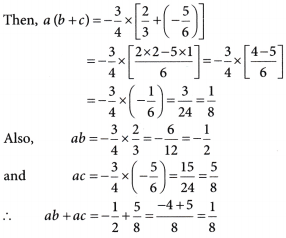
So, a(b + c) = ab + ac
Distributivity of Multiplication Over Subtraction
For any three rational numbers a, b and c,
a(b – c) = ab – ac
e.g. Let the three rational numbers be a = \(\frac{-3}{4}\), b = \(\frac{2}{3}\) and c = –\(\frac{5}{6}\)
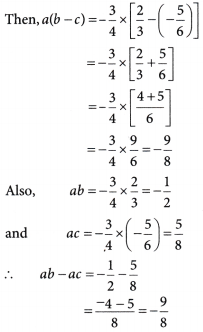
So, a(b – c) = ab – ac
Example 15.
Using appropriate properties, find
\(\frac{2}{3} \times\left(-\frac{5}{7}\right)+\frac{7}{3}+\frac{2}{3} \times\left(-\frac{2}{7}\right)\)
Solution:
We have, \(\frac{2}{3} \times\left(-\frac{5}{7}\right)+\frac{7}{3}+\frac{2}{3} \times\left(-\frac{2}{7}\right)\)
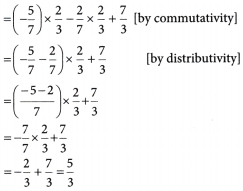
Division of Rational Numbers
Rational number \(\frac{a}{b}\) is divided by another rational number
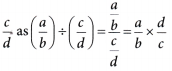
= \(\frac{a}{b}\) × Multiplicative inverse of \(\frac{c}{d}\).
Result of division of two rational numbers by \(\frac{a}{b}\) is \(\frac{c}{d}\) same as multiplication 0f \(\frac{a}{b}\) and multiplicative inverse of \(\frac{c}{d}\).
Example 16.
Find \(\frac{7}{6} \div \frac{4}{3}\)
Solution:
We know that \(\frac{a}{b} \div \frac{c}{d}=\frac{a}{b} \times \frac{d}{c}\)
∴ \(\frac{7}{6} \div \frac{4}{3}=\frac{7}{6} \times \frac{3}{4}=\frac{21}{24}\)
Properties of Division of Rational Numbers
Closure
Rational numbers are not closed under division.
Let \(\frac{a}{b}\) and \(\frac{c}{d}\) be any two rational numbers such that \(\frac{c}{d}\) ≠ 0
then \(\frac{a}{b} \div \frac{c}{d}\) is always a rational number.
e.g. \(-\frac{5}{3} \div \frac{2}{5}=-\frac{5}{3} \times \frac{5}{2}=-\frac{25}{6}\), which is also a rational number.
Note:
For rational number zero and any non-zero rational number a.a ÷ 0 is not defined I.e. rational numbers are not closed under division. However, if we exclude zero then rational numbers are closed under divison.
Zero divided by any non-zero rational number \(\frac{p}{q}\) is always 0
i.e.0 ÷ \(\frac{p}{q}\) = 0
Commutative
For any two rational numbers a and b,
a ÷ b ≠ b ÷ a
e.g. Let two rational numbers be a = –\(\frac{5}{3}\) and b = \(\frac{3}{7}\)
Then, a ÷ b = \(-\frac{5}{3} \div \frac{3}{7}=-\frac{5}{3} \times \frac{7}{3}=-\frac{35}{9}\)
and b ÷ a = \(\frac{3}{7} \div\left(-\frac{5}{3}\right)=\frac{3}{7} \times\left(-\frac{3}{5}\right)=-\frac{9}{35}\)
∴ a ÷ b ≠ b ÷ a
Associative
For any three rational numbers a, b and c,
a ÷ (b ÷ c) ≠ (a÷ b) ÷ c
e.g. Let three rational numbers be
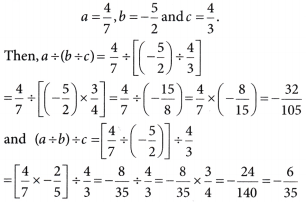
∴ a ÷ (b ÷ c) ≠ (a ÷ b) ÷ c
So, division is not associative for rational numbers.
Example 17.
Find \(\left(\frac{5}{4}\right) \div\left(-\frac{9}{7}\right) \times \frac{16}{25} \div\left(\frac{18}{21}\right)\)
Solution:
We have, \(\left(\frac{5}{4}\right) \div\left(-\frac{9}{7}\right) \times \frac{16}{25} \div\left(\frac{18}{21}\right)\)
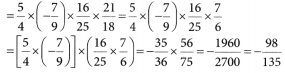
Using some properties, we can made calculations easy.
We can solve it as
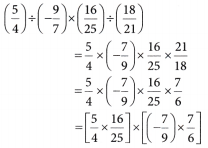
[by commutativity and associativityl
= \(\frac{4}{5} \times\left(-\frac{49}{54}\right)=-\frac{98}{135}\)
Hence, we observed thai using commutativity and associativity it is casier to solve the above problems.
Density of Rational Numbers
(Rational Numbers between Two Rational Numbers)
The density of rational numbers means that between any two distinct rational numbers, there exists atleast one (and consequently infinitely many) rational number.
Proof :
Let a and b be two rational numbers such that a < b.
Consider the number \(\frac{a+b}{2}\).
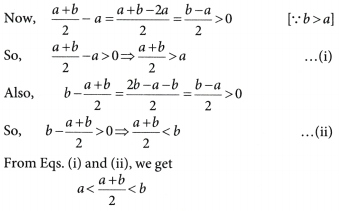
Thus, the rational number \(\frac{a+b}{2}\) lies between a and b.
Further, this process can be repeated to obtain infinitely many rational numbers between them.
Methods to Determine Rational Numbers Between Two Numbers
There are infinitely many rational numbers between any two rational numbers.
To determine one or more than one rational numbers between them, we use the following methods.
Determining One Rational Number
Let x and y be two rational numbers. x + y
Then, \(\frac{x+y}{2}\) is a rational number lying between x and y.
Example 1.
Find a rational number lying between 3 and 4.
Solution:
We know that if x and y are two rational numbers.
Then, \(\frac{x+y}{2}\) is a rational number between x and y
So, a rational number between 3 and 4 = \(\frac{3+4}{2}=\frac{7}{2}\)
Determining More than One Rational Numbers
To determine n rational numbers between two given rational numbers, there are two cases arise.
Case I:
When denominator are same.
If the denominators of two rational numbers are the same then multiplying by (n + 1) in both numerator and denominator in two given rational numbers.
e.g. To find four rational numbers between \(\frac{3}{5}\) and \(\frac{4}{5}\).
Firstly, we multiply by (n + 1) i.e. (4 + 1) = 5 in numerator and denominator of both the numbers then the numbers are \(\frac{3}{5} \times \frac{5}{5}\) and \(\frac{4}{5} \times \frac{5}{5}\) i.e. \(\frac{15}{25}\) and \(\frac{20}{25}\).
Therefore, \(\frac{16}{25}, \frac{17}{25}, \frac{18}{25}\) and \(\frac{19}{25}\) numbers between \(\frac{3}{5}\) and \(\frac{4}{5}\).
Case II:
When denominators are not same.
If the denominators of two rational numbers are different then first make their denominators the same by calculating LCM of the denominators. Then, follow the same method as in Case I.
e.g. To find four rational numbers between \(\frac{3}{2}\) and \(\frac{4}{5}\).
Firstly, change the denominator of \(\frac{3}{4}\) and \(\frac{4}{5}\) to 20
i.e. LCM of 4 and 5.
We have, \(\frac{3 \times 5}{4 \times 5}\) and \(\frac{4 \times 4}{5 \times 4}\)
i.e \(\frac{15}{20}\) and \(\frac{16}{20}\)
Now, multiply both the numerators and denominators by 4 + 1 = 5.
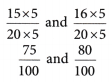
Therefore, \(\frac{76}{100}, \frac{77}{100}, \frac{78}{100}\) and \(\frac{79}{100}\) are four rational numbers between \(\frac{3}{4}\) and \(\frac{4}{5}\).
Question 2.
Find four rational numbers between 5 and 6.
Solution:
We write 5 and 6 as rational numbers with denominator 1
i.e. –\(\frac{5}{1}\) and \(\frac{6}{1}\).
Now, to find four rational numbers between \(\frac{5}{1}\) and \(\frac{6}{1}\), we multiply both the numerators and denominators by 4 + 1 = 5.
5 x \(\frac{5}{5}\) and 6 x \(\frac{5}{5}\)
\(\frac{25}{5}\) and \(\frac{30}{5}\)
Therefore, \(\frac{26}{5}, \frac{27}{5}, \frac{28}{5}\) and \(\frac{29}{5}\) are the four rational numbers between 5 and 6.
Example 3.
Find nine rational numbers between 0 and 0.1.
Solution:
We can write 0 and 0.1 as \(\frac{0}{10}\) and \(\frac{1}{10}\).
Now, to find nine rational numbers between \(\frac{0}{10}\) and \(\frac{1}{10}\).
We multiply both the numerators and denominators by 10.
\(\frac{0}{10} \times \frac{10}{10}\) and \(\frac{1}{10} \times \frac{10}{10}\)
i.e \(\frac{0}{10}\) and \(\frac{10}{10}\)
Therefore, \(\frac{1}{100}, \frac{2}{100}, \frac{3}{100}, \frac{4}{100}, \frac{5}{100}, \frac{6}{100}, \frac{7}{100}, \frac{8}{100}\) and \(\frac{9}{100}\) are nine rational numbers between 0 and 0.1.
Example 4.
Find four rational numbers lying between
Solution:
Firstly, change the denominators of \(\frac{3}{2}\) and \(\frac{2}{3}\) to 15
i.e. LCM of 5 and 3.
We have, \(\frac{3 \times 3}{5 \times 3}\) and \(\frac{2 \times 5}{3 \times 5}\) i.e. \(\frac{9}{15}\) and \(\frac{10}{15}\).
Now, to find four rational numbers between \(\frac{9}{15}\) and \(\frac{10}{15}\).
We multiply both the numerators and denominators by 4 + 1 = 5.
Now, \(\frac{9 \times 5}{15 \times 5}\) and \(\frac{10 \times 5}{15 \times 5}\) i.e. \(\frac{45}{75}\) and \(\frac{50}{75}\).
Therefore, \(\frac{46}{75}, \frac{47}{75}, \frac{48}{75}, \frac{49}{75}\) are four rational numbers between \(\frac{3}{5}\) and \(\frac{2}{3}\)
Decimal Expansions of Rational Numbers
For rational numbers of the form of \(\frac{p}{q}\), where q ≠ 0, when we divide p by q, two main cases arise.
Case I:
The remainder becomes zero.
On dividing p by q, if remainder becomes zero after some steps then decimal expansion terminates or ends after a finite number of steps. Such decimal expansion is called terminating decimal expansion.
e.g \(\frac{639}{250}\) i.e
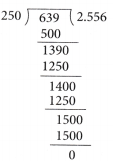
∴ \(\frac{639}{250}\) = 2.556
On dividing 639 by 250, we get the exact value 2.556 i.e. remainder is zero.
So, \(\frac{639}{250}\) has the terminating decimal expansion.
Case II:
The remainder never becomes zero.
On dividing p by q, if remainder never becomes zero and set of digits repeats periodically (or in same interval) then decimal expansion is called non-terminating repeating decimal expansion.
It is also known as non-terminating recurring decimal expansion.
The block of repeated digits is denoted by the bar (—) over it
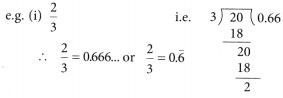
On dividing 2 by 3, we get the block of repeated number 6 again and again i.e. remainder never becomes zero. So, 2/3 has a non-terminating repeating decimal expansion.
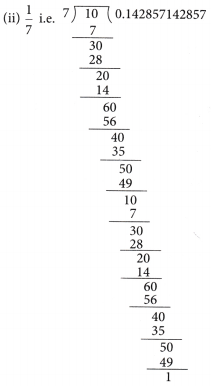
∴ \(\frac{1}{2}\) = 01428571428571……. or \(\frac{1}{2}\)
On dividing 1 by 7, we get the block of repeated numbers 142857 again and again i.e. remainder never becomes zero.
So, \(\frac{1}{7}\) has a non-terminating repeating decimal expansion.
Note:
The decimal expansion of a rational number es either terminating or non terminating recurring. In other words. a number whose decimal expansion is terminating or non-teminating recurring is a rational number
Example 1.
Write the following in decimal form and say, what kind of decimal expansion each has?
(i) \(\frac{39}{100}\)
Solution:
\(\frac{39}{100}\) = 0.39, so it has terminating decimal expansion
(ii) \(5 \frac{1}{8}\)
Solution:
\(5 \frac{1}{8}\) = 5.125 so it has terminating decimal expansion.
(iii) \(\frac{4}{13}\)
Solution:
\(\frac{4}{13}=0 . \overline{307692}\) So it has non-terminating repeating decimal expansion.
(iv) \(\frac{2}{15}\)
Solution:
\(\frac{2}{15}\) = 0.13̄ so it has non-terminating repeating decimal expansion.
(v) \(\frac{329}{500}\)
Solution:
\(\frac{329}{500}\) = 0.658, so it has terminating decimal expansion.
Example 2.
What can the maximum number of digits be in the repeating block of digits in the expansion of \(\frac{2}{13}\)? Perform the division to check your answer.
Solution:
To find the repeating block of digits in the expansion \(\frac{2}{13}\), divide 2 by 13
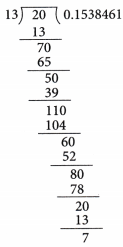
\(\frac{2}{13}=0 . \overline{153846}\)
Therefore, maximum number of digits in the repeating 2
block of digits of \(\frac{2}{13}=0 . \overline{153846}\) are 6.
Decimal Expansion of Rational Number
The decimal expansion of a rational number \(\frac{p}{q}\) (in simplest form) terminates if and only if the prime factorisation of denominator q is of the form 2n × 5m, where n and m are non-negative integers.
In other words, if the denominator of a rational numbers in the simplest form has only the prime factors 2 or 5 or both then its decimal expansion is terminating, otherwise it is non-terminating repeating decimal expansion.
Example 3.
Without performing long division, determine, which of the following rational numbers will have terminating decimals and which will be repeating.
(i) \(\frac{3}{8}\)
Solution:
We have, \(\frac{3}{8}\)
The factors of the denominator 8 are 23 × 50
So, \(\frac{3}{8}\) has a terminating decimal expansion,
(ii) \(\frac{14588}{625}\)
Solution:
We have, \(\frac{14588}{625}\)
The factors of the denominator 625 are 54 × 20.
(iii) \(\frac{31}{343}\)
Solution:
We have, \(\frac{31}{343}\)
The factor of the denominator is 73, which is not of the form 2n × 5m.
So, it has non-terminating repeating decimal expansion.
To Convert Terminating Decimal Expansion in the Form of \(\frac{p}{q}\)
To convert terminating decimal expansion in the form of \(\frac{p}{q}\), write the number without decimal as numerator and put 1 followed by zeros (equal to decimal places) in denominator.
e.g 0.48 = \(\frac{48}{100}=\frac{12}{25}\)
To Convert Non-terminating Recurring Decimal Expansion in the Form of \(\frac{p}{q}\)
Here, the conversion process is explained through two cases.
Case I: When no non-repeating digit exists between decimal and repeating digits.
e.g. Convert 0.6 in the form of p/q.
Step 1
Let x = 0.6̄ ⇒ x =0.666…
Step 2
Count the number of digits of repeating block (number of digit(s) under bar) (say R) and then multiply Eq. (i) by 10R.
Here, only 1 digit is repeating.
On multiplying both sides of Eq. (i) by 101, we get
10x = 6.666… .(ii)
Step 3
Now, on subtracting Eq. (i) from Eq. (ii), we get
10x – x = 6.666,.. – 0.666…
⇒ 9x = 6 ⇒ x = \(\frac{6}{9}\)
Hence, o.6̄ = \(\frac{6}{9}=\frac{2}{3}\)
Case II:
When non-repeating digits exist between decimal and repeating digits.
e.g. Convert 2.25 in the form of p/q.
Step 1.
Let x = 2.25 ⇒ x = 2.2555… …(i)
Step 2
Firstly, we multiply Eq. (I) by 10r, where r is the number of digits between decimal point and recurring digits.
Here, we see that only one digit 2 exists between decimal point and repeating number.
So, on multipling Eq. (i) by 101, we get
10x = 22.555… …(ii)
Step 3
Now, count the number of digits of repeating block (say R) and then multiply Eq. (ii) byIO’. Here, number of repeating digit is 1.
So, on multiplying Eq. (ii) by 101, we get
10(10x) = 225.555… 100x = 225.555…….. (iii)
Step 4
Now, on subtracting Eq. (ii) from Eq. (iii), we get
100x – 10x =225.555… – 22.555…
90x = 203
Hence, 2.25̄ = \(\frac{203}{90}\)
Example 4.
Show that 0.7̄ can be expressed In the form , where p and q are Integers such that q ≠ 0.
Solution:
Assume the given decimal expansion as x.
Then, x = 0.7̄ x = 0.777…
Here, only 1 digit is repeating.
On multiplying both sides of Eq. (i) by 10, we get
10x = 7.77… …(ii)
On subtracting Eq. (j) from Eq. (ii), we get
10x – x = 7.777… – 0.777…
9x = 7
x = \(\frac{7}{9}\)
Hence, 0.7̄ = \(\frac{7}{9}\)
Example 5.
Express \(0.2 \overline{25}\) in the \(\frac{p}{q}\) form, where p and q are integers and q≠0.
Solution:
Let x = 0.22525… .. .(i)
Here, we see that one digit (i.e. 2) exist between decimal point and recurring number.
So, on multiply both sides of Eq. (i) by 10, we get
10x = 2.2525… ..(îi)
Here, we see that two digits are repeating.
So, on multiply Eq. (ii) by 100, we get
1000x = 225.2525… .. .(iii)
On subtracting Eq. (ii) from Eq. (iii), we get
1000x – 10x = 225.2525 – 2.2525
⇒ 990 x = 223x ⇒ x =
Hence, \(0.2 \overline{25}=\frac{223}{990} .\)
Example 6.
Express 0.00323232… in the form of –
Solution:
Let x = 0.00323232… = \(0.00 \overline{32}\)
On multiplying Eq. (i) by 100, we get
100x = 0.323232… … (ii)
Again, on multiplying Eq. (ii) by 100, we get
10000x = 32.3232… …(iii)
On subtracting Eq. (ii) from Eq. (iii). we get
10000x – 100x = 32.3232 … – 0.3232…
9900x = 32 ⇒ x = \(\frac{32}{9900}=\frac{8}{2475}\)
Hence, 0.003232 … = \(\frac{8}{2475}\)
The Magic of Cyclic Numbers
When we convert \(\frac{1}{7}\) into decimal form, we get 0.142857142857 …, where 142857 is the repeating block,
This number is called a cyclic number.
Now, observe
142857 × 1 = 142857, 142857 × 2 = 285714
142857 × 3 = 428571, 142857 × 4 = 571428
142857 × 5 = 714285and 142857 × 6 = 857142
Here, the digits remain the same but shift their positions in a cyclic manner.
Hence, the number 142857 shows a cyclic pattern and this property is a special feature of the rational number \(\frac{1}{7}\).
Irrational Numbers
A number that cannot be expressed in the form \(\frac{p}{q}\), where p and q are integers and q ≠ 0, is called an irrational number.
e.g. √2, √3, √15, π, –\(-\frac{\sqrt{2}}{\sqrt{3}}\),0.1011011101111,…etc.
Theorem 1:
Let p be a prime number and a be a positive integer. If p divides a2 then p divides a.
Given Let p be a prime number and a be a positive integer such that p divides a2.
To prove p divides a.
Proof : We know that every positive integer can be expressed as the product of primes.
So, let a = p1 . p2 …….. pn, where p1, p2 ……….. pn are primes, not necessarily all distinct.
Then, a2 = (p1 . p2 …….. pn)(p1 . p2 …….. pn)
⇒ a2 = (p12 . p22 …….. pn2)
Now, p divides a2.
⇒ p is a prime factor of a2.
⇒ p is one of p1, p2 ,…, pn.
by fundamental theorem of arithmetic, the only prime factors of a2 are p1, p2, …… pn]
⇒ p divides a. [∵ a = p1, p2 ,…, pn]
Hence proved.
Theorem 2. √2 is irrational.
Proof: Let us assume that √2 be rational.
Then, it will be of the form \(\frac{a}{b}\), where a and b are integers and b ≠ 0.
Again, let a and b have no common factor other than 1.
∴ √2 = \(\frac{a}{b}\), where a and b are co-prime integers.
On squaring both sides, we get
2 = \(\frac{a^2}{b^2}\)
⇒ 2b2 = a2 …(i)
⇒ 2 divides a2
⇒ 2 divides a [from theorem 1]
Then, a can be written as 2m, where m is an integer.
On putting a = 2m in Eq. (i), we get
2b2 =(2m)2
⇒ 2b2 = 4m2
⇒ b2 = 2m2
So, 2 divides b2 ⇒ 2 divides b [from theorem 1]
Thus, 2 is a common factor of a and b.
But, this contradicts the fact that a and b have no common factor other than 1. The contradiction arises by assuming that V2 is rational.
Hence, √2 is irrational. Hence proved.
Example 1.
Prove that √3 is an irrational number.
Solution:
Let us assume that √3 is a rational number.
Then, there exist positive integers a and b such that
√3 = \(\frac{a}{b}\), where a and b are co-prime integers and b ≠ 0.
Now,√3 = \(\frac{a}{b}\) ⇒ 3 = \(\frac{a^2}{b^2}\)
⇒ 3b2 = a2
⇒ 3 divides a2
⇒ 3 divides a
So, 3 is a factor of a. …(i)
⇒ a = 3 c for some integer c
⇒ b2 = 9c2
=> 3b2 = 9c2 [∵ a2 = 3b2]
⇒ b2 = 3c2
⇒ 3 divides b2
⇒ 3 divides b
So, 3 is a factor of b. …(ii)
From Eqs. (i) and (ii), we observe that a and b have atleast 3 as a common factor. But this contradicts the fact that a and b are co-prime. This means that our assumption is wrong.
Hence, √3 is an irrational number.
Hence proved.
Example 2.
Show that 5√2 is an irrational number.
Solution:
Let us assume that 5√2 be a rational number. Then, it will be of the form \(\frac{p}{q}\), where p and q are co-prime integers and q ≠ 0.
Now, \(\frac{p}{q}\) = 5√2 ⇒ \(\frac{p}{5q}\) = √2 …(i)
Since, p is an integer and 5q is also an integer (5q≠ 0).
So, \(\frac{p}{5q}\) is a rational number.
∴ √2 is a rational number.
But, this contradicts the fact that Jl is an irrational number. Therefore, our assumption is wrong.
Hence, 5√2 is an irrational number. Hence proved.
Example 3.
Show that 5 + √3 is irrational.
Solution:
Let us assume that 5 + √3 be a rational number. Then, it will be of the form \(\frac{p}{q}\), where p and q are co-prime integers and q ≠ 0.
Now, 5 + √3 = \(\frac{p}{q}\)
On rearranging, we get -5 + \(\frac{p}{q}\) = √3
Since, -5 and \(\frac{p}{q}\) are rational. So, their sum will be rational.
√3 is rational. But, we know that √3 is irrational.
So, this contradicts the fact that √3 is irrational.
Therefore, our assumption is wrong.
Hence, 5 + √3 is irrational.
Hence proved.
Example 4.
Prove that 3√3 + \(\frac{7}{3}\) is an irrational number. Given that √3 is an irrational number.
Solution:
Let us assume that 3√3 + \(\frac{7}{3}\) be a rational number. So, it can be expressed in the form \(\frac{p}{q}\), where p and q are co-prime integers and q ≠ 0.
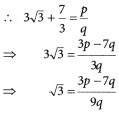
Since, 3q – 7q is an integer and 9q is also an integer.
So, \(\frac{3 p-7 q}{9 q}\) is a rational number.
√3 is a rational number.
But, it is given that √3 is irrational number.
So, it contradicts our assumption.
∴ 3√3 + \(\frac{7}{3}\) is an irrational number.
Hence proved.
Locate an Irrational Number on the Number Line
We can explain how to locate some irrational numbers of the form √n (like √2, √3, √5) on the number line with the help of following example.
Example 5.
Locate √3 on the number line.
Solution:
Step I
Firstly, we will convert the given number into two natural numbers, where in those two numbers, one number is fixed i.e. 1.
Here, 3 = 2 + 1 = (√2 )2 + 12
Step II
Draw a number line and mark point O as zero.
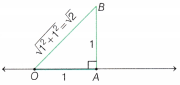
Now, mark point A at one unit distance from O, so OA = 1 unit.

Step III
Draw a right angled A.OAB such that AB = 1 unit By Pythagoras theorem, we get
(OB)2 = (OA)2 +(AB)2
= 12 + 12 = 2
⇒ OB = √2 units
Step IV
With O as the centre and OB as the radius, draw an arc that intersects the number line at point A1.
Thus. OA1 = OB = √2 units, which means A1 represents on the number line.
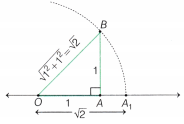
Step V
Draw another right angled AOA,B, such that A1B1 is perpendicular to OA1 and A1B1 = 1 unit.
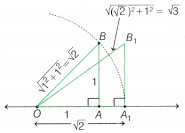
By Pythagoras theorem, we get
(OB)12 = (OA)122 + (A1B)12
= (√2)2 + 12 = 3
⇒ OB = √3 units
Step VI
With O as the centre and OB, as the radius, draw an arc that intersect the number line at point A2.
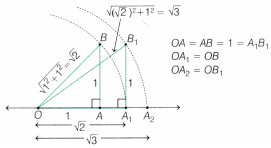
Thus, OA2 = OB1 = √3 units, which means A2 represents √3 on the number line.
Note:
In the same way, we can locate √n for any positive integer n, after \(\sqrt{n-1}\) has been located.
Square Root Spiral
A square root spiral is a spiral formed by constructing
right triangles one after another, where
. each triangle has one side of length 1 unit.
. the hypotenuse of each triangle represents
√2, √3, √4, √5.
Construction of Square Root Spiral
Take a large sheet of paper and construct the ‘square root spiral’ in the following pattern. Start with a point O and draw a line segment OP1 of unit length.
Draw a line segment P1P2, perpendicular to OP1 to unit length (see figure) and join OP2.
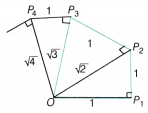
Now, draw a line segment P2P3, perpendicular to OP2 of unit length and join OP3. Then, draw a line segment P3P4, perpendicular to OP3 of unit length and join OP4. Continuing in this manner, you can get the line segment Pn-1Pn by drawing a line segment of unit length perpendicular to OPn-1 Thus, you have created the points P2, P3,…,Pn and join them to create a spiral depicting √2, √3, √4, ….