Students revise important topics using Class 8 Social Science Extra Questions and Class 8 SST Part 2 Chapter 4 The Role of the Judiciary in Our Society Extra Question Answer before exams.
The Role of the Judiciary in Our Society Class 8 Extra Question Answer
Extra Questions of The Role of the Judiciary in Our Society Class 8
The Role of the Judiciary in Our Society Class 8 Very Short Question Answer
Question 1.
Differentiate between substantive justice and procedural justice. (Competency Based Question)
Answer:
The difference between substantive justice and procedural justice are
| Basis | Substantive Justice | Procedural Justice |
| Meaning | Focuses on whether the final decision or outcome is fair, just and reasonable. | Focuses on ensuring that every person gets a fair opportunity to present their case before a decision is made. |
| Main Objective | Ensures justice through a fair and reasonable outcome. | Ensures justice through a fair and impartial decision-making process. |
Question 2.
Why must the Judiciary ensure that everyone is treated equally before the law?
Answer:
The Judiciary must ensure that everyone is treated equally before the law so that justice is delivered with fairness. This helps people live with equality and dignity and maintains peace and harmony in society.
Question 3.
A State government and the Central Government disagree over the control of a constitutional matter. The dispute cannot be settled through discussions. Which court will hear the case first? Give a reason. (Competency Based Question)
Answer:
The dispute will be heard directly by the Supreme Court of India because it has exclusive original jurisdiction to decide disputes between the Centre and a State.
Question 4.
A citizen believes that a law passed by the legislature violates the Constitution. How can the judiciary protect the Constitution in such a situation? (Competency Based Question)
Answer:
The judiciary protects the Constitution in the following ways
- It examines whether the law is consistent with the Constitution.
- It ensures that the legislature and executive function within constitutional limits.

Question 5.
What are the qualifications required for appointment as a Judge of the Supreme Court?
Answer:
A person can be appointed as a Judge of the Supreme Court if he/she
- Is a citizen of India.
- Has been a Judge of a High Court for at least five years.
- Has been an advocate of a High Court for at least ten years.
- Is a distinguished jurist in the opinion of the President.
Question 6.
Why was the concept of Public Interest Litigation (PIL) introduced?
Answer:
Public Interest Litigation was introduced to due to the following reasons
- Enable courts to address issues affecting the public at large.
- Strengthen the Right to Life under Article 21.
Question 7.
A group of residents wants to stop Industrial pollution that is contaminating a nearby river. Which legal remedy would be most suitable? Give a reason. (Competency Based Question)
Answer:
The residents can approach the court through a Public Interest Litigation (PIL) because
- Environmental protection is a matter of public interest.
- PIL allows issues affecting society as a whole to be brought before the courts.
Question 8.
Why have specialised tribunals been established in India?
Answer:
Specialised tribunals have been established in India because
- They deal with specific categories of disputes requiring specialised knowledge.
- They reduce the burden on regular courts.
Question 9.
A family paid an advance to a builder for a flat, but even after several years the construction did not begin. Which forum should they approach? Why? (Competency Based Question)
Answer:
The family should approach the Consumer Forum because the builder failed to fulfil the agreed service. Consumer Forum hear disputes related to deficiency in goods and services and can grant appropriate relief.
Question 10.
Under which act are Gram Nyayalayas established in India, and what is their primary objective?
Answer:
Gram Nyayalayas are established under the Gram Nyayalayas Act, 2008.
Their primary objective is to provide quick, affordable, and accessible justice to people living in rural areas.
The Role of the Judiciary in Our Society Class 8 Short Question Answer
Question 1.
Explain the importance of an independent judiciary in a democratic society.
Answer:
The importance of an independent judiciary in a democratic society are
- It ensures that disputes are decided fairly and impartially without interference from the legislature or the executive.
- It protects the Constitution and safeguards the Fundamental Rights of citizens.
- It ensures that both the government and citizens act within the framework of the law.
Question 2.
Discuss the role of the Supreme Court as the guardian of the Constitution.
Answer:
The Supreme Court acts as the guardian of the Constitution in the following ways
- It protects the Fundamental Rights of citizens through its writ jurisdiction.
- It settles constitutional disputes between the Centre and the States.
- It ensures that laws and executive actions are consistent with the Constitution.
Question 3.
A social organisation working in several States wants to challenge a policy that violates the Fundamental Rights of people across India. Which court should it approach? Explain your answer. (Competency Based Question)
Answer:
The organisation should approach the Supreme Court of India because
- A writ petition can be filed directly before the Supreme Court under Article 32 for enforcement of Fundamental Rights.
- The issue has an all-India impact affecting people in different States.
- The Supreme Court has the authority to protect Fundamental Rights throughout the country.
Question 4.
Explain the functions of the High Courts in India.
Answer:
The High Courts perform the following functions
- They hear appeals from subordinate courts in civil and criminal cases.
- They exercise writ jurisdiction for the enforcement of Fundamental Rights within their territorial limits.
- They supervise subordinate courts and tribunals under Article 227.
Question 5.
What are the key objectives of the newly enacted criminal laws that replaced the older colonial codes?
Answer:
The key objectives of the newly enacted criminal laws that replaced the older colonial codes are as follows
- The new laws (Bharatiya Nyaya Sanhita, Bharatiya Nagarik Suraksha Sanhita and Bharatiya Sakshya Adhiniyam) aim to facilitate faster justice.
- They promote the use of digital evidence and modern technology in court proceedings.
- They provide better protection for victims while making the entire justice system more modern, transparent, and effective.
Question 6.
A District Court delivers a judgment in a criminal case. One of the parties believes that the judgement is incorrect and wants to challenge it. Explain the judicial process that can be followed. (Competency Based Question)
Answer:
The judicial process that can be followed are
- An appeal can first be filed before the High Court.
- If the case involves an important question of law or constitutional interpretation, it may further reach the
Supreme Court through its appellate jurisdiction. - This system ensures that judicial decisions can be reviewed at higher levels.
Question 7.
Explain how digital technology has improved the functioning of the judicial system in India.
Answer:
Digital technology has strengthened the judicial system in the following ways
- Court orders and judgments are made available digitally in multiple languages.
- Facilities such as e-Filing and hybrid hearings improve access to justice.
- The National Judicial Data Grid and Virtual Justice Clock promote transparency and public access to judicial information.
Question 8.
Two neighbouring families are involved in a property dispute. They wish to settle the matter quickly without going through a lengthy court trial while maintaining cordial relations. Suggest a suitable method of dispute resolution and justify your answer. (Competency Based Question)
Answer:
Mediation would be the most suitable method because
- A neutral mediator helps both parties arrive at a mutually acceptable settlement.
- The mediator does not impose a decision, allowing both parties to participate voluntarily.
- It helps preserve friendly relations by encouraging dialogue and cooperation.
The Role of the Judiciary in Our Society Class 8 Long Question Answer
Question 1.
Analyse the relationship between law and justice in a democratic society.
Answer:
The relationship between law and justice in a democratic society can be understood in the following ways
- Laws provide a framework to regulate the conduct of individuals and maintain peace and order in society.
- The judicial system ensures that laws are applied fairly and that every individual receives justice in accordance
with the Constitution. - Courts protect citizens from arbitrary actions by ensuring that government authorities act within legal limits.
- Laws that are unjust or inconsistent with democratic values may be repealed to uphold equality, dignity, and justice.
- Law promotes equality before the law by ensuring that all individuals are treated fairly, irrespective of their background, status, or position.
Question 2.
Evaluate the significance of the Supreme Court’s various jurisdictions in protecting the Constitution and citizens’ rights.
Answer:
The significance of the Supreme Court’s various jurisdictions in protecting the Constitution and citizens’ rights are as follows
- Through writ jurisdiction, it safeguards the Fundamental Rights of citizens.
- Through original jurisdiction, it resolves disputes between the Centre and States, preserving the federal structure.
- Through appellate jurisdiction, it reviews important decisions of High Courts and specialised tribunals, ensuring uniform interpretation of law.
- Through advisory jurisdiction, it assists the President by giving opinions on important legal and constitutional matters.
- Through Special Leave Petitions (Article 136), it may hear appeals from any court or tribunal to ensure justice
in cases involving important questions of law.
Question 3.
A newly enacted law ¡s alleged to violate the Fundamental Rights of citizens across several States. Citizens’ groups decide to challenge the law before the courts. Examine how different constitutional powers of the Supreme Court may help in resolving the Issue. (Competency Based Question)
Answer:
The constitutional powers of the Supreme Court may help resolve the issue in the following ways
- Citizens’ groups may directly file a writ petition under Article 32 for the enforcement of Fundamental Rights.
- As the final interpreter of the Constitution, the Supreme Court examines whether the newly enacted law is Consistent with constitutional provisions.
- If the law is found to violate Fundamental Rights, the Court can issue appropriate directions or orders to protect the rights of citizens.
- The law declared by the Supreme Court under Article 141 is binding on all courts in India, ensuring uniform application of the decision across the country.
- If necessary, the Supreme Court may also exercise its power under Article 142 to pass orders required for doing complete justice in the matter.
Question 4.
Discuss the role of the High Courts and Subordinate Courts in ensuring access to justice.
Answer:
The role of the High Courts and Subordinate Courts in ensuring access to justice is as follows
Role of High Courts
- They hear appeals against the decisions of subordinate courts.
- They exercise writ jurisdiction for the protection of Fundamental Rights within their territorial jurisdiction.
- They supervise subordinate courts and tribunals to ensure proper administration of justice.
Role of Subordinate Courts
- They deal with most civil and criminal disputes at the district and local levels.
- They provide people with the first level of judicial access.
- They bring the justice delivery system closer to citizens and ensure speedy disposal of everyday disputes.
Question 5.
Assess the importance of tribunals in the Indian judicial system.
Answer:
The importance of tribunals in the Indian judicial system is as follows
- Tribunals deal with specialised disputes requiring technical expertise.
- They help reduce the workload of regular courts.
- They ensure quicker disposal of cases related to areas such as the environment, consumer protection, company law, and service matters.
- Different tribunals provide specialised remedies according to the nature of disputes.
- They improve the overall efficiency and accessibility of the justice delivery system.
Question 6.
A city is witnessing a rapid increase in pending court cases. The State government wants to promote faster and less expensive methods of dispute resolution without affecting justice. Evaluate how alternate dispute resolution mechanisms and digital initiatives can help achieve this objective. (Competency Based Question)
Answer:
Alternate dispute resolution mechanisms and digital initiatives can improve the Justice delivery system in the following ways
- Alternate Dispute Resolution
- Arbitration provides legally binding decisions outside regular courts.
- Mediation encourages mutually acceptable settlements through dialogue.
- Lok Adalats help resolve disputes amicably with simplified procedures.
- Gram Nyayalayas provide easy access to justice at the village level.
Digital Initiatives
- e-Filing reduces paperwork and saves time.
- Hybrid hearings improve accessibility for litigants.
- The National Judicial Data Grid enables Citizens to track case status.
- Online availability of judgments promotes transparency and public confidence in the judicial system.
The Role of the Judiciary in Our Society Class 8 Case Based Questions
Question 1.
Read the passage given below and answer the following questions.
Arbitration is a mode of dispute resolution, where the parties agree to refer their disputes to an independent adjudicator or panel of adjudicators, referred to as an ‘arbitrator’ or ‘panel of arbitrators’.
An arbitrator can be a retired judge, a lawyer, or an expert. In arriving at a decision, the arbitrator must follow certain basic requirements, such as acting fairly and impartially, allowing each party to put forth their respective case.
The decision of the arbitrator/ panel is final and legally binding on the parties, and enforceable by a court of law. Arbitration in India is conducted under the Arbitration and Conciliation Act, 1996.
(i) Why is it important for both parties to present their views during arbitration?
Answer:
It is important for both parties to present their views during arbitration because it ensures that each side gets an equal opportunity to explain its case. This helps the arbitrator understand all the facts and make a fair and impartial decision.
(ii) Why is the decision of an arbitrator legally binding on the parties?
Answer:
The decision of an arbitrator is legally binding because both parties voluntarily agree to accept the arbitrator’s decision before the proceedings begin. This ensures that the dispute is resolved finally and the decision can be enforced by a court of law.
(iii) Explain why an arbitrator is expected to act fairly and Impartially while resolving a dispute.
Answer:
An arbitrator is expected to act fairly and impartially while resolving a dispute because both parties deserve equal treatment. A neutral approach ensures that the decision is based only on facts and evidence, making the outcome just and acceptable.
Question 2.
Read the passage given below and answer the following questions.
In each State, there is a system of subordinate courts below the High Courts. The Constitution makes a few provisions in Articles 233 to 237 of the Constitution to regulate the organisation of these courts, and to ensure independence of the subordinate judiciary.
The subordinate judiciary constitutes a very important segment of the judicial system, as it is in these courts that the judiciary comes in close contact with the people.
Subordinate Courts broadly include District Courts, Sessions Courts, Revenue Courts, Small Causes Courts, etc. It is incumbent on each High Court to maintain and uphold the honour and integrity of the subordinate judiciary in the concerned States. The Governor of a State, in consultation with the High Court. appoints the District Judges (Article 233).
(i) Why are subordinate courts considered the foundation of the Indian judicial system?
Answer:
Subordinate courts are considered the foundation of the Indian judicial system because they are the first level of courts where people seek justice. They deal with most civil and criminal cases and ensure that justice is accessible to citizens at the local level.
(ii) Why does the Constitution contain separate provisions for the organisation of subordinate courts?
Answer:
The Constitution contains separate provisions for the organisation of subordinate courts to regulate their functioning and ensure their independence. These provisions help maintain an efficient judicial system and promote fair administration of justice.
(iii) How does the method of appointing District Judges help maintain the independence of the subordinate judiciary?
Answer:
The appointment of District Judges by the Governor in consultation with the High Court helps maintain the independence of the subordinate judiciary. This process ensures that appointments are made with judicial oversight, promoting fairness and impartiality.
A Journey Through Indian Architecture Class 8 Picture Based Questions
Question 1.
Answer the questions based on the pIcture given below.

(i) Mention the three forms of justice mentioned in the picture given below.
Answer:
The three forms of justice mentioned are social justice, economic justice, and political justice.
(ii) What does the phrase We, the People of India’ signify in the Preamble?
Answer:
The phrase “We, the People of India” signifies that the Constitution derives its authority from the people of India and reflects their collective will.
(iii) Name any two Ideals of the Preamble that promote equality and unity among citizens.
Answer:
Any two ideals are equality and fraternity.
Question 2.
Answer the questions based on the picture given below.
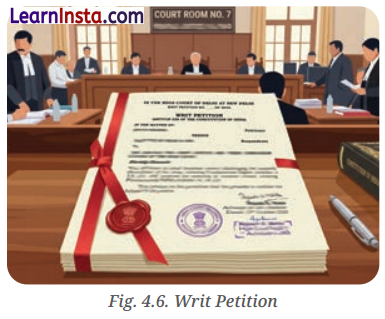
(i) Under which constitutional provisions can a citizen file a writ petition for the enforcement of Fundamental Rights?
Answer:
A citizen can file a writ petition for the enforcement of Fundamental Rights under Article 32 before the Supreme Court and Article 226 before the High Courts of India.
(ii) What is the primary purpose of the writ jurisdiction conferred on the Supreme Court and High Courts in india?
Answer:
The primary purpose of writ jurisdiction is to protect and enforce the Fundamental Rights of citizens and provide legal remedies against violations of these rights.
(iii) Why does the Constitution provide two separate forums-the Supreme Court and the High Court-for filing writ petitions?
Answer:
The Constitution provides two forums to make justice more accessible by allowing citizens to approach the Supreme Court at the national level and the High Courts within their respective States for the protection of rights.
Class 8 The Role of the Judiciary in Our Society Extra Questions for Practice
Objective Type Questions
Question 1.
Which Article of the Constitution empowers every High Court to exercise superintendence over all courts and tribunals within its territorial jurisdiction?
(a) Article 226
(b) Article 227
(c) Article 214
(d) Article 233
Question 2.
Which of the following best describes the role of a Constitution Bench of the Supreme Court?
(a) It hears only criminal appeals.
(b) It decides disputes related to consumer rights.
(c) It hears matters such as Presidential references on important questions of law.
(d) It appoints judges to the High Courts.
Question 3.
Which of the following is not a digital initiative introduced to improve the judicial system?
(a) Hybrid hearings
(b) National Judicial Data Grid
(c) Virtual Justice Clock
(d) Gram Nyayalayas
Question 4.
Assertion (A): Every High Court exercises jurisdiction only within its territorial limits.
Reason (R): A High Court can supervise all courts and tribunals functioning within its territorial jurisdiction.
(a) Both A and R are true, and R is the correct explanation of A.
(b) Both A and R are true, but R is not the correct explanation of
(c) A is true, but R is false.
(d) A ¡s false, but R is true.
Question 5.
Assertion (A): Lok Adalats can settle certain disputes even before a case reaches a regular court.
Reason (R): Lok Adalats function on the principle of amicable settlement between the parties.
(a) Both A and R are true, and R is the correct explanation of A.
(b) Both A and R are true, but R is not the correct explanation of A.
(c) A is true, but R is false.
(d) A is false, but R is true.
Question 6.
Match List I with List II
| List I (Leader) | List II (Contribution) |
| A. Article 141 | 1. Appointment of District Judges |
| B. Article 144 | 2. Law declared by the Supreme Court is binding on all courts |
| C. Article 233 | 3. All civil and judicial authorities shall act in aid of the Supreme Court |
| D. Article 214 | 4. Establishment of a High Court in each State |
Codes
A B C D
(a) 2 3 1 4
(b) 3 2 4 1
(c) 2 1 3 4
(d) 4 3 2 1
Subjective Type Questions
Question 1.
Explain the significance of the Preamble in relation to the judicial system of India.
Question 2.
State any two circumstances under which a citizen can directly approach the Supreme Court.
Question 3.
Explain the importance of writ jurisdiction in protecting the Fundamental Rights of citizens.
Question 4.
Describe the role played by the High Courts in maintaining the efficiency of the subordinate judiciary.
Question 5.
Examine how the constitutional powers of the Supreme Court help maintain the balance between the Centre, the
States and the citizens.
Question 6.
A citizen wants to challenge the violation of a Fundamental Right, while another person wishes to settle a consumer dispute against a builder. Analyse the different legal institutions and remedies available to each of them. (Competency Based Question)
Question 7.
Evaluate how technological innovations and judicial reforms have transformed the delivery of justice in India while improving transparency and accessibility.