Students prefer Class 5 English Santoor Solutions Unit 2 My Colourful World Chapter 3 The Rainbow Class 5 Questions and Answers that are written in simple and clear language.
Class 5 English Chapter 3 The Rainbow Question Answer
Class 5 English The Rainbow Question Answer
Class 5 The Rainbow Questions and Answers
Let us Think (Page 28)
A. Answer the following
Question 1.
Explain the meaning of the word ‘bow’ used in the poem.
Answer:
In the poem, the word ‘bow’ refers to a rainbow. It is described as a beautiful arc in the sky that looks like a bridge connecting the earth to the sky.
Question 2.
Which bridge does the poet like more and why?
Answer:
The poet likes the rainbow bridge more than the bridges built over rivers. She finds it prettier because it stretches across the sky and overtops the trees, making it a magical and beautiful sight.
Question 3.
The word ‘these’ is used for different things in stanzas one and two. What are the things for which ‘these’ has been used in each stanza?
Answer:
In stanza one, ‘these’ refers to the boats on rivers and ships on seas. In stanza two, ‘these’ refers to the bridges over rivers.

Question 4.
State whether the following are True or False.
(a) Ships sail on the river.
(b) Boats sail on the sea.
(c) Bridges are built on the river.
(d) A road is built from earth to the sky.
Answer:
(a) False
(b) False
(c) True
(d) False
B. Think and Discuss (Page 28)
Question 1.
What are the ways in which you can cross a river?
Answer:
We can cross a river by using a bridge, boat, or ferry. In some places, people may also use a raft, or swim, if it is safe.
Question 2.
Have you ever seen a rainbow in real life or in pictures? How did you feel?
Answer:
Yes, I have seen a rainbow in real life. It looked very colourful and beautiful. I felt happy and excited to see such a wonderful sight in the sky.
Question 3.
If you could walk on a rainbow, where do you think it would take you?
Answer:
If I could walk on a rainbow, I think it would take me high up into the sky, to a place filled with magic, stars, and dreams. Maybe I’d find a land of fairies!
Let us Learn (Page 29)
A. Rearrange the letters of each word to form a meaningful word from the poem. Write them in the space provided.
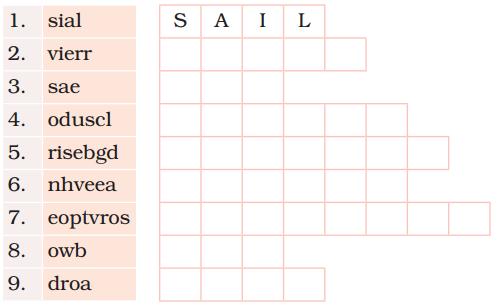
Answer:

B. Work in pairs. One of you moves a finger around in the circle. When your partner says ‘Stop’, perform the action indicated by the segment that the finger lands on.
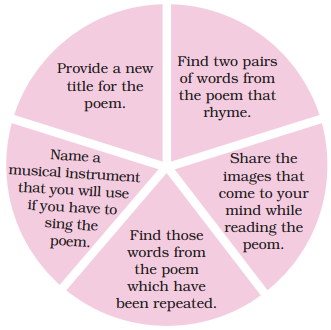
Answer:
(These answers are for reference only. Students should give their own answers)
- “The Magical Sky Bridge”
- Seas and these
Trees and please - A colourful rainbow across the sky
Boats and ships sailing on water
A bright sky filled with clouds
A bridge stretching from the ground to the sky - Sail
These
Pretty - Flute – because of its soft and dreamy sound that matches the peaceful mood of the poem.
Let us Listen (Page 30)
Sit in a circle and listen to the words read aloud by your teacher. Give five rhyming words for each word as indicated.
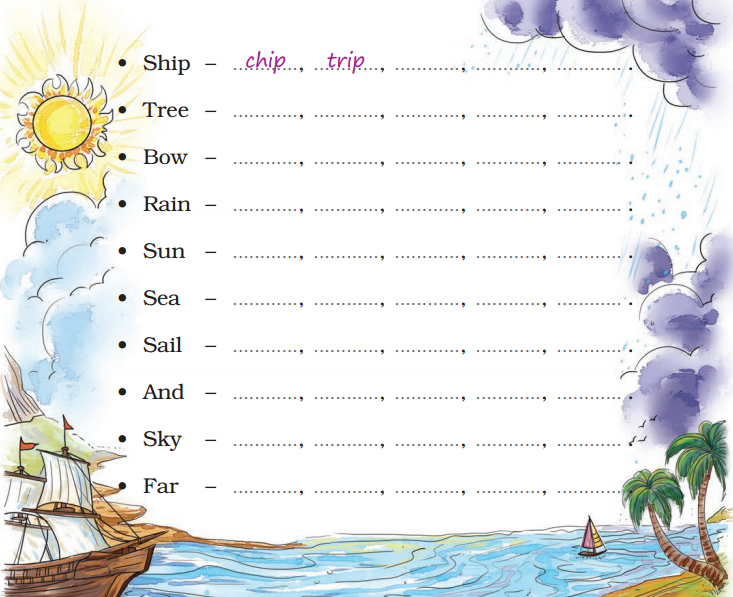
Answer:
- Ship – chip, trip, dip, slip, whip
- Tree – bee, see, free, three, me
- Bow – show, go, low, throw, snow
- Rain – train, pain, gain, brain, main
- Sun – fun, run, bun, done, none
- Sea – bee, key, me, flee, spree
- Sail – tail, mail, nail, fail, trail
- And – sand, hand, land, band, stand
- Sky – fly, try, cry, high, dry
- Far – star, car, jar, bar, par
Let us Speak
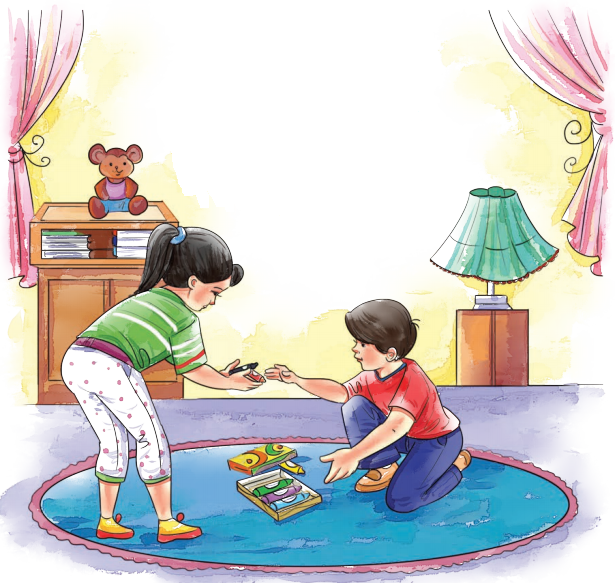
Recite the poem given below in three ways:
a. In a happy voice
b. In an angry voice
c. In a surprised voice
1. Colours
You have a few crayons,
Red, yellow and blue.
Green, purple and black,
I have some too
I need the red
and you need the black.
If we share our crayons,
we have a full pack!
2. Aachoo!
Once a mighty elephant,
Got a mighty cold.
It went to buy a handkerchief,
Where handkerchiefs were sold.
“A hanky for an elephant?”
The sales girl was surprised,
“Sorry sir but we don’t have
A handkerchief that size.”
“AACHOO!”said the elephant.
And shook its mighty head,
“Forget about the handkerchief
Give me a sheet instead.”
im-6
Answer:
Students, do as directed.
Let us Write (Pages 33-38)
A. The poem The Rainbow mentions boats and ships and their journey across the water bodies. You too may have travelled to different places. Share your experience of travelling to any one place with your class.
Write a short paragraph of 80-100 words about your journey to a place you visited recently.
You may include the following points in your paragraph:
- Time of journey and destination
- Purpose of travel
- Whom you travelled with
- Things you liked or disliked during your travel
- Local dishes and snacks
- Monument, landmark or scenery
Answer:
My Visit to Mussoorie
Last winter, I went to Mussoorie with my parents and younger sister. We travelled by car and reached in the evening. The purpose of our trip was to enjoy the cold weather and see the mountains. I loved the scenic views, especially the snow-covered hills and tall pine trees. We visited Kempty Falls and took many photos. I especially enjoyed the hot momo and the local sweets. However, the crowded Mall Road was a bit tiring. It was a short trip, but I had a lot of fun and felt very close to nature.
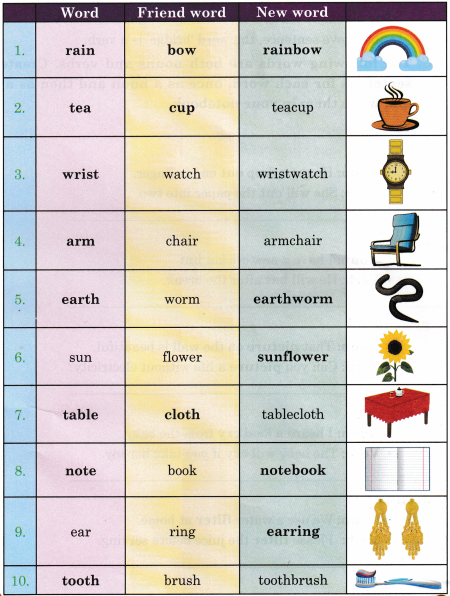
B. A word joins a ‘friend word’ to make new words, as shown below. Complete the table.
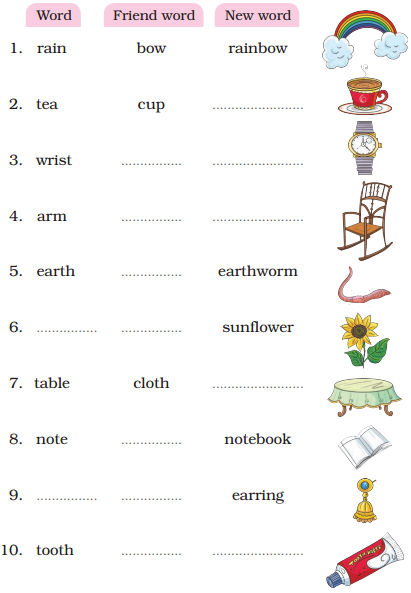
Answer:
Read the following sentences.
(a) I have seen a bridge made of roots in Meghalaya. In the above sentence, the word ‘bridge’ is a noun.
(b) Some planks of woods were used to bridge the stream.
In the above sentence, the word ‘bridge’ is a verb.
C. The following words are both nouns and verbs. Create two sentences for each word, once as a noun and then as a verb and write them in your notebook.
1. cut
2. bat
3. picture
4. cry
5. filter
6. dance
7. plant
8. paint
9. fly
10. face
Answer:
1. cut
- Noun: He got a deep cut on his finger.
- Verb: She will cut the paper into two.
2. bat
- Noun: I have a new cricket bat.
- Verb: He will bat after the break.
3. picture
- Noun: That picture on the wall is beautiful.
- Verb: Can you picture a life without electricity?
4. cry
- Noun: I heard a loud cry from the baby.
- Verb: The baby will cry if you take her toy.
5. filter
- Noun: We use a water filter at home.
- Verb: Please filter the juice before serving.
6. dance
- Noun: We watched a folk dance last evening.
- Verb: They will dance on stage tomorrow.
7. plant
- Noun: The plant needs water every day.
- Verb: We will plant trees on Earth Day.
8. paint
- Noun: The wall is covered in red paint.
- Verb: She wants to paint a sunset.
9. fly
- Noun: A fly was sitting on my food.
- Verb: Birds fly high in the sky.
D. 1. Write the opposites of the following words in the space provided. All your answers must begin with an ‘S’.
a. large × small
b. weak × s……………………
c. fast × s……………………
d. rough × s……………………
e. dull × s……………………
f. curved × s……………………
g. finish × s……………………
h. addition × s……………………
i. complicated × s……………………
j. mild × s……………………
k. blunt × s……………………
Now, make sentences using the words that you have written in the blanks. Write them in your notebook.
Answer:
| Word | Opposite (with ‘S’) |
| a. large | small |
| b. weak | strong |
| c. fast | slow |
| d. rough | smooth |
| e. dull | sharp |
| f. curved | straight |
| g. finish | start |
| h. addition | subtraction |
| i. complicated | simple |
| j. mild | severe |
| k. blunt | sharp |
Sentences using the ‘S’ words:
1. Strong winds blew across the field.
2. The tortoise is very slow.
3. The marble floor felt smooth.
4. Be careful, the knife is sharp.
5. Draw a straight line with a ruler.
6. Let’s start the game now.
7. We are learning subtraction in math today.
8. The puzzle was too simple for me.
9. The storm was very severe last night.
10. Please use the sharpened pencil for drawing.
2. In small groups, choose a letter of the English alphabet and create an exercise similar to the one above.
Answer:
An exercise similar to one above with words starting with ‘C’:
a. warm × cool
b. separate × combine
c. expand × contract
d. straight × curved
e. dirty × clean
f. coward × courageous
g. break × connect
h. complicate × clarify
i. scatter × collect
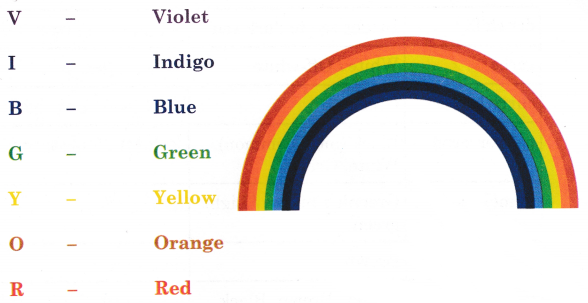
E. VIBGYOR— The colours of the rainbow.
VIBGYOR is an easy way to remember the seven colours of the rainbow in order.
V – Violet
I – Indigo
B – Blue
G – Green
Y – Yellow
O – Orange
R – Red
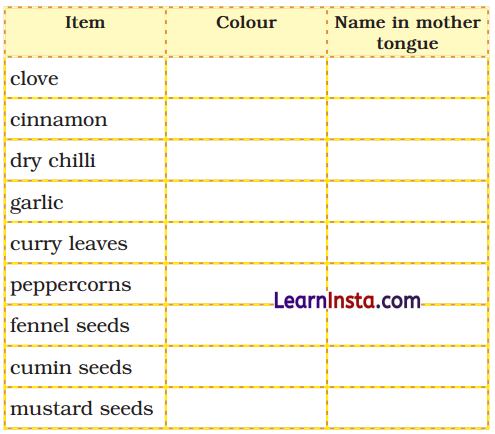
F. The following items, generally found in kitchens, add colour and taste to the food. What colours are they? Write them in the column. What do you call them in your mother tongue?
Answer:
| Item | Colour | Name in mother tongue (Hindi) |
| clove | Dark brown | Laung (लौंग) |
| cinnamon | Light to medium brown | Dalchini (दालचीनी) |
| dry chilli | Bright red to dark red | Sukhi Mirch (सूखी मिच) |
| garlic | White / Off-white | Lehsun (लहसुन) |
| curry leaves | Green | Kari Patta (करी पत्ता) |
| peppercorns | Black (most common), White, Green | Kali Mirch (काली मिच) |
| fennel seeds | Greenish-brown / Light green | Saunf (सौंफ) |
| cumin seeds | Brown | Jeera (जीरा) |
| mustard seeds | Yellow, Brown, Black | Sarson (सरसों) / Rai (राई) |
G. Welcome to the land of flowerpots! Design and colour a Flowerpot Friend!
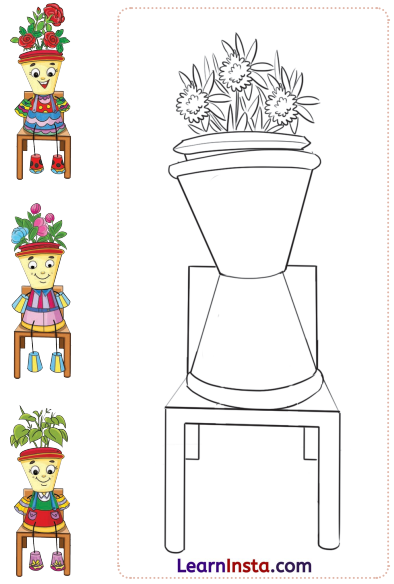
Answer:
Classroom activity. Students should do it themselves.
Let us Do (Page 39)
Do you know these colour combinations? Colour within the outline and write the name of the new colour.
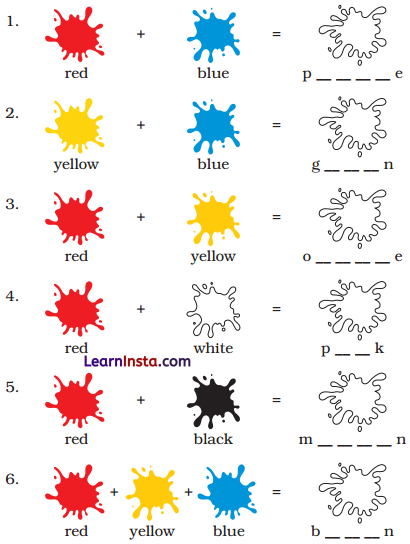
Answer:
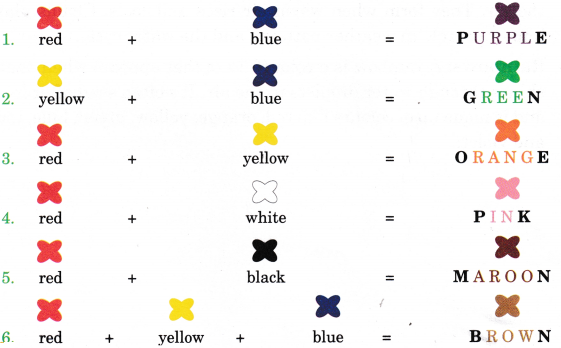
Let us Explore (Page 40)
A. Make a list of different types of boats. Collect pictures and information about the listed types of boats. Make a presentation to depict the differences among them.
Answer:
Students, do as directed.
B. Split the class into two groups. One group can talk about human-made things like ships and bridges. While the other discusses natural things like clouds and rainbows. Let them share their thoughts!
Answer:
Group 1: Human-made things (Ships and Bridges)
- Ships: Ships are large boats used to travel across seas and oceAnswer:They are made by humans to carry goods and people over long distances. Ships are designed to survive tough sea conditions.
- Bridges: Bridges are built to connect two places, like across rivers or valleys. They help people and vehicles cross safely. There are different types of bridges, such as suspension bridges and arch bridges.
Group 2: Natural things (Clouds and Rainbows)
- Clouds: Clouds are made up of tiny water droplets that float in the air. They form when warm air rises and cools. Clouds play an important role in weather patterns and the water cycle.
- Rainbows: A rainbow is a colourful arc that appears when sunlight shines through water droplets in the air. It’s often seen after it rains and is made up of colours like red, orange, yellow, green, blue, indigo, and violet.