Practice with Understanding Society India and Beyond Class 9 Solutions and Class 9 Social Science SST Chapter 9 The Price Puzzle What Drives the Market Question Answer NCERT Solutions to improve your exam performance.
Class 9 SST Chapter 9 The Price Puzzle What Drives the Market Question Answer
Class 9 The Price Puzzle What Drives the Market Question Answer
The Big Questions (Page No. 195)
Question 1.
What are the factors that influence the demand and supply of goods and services in a market?
Answer:
The demand for goods and services is influenced by several factors such as consumers’ income, tastes and preferences, population size, seasonality, future expectations, and the prices of substitute and complementary goods. For example, an increase in income may increase the demand for many products. Similarly, the supply of goods and services depends on factors such as the price of the product, cost of production, technology, number of sellers, weather conditions, and future expectations. Changes in any of these factors can increase or decrease demand and supply in the market.
Question 2.
How are prices of goods and services determined through demand and supply interactions?
Answer:
The demand for goods and services is influenced by factors such as the price of the product, income and purchasing power of consumers, prices of related goods, tastes and preferences, population, seasonality, and future price expectations. Similarly, the supply of goods and services depends on the price of the product, prices of related goods the number of sellers, technology, and future expectations. These factors determine how much buyers wish to purchase and how much sellers are willing to supply.
Question 3.
What is market equilibrium, and does it exist in the real world?
Answer:
Market equilibrium is the situation in which the quantity demanded by consumers is equal to the quantity supplied by producers. At this point, there
is neither a shortage nor a surplus of goods, and the market settles at an equilibrium price and quantity. In theory, equilibrium occurs where the demand curve intersects the supply curve. However, in the real world, markets are constantly changing because of factors such as technology, income levels, weather conditions, trends, and global events. Therefore, equilibrium is not fixed, and markets continuously adjust towards a new equilibrium.
Question 4.
How and why does the government intervene in the market?
Answer:
The government intervenes in the market to ensure fairness, protect consumers, and promote public welfare. It regulates unfair practices, controls monopolies, sets price ceilings on essential goods, and establishes minimum wages through price floors. The government also provides public goods and services such as roads, parks, sanitation, and national defence, which private firms may not provide adequately. Government intervention becomes necessary when markets fail to distribute goods fairly or when essential products become unaffordable. Through regulations and public services, the government seeks to maintain social welfare, equity, and economic stability.

The Price Puzzle What Drives the Market Question Answer Class 9
InText Questions
Let’s Explore
Question 1.
Create your own demand schedule for buying notebooks at different prices. At what price would you buy the most? At what price would you stop buying altogether? What could be the reason behind your choices? (Page No. 200)
Answer:
Do it yourself.
Question 2.
Ask your family members if they postponed or preponed buying any product because of future expectations of changes in price? (Page No. 200)
Answer:
Yes. My family postponed buying a television until the festive season because they expected discounts. This shows that future price expectations influence present demand.
Question 3.
What happens to the supply of a product in case of a change in the cost of inputs for production, discovery or depletion of resources, weather, disaster, etc.? Discuss in class using examples of diverse goods and services. (Page No. 203 )
Answer:
A change in the cost of inputs, availability of resources, weather conditions, or disasters can significantly affect the supply of goods and services. When the cost of inputs such as raw materials, labour, fuel, or electricity increases, production becomes more expensive, and producers may supply less of the product.
On the other hand, lower input costs encourage producers to supply more. The discovery of new resources increases supply by making production easier and cheaper, while depletion of resources reduces supply. Weather conditions also affect supply, especially in agriculture. Good rainfall can increase the supply of crops, whereas droughts, floods, or storms can reduce it. Natural disasters such as earthquakes, cyclones, or pandemics can disrupt production and transportation, leading to a fall in supply. For example, a drought may reduce the supply of wheat, while a technological breakthrough may increase the supply of solar energy services.
Question 4.
From your surroundings, list two goods or services that are provided by the government (for example: roads, street lights, parks, police). Choose one of the goods you listed and answer: (Page No. 207)
(i) Who benefits from it?
(ii) Why would it be difficult for a private company to provide this service on its own?
(iii) Imagine the government stops providing this good or service. What problems might people in your area face?
Answer:
Goods/Services: Roads and street lighting.
(i) Everyone in the community benefits.
(ii) Because it benefits everyone and does not generate enough profit for private companies. People can use these services without paying and often wait for others to pay.
(iii) People would face inconvenience, unsafe roads, poor transport facilities, and an increased risk of accidents.
Let’s Analyse
Question 1.
Using data from the given table, plot the demand and supply curve at the three prices, i.e., ₹ 40, ₹ 100 and ₹ 150. Identify and mark excess demand and supply on the graph. Think about how equilibrium could be reached in these scenarios. (Page No. 204)
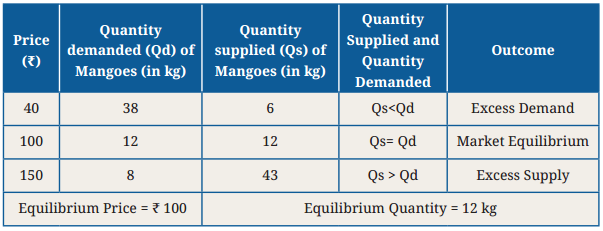
Answer:
Do it yourself.
Think About It
Question 1.
Can you think of another real-life example (other than hotels) where prices change frequently? Explain why the prices keep changing.
Our choices today affect future resources. For example, high demand for fast fashion, overfishing and overuse of groundwater can harm future supply. So, should we focus only on short-term gains, or also think about long-term sustainability? How could this affect the market equilibrium? (Page No. 205)
Answer:
A common real-life example is airline tickets. The prices of airline tickets change frequently depending on demand and supply. During holidays, festivals, weekends, and peak travel seasons, demand for flights increases, causing ticket prices to rise. When fewer people are travelling, airlines often lower prices to attract customers and fill seats. Prices may also change because of fuel costs, competition among airlines, weather conditions, and the number of seats available. Thus, airline ticket prices keep changing as airlines respond to market conditions and consumer demand.
We should not focus only on short-term gains but also consider long-term sustainability. Excessive use of natural resources, such as overfishing, deforestation, overuse of groundwater, and fast fashion production, can reduce the availability of resources in the future. As resources become scarce, the supply of goods may decrease, leading to higher prices and changes in market equilibrium. Sustainable practices help conserve resources, maintain future supply, and ensure stable production. By balancing present needs with future requirements, societies can achieve a more sustainable market equilibrium and avoid shortages, price increases, and environmental damage.
Question 2.
Have you ever seen or heard of the government fixing prices or wages (for example, bus fares, medicines, or minimum wages)? Share an example and why you think it was done. (Page No. 206)
Answer:
Yes. The government fixes the prices of certain essential medicines and prescribes minimum wages for workers. This is done to protect consumers and workers and to promote social welfare.
The Price Puzzle What Drives the Market Class 9 Questions and Answers
Questions and Activities (Page No. 210-213)
Question 1.
An increase in income always leads to a rise in demand for goods. Defend or refute, giving reasons for the same.
Answer:
The statement is not always true. An increase in income generally increases the demand for many goods because consumers can afford to buy more. However, the demand also depends on factors such as taste, preferences, and the nature of the good. Therefore, an increase in income does not always lead to a rise in demand for all goods.
Question 2.
If petrol prices double, what happens to:-
(a) Demand for diesel cars
(b) Demand for electric cars
(c) Demand for car accessories
(d) Demand for public transport
Answer:
If petrol prices double, it will affect the demand for related goods and services in different ways:
(a) Demand for diesel cars: The demand for diesel cars is likely to increase because diesel becomes a relatively cheaper alternative to petrol. Consumers may prefer diesel cars to reduce fuel expenses.
(b) Demand for electric cars: The demand for electric cars is likely to increase significantly because they do not depend on petrol and become a more economical option for transportation.
(c) Demand for car accessories: The demand for most car accessories is likely to remain largely unchanged because accessories such as seat covers, music systems, and floor mats are not directly related to petrol prices. However, if fewer people buy new petrol cars, demand for some accessories may decrease slightly.
(d) Demand for public transport: The demand for public transport is likely to increase because trav-elling by buses, trains, or metros becomes relatively cheaper than using private petrol vehicles.
Thus, a sharp increase in petrol prices encourages consumers to shift towards substitutes such as diesel vehicles, electric cars, and public transport,
Question 3.
A farmer traditionally irrigates fields manually (labour-intensive). He installs drip irrigation (a technology upgrade) that reduces water use by 40% and increases yield by 30%. How does this affect—
(a) His cost of production
(b) His willingness to supply at different prices
(c) The overall market supply if many farmers adopt this technology
Answer:
The installation of drip irrigation is a technological improvement that makes farming more\efficient by . reducing water usage and increasing crop yield.
(a) His cost of production: The farmer’s cost of production is likely to decrease in the long run because drip irrigation uses less water and requires less manual labour for irrigation. Although the initial installation cost may be high, the savings in water, labour, and other resources reduce the overall cost of producing crops.
(b) His willingness to supply at different prices: As production becomes more efficient and profitable, the farmer will be willing to supply a larger quantity of crops even at the same or lower prices. The increase in yield and reduction in costs encourage greater production and supply.
(c) The overall market supply if many farmers adopt this technology: If many farmers adopt drip irrigation, the overall market supply of crops will increase because more output can be produced using the same amount of land and fewer resources. This rightward shift in market supply may lead to lower market prices and greater availability of agricultural products for consumers.
Question 4.
During online festival sales, the prices of many products are very low. Use the concept of demand and supply to explain why the sellers sell at such a low price. What happens to the equilibrium when the price is lowered? Does this benefit only consumers or sellers as well? Explain.
Answer:
During online festival sales, sellers often offer products at very low prices to attract a large number of customers. Lower prices increase the quantity demanded because more consumers are willing to buy the products. Sellers also expect a sharp rise in demand during festival seasons, so they increase their stock and supply accordingly. Although the price per unit is lower, sellers can earn higher total revenue by selling a much larger quantity of goods. Discounts also help clear old inventory and attract new customers.
When the price is lowered, the market moves to a new situation where a larger quantity is bought and sold. The equilibrium quantity increases because consumers purchase more products at the lower price.
This strategy benefits both consumers and sellers. Consumers benefit because they can buy products at reduced prices and save money. Sellers benefit because they increase sales volume, attract more customers, reduce unsold stock, and often earn highei; overall revenue despite charging lower prices per unit. Thus, festival sales can create advantages for both sides of the market.
Question 5.
Suppose the government sets a maximum sale price for an essential vaccine below the market-driven price. What is likely to happen? Choose from the options below and elucidate your point.
(a) Surplus
(b) Shortage
(c) No effect
(d) Fall in demand
Answer:
(b) Shortage
If the government sets a maximum sale price (price ceiling) for an essential vaccine below the market- driven price, a shortage is likely to occur.
At the lower government-fixed price, more people will be willing and able to buy the vaccine, caus¬ing demand to increase. However, producers may find the lower price less profitable and may reduce the quantity supplied. As a result, the quantity de¬manded becomes greater than the quantity supplied, creating a shortage.
For example, if 10,000 people wank to buy the vaccine at the lower price but manufacturers supply only 7,000 doses, a shortage of 3,000 doses will arise. The government usually imposes such price ceilings to make essential goods affordable, but it may also need to take additional measures to ensure adequate supply.
Question 6.
The government levies higher taxes on products such as tobacco and alcohol to promote healthier choices among citizens. Can you find out other goods where price controls have been set in place? What are the reasons for the same?
Answer:
Price controls have been imposed on essential medicines, fertilisers, and certain food items. These controls help make essential goods affordable, protect consumers from exploitation, and promote public welfare.Yes. Governments often set price controls or regulate the prices of certain goods and services to protect consumers, ensure affordability, and promote social welfare.
Examples of Goods and Services with Price Controls
(i) Essential Medicines
- The government regulates the prices of many life-saving medicines.
- This ensures that important drugs remain affordable and accessible to all citizens, especially low-income families.
(ii) LPG (Cooking Gas)
- Governments may provide subsidies or regulate prices of cooking gas.
- This helps households afford a basic necessity and reduces the financial burden on families.
(iii) Electricity
- Electricity tariffs are often regulated by government authorities.
- The aim is to ensure that consumers receive electricity at reasonable rates while maintaining essential services.
(iv) Public Transport Fares
- Bus, metro, and railway fares are often controlled by the government.
- This keeps transportation affordable and accessible to students, workers, and the general public.
(v) Agricultural Products (Minimum Support Price)
- Governments may set a minimum price for crops such as wheat and rice.
- This protects farmers from very low market prices and ensures a stable income.
(vi) Water Supply
- Water charges are often regulated by local governments.
- This ensures that all citizens have access to clean and affordable water.
Reasons for Price Controls
- To make essential goods and services affordable.
- To protect consumers from exploitation.
- To support farmers and workers.
- To prevent monopolies from charging excessively high prices.
- To ensure equitable access to necessities.
- To promote public welfare and social justice.
Thus, governments use price controls when they believe that market prices alone may not adequately serve the interests of society.
Question 7.
Can excessive government regulation hurt markets? Explain with suitable examples.
Answer:
Yes, excessive government regulation can hurt markets if it goes beyond what is necessary to protect consumers and ensure fairness. While some regulation is important, too much intervention can reduce incentives for producers, increase costs, and discourage innovation.
For example, if the government fixes the price of a product too low for a long period, producers may find it unprofitable to continue production. This can lead to shortages in the market. Similarly, excessive rules, permits, and paperwork can make it difficult for businesses to start or expand operations, reducing investment and entrepreneurship. If farmers are not allowed to sell their produce at competitive prices, they may have less motivation to increase production. Therefore, although government regulation is necessary to protect public welfare, excessive regulation can reduce efficiency, limit competition, and slow economic growth. A balance between market freedom and government intervention is essential for a healthy economy.
Question 8.
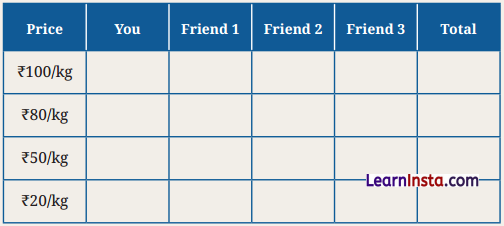
In the table below, different prices of guava are given.
(a) Think and write how much guava you will buy at each price.
(b) Ask the same question to three of your friends and fill in the table.
(c) Also make a graph for each one of you and one final graph for the total quantity.
Answer:
| Price | You | Friend 1 | Friend 2 | Friend 3 | Total |
| ₹ 100/kg | 1 | 1 | 2 | 1 | 5 |
| ₹ 80/kg | 2 | 2 | 2 | 2 | 8 |
| ₹ 50/kg | 3 | 3 | 4 | 3 | 13 |
| ₹ 20/kg | 5 | 5 | 6 | 5 | 21 |
Observation: As the price decreases, the quantity demanded increases.
Question 9.
Visit the nearby vegetable market and try to find answers to the following questions. …
(a) Who decides the prices of different vegetables in the vegetable market?
(b) Sometimes the prices of a few vegetables is too high, and sometimes too low. Why is this?
(c) The price of tomatoes is high in the morning and eventually gets lower by the evening. Have you ever noticed this? Comment.
Answer:
(a) The prices of vegetables in a market are mainly decided by the interaction of demand and supply. Sellers consider factors such as the quantity of vegetables available, transportation costs, weather conditions, and consumer demand while setting prices. Wholesale market prices also influence the prices charged by retailers. Thus, no single person decides the price; it is largely determined by market forces.
(b) Vegetable prices change because demand and supply are constantly changing. Prices become high when the supply of a vegetable decreases due to factors such as poor weather, crop damage, transpprtation problems, or seasonal shortages. Prices become low when there is a large harvest and supply exceeds demand. Changes in consumer preferences and festival seasons can also affect demand and cause price fluctuations.
(c) Yes, this is often observed in vegetable markets. In the morning, tomatoes are fresh, and demand is usually high because many customers come to shop early. As the day progresses, sellers try to sell their remaining stock before it becomes less fresh or spoils. To avoid losses and clear their inventory, they may reduce prices in the evening. This attracts more buyers and helps sellers sell the unsold tomatoes before the market closes
Question 10.
Categorise the following combination of goods into substitute goods and complementary goods.
(i) Movie ticket in the cinema hall and popcorn
(ii) Eraser and pencil
(iii) Laptop and computer
(iv) Air Conditioner and cooler
(v) Notebook and pen
(vi) Apple and banana
(vii) Mobile and earphones
Answer:
Substitute Goods:
(iii) Laptop and computer
(iv) Air Conditioner and cooler
(vi) Apple and banana
Complementary Goods:
(i) Movie ticket in the cinema hall and popcorn
(ii) Eraser and pencil
(v) Notebook and pen
(vii) Mobile and earphones
Explanation: Substitute goods are goods that can be used in place of one another. Complementary goods are goods that are generally used together, so the demand for one affects the demand for the other.
Question 11.
The figure below shows the demand curve DD’ and Supply curve SS’. Based on the figure, answer the following questions:
(i) What does point E represent in this market?
(ii) What is the equilibrium price and equilibrium quantity at point E?
(iii) Point A lies on DD’. Point B lies on SS’. What do the points A and B indicate about demand and supply? What does the gap between A and B (both on the upper dashed price line) represent?
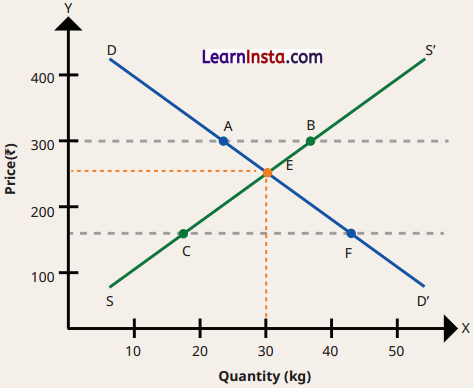
(iv) Point F lies on DD’. Point C lies on SS’. What do the points F and C indicate about demand and supply,? What does the gap between C and F (both on the lower dashed price line) represent?
(v) If the price stays at the lower dashed line, what could happen next in a free market?
Answer:
(i) Point E represents the market equilibrium. It is the point where the demand curve (DD’) intersects the supply curve (SS’). At this point, the quantity demanded by consumers is exactly equal to the quantity supplied by producers. Therefore, there is neither a shortage nor a surplus in the market.
(ii) At point E, the equilibrium price is ₹ 250 and the equilibrium quantity is 30 kg. This is the price and quantity at which buyers and sellers agree, and the market is in balance.
(iii) Points A and B lie on the upper dashed price line (₹ 300). At this price, A shows that consumers demand about 25 kg, while B shows that producers supply about 35 kg. Since supply is greater than demand, the market experiences excess supply (surplus). The gap between A and B represents the surplus quantity, which is approximately 10 kg.
(iv) Points F and C lie on the lower dashed price line (₹ 150). At this price, F shows that consumers demand about 45 kg, while C shows that producers supply about 15 kg. Since demand is greater than supply, the market experiences excess demand (shortage). The gap between C and F represents the shortage quantity, which is approximately 30 kg.
(v) If the price remains at ₹ 150, the quantity demanded will continue to exceed the quantity supplied, creating a shortage. Consumers will compete to buy the limited quantity available, and sellers will notice the excess demand. In a free market, this shortage puts upward pressure on prices. As the price rises, producers will supply more and consumers will demand less, gradually moving the market towards the equilibrium price of ₹ 250 and the equilibrium quantity of 30 kg.
Question 12.
Draw a market equilibrium graph using the following demand schedule.
(a) Plot the demand and supply curve using the above data.
(b) Identify the equilibrium price and quantity.
(c) Observe the above data and analyse what happens if the price is set at ₹ 20 or ₹ 40.
Answer:
Do it yourself.