Practice with Class 9 SST Extra Questions and Class 9 Social Science SST Chapter 9 The Price Puzzle What Drives the Market Extra Questions and Answers to improve your exam performance.
The Price Puzzle What Drives the Market Class 9 Extra Question Answer
Extra Questions of The Price Puzzle What Drives the Market Class 9
The Price Puzzle What Drives the Market Class 9 Very Short Question Answer
Question 1.
What is demand?
Answer:Demand is the quantity of a good or service that consumers are willing and able to buy at different prices during a given period.
Question 2.
What is supply?
Answer:
Supply refers to the quantity of a good or service that producers are willing and able to sell at different prices.
Question 3.
What is market equilibrium?
Answer:
Market equilibrium is the situation where quantity demanded equals quantity supplied, resulting in a stable market price and quantity.
Question 4.
What is a shortage?
Answer:
A shortage occurs when consumers want to buy more of a product than producers are willing to supply at a particular price.
Question 5.
What is a surplus?
Answer:
A surplus occurs when producers supply more of a product than consumers are willing to buy at a given price.
Question 6.
Name two determinants of demand.
Answer:
Consumer income and prices of related goods are two important determinants of demand.
Question 7.
How does technology affect supply?
Answer:
Improved technology increases efficiency, lowers production costs, and generally increases the supply of goods and services.
Question 8.
What are substitute goods?
Answer:
Substitute goods are goods that can be used in place of one another, such as tea and coffee.
Question 9.
Give one example of a public good.
Answer:
Roads are an example of a public good because they are available for use by everyone.

Question 10.
Why does the government intervent in markets?
Answer:
The government intervenes to prote&t consumers, ensure fair competition, provide public goods, and promote social welfare.
The Price Puzzle What Drives the Market Class 9 Short Question Answer
Question 1.
Explain the law of demand with an example.
Answer:
The law of demand states that when the pricfe of a good rises, its demand generally falls, and when the price falls, demand increases, assuming other factors remain unchanged. For example, if the price of mangoes decreases, consumers are likely to buy more mangoes because they become more affordable.
Question 2.
Discuss any three factors that influence demand.
Answer:
Demand is influenced by several factors. Consumer income affects purchasing power, as higher incomes generally increase demand for normal goods. Consumer tastes and preferences also affect demand. Additionally, the prices of related goods, such as substitutes and complements, can influence the demand for a product.
Question 3.
How do production costs affect supply?
Answer:
Production costs directly affect supply. When the cost of inputs such as labour, raw materials, or fuel increases, producers may reduce output because production becomes less profitable. On the other hand, lower production costs encourage producers to supply more goods, thereby increasing market supply.
Question 4.
What is a price ceiling? Why is it imposed?
Answer:
A price ceiling is the maximum price that sellers are legally allowed to charge for a product. Governments impose price ceilings on essential goods such as medicines to make them affordable for consumers. While they protect consumers, very low price ceilings may sometimes lead to shortages.
Question 5.
Explain the role of government in providing public goods.
Answer:
Governments provide public goods such as roads, parks, street lights, and police services because these goods benefit everyone and are difficult to provide profitably through private markets. Government provision ensures that all citizens can access these essential services regardless of their ability to pay.
Question 6.
How does technology influence market supply?
Answer:
Technology improves production efficiency and reduces costs. New machines, improved farming techniques, and better production methods allow producers to make more goods with fewer resources. As a result, producers can supply larger quantities at the same price, causing market supply to increase.
The Price Puzzle What Drives the Market Class 9 Long Question Answer
Question 1.
Explain how demand and supply together determine the price of a product.
Answer:
Demand and supply are the two main forces that determine the price of a product in a market. Demand refers to the quantity consumers are willing to buy, while supply refers to the quantity producers are willing to sell. When demand exceeds supply, prices tend to rise because consumers compete for limited goods. When supply exceeds demand, prices tend to fall as sellers try to attract buyers. The price at which quantity demanded equals quantity supplied is called the equilibrium price, and it helps maintain balance in the market. .
Question 2.
What are the major factors affecting supply? Explain with examples.
Answer:
Several factors influence supply. Production costs affect how much producers are willing to supply; lower costs generally increase supply. Technology improves efficiency and increases output. Availability of natural resources also affects supply. Weather conditions can influence agricultural production, while natural disasters may disrupt supply. Government policies such as taxes and subsidies can either discourage or encourage production. For example, improved irrigation technology can increase crop supply, while floods may reduce the supply of vegetables.
Question 3.
Why does the government intervene in markets? Discuss with examples.
Answer:
Governments intervene in markets to protect consumers, ensure fair competition, provide public goods, and support vulnerable groups. They regulate prices of essential medicines to keep them affordable and may provide subsidies for important services such as education and healthcare. Governments also set minimum support prices for certain crops to protect farmers from very low market prices. Without such interventions, markets may fail to serve public welfare effectively.
Therefore, government action helps balance economic efficiency with social justice.
Question 4.
Explain the concepts of shortage and surplus with suitable examples.
Answer:
A shortage occurs when quantity demanded exceeds quantity supplied at a particular price. For example, if an essential vaccine is sold at a very low price, more people may want it than manufacturers cqn supply. A surplus occurs when quantity supplied exceeds quantity demanded. For instance, if vegetable production is unusually high during a season, sellers may have unsold stock. In a free market, shortages generally cause prices to rise, while surpluses usually cause prices to fall until equilibrium is restored.
Question 5.
Why is sustainability important for markets and future supply?
Answer:
Sustainability is important because current consumption patterns affect the availability of resources in the future. Excessive use of groundwater, overfishing, and deforestation can reduce future supplies of essential resources. If resources become scarce, production costs rise and market supply decreases, leading to higher prices. Sustainable practices help conserve resources, maintain long-term supply, and support stable markets. By balancing present needs with future requirements, societies can promote economic growth while protecting the environment and ensuring availability of resources for future generations.
The Price Puzzle What Drives the Market Class 9 Source Based Questions
Read the sources given and answer the questions that follow:
Question 1.
Public goods are goods and services that are provided by the government for the benefit of all citizens. For example, roads, bridges, public parks, street lighting are provided for public use; national defence protects the country from external threats; sanitation, and drainage systems improve living conditions, and so on. These goods are usually not provided by private companies because they do not generate direct profit.
(i) What are public goods?
Answer:
Public goods are goods and services provided by the government for the benefit of all citizens.
(ii) Why are public goods generally not provided by private companies?
Answer:
Private companies generally do not provide public goods because these goods do not generate direct profit.
(iii) State any two examples of public goods mentioned in the passage. How do these goods benefit society?
Answer:
Examples of public goods include roads, bridges, public parks, street lighting, national defence, sanitation, and drainage systems. (Any two) These goods improve public welfare by providing essential services, ensuring safety, and improving the quality of life.
Question 2.
The government sometimes fixes the prices of essential medicines to ensure that they remain affordable. While consumers benefit from lower prices, producers may earn lower profits. If the controlled price is too low, manufacturers may reduce production, creating shortages in the market. Therefore, governments must carefully balance affordability and adequate supply.
(i) Why does the government regulate the prices of essential medicines?
Answer:
To make medicines affordable and accessible to consumers.
(ii) What may happen if the controlled price is too low?
Answer:
Producers may reduce supply, leading to shortages.
(iii) What challenge does the government face while regulating prices?
Answer:
Balancing consumer welfare with adequate producer incentives.
The Price Puzzle What Drives the Market Class 9 Picture Based Questions
Look at the pictures and answer the questions that follow:
Question 1.
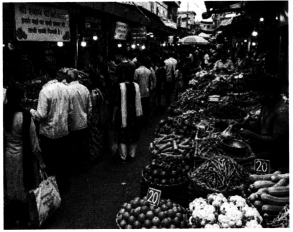
(i) What economic activity is taking place in the picture?
Answer:
Buying and selling of goods in a market.
(ii) Which two market forces influence tftp prices of vegetables?
Answer:
Demand and supply.
(iii) Why might some stalls have more customers than others?
Answer:
They may offer lower prices, better quality, or fresher vegetables.
Question 2.
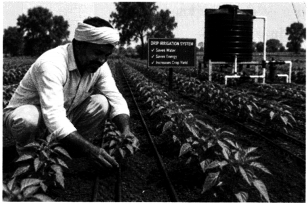
(i) What technology is being used by the farmer?
Answer:
Drip irrigation.
(ii) How does this technology affect production?
Answer:
It reduces water use and increases crop yield.
(iii) What effect can this technology have on supply?
Answer:
It can increase the supply of agricultural products.
The Price Puzzle What Drives the Market Class 9 Graph based Question
Look at the graph and answer the questions that follow:
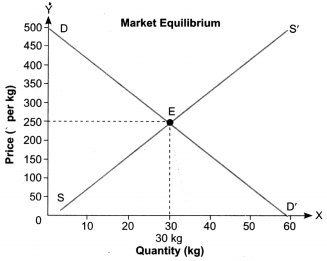
(i) What does point E represent?
Answer:
Point E represents market equilibrium where demand equals supply.
(ii) What are the equilibrium price and quantity?
Answer:
Equilibrium Price = ₹ 250; Equilibrium Quantity = 30 kg.
(iii) What will happen if the market price is below the equilibrium price?
Answer:
Demand will exceed supply, creating a shortage and putting upward pressure on prices until equilibrium is restored.
Class 9 The Price Puzzle What Drives the Market Extra Questions for Practice
Multiple Choice Questions
Question 1.
Which of the following is most likely to (increase the demand for a product?
(a) Increase in consumer income
(b) Rise in the product’s price
(c) Increase in population
(d) Change in fashion in its favour
Question 2.
Which of the following can reduce the supply of agricultural products?
(a) Improved irrigation facilities
(b) Technological advancement
(c) Drought and crop failure
(d) Lower production costs
Question 3.
A good whose demand increases when the price of another good rises is known as:
(a) Complementary good
(b) Inferior good
(c) Public good
(d) Substitute good
Question 4.
Which of the following is an example of government intervention in the market?
(a) Consumer choice
(b) Setting a minimum support price for crops
(c) Seasonal demand
(d) Technological innovation
Assertion & Reason Questions
Question 1.
Assertion (A): Market equilibrium is a desirable situation for both buyers and sellers.
Reason (R): At equilibrium, the quantity demanded is equal to the quantity supplied.
Options:
(a) Both (A) and (R) are true and (R) is the correct explanation of (A).
(b) Both (A) and (R) are true but (R) is not the correct explanation of (A).
(c) (A) is true but (R) is false.
(d) (A) is false but (R) is true. x
Fill in the blanks
1. Goods that can be used in place of each other are called ___________ goods.
2. The meeting point of the demand curve and supply curve is called ___________
3. Government-provided facilities such as parks and street lights are examples of ___________ goods.
4. An increase in production costs generally causes market supply to ___________
Very Short Answer Type Questions
Question 1.
What is meant by market price?
Question 2.
Define complementary goods with an example.
Question 3.
What is the diminishing marginal utility principle?
Question 4.
How can weather affect the supply of crops?
Short Answer Type Questions
Question 1.
Explain the relationship between the price of a product and its demand.
Question 2.
How do changes in consumer preferences influence market demand?
Question 3.
Discuss the impact of natural disasters on market supply.
Question 4.
Why do governments regulate the prices of certain essential goods?
Long Answer Type Questions
Question 1.
Explain how substitute goods and complementary goods influence the demand for a product with suitable examples.
Question 2.
Describe the factors that influence the supply decisions of producers in a market.
Question 3.
Explain why market equilibrium is considered dynamic rather than permanent in the real world.
Question 4.
Discuss the limitations of government intervention in markets with suitable examples.