These Class 8 Social Science Worksheet and Class 8 SST Chapter 6 The Parliamentary System: Legislature and Executive Worksheet with Answers are excellent for board exam practice.
Class 8 SST Chapter 6 The Parliamentary System: Legislature and Executive Worksheet
Class 8 The Parliamentary System: Legislature and Executive Worksheet
Worksheet On The Parliamentary System: Legislature and Executive Class 8 – The Parliamentary System: Legislature and Executive Worksheet Class 8
Multiple Choice Questions
Question 1.
Which country’s system inspired India’s parliamentary democracy?
(a) USA
(b) Britain
(c) France
(d) Australia
Question 2.
Which house of Parliament directly represents the people of India?
(a) Rajya Sabha
(b) Legislative Assembly
(c) Lok Sabha
(d) Legislative Council
Question 3.
What is the maximum number of members that the Lok Sabha can have as per the Constitution?
(a) 500
(b) 550
(c) 600
(d) 650
Question 4.
Identify the article which declared the Right to Education (RTE) as a Fundamental Right in our Constitution:
(a) Article 21A
(b) Article 12A
(c) Article 3A
(d) Article 19A
Question 5.
What does the Sengol symbolise in the Lok Sabha?
(a) Political supremacy
(b) Economic strength
(c) Just and righteous rule
(d) Regional unity
Question 6.
What is a ‘Gazette’?
(а) An official government publication
(b) A type of bill
(c) A type of Parliament session
(d) A document for voting
Question 7.
India has a bicameral house. Which of the following is/are not a feature/s of the bicameral legislature in India?
(i) It ensures three levels of government
(ii) It includes Lok Sabha and Rajya Sabha
(iii) Promotes federal balance and diversity
(iv) Found at all states
(a) (i), (ii) and (iii)
(b) only (iii)
(c) (i), (ii) and (iv)
(d) (i) and (iv)
Question 8.
What is the final step for a Bill to become a law?
(a) Assent by the President
(b) Approval by the Rajya Sabha
(c) Approval by the Lok Sabha
(d) Debate in the Parliament
Question 9.
Where can a ‘Money Bill’ be introduced?
(a) In both Lok Sabha and Rajya Sabha
(b) In the Rajya Sabha only
(c) In the Lok Sabha only
(d) It can be introduced in any state legislature
Question 10.
What is the primary focus of Chapter I of Part V?
(a) The powers of the Parliament
(b) The roles of the President, Vice President, and Council of Ministe
(c) The functions of the Judiciary
(d) The responsibilities of citizens
Assertion and Reason Questions
There are two statements marked as Assertion (A) and Reason (R). Mark your answer as per the codes provided below:
Question 1.
Assertion (A): The Prime Minister is a de facto executive head of the country.
Reason (R): The President acts on the advice of the Prime Minister and the Council of Ministers.
Codes:
(a) Both (A) and (R) are true, and (R) is the correct explanation of (A).
(b) Both (A) and (R) are true, but (R) is not the correct explanation of (A).
(c) (A) is true, but (R) is false.
(d) (A) is false, but (R) is true.
Question 2.
Assertion (A): Universal Adult Franchise is a unique feature that strengthens Indian diversity.
Reason (R): All adults, regardless of caste, gender, or religion, have the right to vote.
Codes:
(a) Both (A) and (R) are true, and (R) is the correct explanation of (A).
(b) Both (A) and (R) are true, but (R) is not the correct explanation of (A).
(c) (A) is true, but (R) is false.
(d) (A) is false, but (R) is true.

Fill in the Blanks with the Words given in the Box Below
| Ayush, bicameral, 18th, State Legislative Assemblies, Constitutional Amendment |
1. The ____________ Lok Sabha was constituted in June 2024, continuing India’s democratic journey.
2. State legislatures in India can be either unicameral or ____________
3. ____________ is a formal change, addition, or deletion made to the provisions of the Constitution.
4. Members of the Rajya Sabha are elected by the members of the ____________
5. The Ministry of ____________ is a government body responsible for promoting and developing traditional systems of medicine in India.
State Whether the following Statements are True or False
1. The Speaker of the Lok Sabha also manages Rajya Sabha.
2. India’s Constitution was inspired by the British system.
3. Parliament sessions include Budget, Monsoon, and Summer sessions.
4. ‘Money Bill’ can be introduced in both the Lok Sabha and Rajya Sabha.
5. The Right to Education (RTE) Act was passed in 2009.
Match the Contents in Column A with those in Column B
| Column A | Column B |
| A. LokSabha | (i) Upper House of the Parliament |
| B. Rajya Sabha | (ii) Lower house of the Parliament |
| C. Vidhan Sabha | (iii) Represents the interests of states at union level |
| D. Vidhan Parishad | (iv) State- level legislative body |
Choose the correct option:
(a) A – (iii), B – (iv), C – (ii), D – (i)
(b) A – (ii), B – (i), C – (iv), D -(iii)
(c) A – (iv), B – (ii), C – (iii), D – (i)
(d) A – (i), B – (iii), C – (ii), D – (iv)
Very Short Answer Type Questions
Question 1.
Give one important function of the Legislature.
Answer:
__________________________________
Question 2.
What is a “Clause” in a bill?
Answer:
__________________________________
Question 3.
What is a “Gazette”?
Answer:
__________________________________
Question 4.
Where is the Sengol placed now?
Answer:
__________________________________
Question 5.
How did freedom fighters shape the Constitution?
Answer:
__________________________________
Short Answer Type Questions
Question 1.
What are the roles of the three branches of government in India as per the Constitution?
Answer:
__________________________________
Question 2.
How did the 86th Constitutional Amendment Act of 2002 contribute to the Right to Education Act?
Answer:
__________________________________
Question 3.
Which traditional Indian practices influenced the framing of the Indian Constitution?
Answer:
__________________________________
Question 4.
How are Parliamentary discussions made accessible to people speaking different languages in India?
Answer:
__________________________________
Long Answer Type Questions
Question 1.
How is India’s parliamentary system structured?
Answer:
__________________________________
Question 2.
What steps have been taken to make Parliamentary discussions more accessible to people speaking different languages in India, and how has the translation service evolved?
Answer:
__________________________________
Question 3.
How does India maintain the separation of powers when the Executive is part of the Legislature?
Answer:
__________________________________
Case Based Questions
Read the given excerpt and answer the questions that follow:
In 1956, Railway Minister Lai Bahadur Shastri resigned after a train accident. Although he was not blamed for the accident, he believed that a minister must take moral responsibility for anything that happens in their ministry. He offered his resignation to the then Prime Minister Jawaharlal Nehru; Nehru declined at first, but Shastri insisted. Finally, his resignation was accepted.
(a) To whom did Shastri offer his resignation?
(b) What happened after Nehru declined the resignation?
(c) Do you think Lai Bahadur Shastri was right to resign even though he wasn’t directly responsible for the accident? Why or why not?
(d) What values do you think Shastri demonstrated by insisting on resigning? Do you think such values are important in leadership today?
(e) Can moral responsibility be more important than legal responsibility in public service? Discuss with reference to this case.
Answer:
__________________________________
Skill Based Question
Question 1.
Explain how the structure of the Indian Parliament ensures a balance of power, and suggest two ways citizens can actively contribute to strengthening Indian democracy.
Answer:
__________________________________
Competency Based Question
Question 1.
Can the separation of powers ever lead to conflicts between the Parliament, Executive, and Judiciary? How should such conflicts be resolved?
Answer:
__________________________________
Picture Based Questions
Observe the picture given below and answer the questions that follow:
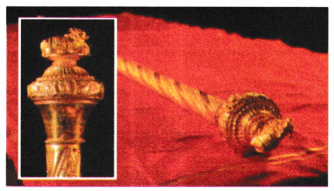
(a) What is the Sengol and why was it given to Nehru?
(b) Where is the Sengol kept now?
(c) Which ancient period does the Sengol come from?
(d) What symbol is on the top of the Sengol has been shown?
(e) What does the Sengol represent?
Answer:
__________________________________