Students can use NCERT Class 9 Advanced Science Notes and Chapter 4 The Geometry of Power Advanced Simple Machines Class 9 Notes to understand complex concepts with ease.
The Geometry of Power Advanced Simple Machines Notes Class 9 Advanced Science
Class 9 The Geometry of Power Advanced Simple Machines Notes
Introduction
A simple machine is a mechanical device that changes the magnitude or direction of an applied force, thereby making work easier to perform. Simple machines do not reduce the total work done but help in applying force more conveniently by altering the force-distance relationship.
The fundamental principle involved in simple machines is the law of conservation of energy.
Types of Simple Machines
The basic simple machines are:
- Lever
- Pulley
- Inclined Plane
- Wheel and Axle
- Screw
- Wedge

Basic Terminology
- Effort (E): The force applied to operate the machine.
- Load (L): The resistance or weight that is to be overcome.
- Work Input: The work done on the machine by the effort.
- Work Output: The work done by the machine in lifting or moving the load.
Mechanical Advantage
Mechanical Advantage is defined as the ratio of the load lifted by the machine to the effort applied.
MA = \(\frac{\text { Load }}{\text { Effort }}\)
It is a dimensionless quantity that indicates a machine’s effectiveness in amplifying force.
- If MA > 1, the machine multiplies force and also called ‘Force Multiplier’.
- If MA = 1, the machine does not multiply force (it may change direction or simply transmit force).
- If MA < 1, the machine does not provide a force advantage but may increase speed or distance.
Velocity Ratio
Velocity Ratio is defined as the ratio of the distance moved by the effort to the distance moved by the load.
VR = \(\frac{\text { Distance moved by effort }}{\text { Distance moved by load }}\)
It is a dimensionless quantity.
Velocity Ratio depends only on the machine’s geometry and design and is independent of friction.
Efficiency of a Machine
Efficiency is a measure of how effectively a machine converts input work into output work. It is defined as:
η = \(\frac{\text { Work Output }}{\text { Work Input }}\) × 100%
Alternatively,
η = \(\frac{\text { MA }}{\text { VR }}\) × 100%
Efficiency is always less than 100% in practical machines due to energy losses, mainly because of friction.
Ideal and Real Machines
Ideal Machine
An ideal machine is one in which there is no loss of energy. Therefore:
Efficiency = 100% and MA=VR
Such machines are theoretical and do not exist in practice.
Real Machine
In real machines, some energy is always lost due to friction and other dissipative forces. Hence:
- Efficiency is less than 100%
- MA < VR
Activity 4.1:
- A truck driver turning a massive vehicle using only two hands.
A crane lifting heavy concrete beams smoothly.
A cyclist moving very fast by pedalling lightly.
Now think carefully:
(1) Is the driver extremely strong?
(2) Does the crane create extra force?
(3) Does the cyclist get ‘free’ speed?
Answer:
(1) No, the truck driver uses a steering system that multiplies the turning effect.
(2) No, the crane uses pulleys/hydraulics to lift heavy loads with controlled force.
(3) No, the cyclist uses gears to trade force for speed.
In all these cases, machines are helping us multiply force or increase speed.
This multiplication is called Mechanical Advantage (MA).
Wheel and Axle – The Steering Mastery
The wheel and axle are one of the most important simple machines used in daily life. It consists of a large wheel attached rigidly to a smaller rod called an axle. Both rotate together about a common axis.
Principle of Working
The wheel and axle work on the principle of the turning effect of force (torque) and mechanical advantage.
When effort is applied on the larger wheel, it produces a greater turning effect on the smaller axle, making work easier.
Mechanical Advantage (MA)
MA = \(\frac{R_{\text {wheel }}}{R_{\text {axle }}}\)
Where:
- Rwheel = Radius of the wheel
- Raxle = Radius of the axle
A larger wheel compared to the axle gives greater mechanical advantage.
Types of Use
Force Multiplier (MA > 1)
- Small effort produces a large force
- Example: Steering wheel, windlass
Speed Multiplier (MA < 1)
- Increases speed instead of force
- Example: Bicycle wheels
Applications in Daily Life
- Steering wheel of cars and trucks
- Door knobs
- Screwdrivers
- Water lifting devices (windlass)
- Bicycle systems
Activity 4.2: Think and Answer
‘Think about a steering wheel and axle (steering column) and their respective radius.’
(1) The steering wheel is large. The steering column connected to it is small. Why is this so?
(2) Why not make both of equal size?
Answer:
(1) The steering wheel is made large and the steering column (axle) is small to increase mechanical advantage. From the relation:
MA ∝ \(\frac{R_{\text {wheel }}}{R_{\text {axle }}}\)
- A larger wheel radius means a greater turning effect (torque) for the same effort.
- This allows the driver to turn heavy vehicle wheels with less force.
So, even a massive truck can be controlled with a small effort.
(2) If the steering wheel and column were the same size, then mechanical advantage will be unity which means there will be no advantage at all. Very large amount of force will be required to apply which would make turning extremely difficult. A massive, bulky steering column right in front of the driver would be highly impractical.
Note: In practice, some input work is lost due to friction within the machine. The efficiency of a machine is defined as η = \(\left(\frac{\text { useful output work }}{\text { total input work }}\right)\) × 100%
( total input work
A real machine always has p < 100%. Mechanical Advantage, as calculated here, assumes an ideal (frictionless) machine.
Tension:
Tension is a contact force transmitted through a string, rope, cable or wire when it is pulled by forces acting from opposite ends. It is essentially a ‘pulling’ or ‘stretching’ force that travels along the length of the medium.
Mechanism of Tension
When an object is suspended by a thread, two primary interactions occur:
- Action: The weight of the object pulls the thread downward.
- Reaction: In response, the thread exerts an upward force on the object to support it. This internal pulling force is what we identify as Tension (T).
Characteristics of Tension
- Direction: Tension always acts along the length of the string and pulls away from the object to which it is attached.
- Magnitude: If the mass of the hanging object increases, the tension in the string increases proportionally to counteract the gravitational pull.
- Uniformity: In an ‘ideal’ string (massless and inextensible), the tension is considered constant throughout its entire length.
- S.I. Unit: As tension is a force, its standard unit is the newton (N).
Tension and Equilibrium
An object is said to be in a state of Equilibrium when the net force acting on it is zero.
- Static Equilibrium: If the upward tension (T) exactly equals the downward weight (W), the object remains at rest.
- Mathematical Representation: Σ F = T – W = 0
⇒ T = w.
Dynamics in Pulley Systems
Tension plays a critical role in how motion is transferred in mechanical systems:
- Balanced System: If equal weights are placed on both sides of a pulley, the tensions are equal, and the system remains stationary.
- Unbalanced System: According to Newton’s Second Law, if one side is heavier, the forces become unbalanced. The heavier mass accelerates downward while the lighter mass is pulled upward by the tension.
Activity 4.3:
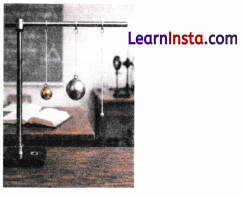
Hang a thread from an iron stand as shown in the figure. Observe its natural length.
1. Attach a small bob to the lower end of the thread. How does the thread stretch?
2. Replace the small bob with a heavier bob. Does the stretch increase or decrease?
Further,
Pass the thread over a pulley. Attach a weight to one side and observe.
3. Attach equal weights (equal bobs) on both sides of the pulley. Does the rope move, or does it only stretch?
4. Replace one of the equal bobs with a heavier bob on the left side. In which direction the system moves?

Answer:
1. The thread is stretched slightly.
2. When we replace the small bob with a heavier one, the thread stretches more because the greater weight exerts a stronger downward pull, which in turn increases the tension in the thread.
3. When we pass the thread over a pulley and attach equal weights to both sides, the rope does not move, only stretches, because the forces are perfectly balanced and the system is in equilibrium, with equal tension on both sides.
4. If we replace one of the bobs with a heavier one on the left side, the system moves toward the left because the weights are now unbalanced, causing the heavier bob to pull the system downward in its direction while the lighter bob moves upward.

Examples:
Question 1.
A 5 kg object is suspended stationary from a rope. Calculate the tension.
Answer:
The weight of the object = m × g
T = m × g = 5 kg × 9.8 m/s2 = 49N
Question 2.
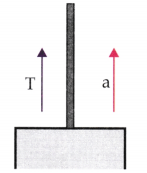
A 4 kg mass is lifted upward with an acceleration of 2 m/s2. Calculate the tension.
Answer:
Using Newton’s Second Law
T – mg = ma
T = m(g + a)
T = 4 kg × (9.8 m/s2 + 2 m/s2