Students prefer Class 5 English Santoor Solutions Unit 4 Ups and Downs Chapter 8 The Decision of the Panchayat Class 5 Questions and Answers that are written in simple and clear language.
Class 5 English Chapter 8 The Decision of the Panchayat Question Answer
Class 5 English The Decision of the Panchayat Question Answer
Class 5 The Decision of the Panchayat Questions and Answers
Let us Think (Page 95)
A. Answer the following questions.
Question 1.
Why did the farmer buy the well?
Answer:
The farmer bought the well because he needed water for his fields.
Question 2.
Why did the farmer become upset?
Answer:
The farmer became upset because his neighbour stopped him from taking water from the well he bought earlier.
Question 3.
How did the Panchayat solve the problem?
Answer:
The Panchayat listened to both the farmer and the neighbour, talked about the problem, analysed both arguments and then gave a decision.

Question 4.
What was the final judgment given by the Panchayat?
Answer:
The Panchayat said that the neighbour had sold only the well, not the water. If the neighbour thinks the water was still his, he had to remove it or use it quickly. Otherwise, the water would belong to the farmer.
B. Think and discuss
Question 1.
Do you think the decision of the Panchayat was correct?
Answer:
Yes, the Panchayat made the right decision and gave a fair and wise judgment that solved the problem. The farmer was allowed to use the water, and the cunning neighbour learned a lesson for trying to cheat.
Question 2.
You have an extra painting box which you wish to share with your friends in the class to complete an activity. Two of your best friends, Radha and Sita, fight for the box. How would you deal with the situation so that you are fair to both of them?
Answer:
If Radha and Sita both want to use the painting box, I would tell them to share it. They can take turns using the box or by splitting the colours they each need. This way, both friends will get a fair chance to complete their works and do well in the activity.
Question 3.
Who said to whom:
(а) “I sold only the well, not the water.”
(b) “Remove the water or use it all up immediately’
(c) “He is not letting me take the water.”
Answer:
(а) The neighbour said this to the farmer.
(b) The village chief said this to the neighbour.
(c) The farmer said this to the village chief.
Let us Learn (Pages 96-97)
A. Match the words with their meanings.

Answer:
| Word | Meaning |
| 1. prospered | (f) to grow wealthy. |
| 2. cunning | (a) clever in a tricky way. |
| 3. worried | (e) very upset. |
| 4. summon | (c) to order someone come to a particular place. |
| 5. adamant | (b) refusing to change one’s mind. |
| 6. judgment | (d) a decision made by a group (here Panchayat). |
B. Fill in the blanks with the correct prepositions (in, at, by, after, before, under, with, to, for). A preposition can be used more than once.
1. The farmer went ………………. the village chief to explain his problem.
2. The neighbour was standing ………………. the well, blocking the way.
3. The villagers tried to reason ………………. the cunning man.
4. The decision was made ………………. careful consideration of both sides.
5. Their lived a farmer ………………. the small village.
6. The Panchayat members listen to both the sides ………………. coming to decision.
7. The villagers gathered the Panchayat ………………. the banyan tree.
8. The neighbour was punished ………………. his dishonesty.
9. The chief listened carefully ………………. both the farmer and the neighbour.
10. The villagers agreed to meet ………………. a later time to discuss the issue.
11. The farmer decided to buy a well ………………. buying his third field.
Answer:
1. The farmer went to the village chief to explain his problem.
2. The neighbour was standing by the well, blocking the way.
3. The villagers tried to reason with the cunning man.
4. The decision was made after careful consideration of both sides.
5. Their lived a farmer in the small village.
6. The Panchayat members listen to both the sides before coming to decision.
7. The villagers gathered the Panchayat under the banyan tree.
8. The neighbour was punished for his dishonesty.
9. The chief listened carefully to both the farmer and the neighbour.
10. The villagers agreed to meet at a later time to discuss the issue.
11. The farmer decided to buy a well after buying his third field.
C. Rearrange the events in the correct order.
1. Sam sat by a small stream to rest and enjoy the peaceful sound of the water. {__}
2. Sam felt grateful for the time he spent in nature. {__}
3. Sam decided to go for a walk in the forest near his house. {__}
4. Sam walked along the narrow path, listening to the sound of birds chirping and leaves rustling. {__}
5. After resting, Sam continued his walk, feeling refreshed. {__}
Answer:
1. Sam sat by a small stream to rest and enjoy the peaceful sound of the water. {3}
2. Sam felt grateful for the time he spent in nature. {4}
3. Sam decided to go for a walk in the forest near his house. {1}
4. Sam walked along the narrow path, listening to the sound of birds chirping and leaves rustling. {5}
5. After resting, Sam continued his walk, feeling refreshed. {2}
Let us Speak (Pages 98-99)
I. Look at the pictures below:
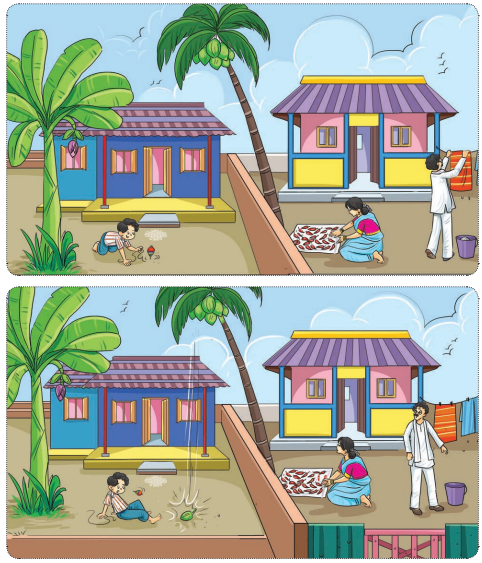
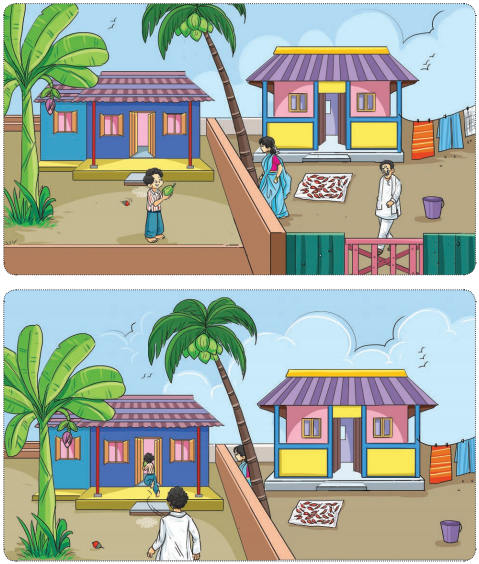
What do you think will happen next? Sit in small groups and discuss. One student from each group will narrate the ending to the whole class.
Answer:
The boy ran inside his house with the coconut, thinking he would keep it. But when he saw the man walking towards his house, he felt a little scared and confused. He looked at the coconut in his hands and realised it was not his. He knew it had fallen from the man’s tree, and he should not keep it without permission. After thinking for a moment, the boy came outside and returned the coconut to the man. The man smiled and said the boy was honest and good. This made the boy feel proud and happy.
Let us Write (Page 100)
A. Imagine you are the farmer. Write a letter to your friend about the incident and the decision of the Panchayat.
You may begin as follows:
My dear friend,
Something happened last week, which I want to tell you. I wanted to buy a well…
Answer:
Kalyanpur Village
Lucknow, Uttar Pradesh
209202
25th June 2025
Dear Raghav,
I hope this letter finds you in good health and high spirit. I have something interesting to tell you. Last week, I bought a well from my neighbour to use it on my field. However, the next day, he stopped me from using the water, claiming that he had sold only the well, not the water inside it. I was quite worried about the impact this would have on my crops.
I went to the village chief, and a Panchayat meeting was held. After hearing both sides, the chief made a wise decision. She said that if the neighbour truly owned the water, he must remove it from my well immediately. If not, the water would belong to me.
The neighbour had no answer, apologised, and paid a fine. I was very happy, and everyone praised the Panchayat’s wisdom.
Yours faithful,
Rajendra
B. Read the following sentence.
Water is priceless.
It means that water is valuable. It is so valuable that you cannot put a price on it.
Words + suffix = New word
Use + less = …………………………
Care + less = …………………………
Hope + less = …………………………
Fear + less = …………………………
Colour + less = …………………………
Answer:
Words + Suffix = New word
Use + less – Useless
Care + less = Careless
Hope + less = Hopeless
Fear + less = Fearless
Colour + less Colourless
Make sentences using the new words in your notebook.
Answer:
1. This old phone is useless because it doesn’t work.
2. She was careless and forgot to lock the door.
3. After losing the game, he felt hopeless.
4. The fearless dog protected its owner.
5. The water is clear and colourless.
Let us Listen (Pages 101-102)
Listen to your teacher read out this passage and answer the questions by choosing the correct option.
Sri Ramakrishna Paramahamsa
A long time ago, in a small village of West Bengal, there lived a kind and wise man named Sri Ramakrishna Paramahamsa. He loved to talk to people about God and taught that all religions are like rivers— they may take different paths, but they all lead to the same ocean. He lived a simple life, wearing plain clothes and eating very little, but his smile and loving words made everyone feel special.
One day, a curious young boy named Naren came to meet him. Ramakrishna saw something special in Naren and became his teacher. He taught Naren about courage, kindness, and how to find peace within.
1. Where was Sri Ramakrishna Paramahamsa born?
a. A colony in Kolkata.
b. A small village in West Bengal.
c. A mountain in the Himalayas.
d. A forest in Kerala.
Answer:
b. A small village in West Bengal.
2. Who was the curious boy that became Sri Ramakrishna’s student?
a. Mahatma Gandhi
b. Swami Vivekananda (Naren)
c. Rabindranath Tagore
d. Sri Aurobindo
Answer:
b. Swami Vivekananda (Naren)
3. What kind of life did Sri Ramakrishna live?
a. A life full of luxury,
b. A simple and loving life.
c. A life of traveling.
d. A secretive life.
Answer:
b. A simple and loving life.
4. What did Sri Ramakrishna compare religions to?
a. Trees in a forest
b. Stars in the sky
c. Rivers flowing to the ocean
d. Books in a library
Answer:
c. Rivers flowing to the ocean
5. What did Sri Ramakrishna teach Naren?
a. To find a teacher
b. To become wealthy
c. To travel the world
d. To find peace
Answer:
d. To find peace
Let us Do (Pages 103-104)
A. Read the passage carefully and answer the following questions.
The Neem Tree
You must have seen a neem tree near your house, or near the school, or beside the road. Almost everyone can recognise a neem tree.
The neem is a magic medicine tree because almost every part of the tree is used for medicine.
Sometimes, sick people are given neem juice to drink. People use the twigs of the neem tree as a toothbrush to clean their teeth. Burn some dry neem leaves inside the house and see the mosquitoes disappear! When you store winter clothing or blankets, keep dry neem leaves between them. This helps keep away insects. When you store rice, keep dry neem leaves at the bottom of the rice bin. This keeps pests away.
Answer the following questions.
Question 1.
Where can you find neem trees?
Answer:
Neem trees can be usually found near our houses, schools, or . beside the road.
Question 2.
Why do you think ‘neem’ is called a magic tree?
Answer:
Neem is called a magic tree because almost every part of it is used for medicine.
Question 3.
What happens when dry neem leaves are burnt?
Answer:
When dry neem leaves are burnt, mosquitoes disappear and the air becomes clean.
Question 4.
Why do people put neem leaves in clothes and rice containers?
Answer:
People put neem leaves in clothes and rice containers to keep away insects and pests.
Question 5.
How are neem twigs used?
Answer:
Neem twigs are used as a toothbrush to clean teeth.
Question 6.
Find the meaning of the word ‘disappear’ from the following options:
(a) Appear
(b) Vanish
(c) Grow
(d) Fly
Answer:
(b) Vanish
Question 7.
Find the word in the passage which means ‘a short stick’:
(a) Tree
(b) Part
(c) Twig
(d) Leaf
Answer:
(c) Twig
B. Point out 11 differences in the two pictures given below. Work in pairs and write down the 11 differences in your notebook.

Answer:

1. In the second picture, there are no sun rays visible, whereas they are present in the first picture.
2. In the first picture, the basil is dense, while in the second picture, there is thin.
3. In the second picture, the colour of the slippers is different from the first picture.
4. The design of the slippers is different in the second picture compared to the first one.
5. In the second picture, the woman’s bun is missing, but it is present in the first picture.
The woman has fewer dicks in her hair in the second picture, whereas there are more in the first picture.
7. The design of the border of the woman’s saree is different in the second picture.
8. The design of the woman’s saree drape is different in the first and second pictures.
In the second picture, there are two steps, while in the first picture, there are three steps.
10. In the second picture, the colour of the fan in the woman’s hand is different from the first picture.
11, In the second picture, the woman is not wearing a nose ring, while she is wearing one in the first picture.