Teachers guide students to use Exploring Society India and Beyond Class 7 Solutions and Class 7 Social Science SST Chapter 10 The Constitution of India An Introduction Question Answer NCERT Solutions for quick learning.
Class 7 Social Science Chapter 10 Question Answer The Constitution of India An Introduction
NCERT Class 7 Social Science Chapter 10 The Constitution of India An Introduction Questions and Answers Solutions
The Constitution of India An Introduction Class 7 Question Answer (In-Text)
The Big Questions? (Page 209)
Question 1.
What is a constitution, and why do we need one?
Answer:
A constitution is the rulebook of a country, which helps in proper governance. It defines the nature of the government, its procedure of formation and mechanism of its functioning. The Constitution lays down the procedure of making laws and outlines the functions of three organs of the government (Legislative, Executive and Judiciary). It reflects the core values of the nation- like justice, fraternity, equality, respect, freedom and pluralism.
Question 2.
How was the Indian Constitution prepared?
Answer:
The task of writing our constitution was given to a Constituent Assembly, which was formed on 9 December, 1946. It was a body of representatives who were elected by the legislative assemblies of the provinces. These elections were held in July 1946.
Initially the Assembly consisted of 389 members (before Partition) and was later reduced to 299 members after the Partition of India and Pakistan in 1947. 15 women members were there in the Assembly. The task’ of drafting the constitution was completed k from 9 December, 1946 to 26 November 1949.
It took approximately two years, eleven months, and seventeen days to complete. Dr. B.R. Ambedkar was the Chairman of the Drafting Committee. The Constitution was adopted on November 26, 1949, and came into effect on January 26, 1950.
Question 3.
How did our freedom struggle and civilisational heritage influence the Constitution?
Answer:
India’s Constitution has been deeply influenced by both the values of the freedom struggle and the rich legacy of its civilisational heritage.
The experience of the freedom movement played a vital role in shaping the core ideals of the Constitution. Principles such as equality for all, justice, freedom, fraternity, and the preservation of India’s cultural heritage were incorporated as guiding values.
In addition to these, many principles rooted in India’s ancient civilisational history found a place in the Constitution. These include the reverence for nature, the pursuit of knowledge and learning, respect for women, and the timeless concepts of Vasudhaiva Kutumbakam (“the world is one family”) and Sarue Bhauantu Sukhinah (a prayer for the well-being of all). The Constitution also reflects the acceptance of diverse ideologies, a hallmark of India’s pluralistic ethos.

Question 4.
What are the key features of the Constitution of India? Why is it still relevant, even though it was written more than seventy years ago?
Answer:
The key features of the Constitution of India are:
- The Indian Constitution is the longest written Constitution. It originally had 395 Articles, 22 parts and 8 Schedules and now contains over 470 Articles, 25 parts and 12 Schedules.
- India has a parliamentary form of government consisting of the Lok Sabha and the Rajya Sabha.
- Constitution declares India as a democratic country and all citizens above 18 years of age have a right to vote.
- There is an independent, integrated and powerful judiciary system.
- There are three organs of government- legislature, executive and judiciary with a ‘separation of powers’ as a core.
- There are three levels of government: Central, State and Local. The Constitution is still relevant because it provides the foundational principles and rights that guide the functioning of the country and adapt to changing times through amendments.
Let’s remember
Question 1.
Recall that in Grade 6, we saw the meaning of the word ‘constitution’ a document that lays down the basic principles and laws of a nation. In small groups of three, list all the questions that come to your mind about a country’s constitution. (Page 210)
Answer:
Some of the questions that came to our minds about a country’s constitution are:
- What is the role of the Constitution?
- Can we have a Constitution for our school?
- What should students learn about the Constitution?
- How can we celebrate Constitution Day in schools?
- Can we have a text of the original Constitution?
- How does the Constitution limit the powers of the government?
- How does the Constitution affect our daily lives?
- What will happen if there is no Constitution?
- Who ensures that the Constitution is followed in India?
- Can the Constitution be changed? If yes, how?
- Why is our Constitution so unique?
- How is India’s Constitution different from other countries?
- Why is our Constitution one of the longest in the world?
- What can we learn from the Constitution?
Let’s Explore
Question 1.
Discuss in your group what might have happened if there was no official rulebook that the referee and the team captains could refer to? (Page 212)
Answer:
In the absence of a rulebook, match decisions would lack consistency and fairness. This could lead to frequent disputes and unfair practices, resulting in disruptions and, eventually, the cancellation of matches. At times, powerful teams especially those with strong local support might even influence decisions in their favour.
Question 2.
What is required to ensure everyone agrees to abide by the rulebook? What might happen if the team captains did not agree to refer to the rulebook at all? (Page 212)
Answer:
Trust, faith, respect and cooperation are some of the values required so that everyone agrees to abide by the rulebook.
If team captains choose not to refer to the rulebook, match decisions would become chaotic. This could lead to frequent conflicts, unfair practices, and eventually, disruptions that might result in the cancellation of the match.
Question 3.
Think of a game that you play often and list the rules you follow. Each group will then present their set of rules to the rest of the class. Listen to each presentation, discuss the rules, and work together to decide on a common set of rules for the game.
Answer:
(Suggestive Answer) One game, we frequently play is Basketball, below are the basic rules we follow while playing this game:
- Each team has 5 players on the court, with sides rotating after 14 minutes. The total time for match is 56 minutes.
- No pushing or rough contact is allowed (foul play).
- The team with the highest score at the end of the stipulated time wins.
- No foul play is allowed.
- The referee’s decision is final.
Question 4.
What challenges do you face in reaching a consensus on rules that everyone agrees with? (Page 212)
Answer:
The challenges that are faced while reaching a consensus on rules that everyone agrees with are:
- Often, the rules are not clear to few team members which leads to confusion.
- It was difficult to establish fair rules as everyone has their own interpretation.
- Frequent arguments and verbal disputes occur.
- At times, we forgot the consensus we had reached, and it is very tough to write down.
- The process is time consuming.
However, a referee solves this problem in professional games.
Question 5.
What could be the ‘rulebook’ for a country? How would it be made? (Page 212)
Answer:
The ‘rulebook’ for a country is its Constitution. Generally, it is made by the people of the country through Constituent Assembly. A specialised group is formed, comprising different committees with one head. These members may either be elected or selected, and represent the people of the country. Each idea is thoroughly debated and discussed, before arriving at a consensus. The committee discusses important areas such as the nature of the government, the powers of each organ of the government, and rights and duties of citizens. Once a draft is created it is published together and feedback from all concerned stakeholders, including legal experts, public and others is taken. Any necessary amendments are then accommodated, and the final version is presented to the Committee for approval. Once the draft has been agreed upon, the process of officially writing the Constitution begins. After, writing is completed a specific day is declared when the Constitution is formally enforced and comes into effect.
Question 6.
In small groups, try to find out the names of people from your region who may have participated in the making of the can you use to gather this information? (Hint: Look for books in your school or local library. You could also ask your teacher, parents and other elders in the neighbourhood.) (Page 215)
Answer:
People who participated in the making of Constitution according to some states are:
Bihar: Dr Rajendra Prasad, Jagjivan Ram
Jharkhand: Jaipal Singh
Gujarat: Vallabhbhai Jhaverbhai Patel
Tamil Nadu: T.T.Krishnamachari
Question 7.
Read the quotation given below. Which article of the Constitution do you think she was referring to? Why do you think she said that the equality of women was not a new concept for India? Discuss in the class.
Sir, the women of India are happy to step into their rightful heritage of complete equality with men in all spheres of life and activity. I say so because I am convinced that this is no new concept which has been postulated for the purposes of this Constitution, but is an ideal that has long been cherished by India, though social conditions for some time had tragically debased it in practice. This Constitution affirms that ideal and gives the solemn assurance that the rights of women in law will be wholly honoured in the Indian Republic. Begum Aizaz Rasul, 22 November 1949, during the Constituent Assembly’s debates (Page 221)
Answer:
The speaker is likely referring to Article 15 and Article 39 of the Indian Constitution. Article 15 prohibits discrimination on the grounds of gender, ensuring equality for women, while Article 39 directs the state to ensure equal opportunities and welfare for women, particularly in areas like employment and healthcare.
She said that the equality of women was not a new concept for India because historically, the idea of gender equality has been part of India’s cultural and social heritage. Although social conditions, such as patriarchal norms, had often prevented the full realisation of this equality, India has a long tradition of women in significant roles in society. This includes women leaders, freedom fighters, and the historical presence of matriarchal systems in certain parts of India. The Constitution, therefore, is not introducing anew idea, but reaffirming the long-held belief in gender equality.
Question 8.
Can you find out the amendments made to the Constitution in the past ten years? (Page 223)
Answer:
Some important amendments that were made to the Constitution in the past ten years are:
| Amendment | Year | Subject |
| 101st | 2016 | Change in Indirect taxes with the introduction of Goods and Services Tax (GST). |
| 103rd | 2019 | 10% reservation for Economically Weaker Sections (EWS). |
| 104th | 2020 | Extended SC/ST seat reservation and removed Anglo- Indian reservation at the Lok Sabha. |
| 106th | 2023 | 33% reservation for women in Lok Sabha and State Assemblies Women’s Reservation Act- Nari Shakti Vandan Adhiniyam. |
Question 9.
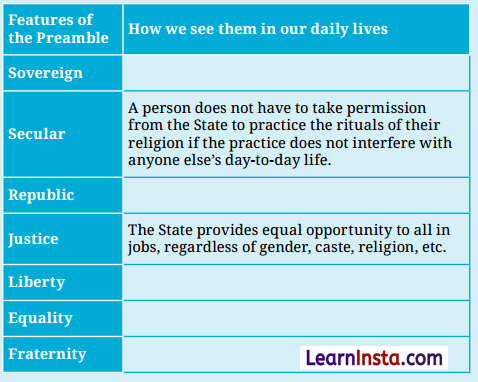
Below is the list offeatures given in the Preamble. Read them closely from the image above and write down examples of the application of these values in daily life around you. Two have been completed to help you with the exercise. (Page 226)
Answer:
| Features of the Preamble | How we see them in our daily lives |
| SOVEREIGN | India is free to make its own decisions – both internal and external – without any interference from other countries. The Parliament makes laws nation’s requirements. The Government of India maintains its foreign relations with other countries and the United Nations as it sees fit. |
| SECULAR | A person does not have to take permission from the State to practice the rituals of their religion if the practice does not interfere with anyone else’s day-to-day life. |
| REPUBLIC | The head of the state cannot be chosen due to heredity. India is a republic country because the highest political offices, like the President and the Prime Minister, are elected the President is chosen indirectly by an elected body, and the Prime Minister is selected from the directly elected representatives of the people. |
| JUSTICE | The state provides equal opportunity to all in jobs, regardless of gender, caste, religion, etc. |
| LIBERTY | Liberty means that we have the freedom to decide for ourselves. We have the right to think, speak dress and choose our careers under existing laws. |
| EQUALITY | Under the Rule of law all are equal and there is no discrimination on any basis. All public places are open to all for equal access like mall, parks, ‘ national monuments and others. |
| FRATERNITY | In our society, everyone is treated with respect and equality. People from different religions, languages, and cultures live, study, and work together in harmony. We celebrate all festivals together, which shows our unity in diversity. |
Don’t miss out
Question 1.
Just as your textbook has many sections and chapters, the Constitution of India has 25 parts and 12 schedules. Each part has sections within it. It is the world’s largest written constitution. When it came into effect, it had 22 Parts and 8 schedules. You don’t need to remember these numbers, but can you guess why they have increased since 1950? (Page 212)
Answer:
The Constitution of India has added new parts over the past 75 years to address the changing needs and requirements of society and governance. It has also evolved to face new challenges.
In recent decades, new areas like information technology, globalisation, climatic change and others have emerged. People have also become more demanding and want a greater role in decision making process, which has led to the addition of parts like parts related to Local Self-government were added in 1992 – for setting up the Panchayati Raj institutions and municipalities.
The Women’s Reservation Act 2023 (also called: Nari Shakti Vandan Adhiniyam) reserves 33% (one-third) of seats for women in the Lok Sabha (the Lower House of Parliament) and State Legislative Assemblies.
Class 7 SST Chapter 10 The Constitution of India An Introduction Question Answer (Exercise)
Questions and Activities (Page 227-228)
Question 1.
“The Constituent Assembly had representatives from diverse backgrounds in India.” Why do you think it was important to have a diverse set of representatives from all over India?
Answer:
It was important to have representatives from diverse backgrounds in the Constituent Assembly to appreciate and celebrate India’s rich diversity. Leaders and experts from various regions, communities, genders, and fields brought their unique perspectives and expertise, ensuring that the Constitution would be fair and inclusive for all. The Drafting Committee, led by Dr. B.R. Ambedkar, played a key role in shaping the Constitution, and it is noteworthy that 15 women actively participated in the process. Begum Qudsia Aizaz Rasul was the only Muslim woman in the Constituent Assembly that drafted the Indian Constitution. The assembly was chaired by Dr. Rajendra Prasad. Having such a wide range of representatives allowed the Constitution to address the needs of all sections of society, including marginalised and minority groups.
Question 2.
Read the statements below carefully and identify which key features / values in the Constitution of India are reflected in each statement.
(a) Sheena, Rajat, and Harsh are standing in a line. They are excited to cast their first vote in the general elections.
(b) Radha, Imon, and Harpreet study in the same class in the same school.
(c) Parents must make arrangements to ensure their children’s education.
(d) People of all castes, genders, and religions can use the village well.
Answer:
(a) Universal Adult Franchise.
(b) Right to Education and Respect for Diversity.
(c) Right to education as a Fundamental Right under Article 21 A.
(d) Article 14 – Right to Equality and Article 17 – Abolition of Untouchability.
Everyone has equal access to public facilities and there shall be no discrimination. At the same time, we belong to same fraternity.
Question 3.
It is said that ‘All citizens in India are equal before the law’. Do you think this is a fact? If yes, why? If not, why not? Formulate your arguments.
Answer:
The statement “All citizens in India are equal before the law” is a fundamental fact guaranteed under Article 14 of the Indian Constitution. It is a part of- the Right to Equality, one of the six Fundamental Rights provided to all Indian citizens. Accordingly, every individual, regardless of their background whether a common citizen, the Prime Minister, or the President is to be treated equally in the eyes of the law.
The law does not allow any discrimination on the basis of religion, caste, gender, place of birth, economic status, or social background.
However, in practice, achieving this equality can sometimes be difficult. Social and economic factors such as access to quality education, healthcare, resources, opportunities, and information may lead to indirect discrimination. People from marginalised communities or disadvantaged backgrounds often face challenges that prevent them from enjoying the rights guaranteed to them to the fullest.
Question 4.
You have learnt that ‘India is the only country that provided universal adult franchise to its citizens from the beginning.’ Can you explain why India did it?
Answer:
India granted universal adult franchise to all its citizens from the very beginning. This was possible because of the visionary leaders and the experience gained during the freedom struggle. It was one of the few provisions in the Constitution that saw almost no disagreement, as all members strongly supported giving the right to vote to every adult, regardless of their background. The leaders believed that a strong democracy requires participation from all sections of the society, including the poorest, the marginalised, and women.
A democratic government is the foundation of our Constitution, and the right to vote was seen as a special right for all citizens. The members of the Constituent Assembly had complete faith in the people’s ability to choose the right leaders, and they wanted to create a system that respected diversity and empowered every citizen in the decision making process.
Question 5.
How did the freedom struggle inspire the making of the Constitution of India ? How did India’s civilisational heritage inspire some of the key features in the Constitution of India? Explain.
Answer:
India’s Constitution has been deeply influenced by both the values of the freedom struggle and the rich legacy of its civilisational heritage.
The experience of the freedom movement played a vital role in shaping the core ideals of the Constitution. Principles such as equality for all, justice, freedom, fraternity, and the preservation of India’s cultural heritage were incorporated as guiding values.
In addition to these, many principles rooted in India’s ancient civilisational history found a place in the Constitution. These include
the reverence for nature, the pursuit of knowledge and learning, respect for women, and the timeless concepts of Vasudhaiva Kutumbakam (“the world is one family”) and Sarve Bhavantu Sukhinah (a prayer for the well-being of all). The Constitution also reflects the acceptance of diverse ideologies, a hallmark of India’s pluralistic ethos.
Question 6.
Do you think we, as a society, have achieved all the ideals of the Constitution? If not, what can we each do as citizens to move our country closer to these ideals?
Answer:
The Constitution has laid down many ideals for welfare and development of the nation and its citizens. Many goals have been achieved, like free and fair elections, the right to contest elections, the rule of law, the right to freedom, the right to religion and others. However, challenges still persist. We continue to struggle with economic and social inequalities, poverty, gender discrimination, low literacy rates and caste based discrimination.
As citizens, we can play an active role by raising awareness, helping the poor and – marginalised communities to come forward and empowering them through better education and healthcare. It is also essential to ensure that there is no discrimination against any section of society, in any place.
Question 7.
Read the clues carefully to solve the crossword to uncover important concepts from the Indian Constitution.

Across
2. The branch of government that makes laws.
7. The part of the Constitution that outlines the duties of citizens towards the country.
8. The highest court in India that protects the Constitution.
9. A system where the head of state is elected, not hereditary.
10. The process by which the Constitution can be changed over time.
Down
1. The group of people who wrote the Indian Constitution.
3. The statement at the beginning of the Constitution that tells us the values it upholds.
4. The document that lays out the rules and laws of a country.
5. The gas used to preserve the original Constitution safely.,
6. Basic rights given to every citizen, like freedom and equality.
Answer: