Practice with Understanding Society India and Beyond Class 9 Solutions and Class 9 Social Science SST Chapter 5 State and Society up to 1000 CE Question Answer NCERT Solutions to improve your exam performance.
Class 9 SST Chapter 5 State and Society up to 1000 CE Question Answer
Class 9 State and Society up to 1000 CE Question Answer
The Big Questions? (Page No. 95)
Question 1.
How did society and state organise themselves prior to 1000 CE?
Answer:
Before 1000 CE, society organised itself from small, family-based units like kula (members of blood relations or with common ancestors) and jana into larger territorial states called janapadas and mahajanapadas. While society was managed by traditions and customs, the state functioned through formal administrative laws. Power became a mix of centralised monarchies and decentralised local governance, where village assemblies or local administrative bodies independently managed daily local affairs like disputes and robbery, revenue, and infrastructure.
Question 2.
How did states and societies emerge and spread to different parts of the Indian subcontinent?
Answer:
The expansion of agriculture, the use of iron technology, and the growth of settlements led to the emergence of janapadas and later mahajanapadas. Magadha became the most powerful kingdom and gave rise to the Mauryan Empire. In different regions of the subcontinent, kingdoms such as the Satavahanas, Pallavas, Chalukyas, Cheras, Cholas, Pandyas, Gurjara-Pratiharas, Palas, and Rashtrakutas established organised systems of administration. Trade routes, centres of learning, literature, and religious traditions helped spread ideas and institutions across the Indian subcontinent.
Question 3.
How did the ideas of dharma and chakravarti samrat help create unity in social values and governance, and promote the idea of the Indian subcontinent as one political entity?
Answer:
Dharma emphasised justice, righteousness, moral conduct, and the welfare of society. It guided rulers as well as ordinary people in performing their duties. The ideal of the chakravarti samrat represented a universal ruler exercising authority over the Indian subcontinent. Concepts such as Bharatavarsa, Jambudvipa, Prithivi, Ashvamedha, and Rajasuya expressed the idea of political unity. Ashoka’s policy of Dhamma further promoted ethical governance, compassion, tolerance, and harmony among people.

Question 4.
How did different social, administrative, and occupational groups take shape over time and come together culturally?
Answer:
Different social groups developed through the varna and jati systems, while occupations expanded into agriculture, trade, crafts, administration, education, and other professions. Guilds (srenlsj organised merchants and artisans, and village assemblies managed local administration. Educational institutions, Sanskrit and Tamil literature, the Bhakti tradition, and extensive trade networks encouraged interaction among different regions and communities. These developments contributed to the growth of a shared cultural heritage across the Indian subcontinent.
State and Society up to 1000 CE Question Answer Class 9
InText Questions
Let’s Explore
Question 1.
As you read the chapter, follow the timeline at the bottom of each page. Notice the important events, changes, and connections across time. Think about which event interests you the most and why. By the end of the chapter, share one event you would like to explore further and document: (Pages No. 96-97)
(i) What happened?
Answer:
Emperor Ashoka introduced the policy of Dhamma, which encouraged people to follow moral values such as compassion, non-violence, tolerance, and respect for all. He spread these ideas through his edicts across his empire.
(ii) When did it happen?
Answer:
During the reign of Ashoka, 272-232 BCE.
(iii) Why do you think it matters?
Answer:
It matters because Dhamma promoted ethical governance, public welfare, religious harmony, and peaceful coexistence. It also reflected the ideal that a ruler should care for the well-being of all people.
Question 2.
Read the verse given below and discuss it in groups. As you do so. think like historians- look for clues in the source and use them to understand what life may have been like. (Pages No. 118-119)
While discussing, keep these questions in mind:
- What does the source tell us? (evidence),
- What can we understand from it? (interpretation)
- What might it not tell us? (limits of the source)
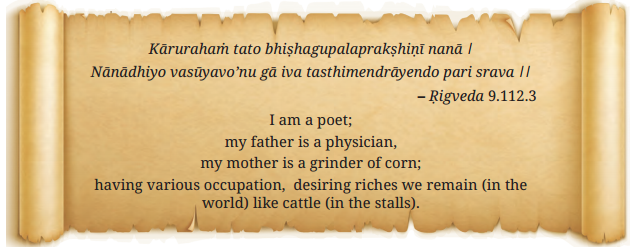
Now answer the following
(i) What occupations are mentioned in the family described in the verse? What does this indicate about the nature of occupations in Vedic society?
Answer:
The occupations mentioned are a poet, a physician, and a grinder of corn. This indicates that occupations in the early Vedic period were flexible, and members of the same family could follow different professions. They were not strictly determined by birth.
(ii) How does the above verse challenge the idea that social status and occupation were fixed by birth?
Answer:
The verse shows that people within the same family followed different occupations. This suggests that occupation and social status were not rigidly fixed by birth in the early Vedic period, but could vary according to an individual’s work and skills.
(iii) What different occupations do you find in contemporary society?
Answer:
In contemporary society, people work as doctors, teachers, engineers, scientists, farmers, artists, lawyers, businesspersons, police officers, soldiers, drivers, nurses, and software professionals, among many other occupations.
(iv) After the discussion, compare your group’s responses with those of another group and note the similarities and differences in interpretation. Did all groups interpret the source in the same way? What does this tell us about how historians use evidence to understand the past?
Answer:
Different groups may interpret the source in slightly different ways because each group may focus on different details. This shows that historians carefully analyse evidence, compare it with other sources, and conclude only after examining all the available information.
Question 3.
Compare your school life with the life of a student in a gumkula in early India. Think about aspects such as daily routine, subjects studied, relationship with teachers, discipline, and living arrangements. What advantages and challenges do you think each system of education might have for students? (Page No. 126)
Answer:
A student in a gurukula lived with the teacher (guru) and followed a disciplined life based on self-control, obedience, service, and simple living. Students studied the Vedas along with grammar, philosophy, ethics, mathematics, medicine, astronomy, music, dance, painting, physical education, yoga, meditation, and martial arts. The guru-sisya parampara emphasised respect for the teacher, and students were treated as members of the teacher’s family. In contrast, students today usually attend school during fixed hours and return home after classes. They learn in classrooms, libraries, laboratories, and digital resources while studying a wide range of subjects.
The gurukula system helped develop discipline, moral values, practical skills, and a close relationship between the teacher and students. Modern schools provide better educational facilities, access to technology, and opportunities to learn many specialised subjects. Both systems aim at educating students, but each has its own advantages and challenges.
Think About It
Question 1.
In modern democracies, heads of government exercise power but are bound by constitutions and parliaments, which function as representative bodies that check the powers of elected leaders. Do the roles of the raja and the assemblies in Vedic times suggest a similar principle? Can we say that systems of governance in Indian history-since their early institutionalised forms-were guided by the idea of ensuring people’s participation in the political process? (Page No. 101)
Answer:
Yes, the roles of the raja and Vedic assemblies suggest a similar democratic principle. The king’s power was not absolute; it was guided and checked by assemblies like the Sabha, Samiti, and Vidhata, which could even select or remove rulers and settle legal disputes. Therefore, we can say that early Indian governance was built on ensuring people’s participation. From these Vedic assemblies to the independent village councils and election systems like Kudavolai in the Chola period, early institutions consistently valued community input and ethical, public-centered rule. (Kudavolai: It was an ancient Tamil electoral system used during the Chola period, where village representatives were chosen through a lottery-like method using palm-leaf ballots placed in a pot, as recorded in the Uthiramerur inscriptions.)
Question 2.
Texts such as the Mahabharata and the Arthashastra describe the king’s duties as protecting people and ensuring justice. Why do you think it was important for rulers to protect people and ensure justice? What do these descriptions tell us about ideas of governance and the relationship between rulers and subjects during that period?
Answer:
It was important for rulers to protect the people and ensure justice because these were considered the primary duties of a king. The chapter explains that the king was expected to maintain law and order, defend the kingdom, administer justice, and work for the welfare of the people. Texts such as the Mahabharata and Kautilya’s Arthasastra describe the qualities of an ideal ruler and emphasise that a king should govern according to dharma, act fairly, and fulfil his responsibilities towards the state and its people.
These descriptions show that kingship was viewed as a position of duty and responsibility. They also indicate that good governance depended on justice, ethical conduct, efficient administration, and the welfare of the people, while ministers and officials assisted the king in carrying out these responsibilities.
Question 3.
Why do you think different rulers chose to record their inscriptions on the same stone instead of a new one? Discuss your answers with your classmates. (Page No. 111)
Answer:
Different rulers chose to record their inscriptions on the same stone instead of a new one to claim a direct historical connection with powerful past rulers and legitimize their own authority. By placing their names next to famous ancestors, they showed the public that they were continuing a great legacy. For example, the Junagadh Rock Inscription near Girnar (Gujarat) bears inscriptions from Emperor Ashoka (Mauryan), Rudradaman I (Saka), and Skandagupta (Gupta). When Rudradaman recorded how he repaired the Sudarshana Lake dam, which was originally built under the Mauryas, he used the exact same rock to proudly display his administrative success, public welfare efforts, and political dominance in the region.
Question 4.
How would dividing a kingdom into provinces, districts, and villages have helped rulers manage their empires? What similarities can you identify between these administrative divisions and the system of governance in India today? (Page No.112)
Answer:
Dividing a kingdom into provinces, districts, and villages helped rulers administer large empires more effectively. Different officials looked after administration at each level. Provincial governors and district officers were responsible for judicial and administrative functions, while village headmen managed village affairs. This system made revenue collection, the maintenance of law and order, and local administration easier. In some kingdoms, important local people such as bankers, merchants, artisans, and scribes were also consulted before important decisions were made.
A similar system exists in India today. The country is divided into states, districts, and villages (or urban local bodies), each with its own administrative authorities. Like ancient India, these administrative divisions help in the efficient governance and management of the country.
Question 5.
Why do you think irrigational structures like dams and canals were considered so important that their construction was recorded in inscriptions? (Page No. 129)
Answer:
Irrigation structures like dams and canals were considered so vital because ancient Indian economies relied heavily on agriculture. Since crop production was the primary source of state revenue, ensuring a stable water supply protected the kingdom from droughts and secured the treasury. Building these systems was a major public welfare effort that won the loyalty of the people. For instance, Pushyagupta, a Mauryan governor under Chandragupta Maurya, built a dam on Sudarshana Lake, which ensured agricultural prosperity and rightful governance.
Let’s Analyse
Question 1.
If you visualise the maps of the Indian subcontinent of the second and first millennium BCE, you will find more settlements concentrated in the Gangetic region in the latter map. Archaeological findings from this region during the first millennium BCE provide increasing evidence of the use of iron implements, a wider variety of grain, and the characteristic PGW pottery. Further, in the second half of the first millennium BCE, particularly in the middle Gangetic region (from present-day Prayagraj to eastern Bihar), there is evidence of a refined ‘deluxe ware’ called NBPW, known for its smooth, glossy black surface. Archaeologically, this phase marks the emergence of a richer, more advanced material culture. Literary sources from this period also contain numerous references to expanding agricultural activities, increased grain output, greater crop variety-particularly paddy-and the use of iron implements.
Can you identify the crucial factors behind this change? (PagesNo. 102-103 )
Answer:
The increase in settlements in the Gangetic region was mainly due to the use of iron implements, the cultivation of a wider variety of grains, especially paddy, and the expansion of agricultural activities. The emergence of Painted Grey Ware (PGW) and later Northern Black Polished Ware (NBPW) reflects the development of a more advanced material culture during this period. These developments led to increased agricultural production and supported the growth of more settlements in the Gangetic region.
State and Society up to 1000 CE Class 9 Questions and Answers
Questions and Activities (Page No. 134-135)
Question 1.
How did political organisation change from the Vedic period to the age of large empires such as the Mauryas and the Guptas? Explain the administrative system of the early Indian states.
Answer:
In the early Vedic period, society was organised into janas (clans) led by a raja. The Sabha, Samiti, and Vidhata assisted the king in governance and decision-making. As agriculture expanded and settlements grew, janapadas and later mahajanapadas emerged. Powerful kingdoms such as Magadha eventually developed into large empires like the Mauryan and Gupta Empires.
Early Indian states had a well-organised admini-strative system. Large empires were divided into provinces, districts, and villages. Provincial governors, district officers, and village headmen looked after administration, justice, revenue collection, and law and order. The king was assisted by a Council of Ministers and other officials. In later periods, village assemblies also played an important role in local administration, especially under the Cholas.
Question 2.
Describe the role of the king, important officers, and the methods used to govern large territories.
Answer:
The king was regarded as the protector of the people and was responsible for maintaining law and order, administering justice, defending the kingdom, and promoting the welfare of the people. Ancient texts such as the Mahabharata and the Arthasastra describe the qualities and duties of an ideal ruler. The king was assisted by a Council of Ministers and important officials such as the mantri, amatyas, provincial governors, district officers (pradesikas), and village headmen (gramikas). Large territories were governed by dividing the empire into provinces, districts, and villages, with officials responsible for administration at each level. In many kingdoms, village assemblies also helped manage local affairs.
Question 3.
After studying this chapter, what do you think were the most important features of the state and society in India before 1000 CE?
Answer:
Some of the most important features of the state and society before 1000 CE were:
- Well-organised kingdoms and empires with efficient administrative systems.
- Division of the kingdom into provinces, districts, and villages for better governance.
- The importance of dharma, justice, and ethical values in governance.
- Growth of agriculture, irrigation, trade, and guilds.
- Development of centres of learning such as Nalanda and Takshashila.
- Rich literary, artistic, and cultural traditions.
- Village assemblies and local self-government in several kingdoms.
- Expansion of trade routes and flourishing economic activities.
- Growth of religious traditions, including the Bhakti movement.
Question 4.
What do early texts such as the Rig Veda, Arthasastra, and the Mahabharata reveal about political and social life?
Answer:
The Rig Veda provides information about early Vedic society, assemblies such as the Sabha and Samiti, and the role of the raja. The Arthasastra explains administration, statecraft, diplomacy, taxation, and the duties of the king and officials. The Mahabharata describes the responsibilities of rulers, the importance of dharma, justice, and good governance. Together, these texts provide valuable information about the political organisation, administration, social life, and moral values of early India.
Question 5.
What can we learn from early Indian society about varna and the role of women?
Answer:
Early Indian society shows that social structures changed significantly over time. Initially, the varna system was flexible and based on individual skills, allowing occupational flexibility, but it later grew rigid and hereditary, subdivided into jatis. Similarly, the status of women shifted—during the early Vedic period, they possessed considerable freedom, access to education, and participation in public assemblies. However, in the later Vedic period, their social roles became more restricted as family structures became increasingly patriarchal.
Question 6.
Explain how assemblies like Sabha and Samiti limited the power of the raja. Which modern institutions perform similar functions today?
Answer:
The chapter explains that the Sabha and Samiti were important assemblies in the Vedic period that assisted the raja in governance. They discussed important matters and advised the king, ensuring that he did not take decisions entirely on his own. In later periods, councils of ministers, provincial officials, and village assemblies also participated in administration. Although these institutions were different from modern democratic bodies, they show that consultation played an important role in governance. Today, institutions such as Parliament, State Legislatures, and the judiciary help ensure that the powers of the government are exercised according to the Constitution and the law.
Question 7.
What do the terms varna and jati refer to in early Indian society? How were they different, and what factors may have contributed to the formation of various jatis?
Answer:
The varna referred to the four broad social categories—Brahmanas, Kshatriyas, Vaishyas, and Shudras. Initially, the varna system was based on duties and occupations and was not strictly determined by birth. Jati refers to a social group that gradually developed due to factors such as occupations, intermarriage among the varnas, migrating communities becoming endogamous, and territorial differences. While the number of varnas remained four, there was no restriction on the number of jatis, and new jatis emerged as new occupations and social groups developed.
Question 8.
Why do you think education in early India emphasised both knowledge and moral values? How might this have benefited society?
Answer:
Education in early India emphasised both professional knowledge and moral values because the ultimate goal was holistic character building, rather than just preparing individuals for economic gain. This balanced approach ensured that individuals did not just learn technical skills, but also understood their ethical duties (dharma) toward their family and community.
Benefits to Society:
- Social Harmony: Teaching values like samatva (equality) and truthfulness reduced community conflicts and created a peaceful, stable social order.
- Responsible Leadership: Rulers, administrators, and traders educated in ethics prioritised public welfare and honest economic management, ensuring justice across the empire.
Question 9.
Look at the major trade routes of early India (Figure Map of major trade routes of early historical India). How do you think these routes helped people in the exchange of goods, skills, beliefs, and cultural practices?
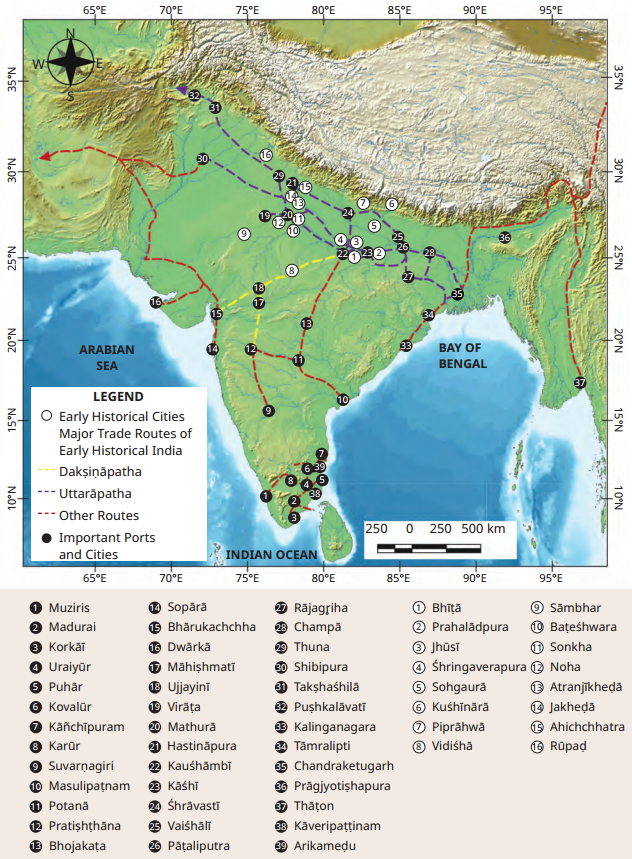
Figure. Major trade routes of early historical India
Answer:
The major trade routes connected different parts of the Indian subcontinent and linked inland regions with important ports. They facilitated the movement of goods, people, and ideas and integrated overland and maritime trade networks. Indian ports also connected traders with regions such as Mesopotamia, the Persian Gulf, Rome, and Southeast Asia. These routes encouraged trade and also helped spread skills, knowledge, religious ideas, and cultural practices between different regions.
Question 10.
What might have been the advantages and challenges of ruling a large empire in the absence of modern communication systems?
Answer:
Ruling a large empire without modern communication would have been challenging because information and messages travelled slowly over long distances. It would have taken time for rulers to communicate with distant provinces and respond to local problems.
To manage these challenges, large empires developed organised administrative systems. They divided the empire into provinces, districts, and villages, where governors, district officers, and village headmen looked after local administration, justice, revenue collection, and law and order. This administrative structure helped rulers govern large territories more effectively.
Question 11.
Many ideas about governance come from texts composed by scholars and advisors of the king. What might be some limitations of relying only on such sources?
Answer:
Texts composed by scholars and advisors of the king often present the ideals and viewpoints of rulers. They may not describe how governance actually functioned in practice or reflect the experiences of ordinary people. Therefore, historians compare such texts with inscriptions, coins, archaeological evidence, and other literary sources to develop a more complete understanding of the past.
Question 12.
Read the source and answer the questions:
The Nashik cave inscription (2nd century CE) of Ushavadata records:
“Ushavadata, son of Dinika, son-in-law of king Nahapana … has bestowed this cave on the Saṁgha generally; he has also given a perpetual endowment, three thousand—3000 kahapanas which, for the members of the Samgha of any sect, and any origin dwelling in this cave, will serve as cloth money and money for outside life (kuśhana); and those kahapanas have been invested in guild dwelling at Govadhana—2000 in a weavers’ guild, interest one pratika (monthly) for the hundred, (and) 1000 in another weaver’s guild, interest three quarters of a padika (monthly) for the hundred.”
(a) What does this source tell us about the economic role of guilds?
Answer:
The source shows that guilds were important economic institutions. They accepted money deposits, invested them, paid interest, and managed funds. Besides regulating trade and crafts, guilds also functioned as banking and financial institutions.
(b) Why were guilds trusted with money deposits?
Answer:
Guilds were trusted because they were well- organised and influential institutions. They managed funds securely, paid regular interest on deposits, and maintained professional standards and discipline, making them reliable financial institutions.
(c) Identify the donor and the donees from the given source.
Answer:
Donor: Ushavadata, son of Dinika and son-in-law of King Nahapana.
Donees: The Samgha (Buddhist monastic community) living in the cave
Question 13.
Mark and locate on the map of India the following important centres: Pataliputra, Nashik, Ujjain, Vikramshila, Kanchipuram, Mathura, Rajgriha.
Answer:
Do it yourself.
Question 14.
Prepare a short presentation or poster on one of the following-
(a) Life in the Vedic society
(b) Early education system (gurukula)
(c) Trade and guilds in early India
(d) Role of women in early Indian society
Answer:
Do it yourself