Practicing Class 9 Science MCQ and Class 9 Science Exploration Chapter 10 MCQ Online Test with Answers Sound Waves Characteristics and Applications daily helps in time management.
Class 9 Science Chapter 10 Sound Waves Characteristics and Applications MCQ
Sound Waves Characteristics and Applications MCQ
Class 9 Science Chapter 10 MCQ online test
Question 1.
The frequency of a source of sound is 50 Hz. How many times does it vibrate in one minute?
(a) 50
(b) 300
(c) 3000
(d) 30000
Answer:
(c) 3000
Question 2.
If the frequency of a wave is tripled, then its wavelength is
(a) doubled
(b) one third
(c) half
(d) same
Answer:
(b) one third
Question 3.
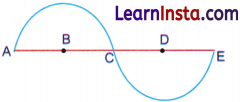
In the curve shown in fig., half the wavelength
(a) AB
(b) BD
(c) DE
(d) AE
Answer:
(b) BD
Question 4.
When we change the feeble sound to loud we increase its
(a) frequency
(b) amplitude
(c) velocity
(d) wavelength
Answer:
(b) amplitude

Question 5.
Same notes being played on guitar and harmonium differ in
(a) pitch
(b) quality
(c) both pitch and quality.
(d) neither pitch nor quality.
Answer:
(b) quality
Question 6.
The separation between two successive crests in a wave is
(a) λ
(b) \(\frac{\lambda}{2}\)
(c) 2λ
(d) \(\frac{\lambda}{4}\)
Answer:
(a) λ
Question 7.
If a wave completes 20 vibrations in 2.5 s, then its frequency is
(a) 8 Hz
(b) 20 Hz
(c) 50 Hz
(d) 200 Hz
Answer:
(a) 8 Hz
Question 8.
The reciprocal of frequency is
(a) amplitude
(b) wavelength
(c) time-period
(d) wave velocity
Answer:
(c) time-period
Question 9.
When we pluck the wire of a sitar, the waves produced in its wire are
(a) transverse
(b) longitudinal
(c) both transverse and longitudinal
(d) neither transverse nor longitudinal
Answer:
(a) transverse
Question 10.
A boat at anchor is rocked by waves whose crests are 100 m apart and whose velocity is 25 m/s. How often do the crests reach the boat?
(a) 2500 s
(b) 75 s
(c) 4 s
(d) 0.25 s
Answer:
(c) 4 s
Question 11.
Tone is a sound
(a) of mixture of several frequencies
(b) of mixture of two frequencies only
(c) of a single frequency
(d) always unpleasant to listen
Answer:
(c) of a single frequency
Question 12.
A key of a mechanical piano struck gently and then struck again but much harder this time. In the second case
(a) sound will be louder but pitch will not be different
(b) sound will be louder and pitch will also be higher
(c) sound will be louder but pitch will be lower
(d) both loudness and pitch will remain unaffected
Answer:
(a) sound will be louder but pitch will not be different
Question 13.
Note is a sound
(a) of mixture of several frequencies
(b) of mixture of two frequencies only
(c) of a single frequency
(d) always unpleasant to listen
Answer:
(a) Note is a sound of mixture of several frequencies.
Question 14.
A key of a mechanical piano struck gently and then struck again, but much harder this time. In the second case
(a) sound will be louder, but pitch will not be different
(b) sound will be louder, and pitch will also be higher
(c) sound will be louder, but pitch will be lower
(d) Both loudness and pitch will remain unaffected
Answer:
(a) When the key of a mechanical piano is struck harder, sound will be louder as it will vibrate with greater amplitude, but pitch will not be different as it does not depend on how hard the key is struck.
Question 15.
In SONAR, we use
(a) ultrasonic waves
(b) infrasonic waves
(c) radio waves
(d) audible sound waves
Answer:
(a) Ultrasonic waves are used in SONAR.
Question 16.
Sound travels in air if
(a) Particles of medium travel from one place to another
(b) There is no moisture in the atmosphere
(c) disturbance moves
(d) Both particles as well as disturbance travel from one place to another.
Answer:
(c) Sound travels in air if disturbance moves, not the particles of medium.
Question 17.
When we change feeble sound to loud sound, we increase its
(a) frequency
(b) amplitude
(c) velocity
(d) wavelength
Answer:
(b) As the loudness and softness of sound or intensity of sound is directly proportional to the square of amplitude of sound wave, therefore, feeble sound can be changed to loud sound by increasing its amplitude.
Question 18.
In the curve, half the wavelength is

(a) AB
(b) BD
(c) DE
(d) AE
Answer:
(b) BD represents half the wavelength in the curve.
Question 19.
Earthquake produces which kind of sound before the main shockwave begins
(a) ultrasound
(b) infrasound
(c) audible sound
(d) none of the above
Answer:
(b) Earthquake produces infrasound before the main shock wave begins.
Question 20.
Infrasound can be heard by
(a) dog
(b) bat
(c) rhinoceros
(d) human beings
Answer:
(c) Infrasound can be heard by rhinoceros.
Question 21.
Before playing the orchestra in a musical concert, a sitarist tries to adjust the tension and pluck the string suitably. By doing so, he is adjusting
(a) intensity of sound only
(b) amplitude of sound only
(c) frequency of the sitar string with the frequency of other musical instruments
(d) loudness of sound
Answer:
(c) Frequency of the sitar depends upon tension in string, so, sitarist is adjusting frequency of the sitar string with the frequency of other instruments.
Sound Waves Characteristics and Applications Class 9 Assertion and Reason Questions
Directions: For questions number (i) to (ii), two statements are given – one labelled as Assertion (A) and the other labelled as Reason (R). Select the correct answer to these questions from the codes (a), (b), (c and (d) as given below.
(a) Both (A) and (R) are true and (R) is the correct explanation of (A).
(b) Both (A) and (R) are true but (R) is not the correct explanation of (A).
(c) (A) is true but (R) is false.
(d) (A) is false but (R) is true.
Question 1.
Assertion (A): The pitch of a sound depends on its frequency.
Reason (R): High frequency sound waves have a higher pitch.
Answer:
(a) Both (A) and (R) are true and (R) is the correct explanation of (A).
Question 2.
Assertion (A): Ultrasound is used for medical imaging purposes.
Reason (R): Ultrasound waves have a very high frequency and can penetrate tissues without causing harm.
Answer:
(a) Both (A) and (R) are true and (R) is the correct explanation of (A).
Sound Waves Characteristics and Applications Class 9 Fill in the Blanks
1. Sound is produced due to __________ of objects.
Answer:
vibrations
2. The number of vibrations per second is called __________.
Answer:
frequency
3. The SI unit of frequency is __________.
Answer:
hertz (Hz)
4. The loudness of a sound depends on its __________.
Answer:
amplitude
5. The speed of sound is maximum in __________.
Answer:
solids
Sound Waves Characteristics and Applications Class 9 True or False
1. Sound waves can travel through liquids.
Answer:
True
2. Wavelength decreases when frequency increases (at constant speed).
Answer:
True
3. Sound waves travel in a straight line only.
Answer:
False
4. Higher amplitude means louder sound.
Answer:
True
5. Frequency of a wave changes with the medium.
Answer:
False
6. Echo is caused by reflection of sound.
Answer:
True
Sound Waves Characteristics and Applications Class 9 Match the Following
Question 1.
Match the following items given in Column A with that in Column B.
| Column A | Column B |
| 1. Frequency | (a) Number of vibrations per second |
| 2. Amplitude | (b) Depends on frequency |
| 3. Wavelength | (c) Loudness of sound |
| 4. Pitch | (d) Distance between two compressions |
Answer:
| Column A | Column B |
| 1. Frequency | (a) Number of vibrations per second |
| 2. Amplitude | (c) Loudness of sound |
| 3. Wavelength | (d) Distance between two compressions |
| 4. Pitch | (b) Depends on frequency |
Question 2.
Match the following items given in Column A with that in Column B.
| Column A | Column B |
| 1. Vacuum | (a) Unit of frequency |
| 2. Echo | (b) Region of high pressure |
| 3. Hertz | (c) Sound cannot travel |
| 4. Compression | (d) Reflection of sound |
Answer:
| Column A | Column B |
| 1. Vacuum | (c) Sound cannot travel |
| 2. Echo | (d) Reflection of sound |
| 3. Hertz | (a) Unit of frequency |
| 4. Compression | (b) Region of high pressure |
MCQ On Sound Waves Characteristics and Applications Class 9 for Practice
Choose the correct option in the following questions
Question 1.
If the velocity of sound in air is 350 m/s, a person singing a note of 250 cycles per second is producing sound waves with a wavelength of …..
(a) 5/7 m
(b) 1.4 cm
(c) 1.4 m
(d) 87.5 km
Question 2.
Infrasonic (vi), Audible (va) and Ultrasonic (vu) sounds are related as
(a) vi < va < vu
(b) vi > va > vu
(c) va <vi × vu
(d) va < vu < vi
Question 3.
Echo is not heard in a room of 10 m × 10 m × 10 m dimension due to (speed of sound in air = 300 m/s)
(a) reflection
(b) absorption
(c) persistence
(d) humidity
Question 4.
Sound travles in air if
(a) particles of medium travel from one place to another
(b) there is no moisture in the atmosphere
(c) disturbance moves
(d) both particles as well as disturbance travel from one place to another
Question 5.
The wave having an amplitude of 5 cm and frequency f = 100 Hz can be best represented by
(a) 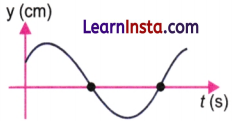
(b) 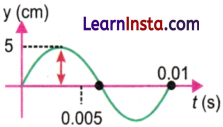
(c) 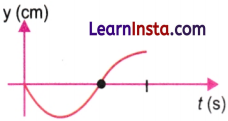
(d) 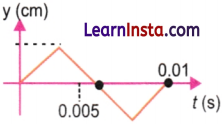
Assertion-Reason Questions
Directions: For questions number (1) to (2), two statements are given — one labelled as Assertion (A) and the other labelled as Reason (R). Select the correct answer to these questions from the codes (a), (b), (c) and(d) as given below.
(a) Both (A) and (R) are true and (R) is the correct explanation of (A).
(b) Both (A) and (R) are true but (R) is not the correct explanation of (A).
(c) A is true but (R) is false.
(d) A is false but (R) is true.
Question 1.
Assertion (A): During the rainy season, lightning is seen first followed by hearing the thunder.
Reason (R): Speed of light is much greater than speed of sound in air.
Question 2.
Assertion (A): Under the given conditions of pressure and temperature, the velocity of sound is higher in air as compared to that in water.
Reason (R): Density of water is more than that of air.
Fill in the Blanks
1. The distance between two consecutive compressions or rarefactions is called __________.
2. Sound cannot travel through __________.
3. The quality of sound is also known as __________.
4. A sound with a frequency less than 20 Hz is called __________ sound.
5. A sound with a frequency greater than 20,000 Hz is called __________ sound.
State whether the statements given below are True or False
1. Sound can travel through vacuum.
2. Higher frequency corresponds to higher pitch.
3. The speed of sound is fastest in gases.
4. Ultrasound is audible to humans.
5. Echo is caused due to absorption of sound.
6. Time period is the reciprocal of frequency.
7. Sound travels slower in solids than in liquids.
Match the Columns
Question 1.
Match the following items given in Column A with that in Column B.
| Column A | Column B |
| (a) Frequency | (i) Determines loudness |
| (b) Amplitude | (ii) Number of oscillations per second |
| (c) Time period | (iii) Time taken for one oscillation |
| (d) Pitch | (iv) Depends on frequency |
Question 2.
Match the following items given in Column A with that in Column B.
| Column A | Column B |
| (a) Echo | (i) Device to measure sea depth |
| (b) SONAR | (ii) Repetition of sound due to reflection |
| (c) Ultrasound | (iii) Sound above 20,000 Hz |
| (d) Reverberation | (iv) Persistence of sound in a hall |