Practice with Class 9 SST Extra Questions and Class 9 Social Science SST Chapter 2 Shaping of the Earth’s Surface Extra Questions and Answers to improve your exam performance.
Shaping of the Earth’s Surface Class 9 Extra Question Answer
Extra Questions of Shaping of the Earth’s Surface Class 9
Shaping of the Earth’s Surface Class 9 Very Short Question Answer
Question 1.
Why is the theory of Plate Tectonics important?
Answer:
The theory of Plate Tectonics helps explain how the Earth’s surface changes over time. It explains the formation of mountains, volcanoes, earthquakes, continents, and oceans.
Question 2.
What is the role of convection currents in plate movement?
Answer:
Convection currents in the mantle are generated by heat from the Earth’s interior. These currents push and pull tectonic plates, causing them to move slowly over the asthenosphere.
Question 3.
Why is the Himalayan region prone to earthquakes?
Answer:
The Himalayan region is prone to earthquakes because it lies along the convergent boundary where the Indian Plate continues to collide with the Eurasian Plate.
Question 4.
How does weathering contribute to soil formation?
Answer:
Weathering breaks rocks into smaller particles over long periods. These particles mix with organic matter to form soil, which supports plant growth and agriculture.
Question 5.
How is erosion different from weathering?
Answer:
Weathering breaks rocks into smaller pieces without moving them, whereas erosion involves the removal and transportation of weathered materials by agents such as water, wind, glaciers, and waves.
Question 6.
Why are meanders important for agriculture?
Answer:
Meanders deposit fertile sediments along river banks, creating nutrient-rich soil that is highly suitable for farming and agricultural activities.
Question 7.
Why are deltas densely populated?
Answer:
Deltas have fertile alluvial soil, abundant water resources, fishing opportunities, and good transport facilities, making them attractive areas for human settlement.

Question 8.
What is the significance of glaciers for human life?
Answer:
Glaciers are important sources of freshwater and feed many rivers that support agriculture, drinking water supplies, and hydroelectric power generation.
Question 9.
Why should people study landforms?
Answer:
Studying landforms helps us understand natural processes, manage resources wisely, reduce disaster risks; and promote sustainable development.
Shaping of the Earth’s Surface Class 9 Short Question Answer
Question 1.
Explain how tectonic plate movements shape the Earth’s surface.
Answer:
The Earth’s lithosphere is divided into tectonic plates that move slowly over the semi-molten asthenosphere. At convergent boundaries, plates collide and form mountains such as the Himalayas. At divergent boundaries, plates move apart and create new crust, while transform boundaries often generate earthquakes. These movements continuously reshape the Earth’s surface by forming mountains, valleys, volcanoes, and ocean basins.
Question 2.
Describe the three main types of weathering.
Answer:
Weathering occurs in three forms:
- Physical Weathering: Rocks break into smaller pieces due to temperature changes, frost action, or wind.
- Chemical Weathering: Minerals in rocks undergo chemical reactions with water, air, or acids, changing their composition.
- Biological Weathering: Plants, animals, and microorganisms break down rocks. For example, roots growing into rock cracks can split them apart.
Together, these processes gradually shape the Earth’s surface and contribute to soil formation.
Question 3.
How do rivers create different landforms along their course?
Answer:
Rivers shape land through erosion, transportation, and deposition. In the upper course, rivers create V-shaped valleys, waterfalls, and rapids. In the middle course, they form meanders and floodplains. In the lower course, rivers deposit sediments to form deltas and levees. These landforms support agriculture, settlements, transportation, and biodiversity.
Question 4.
Explain the relationship between landforms and human activities.
Answer:
Landforms strongly influence human life. Fertile plains support agriculture and dense populations. Mountains provide water resources, forests, and tourism opportunities. Coastal regions encourage fishing and trade. Rivers supply water, transport routes, and fertile land. Thus, human settlements, occupations, transportation systems, and cultural development are closely linked to landforms.
Question 5.
Why is erosion considered both beneficial and harmful?
Answer:
Erosion is beneficial because it helps create fertile plains, deltas, and new landforms. However, excessive erosion can remove fertile topsoil, damage agricultural land, destroy infrastructure, and increase the risk of floods and landslides. Therefore, proper soil conservation measures are necessary to reduce its harmful effects.
Shaping of the Earth’s Surface Class 9 Long Question Answer
Question 1.
Explain the theory of Plate Tectonics and its importance in understanding the Earth’s surface.
Answer:
The theory of Plate Tectonics, proposed by W. J. Morgan, states that the Earth’s lithosphere is divided into several large and small tectonic plates that move slowly over the semi-molten asthenosphere. The movement of these plates is driven by convection currents generated by heat from the Earth’s interior.
There are three main types of plate boundaries: convergent, divergent, and transform boundaries. Convergent boundaries form mountains and volcanoes, divergent boundaries create new crust and mid-ocean ridges, while transform boundaries are associated with earthquakes.
This theory explains the formation of continents, oceans, mountain ranges, earthquakes, and volcanic activity. It helps scientists identify disaster-prone regions and understand the dynamic nature of the Earth.
Question 2.
Describe the role of weathering and erosion in shaping the Earth’s surface.
Answer:
Weathering and erosion are important processes that continuously modify the Earth’s surface. Weathering breaks rocks into smaller pieces through physical, chemical, and biological processes. Erosion then removes and transports these weathered materials through water, wind, glaciers, and waves.
Together, these processes wear down mountains, carve valleys, create plains, and form various landforms such as caves, cliffs, beaches, and deltas. They also contribute to soil formation, which supports agriculture and ecosystems.
While these processes help create productive landscapes, excessive erosion can damage farmland, infrastructure, and natural habitats. Therefore, understanding weathering and erosion is essential for environmental conservation and sustainable land management.
Question 3.
Explain how rivers act as agents of gradation and create important landforms.
Answer:
Rivers are among the most important agents of gradation because they erode, transport, and deposit materials. In their upper course, rivers possess high energy and create V-shaped valleys, rapids, and waterfalls through erosion.
As rivers enter their middle course, they lose some energy and form meanders, floodplains, and oxbow lakes through lateral erosion and deposition. In the lower course, rivers deposit large amounts of sediments at their mouths, forming deltas and levees.
These landforms provide fertile soil, support agriculture, facilitate transportation, and encourage settlement. Rivers have therefore played a crucial role in the development of human civilizations throughout history.
Question 4.
Discuss the importance of glaciers and the landforms created by them.
Answer:
Glaciers are large masses of moving ice that shape landscapes through erosion and deposition. They create distinctive landforms such as U-shaped valleys, cirques, aretes, hanging valleys, fjords, and moraines.
These landforms attract tourists and support activities such as trekking, skiing, and mountaineering. Glaciers are also important reservoirs of freshwater and feed rivers that support millions of people. However, climate change is causing glaciers to melt rapidly, increasing the risk of Glacial Lake Outburst Floods (GLOFs). Therefore, glaciers are significant both as agents of landscape formation and as vital natural resources that require protection.
Question 5.
Explain how landforms influence human life and why understanding them is important.
Answer:
Landforms influence where people live, work, travel, and develop settlements. Fertile plains support agriculture and dense populations, while mountains provide water, forests, and tourism opportunities. Coastal regions encourage fishing, trade, and port development, whereas deserts influence transportation routes and settlement patterns.
Landforms also affect economic activities, cultural development, and historical events. At the same time, certain landforms are associated with natural hazards such as landslides, avalanches, GLOFs, and dust storms.
Understanding landforms helps people manage natural resources, plan settlements wisely, reduce disaster risks, and promote sustainable development. It strengthens the relationship between humans and the environment and encourages responsible use of natural resources.
Shaping of the Earth’s Surface Class 9 Source Based Questions
Read the sources given below and answer the questions that follow:
Question 1.
Plate tectonics is an important theory that explains the movement of the Earth’s crust. According to this theory, the outermost layer of the Earth is broken into several large and small pieces called tectonic plates. These plates move slowly over the semi- molten layer beneath them and are responsible for major physical features and natural phenomena, such as mountains, earthquakes, and volcanoes.
(i) What are the broken pieces of the Earth’s crust called?
Answer:
They are called tectonic plates.
(ii) Over which layer do tectonic plates move?
Answer:
Tectonic plates move over the semi-molten asthenosphere (upper mantle).
(iii) How does the movement of tectonic plates shape the Earth’s surface?
Answer:
The movement of tectonic plates forms landforms such as mountains, volcanoes, and ocean basins and causes earthquakes. It continuously changes and reshapes the Earth’s surface.
Question 2.
Weathering is the process through which rocks on the Earth’s surface break down into smaller pieces due to various processes. It does not involve movement of the broken material, only the breaking down. There are three main types of weathering: physical weathering, chemical weathering, and biological weathering.
(i) What is weathering?
Answer:
Weathering is the process by which rocks on the Earth’s surface break down into smaller pieces without being moved.
(ii) Name any two types of weathering.
Answer:
Physical weathering and chemical weathering.
(iii) Differentiate between weathering and erosion.
Answer:
| Weathering | Erosion |
| It breaks rocks into smaller pieces without moving them. | It wears away and transports weathered material from one place to another. |
| It occurs at the place where the rocks are present. | It is carried out by agents such as water, wind, ice, and waves. |
Shaping of the Earth’s Surface Class 9 Picture Based Questions
Question 1.
Observe , the pictures and answer the questions that follow:
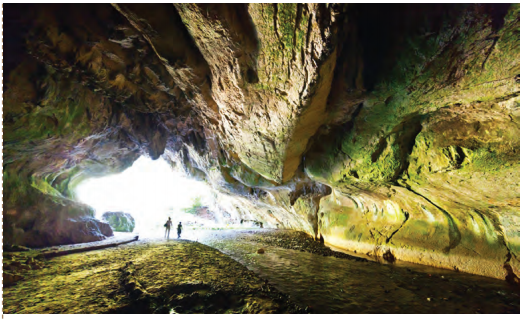
(i) Identify the landform shown in the picture.
Answer:
The picture shows a cave.
(ii) Which natural agent is mainly responsible for the formation of this landform?
Answer:
Underground water is mainly responsible for the formation of this landform.
(iii) Explain how caves are formed. Name any two features found inside caves.
Answer:
Caves are formed when underground water dissolves soluble rocks such as limestone over a long period. This process enlarges cracks and forms underground caves. Two features commonly found inside caves are stalactites (hanging from the roof) and stalagmites (rising from the floor).
Question 2.
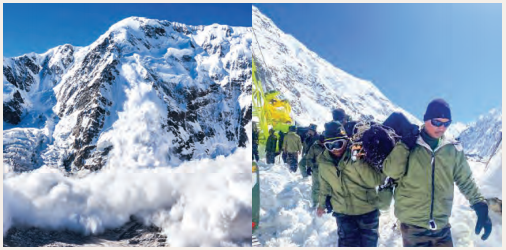
(i) Identify the natural disaster shown in the picture.
Answer:
The picture shows an avalanche.
(ii) What is an avalanche?
Answer:
An avalanche is the sudden downward movement of a large mass of snow and ice down a steep mountain slope.
(iii) State any two causes of avalanches.
Answer:
The two causes of avalanches are:
(a) Heavy snowfall on steep mountain slopes makes the snow unstable.
(b) Earthquakes, vibrations, or human activities such as skiing, trekking, or construction can trigger an avalanche by disturbing the snow-covered slopes.
Class 9 Shaping of the Earth’s Surface Extra Questions for Practice
Multiple Choice Questions
Question 1.
Which theory explains the movement of the Earth’s crustal plates?
(a) Evolution Theory
(b) Plate Tectonic Theory
(c) Big Bang Theory
(d) Gravity Theory
Question 2.
Which landform is formed by the deposition of sediments at the mouth of a river?
(a) Meander
(b) Waterfall
(c) Delta
(d) Fjord
Question 3.
Which agent is responsible for forming U-shaped valleys?
(a) Wind
(b) Rivers
(c) Waves
(d) Glaciers
Question 4.
Stalactites and stalagmites are formed by the action of:
(a) Wind
(b) Waves
(c) Underground water
(d) Rivers
Question 5.
Which disaster is associated with glacial regions?
(a) Dust Storm
(b) Landslide
(c) GLOF
(d) Cyclone
Assertion & Reason Questions
Question 1.
Assertion (A): Most earthquakes occur near tectonic plate boundaries.
Reason (R): Plate movements release energy stored within rocks.
Options:
(a) Both (A) and (R) are true and (R) is the correct explanation of (A).
(b) Both (A) and (R) are true but (R) is not the correct explanation of (A).
(c) (A) is true but (R) is false.
(d) (A) is false but (R) is true.
Fill in the blanks
1. The Earth’s outer rigid layer is called the ______
2. Convection currents occur in the Earth’s ______
3 A winding bend in a river is known as a ______
4. Deposits left behind by glaciers are called ______
5. A sudden release of water from a glacial lake is called a ______
Very Short Answer Type Questions
Question 1.
What is Plate Tectonic Theory?
Question 2.
What is weathering?
Question 3.
What is a delta?
Question 4.
What is a fjord?
Question 5.
What is a sinkhole?
Short Answer Type Questions
Question 1.
Explain the role of convection currents in plate movement.
Question 2.
How do rivers shape the Earth’s surface?
Question 3.
How are glaciers useful to humans?
Question 4.
Why are landforms important for human life?
Long Answer Type Questions
Question 1.
Describe the different types of weathering and their importance.
Question 2.
Explain how rivers act as agents of gradation.
Question 3.
Discuss the role of glaciers in shaping the Earth’s surface.
Question 4.
Explain how landforms influence human life and the environment.