Students often refer to Maths Mela Class 5 Solutions Chapter 7 Shapes and Patterns Question Answer NCERT Solutions to verify their answers.
Class 5 Maths Chapter 7 Shapes and Patterns Question Answer Solutions
Shapes and Patterns Class 5 Maths Solutions
Class 5 Maths Chapter 7 Solutions
Find Out (Page 94)
Question 1.
Can regular triangles fit together at a point without any gap? How many of them fit together?

Answer:
Yes, 6 triangles.
Question 2.
Can squares fit together around a point without any gap or overlap? How many squares did you need?
Answer:
Yes, 4 squares.
Question 3.
Can five squares fit together around a point without any gaps or overlaps? Why or why not?
Answer:
No, because 5 × 90° = 450°, which is more than 360°, so the squares will overlap.
Question 4.
Can regular hexagons fit together around a point without any gaps or overlaps? How many fit together at a point?
Answer:
Yes, 3 hexagons.

(Page 95)
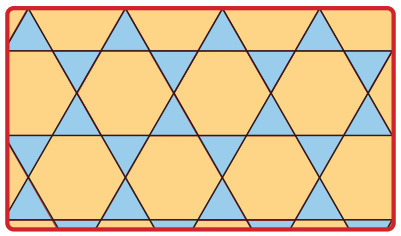
Here is a tessellating pattern with more than one shape. What shapes have been used in this pattern? _______, _______
Answer:
Triangles and hexagons.
(Page 96)
Question 1.
Look at the pattern given below:
What shapes are coming together at the marked points in the first (blue box) pattern? Are the same set of shapes coming together at these points?

Answer:
1 square (blue) and 4 octagon (green). Yes.
Question 2.
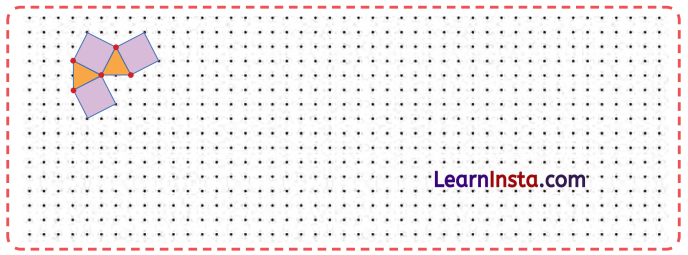
Are the triangles equilateral? Why or why not?
Answer:
No because an equilateral triangle has all three sides and angles equal (each angle is 60°). In the pattern, the triangles appear longer on one side and have angles that are not all 60°, so they are isosceles or scalene, not equilateral.
Question 3.
What shapes are coming together at the marked points?
Answer:
3 squares and 2 triangles.
Question 4.
Are the same set of shapes coming together at these points?
Answer:
Yes
Which Shape Am I? (Page 100)
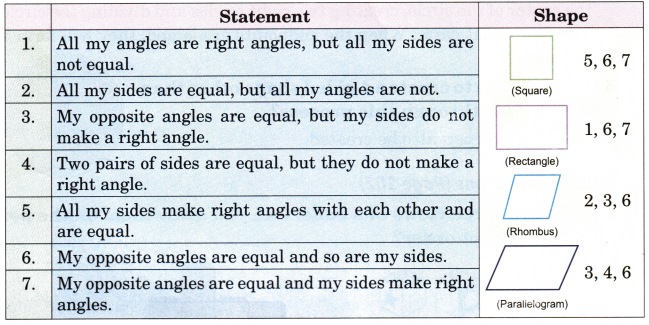
Match the statements with appropriate shapes. Do some of them describe more than one shape?

Answer:
Kites (Page 100)
Question 1.
What shapes do you see in the kite?
Answer:
A rhombus as the main body of the kite and four triangles within the rhombus.
Play with Circles (Page 101)
Question 1.
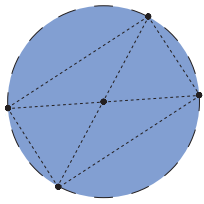
What shape is formed?
Answer:
Rectangle
Question 2.
What do you notice about the shape that is formed?
Answer:
When we draw any two diameters and connect their endpoints, rectangle will be formed always. This is because the two diameters intersect at the center of the circle, creating two right angles and dividing the circle into four equal parts. When the endpoints are joined, they will form a rectangle.
Question 3.
Is it possible to create a 4-sided shape other than a rectangle through this process?
Answer:
Yes, a square can also be created.
Cube Connections (Page 102)
Question 1.
Here are three views of a cube. Can you draw them on the net in the correct order?

Answer:
Based on the three views, here is one possible correct way to draw the faces on the provided net.
- The yellow-blue face is opposite the blue-pink face.
- The yellow-brown face is adjacent to both the yellow-blue and blue-pink faces.
Question 2.
Here are some big solid cube frames. How many small cubes have been removed from each cube?
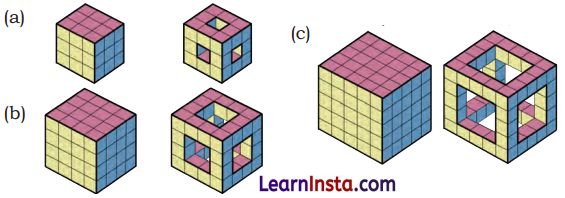
Answer:
(a) 7
(b) 24
(c) 61
Question 3.
Nisha has glued 27 small cubes together to make a large solid cube. She paints the large cube red. How many of the original small cubes have-
(a) three faces painted red? _______
(b) two faces painted red? _______
(c) one face painted red? _______
(d) no faces painted red? _______
Answer:
(a) 8
(b) 12
(c) 6
(d) 1
Puzzle (Page 102)
Question 1.
Tanu arranged 7 shapes in a line. She used 2 squares, 2 triangles, 1 circle, 1 hexagon, and 1 rectangle.
Find her arrangement using the following clues:
(a) The square is between the circle and the rectangle.
(b) The rectangle is between the square and the triangle.
(c) The two triangles are next to the square.
(d) The hexagon is to the right of the triangle.
(e) The circle is to the left of the square.
Answer:
Arrangement of seven shapes:
Circle, Square, Rectangle, Triangle, Square, Triangle, Hexagon
Icosahedron and Dodecahedron (Page 103)
Question 1.
What shapes do you see in an icosahedron and a dodecahedron?
Answer:
- Icosahedron: Triangles
- Dodecahedron: Pentagons
Question 2.
Do all the faces look the same?

Answer:
- Icosahedron: Yes
- Dodecahedron: Yes
Question 3.
How many faces meet at a vertex (point)?
Answer:
- Icosahedron: 5
- Dodecahedron: 3
Question 4.
Do the same number of faces meet at each vertex?
Answer:
- Icosahedron: Yes
- Dodecahedron: Yes
Question 5.
How many edges do you see?
Answer:
- Icosahedron: 30
- Dodecahedron: 30
Question 6.
Can you think of any other solid shapes that have faces that look the same? Do the same number of faces meet at each common vertex?
Answer:
Yes.
- Cube: has 6 square faces.
- Tetrahedron: has 4 triangular faces.
- Octahedron: has 8 triangular faces.
The same number of faces do meet at each common vertex in these shapes.