Practicing Class 8 Maths MCQ and Class 8 Maths Chapter 4 Quadrilaterals MCQ Questions Online Test with Answers daily helps in time management.
MCQ on Quadrilaterals Class 8
Quadrilaterals MCQ Class 8
Class 8 Maths MCQ Chapter 4 Quadrilaterals
Multiple Choice Questions
Question 1.
If the adjacent angles of a parallelogram are equal, then the parallelogram is a
(a) rectangle
(b) trapezium
(c) rhombus
(d) any of the three
Answer:
(a) rectangle
Question 2.
Which of the following is true for the adjacent angles of a parallelogram?
(a) they are equal to each other
(b) they are complementary angles
(c) they are supplementary angles
(d) none of these
Answer:
(c) they are supplementary angles

Question 3.
Diagonals of a ……. do not bisect it into two congruent triangles.
(a) rhombus
(b) trapezium
(c) square
(d) rectangle
Answer:
(b) trapezium
Question 4.
What is the value of x in the adjoining figure?

(a) 120°
(b) 80°
(c) 60°
(d) 100°
Answer:
(c) 60°
Question 5.
If two adjacent angles of a parallelogram are (5x – 5)° and (10x + 35)°, then the ratio of these angles is
(a) 1: 3
(b) 2: 3
(c) 1: 4
(d) 1: 2
Answer:
(a) 1: 3
Assertion-Reason Based Questions
In the following question 6, a statement of Assertion (A) is followed by a statement of Reason (R). Choose the correct option as:
(a) Both Assertion and Reason are true and Reason is the correct explanation of Assertion.
(b) Both Assertion and Reason are true but Reason is not the correct explanation of Assertion.
(c) Assertion is true but Reason is false.
(d) Assertion is false but Reason is true.
Question 1.
Assertion (A): A quadrilateral with all its sides equal is a rhombus.
Reason (R): The diagonals of a rhombus bisect each other at right angles.
Answer:
(b) Both Assertion and Reason are true but Reason is not the correct explanation of Assertion.
Fill in the blanks:
1. A quadrilateral that is not a parallelogram but has exactly two opposite angles of equal measure is a _____.
Answer: kite
2. If one diagonal of a rectangle is 6 cm long, the length of the other diagonal is ______ .
Answer: 6 cm
3. A quadrilateral whose opposite sides and all the angles are equal is a _______.
Answer: Rectangle
4. If the angles of a quadrilateral are in the ratio 1 : 2 : 3 : 4, then the angles of the quadrilateral are _______ .
Answer: 36°, 72°, 108°, 144°
5. If PQRS is a parallelogram, then ∠P – ∠R is equal to _____ .
Answer: 0°
Write ‘true’ or ‘false’:
1. All kites are squares.
Answer: False
2. Adjacent angles of a parallelogram are supplementary.
Answer: True
3. All rectangles are parallelograms.
Answer: True
4. A polygon is regular if all of its sides are equal.
Answer: True
5. If the diagonals of a quadrilateral are equal, it must be a rectangle.
Answer: False
Match the following:
Question 1.
| Column I | Column II |
| (a) All sides are equal, opposite angles are equal, and diagonals bisect each other at right angles. | (i) Square |
| (b) Diagonals bisects each other, and are of equal length, opposite sides are equal, but adjacent sides are not equal. | (ii) Trapezium |
| (c) All sides are equal, and diagonals are equal and bisect each other at right angles. | (iii) Kite |
| (d) Exactly one pair of opposite sides is parallel. | (iv) Rhombus |
| (e) Diagonals are perpendicular, and only one diagonal bisects the other. | (v) Rectangle |
Answer:
| Column I | Column II |
| (a) All sides are equal, opposite angles are equal, and diagonals bisect each other at right angles. | (iv) Rhombus |
| (b) Diagonals bisects each other, and are of equal length, opposite sides are equal, but adjacent sides are not equal. | (v) Rectangle |
| (c) All sides are equal, and diagonals are equal and bisect each other at right angles. | (i) Square |
| (d) Exactly one pair of opposite sides is parallel. | (ii) Trapezium |
| (e) Diagonals are perpendicular, and only one diagonal bisects the other. | (iii) Kite |
Do as Directed
Question 1.
The diagonals of a rhombus ABCD intersect at O. If ∠ADC = 120° and OD = 6 cm, find
(i) ∠OAD
(ii) side AB
(iii) perimeter of the rhombus ABCD.
Answer:
(i) 30°
(ii) 12 cm
(iii) 48 cm
Question 2.
In the adjoining figure, ABCD is a trapezium.

(i) Find the value of x.
(ii) If EB and EC are bisectors of ∠B and ∠C respectively, find ∠BEC.
Answer:
(i) 80°
(ii) 90°
Question 3.
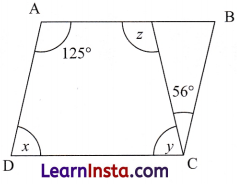
In the parallelogram ABCD given below, find the values of x, y, z.
Answer:
x = 55°, y = 69°, z = 111°
Question 4.
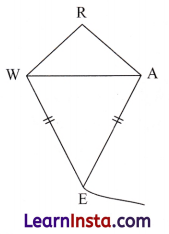
In kite WEAR, ∠WEA = 70° and ∠ARW = 80°. Find the remaining two angles.
Answer:
∠RWE = 105°, ∠RAE = 105°
Case Study Based Question:
Sarah is designing a new garden in her backyard. She wants the garden to be in the shape of a quadrilateral. She decides to make two opposite sides parallel and the lengths of opposite sides as 50 metre and 30 metre respectively, and all four comers are perfect right angles.
Question 1.
Based on Sarah’s design, what type of quadrilateral is her garden?
Answer:
Rectangle
Question 2.
If she wants to plant along the diagonals, using which property can she compare the number of plants along both the diagonals?
Answer:
Diagonals of a rectangle are equal.
Question 3.
What is the area of Sarah garden?
Answer:
1500 sq. metre