These Class 8 Science Curiosity Worksheet and Class 8 Science Chapter 13 Our Home: Earth, a Unique Life Sustaining Planet Worksheet with Answers are excellent for board exam practice.
Class 8 Science Chapter 13 Our Home: Earth, a Unique Life Sustaining Planet Worksheet
Class 8 Our Home: Earth, a Unique Life Sustaining Planet Worksheet
Worksheet On Our Home: Earth, a Unique Life Sustaining Planet Class 8 – Our Home: Earth, a Unique Life Sustaining Planet Worksheet Class 8
Let’s Begin
A. Multiple Choice Questions
Question 1.
Which planet is known to support life in the solar system?
(a) Mars
(b) Venus
(c) Jupiter
(d) Earth
Question 2.
What does ISRO stand for?
(a) Indian Satellite Research Organisation
(b) Indian Science Research Organisation
(c) Indian Space Research Organisation
(d) International Space Research Organisation
Question 3.
What type of particles does the solar wind contain?
(a) Low-energy particles
(b) High-energy particles
(c) Neutral gas particles
(d) Radioactive particles
Question 4.
What is one strategy birds use to ensure nutrition for the developing embryo?
(a) Feeding the chick before it hatches.
(b) Putting enough food inside the egg before laying it.
(c) Keeping the egg in the nest for long.
(d) Hatching multiple eggs together.
Question 5.
This question consists of an Assertion (A) and a Reason (R). Read the Assertion and Reason and choose the appropriate answer.
Assertion (A): Offspring do not look exactly like their mother or father.
Reason (R): Every offspring gets a mix of genetic information from both parents through gametes.
(a) Both A and R are true and R is the correct explanation of A.
(b) Both A and R are true but R is not the correct explanation of A.
(c) A is true but R is false.
(d) A is false but R is true.

Question 6.
This question consists of an Assertion (A) and a Reason (R). Read the Assertion and Reason and choose the appropriate answer.
Assertion (A): Burning fossil fuels contributes to global warming.
Reason (R): Fossil fuels release greenhouse gases like carbon dioxide.
(a) Both A and R are true and R is the correct explanation of A.
(b) Both A and R are true but R is not the correct explanation of A.
(c) A is true but R is false.
(d) A is false but R is true.
B. State True (T) or False (F).
1. About 90% of Earth’s surface is covered by water.
2. Pollination can occur through wind, insects, or animals.
3. Gravity is the force that keeps objects floating in space.
4. Recycling, repairing and reusing materials like plastic and clothes reduce pollution.
5. Photosynthesis is a process in which animals convert sunlight into food.
C. Fill in the blanks.
1. The __________ gas traps heat and contributes to global warming.
2. Venus is the __________ planet of the solar system.
3. In mammals, the embryo develops __________ the mother’s body.
4. The planet __________ has no atmosphere at all.
5. __________ along with Paris Agreement committed countries to reduce greenhouse gas emissions.
D. Assign one word to the following terms.
1. The layer of gases surrounding the Earth.
2. The type of reproduction involving a single parent.
3. The gas responsible for forming the ozone layer.
4. The outer solid layer of the Earth made of soil, rocks and minerals,,
5. The part of Earth containing all water bodies.
6. Increase in Earth’s average temperature due to greenhouse gases.
7. Early stage of development after the zygote.
E. Match the terms given in Column I with the correct descriptions given in Column II.
| Column I | Column II |
| (i) Mangalyaan | (a) Distance from the Sun where water remains liquid |
| (ii) Gold ilocks Zone | (b) Protects the Earth from harmful cosmic and solar radiation |
| (iii) Greenhouse Effect | (c) Ensures continuity of life |
| (iv) Magnetic Field | (d) India’s Mars mission launched by ISRO |
| (v) Reproduction | (e) Traps heat on the Earth to maintain suitable temperature |
Wonder Why?
A. Give reasons for the following.
1. Venus is hotter than Mercury, even though Mercury is closer to the Sun.
______________________________
______________________________
2. Reproduction process can lead to both similarity and variation.
______________________________
______________________________
3. Mammals like dogs, cows, etc could not lay eggs.
______________________________
______________________________
4. The Earth’s crust is very important, even though it is very thin.
______________________________
______________________________
5. Mars has a much thinner atmosphere than Earth.
______________________________
______________________________
6. Climate change is dangerous for life on Earth.
______________________________
______________________________
B. Read the conversation between Rishi and Rajesh. Interpret/Analyse
Rishi: You know, I think Earth is the only planet in the solar system that receives sunlight.
Rajesh: Yes, and the Earth is also the closest planet to the Sun, which is why it is warm enough for life.
Rishi: Yes, that’s right. Also, the Earth’s atmosphere has many gases along with oxygen, which we need to survive.
Rajesh: But oxygen is harmful! Too much of it can cause pollution.
Rishi: Yes, maybe. I think Earth’s atmosphere does not really matter much, it just gives us air to breathe.
Rajesh: I heard the greenhouse effect is harmful and we should eliminate all greenhouse gases.
Rishi: Maybe. I still think that the Earth is the only planet in the solar system on which life exists.
Evaluate the accuracy of their statements. If you find any incorrect statements, rewrite them correctly.
___________________________________________________
___________________________________________________
___________________________________________________
C. Earth ¡s located in the Sun’s habitable zone, where temperature allows water to remain mostly in liquid form. Imagine Earth suddenly moved:
- Closer to the Sun (between Mercury and Venus), or
- Farther from the Sun (beyond Mars).
How would this shift affect the presence of liquid water, the survival of plants and animals, and the Earth’s ability to support life?
Explain your reasoning with examples.
___________________________________________________
___________________________________________________
___________________________________________________
D. Your school organises a campaign on “Protecting Biodiversity and Climate.” You are asked to refer to an important global event related to this topi(c) Which global event would be most relevant, and why? Identify/Understanding
___________________________________________________
___________________________________________________
___________________________________________________
Learn By Doing
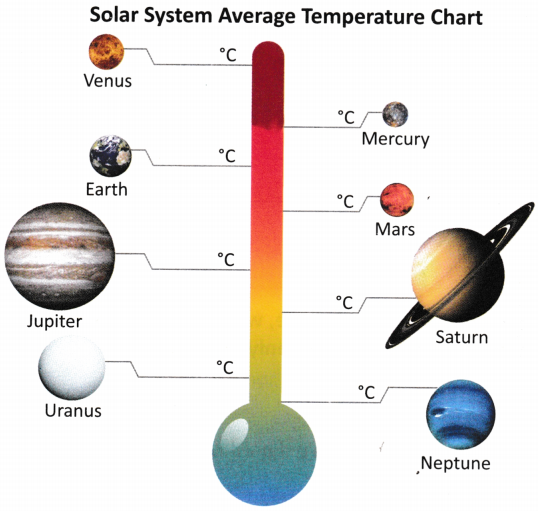
A. Find out the average temperature of the planets in our solar system using information available from school textbooks, trusted websites, etc, and complete the chart given
B. Label the layers of the Earth in the following diagram.

C. Observe the given pictures and identify their mode of reproduction. Complete the given table. One example has been done for you.

Explore With Curiosity
A. Read the paragraph and answer the following questions.
A group of students visits a nearby town and observes several environmental problems. They notice that the summers have become unusually hot, and the river running through the town is drying up. Trees in a nearby forest have been cut down for building roads, and many birds and animals that once lived there are no longer seen. Along with this, smoke from factories and vehicles pollute the air, and waste materials are seen floating in the river. Concerned, the students decide to investigate further and create a project on how human activities are harming the environment.
Question 1.
List the three components of the “triple planetary crisis” observed by the students.
___________________________________________________
___________________________________________________
Question 2.
What caused the biodiversity loss in the area, and how does it affect the environment?
___________________________________________________
___________________________________________________
Question 3.
How can the air and water pollution seen in the town lead to health problems?
___________________________________________________
___________________________________________________
Question 4.
What simple actions can students take to help reduce pollution and protect biodiversity?
___________________________________________________
___________________________________________________
Question 5.
Why is it important to take action on all three crises together?
___________________________________________________
___________________________________________________
B. Label the given diagrams and answer the following questions.

Question 1.
What is the process of transferring pollen from one flower to another called?
___________________________________________________
___________________________________________________
Question 2.
What are the male and female gametes in flowering plants?
___________________________________________________
___________________________________________________
Question 3.
What are the male and female gametes in animals called?
___________________________________________________
___________________________________________________
Question 4.
What are the advantages of giving birth to young ones instead of laying eggs?
___________________________________________________
___________________________________________________
C. Look at the given picture and answer the following questions.

Question 1.
What type of reproduction is being shown ¡n the given picture?
___________________________________________________
___________________________________________________
Question 2.
Which of the fragments of the Planaria could regrow to form a complete organism? Give reason.
___________________________________________________
___________________________________________________
Question 3.
Find out another example of an organism that follows the same mode of reproduction as Planaria.
___________________________________________________
___________________________________________________
Question 4.
Why is this type of reproduction not the same as reproduction in humans?
___________________________________________________
___________________________________________________
Word Puzzle
Find the words in the word search puzzle with the help of clues given below.
1. Force that pulls everything towards the Earth’s centre. __________
2. Characteristics such as colour, height, etc, among individuals of same species. __________
3. The outer solid layer of the Earth where we live. __________
4. The variety of landforms and rock types on the Earth. __________
5. A type of reproduction that involves two parents. __________
6. A detailed instruction manual found inside each cell of a living being. __________
7. The protective layer that blocks harmful UV rays from the Sup. __________
8. Harmful changes in air, water, or soil. __________
9. Specialised reproductive cells that carry half of the parent’s genetic material. __________
10. High-energy particles that come from far across the universe to the Earth. __________

Suggested Activities
A. Visit a pond to see hundreds of tiny frog eggs floating on the surface of water. Discuss with your class teacher why frogs lay so many eggs at once, while animals like birds or cows have only a few young ones. Write in your notebook about its advantages and disadvantages.
B. India is preparing for its ambitious lunar mission, Chandrayaan-4, which aims to collect and return soil samples from the Moon. If water existed on the Moon, do you think plants could grow in its soil? Imagine you have the soil from the-Moon and water is available. How would you test its ability to support plant life? Make a report on it.