Each of our Ganita Manjari Class 9 Worksheet and Class 9 Maths Chapter 1 Orienting Yourself The Use of Coordinates Worksheet with Answers focuses on conceptual clarity.
Class 9 Orienting Yourself The Use of Coordinates Worksheet
Ganita Manjari Class 9 Chapter 1 Worksheet
Multiple Choice Questions
Question 1.
The diagonals of a rhombus are 18 units and 8 units long. If they bisect each other at the orign and are parallel to the coordinate axes, then the coordinate axis, then the coordinates of its vertices are.
(a) A(-9, 0), B(0, 4), C(9, 0), D(0, -4)
(b) A(-18, 0), B(0, 8), C(18, 0), D(0, -8)
(c) A(-9, 0), B(0, 8), C(9, 0), D(0, -8)
(d) A(-4, 0), B(0, 9), C(4, 0), D(0, -9)
Answer:
(a) Since, the diagonals of the rhombus intersect at the origin 0(0, 0) and bisect each other.
∵ AC = 18 cm ⇒ OA = OC = 9 cm
BD = 8 cm ⇒ OB = OD = 4 cm
From the figure,
A and C lie on the X-axis.
B and D lie on the Y-axis.
Therefore, A(-9, 0), 6(0, 4), C(9, 0), D(0, -4)
Question 2.
Taking a suitable scale, the points A (-6,4), 8 (3, -5),C (5,2), D (-4, -3) and 8(0,7) are plotted on a graph paper. Which of the following points lies in the third quadrant?
(a) A(-6, 4)
(b) 8(3, -5)
(c) C(5, 2)
(d) D(-4, -3)
Answer:
(d) A point lies in the third quadrant when both coordinates are negative. Checking by options
A (-6, 4) → Second Quadrant
B (3, -5) Fourth Quadrant
C (5, 2) First Quadrant
D (-4, -3) → Third Quadrant
E (0,7) → First Quadrant
Therefore, the required point is D(-4, -3).
Question 3.
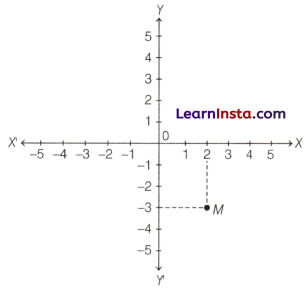
From the figure given below, the coordinates of point M are
(a) (-2, -3)
(b) (2, -3)
(c) (-2, 3)
(d) (2, 3)
Answer:
(b) In the given figure, point M lies at a distance of 2 units from Y-axis and at a distance of 3 units from X-axis along the negative direction of Y-axis. The x-coordinate is 2 and the y-coordinate is -3 Thus, the coordinates of point M are (2,-3).
Question 4.
Study the plotted points on the Cartesian plane below.
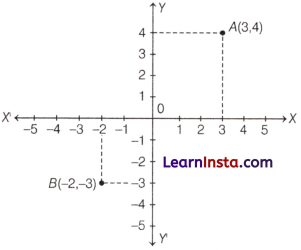
Which of the following statements is correct?
(a) Point A(3, 4) lies in Quadrant II
(b) Point B(-2, -3) lies in Quadrant III
(c) Point A(3, 4) lies in Quadrant IV
(d) Point B(-2, -3) lies on the Y-axis
Answer:
(b) point A(3, 4),x = 3 > 0, y = 4 > 0 So, point A lies in Quadrant I.
For point 8(-2, -3), x < 0, y < 0
So, 6 lies in Quadrant III, not Quadrant IV.
Question 5.
If a point (a, b) lies in Quadrant II, then the point (b, a) lies in
(a) Quadrant I
(b) Quadrant II
(c) Quadrant III
(d) Quadrant IV
Answer:
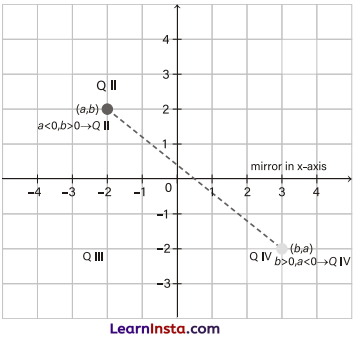
For a point in Quadrant II
a < 0, b > 0
Thus, for the new point (b, a), the x-coordinate is positive and y-coordinate is negative.
A point with positive x-coordinate and negative y-coordinate lies in Quadrant IV.

Question 6.
Which of the following ordered pairs represents a point that is 4 units to the right of the origin and 7 units below the X-axis?
(a) (4,-7)
(b) (-4, -7)
(c)(7, -4)
(d) (4, 7)
Answer:
(a) Let (x, y) be the coordinates of a point.
4 units to the right of the origin means x = 4. 7 units
below the x-axis means y = -7
Hence, the required point is (4, – 7).
Question 7.
The coordinates of two points are A(-2,1) and 6(4,9). Using the distance formula, the distance between A and 6 is
(a) 8 units
(b) 10 units
(c) 12 units
(d) √80 units
Answer:
(b) 10 units
Given points are A(-2, 1) and B(4 9).
We have, AB = \(\sqrt{[4-(-2)]^2+(9-1)^2}\)
= \(\sqrt{6^2+8^2}\)
= \(\sqrt{36+64}\)
= \(\sqrt{100}\) = 10 units
Question 8.
The coordinates of three points are >A(1,2), 6(7,2) and C(4,8). The triangle formed by joining these points is
(a) equilateral triangle
(b) scalene triangle
(c) isosceles triangle
(d) right-angled triangle
Answer:
(c) isosceles triangle
We Have,
AB = \(\sqrt{(7-1)^2+(2-2)^2}\) = 6 units
[using distance formula]
BC = \(\sqrt{(7-4)^2+(8-2)^2}=\sqrt{9+36}=\sqrt{45}\)
and CA = \(\sqrt{(4-1)^2+(8-2)^2}=\sqrt{9+36}=\sqrt{45}\)
Since, BC = CA
Therefore, the triangle formed is an isosceles triangle.
Question 9.
A point P(x, y) is equidistant from the points -4(6,2) and 6(2,6). Which of the following relations between x and y is correct?
(a) x + y = 8
(b) x – y = 0
(c) x + y = 4
(d) x – y = 4
Answer:
(b) x – y = 0
Since P(x, y) is equidistant from A (6,2) and B (2,6).
∴ PA = PB
⇒ (x – 6 )2 + (y – 2)2 = (x – 2)2 + (y – 6)2
On expanding, we get
x2 – 12x + 36 + y2 – 4y + 4 = x2
– 4x + 4 + y2 – 12y + 36
⇒ -12x -4y = -4x -12y
⇒ 8y = 8x
⇒ x = y
⇒ x – y = 0
Question 10.
If three trees are planted at points A{ 1,2), 6(4,6) and C(7,10), then which of following is true?
(a) The points are collinear
(b) The points form an equilateral triangle
(c) The points form an isosceles triangle
(d) The points are not collinear
Answer:
(a) Given, points are A(1,2), B(4,6) and C(7,10).
We have, AB = \(\sqrt{(4-1)^2+(6-2)^2}\)
[using distance formula]
= \(\sqrt{3^2+4^2}=\sqrt{25}=5 \text { units }\)
BC = \(\sqrt{(7-4)^2+(10-6)^2}\)
= \(\sqrt{3^2+4^2}=\sqrt{25}\) = 5 units
and AC = \(\sqrt{(7-1)^2+(10-2)^2}\)
= \(\sqrt{6^2+8^2}=\sqrt{100}\) = 10 units
Since, AB + BC = AC
Therefore, the given points are collinear.
Question 11.
The mid-point of the line segment joining the points P{- 5,7) and Q(9, – 3) is
(a) (2,2)
(b) (3,2)
(c) (2,1)
(d) (1,2)
Answer:
(a) (2,2)
Given, points are P(-5, 7) and Q(9, -3)
∴ Mid point = \(\left(\frac{-5+9}{2}, \frac{7+(-3)}{2}\right)=\left(\frac{4}{2}, \frac{4}{2}\right)=(2,2)\)
Question 12.
The centre of a circle is C(3, -2). If P(5,4) is one end of a diameter, then the coordinates of the other end Q are
(a) (1, -8)
(b) (2, -6)
(c) (4, -8)
(d) (o, -6)
Answer:
(a) (1, -8)
Let the coordinates of the other end Q be (x, y).
Since, the centre C of a circle is the mid-point of its diameter PQ,
∴ \(\left(\frac{x+5}{2}, \frac{y+4}{2}\right)=(3,-2)\)
On comparing the coordinates we get
\(\frac{x+5}{2}=3\)
⇒ x + 5 = 6
⇒ x = 1
and \(\frac{y+4}{2}=-2\)
⇒ y + 4 = -4
⇒ y = -8
Therefore, the coordinates of Q are (1, -8).
Question 13.
If M is the mid-point of AB, where -4(6, y), M{2,3) and 6(- 2,5), then the value of y is
Conceptual, NCERT Pg. 13
(a) 1
(b) 2
(c) 3
(d) 4
Answer:
(a) 1
Given, M(2,3) is the mid-point of 4(6, y) and S(-2,5).
Using the mid-point formula for the y-coordinate,
\(\frac{y+5}{2}=3\)
⇒ y + 5 = 6
⇒ y = 1
Assertion-Reason Questions
Direction (Question Nos. 1-6) Select the correct option from (a), (b), (c), (d) as given below.
(a) Both A and R are true and R is the correct explanation of A,
(b) Both A and R are true but R is not the correct explanation of A.
(c) A is true but R is false.
(d) A is false but R is true.
Question 1.
Assertion (A) If a point lies on the V-axis, then its x-coordinate is always zero.
Reason (R) The V-axis is represented by the equation x = 0.
Answer:
(a) Both A and R are true and R is the correct explanation of A.
Since, every point on the Y-axis satisfies x = 0, its x-coordinate is always zero.
Therefore, any point lying on the Y-axis must have x-coordinate equal to zero.
Hence, both Assertion (A) and Reason (R) are true, and Reason (R) correctly explains Assertion (A).
Question 2.
Assertion (A) A point lying on the Y-axis at a distance of 9 units from the x-axis can only has the coordinates (0,9).
Reason (R) The distance of a point from the X-axis is equal to the absolute value of its y-coordinate.
Answer:
(d) A is false but R is true.
The distance of a point from the X-axis is equal to the absolute value of its y-coordinate.
Distance from x-axis = |y|
Given that the point lies on the Y-axis, its x-coordinate must be 0.
Also, its distance from the x-axis is 9 units, so |y| = a
which gives y = 9 or y = -9.
Therefore, the possible coordinates are (0, 9) and (0, -9).
So, Assertion is false clearly, Reason is true.
Therefore, both A and R are true and R is the correct explanation of A.
Question 3.
Assertion (A) The point (-7, -4) lies in Quadrant III.
Reason (R) Every point in Quadrant III has both coordinates negative.
Answer:
(a) Both A and R are true and R is the correct explanation of A,
For the point (-7, -4).
x = -7 < 0 and y = -4 < 0
Since, both coordinates are negative, the point lies in Quadrant III.
So, Assertion is true.
The reason is also true because all points in Quadrant III have negative x-coordinates and negative y-coordinates.
Hence, both A and R are true and R is the correct explanation of A.
Question 4.
Assertion (A) If the distances AB, BC and AC between three points A, B and C satisfy AB + BC = AC, then the points A, B and C are collinear.
Reason (R) For three collinear points, the distance between the two extreme points is equal to the sum of the distances of the intermediate point from them
Answer:
(a) Both A and R are true and R is the correct explanation of A,
If AB + BC = AC, then point B lies on the line segment joining A and C. Hence, the three points are collinear. Also, for collinear points with one point lying between the other two points. Thus, the Reason correctly explains the Assertion. Therefore, both A and R are true and R is the correct explanation of A.
Question 5.
Assertion (A) The points A(1,2), B(4,6) and C(7,10) are collinear.
Reason (R) If a point X is equidistant from points A and B, then AX = BX
Answer:
(b) Both A and R are true but R is not the correct explanation of A.
Using the distance formula,
AB = \(sqrt{(4-1)^2+(6-2)^2}=\sqrt{9+16}=5\)
BC = \(\sqrt{(7-4)^2+(10-6)^2}=\sqrt{9+16}=5\)
AC = \(\sqrt{(7-1)^2+(10-2)^2}=\sqrt{36+64}=10\)
Thus, AS + SC = 5 + 5 = 10 = AC.
So, the points are collinear.
Therefore, Assertion is true.
Clearly, Reason is true.
Hence, both A and R are true and R is not the correct explanation of A.
Question 6.
Assertion (A) If the mid-point of a line segment joining A(x1y1) and B(x2,y2) is (0,0), then x1 + x2 = 0 and y1 + y1 = 0.
Reason (R) The coordinates of the mid-point of a line segment are the arithmetic means of the corresponding coordinates of its endpoints.
Answer:
(a) Both A and R are true and R is the correct explanation of A,
Given, the mid-point of A(x, y) and B(x2, y2) is (0, 0).
So, by the mid-point formula.
\(\left(\frac{x_1+x_2}{2}, \frac{y_1+y_2}{2}\right)\) = (0,0)
On comparing both sides, we get x1 + x2 = 0, y1 + y2 = 0.
So, assertion is true.
The Reason states the mid-point formula itself, which directly explains the Assertion.
Both A and R are true and R is the correct explanation of A.
Class 9 Maths Orienting Yourself The Use of Coordinates Worksheet
Worksheet On Orienting Yourself The Use of Coordinates Class 9
Very Short Answer Questions
Question 1.
If a point lies on the X-axis and is 6 units to the left of the origin, find its coordinates..
Answer:
We know that a point on the x-axis has y = 0. Since, it is 6 units to the left of the origin, its x-coordinate is -6. Therefore, the coordinates of the point are (-6,0).
Question 2.
In which quadrant, the point (5, -9.5) lies?
Answer:
In point(5, -9.5), x = 5 > 0 and y = -9.5 < 0
∴ Point (5, -9.5) lies in IV quadrant.
Question 3.
A point has an ordinate of 7 and is at a perpendicular distance of 9 units from the Y-axis. Write all possible coordinates of the point.
Answer:
Given, a point has y-coordinate or (dinate) of 7.
∴ y = 7
Distance from the y-axis = |x| = 9
x = 9 or -9
Therefore, the possible coordinate of the point are (9, 7) and (- 9, 7).
Question 4.
The coordinates of a point and its mirror image in the X-axis are (3, k) and (3, -11). Find the value of k.
Answer:
Reflection in the X-axis changes the sign of the y-coordinate but keeps the x-coordinate exactly the same.
Therefore, k = -(-11) = 11
Question 5.
A point P(a, b) lies in Quadrant II and its mirror image in the X-axis lies in Quadrant III. State the signs of a and b with proper mathematical justification.
Answer:
Given, a point (a, b) lies in Quadrant II.
For Quadrant II, a < 0, b > 0
After reflection in X-axis,
The coordinates of the point are (a, – b).
We know, a < 0 and – b < 0 Thus, both coordinates are negative.
Therefore, the image lies in Quadrant III, making the true mathematical relation a < 0 and b > 0.
Question 6.
The mirror image of a point in the X-axis is (- 4, – 7). Find the original point and its mirror image in the Y-axis.
Answer:
If reflection in X-axis gives (-4, -7), then original point is (-4, 7).
Then, Reflection of (-4, 7) in Y-axis is (4, 7).
Question 7.
Find the distance of the point (-16,12) from the origin.
Answer:
We know that the distance of the point (x, y) from the origin = \(\sqrt{x^2+y^2}\)
∴ Distance of the point (-16,12) from the origin
= \(\sqrt{(-16)^2+(12)^2}\)
= \(\sqrt{256+144}=\sqrt{400}\)
= 20 units
Question 8.
Find the value of x, if the distance between the points (x, 2) and (5,5) is 5 units.
Answer:
Let the points be A(x, 2) and B(5,5)
Given, AB = 5 units
Using the distance formula,
AB = \(\sqrt{(5-x)^2+(5-2)^2}\) = 5
⇒ \(\sqrt{(5-x)^2+9}\) = 5
On squaring both sides, we get
(5 – x)2 + 9 = 25
⇒ (5 – x)2 = 16
⇒ (5 – x) = ±4
Cast I 5 – x = 4
⇒ x = 1
Cast II 5 – x = -4
⇒ x = 9
Therefore, x = 1
or x = 9
Question 9.
Find a point on the Y-axis which is equidistant from the points (4,1) and (- 2,5).
Answer:
Let the required point be P(0, y).
Also, let the given points be A(4,1) and B(-2,5) Since P, is equidistant from both points A and B.
∴ PA = PB
⇒ \(\sqrt{(0-4)^2+(y-1)^2}=\sqrt{(0+2)^2+(y-5)^2}\)
On squaring both sides, we get
16 + (y -1)2 = 4 + (y – 5)2
⇒ 16 + y2 – 2y + 1 = 4 + y2 – 10y + 25
⇒ 17 – 2y = 29 – 10y
⇒ 8y =12
⇒ y = \(\frac{3}{2}\)
Hence, the required point is \(\left(0, \frac{3}{2}\right)\)
Question 10.
Find the value of x for which the distance between the points P(2,3) and Q(x, 6) is 5 units,
Answer:
Given, distance PQ = 5 units
Using the distance formula,
\(\sqrt{(x-2)^2+(6-3)^2}\) = 5
⇒ \(\sqrt{(x-2)^2+9}\) = 5
On, squaring both sides, we get
⇒ (x – 2)2 + 9 = 25
⇒ (x – 2)2 = 16
⇒ x – 2 = ± 4
⇒ x = 6
or x = -2
Question 11.
Find the points on the X-axis, each of which is at a distance of 10 units from the point (6,8).
Answer:
Let the required point on the x-axis be P(x, 0).
Given that the distance between P(x, 0) and A(6, 8) is 10 units.
∴ AP = 10
Using the distance formula,
\(\sqrt{(x-6)^2+(0-8)^2}\) = 10
⇒ \(\sqrt{(x-6)^2+64}\) = 10
On squaring both sides, we get
(x – 6)2 + 64 = 100
⇒ (x – 6)2 = 36
⇒ x – 6 = ± 6
⇒ x = 12 or x = 0
Therefore, the required points are (12, 0) and (0, 0).
Question 12.
The vertices of a triangle are (1,2), (5,2) and (3,6). Name the type of triangle formed.
Answer:
Let the vertices be A(1, 2), B(5, 2) and C(3, 6).
Here, AB = \(\sqrt{(5-1)^2+(2-2)^2}\) = 4 units
[Using distance formula]
AC = \(\sqrt{(3-1)^2+(6-2)^2}\)
= \(\sqrt{4+16}=\sqrt{20}\)units
and BC = \(\sqrt{(3-5)^2+(6-2)^2}\)
= \(\sqrt{4+16}=\sqrt{20}\) units
Since, AC = BC
So, the triangle is an isosceles triangle.
Short Answer Questions
Question 1.
If the coordinates of two points are P(3,-5) and Q(-4,8), find the value of ordinate of Q and ordinate of P).
Answer:
Given, the coordinates of two points are P(3,-5) and Q(-4,8).
Since, the ordinate refers to the y-coordinate, the ordinate of Q is 8 and the ordinate of P is -5. Therefore, (ordinate of Q) – (ordinate of P)
= 8 – (-5) = 8 + 5 = 13
Question 2.
In the figure, CD is a line parallel to the X-axis at a distance of 3 units.

(i) What are the coordinates of the points L, M and N?
Answer:
From the figure
L (-3, 3), M(1,3), N(3,3)
(ii) What is the difference between the ordinates of point C and point D?
Answer:
The ordinate (y-coordinate) of point C is 3 and the ordinate of point D is also 3.
∴ Difference = 3 – 3 = 0
(iii) In which quadrants do the points L,M and N lie in?
Answer:
Since, L(- 3,3) has x < 0 and y > 0, it lies in Quadrant II.
Since, M(1, 3) and N(3, 3) have x > 0 and y > 0, they lie in Quadrant I.
Hence, L lies in Quadrant II; M and N lie in Quadrant I.
Hence, L lies in Quadrant II; M and N lie in Quadrant I.
Question 3.
If the coordinates of two points are A(-7,4) and B(-2,6), find the value of (abscissa of B – abscissa of A).
Answer:
Given, the coordinates of two points are A(-7,4) and B(-2,6).
Since, the abscissa refers to the x-coordinate, the
abscissa of B is -2 and the abscissa of A is -7.
Therefore, (abscissa of B) — (abscissa of A)
= -2 – (-7)= -2 + 7 = 5.
Question 4.
In which quadrant or on which axis each of the following points lie?
(i) (-5,2)
(ii) (3, 4)
(iii) (0,-7)
Answer:
(i) The x-coordinate is negative and the y-coordinate is positive, so it lies in II quadrant.
(ii) The x-coordinate and y-coordinate are both positive, so it lies in I quadrant.
(iii) The x-coordinate is zero and the y-coordinate is negative, so it lies on the /-axis.
Question 5.
Write down the
(i) coordinates
(ii) quadrant for the points P, Q, R and S

Answer:
For Point P
(i) Coordinates of the point = (3,4)
(ii) The point (3,4) lies in the I quadrant.
For Point Q
(i) Coordinates of the point = (-4,2)
(ii) The point (-4,2) lies in the II quadrant.
For Point R
(i) Coordinates of the point = (-3, – 5)
(ii) The point (-3, -5) lies in the III quadrant.
For Point S
(i) Coordinates of the point = (6, – 2)
(ii) The point (6, -2) lies in the IV quadrant.
Question 6.
Find the distance between the following pairs of points.
(i) (2, 3) and (8,11)
(ii) (-3,4) and (9, 9)
Answer:
(i) Given points A(2, 3) and B(8,11)
Distance AB = \(\sqrt{(8-2)^2+(11-3)^2}\)
= \(\sqrt{6^2+8^2}=\sqrt{36+64}\)
= √100 = 10 units.
(ii) Given points A(-3,4) and B(9, 9).
Distance AB = \(\sqrt{9-(-3)^2+(9-4)^2}\)
= \(\sqrt{12^3+5^2}=\sqrt{144+25}\)
= \(\sqrt{12^3+5^2}=\sqrt{144+25}\)
= √169 = 13 units.
Hence, the distance is 13 units.
Question 7.
Riya plots three points A(1,2), B(3,6) and C(5,10) on a graph. Are these points collinear, Justify your answer?
Answer:
Riya plots the points A(1.2), B(3,6) and C(5,10) on the Cartesion plane, as shown below.

Here,
AB =\(\sqrt{(3-1)^2+(6-2)^2}=\sqrt{4+16}=\sqrt{20}=2 \sqrt{5} \text { units }\)
[using distance formula]
BC = \(\sqrt{(5-3)^2+(10-6)^2}\)
=\( \sqrt{4+16}=\sqrt{20}=2 \sqrt{5}\) units
AC = \(\sqrt{(5-1)^2+(10-2)^2}\)
\(\sqrt{16+64}=\sqrt{80}\) = 4√5
Since, AB + BC = 2√5 + 2√5 = 4√5 = AC
Hence, the three points are collinear.
Question 8.
Find the coordinates of the point equidistant from the three given points A{2,4), B(- 2, – 4) and C(6, – 4).
Answer:
Let the required point be P(x, y).
Since, P is equidistant from A, B and C,
∴ PA = PB
⇒ PA2 = PB2
⇒ (x-2)2 + (y – 4)2 = (x + 2)2 + (y + 4)2
[using distance formula]
⇒ x2 + 4 – 4x + y2 + 16 – 8y
= x2 + 4 + 4x + y2 +16 + 8y
⇒ -4x -8y = 4x + 8y
⇒ x + 2y = 0
⇒ x = -2y … (i)
Also, PB = PC
⇒ (x + 2)2 + (y + 4)2 = (x – 6)2 + (y + 4)2
⇒ (x + 2)2 = (x – 6)2
⇒ x2 + 4x + 4 + x2-12x + 36
⇒ 16x = 32
⇒ x = 32
⇒ x = 2
From Eqs. (i) and (ii), 2 = -2y
⇒ y = -1
Hence, the required point is P(2, -1)
Question 9.
The mid-point of a line segment is (5,4). One endpoint is (3,2). Find the other endpoint.
Answer:
Let the other endpoint be (x, y)
Using the mid-point formula.
\(\left(\frac{3+x}{2}, \frac{2+y}{2}\right)=(5,4)\)
On corresponding coordinates both sides, we get
\(\frac{3+x}{2}\)
⇒ 3 + x = 10
⇒ x = 7
and \(\frac{2+y}{2}\) = 4
⇒ 2 + y = 8
⇒ y = 6
Therefore, the other endpoint is (7, 6).
Question 10.
Find the coordinates of the point that divides the line segment joining (2,4) and (10,12) into two equal parts.
Answer:
We know that the point dividing the line segment into two equal parts is the mid-point.
Given points are (2, 4) and (10,12).
Using the mid-point formula,
M = \(\left(\frac{x_1+x_2}{2}, \frac{y_1+y_2}{2}\right)\)
On substituting the given coordinates, we get
M = \(\left(\frac{2+10}{2}, \frac{4+12}{2}\right)\)
M = \(\left(\frac{12}{2}, \frac{16}{2}\right)\)
⇒ M = (6,8)
Long Answer Questions
Question 1.
Without plotting the points, indicate the quadrants in which they will lie if
(i) Ordinate is – 4 and abscissa is 6.
(ii) Abscissa is – 7 and ordinate is – 2.
(iii) Abscissa is – 8 and ordinate is 5.
(iv) Ordinate is 9 and abscissa is 4.
Answer:
We know that the quadrants of a point depends on the sign of its coordinates, as follows.
If x > 0 and y < 0, the point lies in Quadrant IV.
If x < 0 and y < 0, the point lies in Quadrant III.
If x < 0 and y > 0, the point lies in Quadrant II.
If x > 0 and y > 0, the point lies in Quadrant I.
Therefore.
(i) (6, -4) → Quadrant IV
(ii) (- 7, – 2) → Quadrant III
(iii) (-8, 5) → Quadrant II
(iv) (4, 9) → Quadrant I
Question 2.
See figure and write the following.

(i) The coordinates of the point B.
Answer:
Point B is at x = -4 and y = 3. Its coordinates are (-4,3). (This is 4 units from the V-axis and 3 units from the X-axis).
(ii) The coordinates of the point C.
Answer:
Point C is at x = 4 and y = – 3. Its coordinates are (4,-3). (This is 4 units from the Y-axis and 3 units from the X-axis).
(iii) The point identified by the coordinates (-6,-2) and the point identified by the coordinates (6-4).
Answer:
This point has x-coordinate -6 and y-coordinate -2 From the figure, this is Point E. Additionally, the point with x-coordinate 6 and y-coordinate -4 is Point G.
(iv) The abscissa of the point D and the ordinate of the point H.
Answer:
Abscissa is the X-coordinate. Point D is at (2, 5), so its abscissa is 2. Ordinate is they-coordinate. Point H is at(-1, -6), so its ordinate is -6.
(v) The coordinates of the point L and the coordinates of the point M.
Answer:
Point L is on the Y-axis (positive side) at distance 5. For points on the X-axis, x = 0. Its coordinates are (0, 5). Point M is on the X-axis (positive side) at distance 3. For points on the X-axis, y = 0. Its coordinates are (3, 0).
Question 3.
A rectangle OPQR is drawn on a Cartesian plane such that its length is 6 units and its breadth is 4 units. One of its vertices is located exactly at the origin 0(0, 0). It is given that the longer side of the rectangle lies along the Y-axis, and one of the vertices lies strictly in the second quadrant. Based on this information, answer the following:
(i) Determine the coordinates of all four vertices of the rectangle.
Answer:
Let the vertices of the rectangle be 0, P, Q, and R. Given, one vertex is at the origin, so O = (0,0).
The longer side (length = 6 units) lies on the Y-axis. For any point on the Y-axis, its x-coordinate is 0. Therefore, the adjacent vertex on the Y-axis will be at a distance of 6 units from the origin, i.e., either (0,6) or (0,-6).
The shorter side (breadth = 4 units) lies on the X-axis. For any point on the X-axis, its y-coordinate is 0. Therefore, the adjacent vertex on the X-axis will be at a distance of 4 units from the origin, i.e., either (4, 0) or (-4,0).

It is given that one vertex lies in the second quadrant. We know that in the second quadrant, the x-coordinate (abscissa) is negative and the y-coordinate (ordinate) is positive.
For a vertex to fall in the second quadrant, the rectangle must be drawn along the negative X-axis and the positive Y-axis.
∴ The vertex on the Y-axis must be P(0, 6) and the vertex on the X-axis must be fl(-4,0)
The fourth vertex, Q, completes the rectangle. It will have the same x-coordinate as R and the same y-coordinate as P.
∴ Coordinates of Q = (-4,6) This vertex lies in the second quadrant, satisfying the given condition. Hence, the coordinates of the vertices are 0(0,0), P(0,6), Q(-4,6) and R(-4,0).
(ii) Write the abscissa and ordinate of the vertex that lies in the second quadrant, and state its perpendicular distance from both the axes.
Answer:
From part (i), the vertex lying strictly in the second quadrant is Q(-4,6).
For point Q(-4,6)
Abscissa x-coordinate) = -4
Ordinate (y-coordinate) = 6
We know that the perpendicular distance of a point from the Y-axis is the absolute value of its x-coordinate, and from the X-axis is the absolute value of its y-coordinate.
∴ Perpendicular distance from Y-axis = |-4| = 4 units.
∴ Perpendicular distance from X-axis = |6| = 6 units.
(iii) Calculate the perimeter and the area of the rectangle.
Answer:
Given the dimensions of the rectangle:
Length (l) = 6 units
Breadth (b) = 4 units
∴ Perimeter of rectangle = 2(l + b)
= 2(6 + 4) = 2(10) = 20 units
Area of rectangle = l × b = 6 × 4 = 24 sq. units
Hence, the perimeter is 20 units and the area is 24 sq. units.
Question 4.
Find the values of x and y, if the following ordered pairs are equal.
(i) (2x -1, y + 4) = (11,9)
Answer:
Given, ordered pairs are (2x -1, y +4) and (11, 9).
Since, these ordered pairs are equal, so their corresponding coordinates are also equal.
Thus,
2x -1 = 11 ⇒ 2x = 12 ⇒ x = 6 and y + 4 = 9 ⇒ y = 5
Hence, x = 6 and y = 5.
(ii) (2x + y,x-y) = (11,1)
Answer:
Given, ordered pairs are (2x + y, x – y) and (11,1). Since, these ordered pairs are equal, so their corresponding coordinates are also equal.
Thus, 2x + y = 11 ……(i)
and x – y = 1 ……(ii)
From equation (ii)
⇒ y = x – 1
On substituting in Eq. (i), we get
2x + (x – 1) = 11
⇒ 3x – 1 = 11
⇒ 3x = 12
⇒ x = 4
On substituting x = 4 in Eq. (ii)
4 – y = 1
⇒ y = 3
Hence, x = 4 and y = 3.
Question 5.
Using the distance formula, answer the following questions.
(i) Determine the perimeter of the triangle whose vertices are (1,1), (4, 5) and (8, 2).
Answer:
Let given points be A(1,1), B((4,5) and C(8,2).
Here,
AB = \(\sqrt{(4-1)^2+(5-1)^2}=\sqrt{25}\) = 5 units
BC = \(\sqrt{(8-4)^2+(2-5)^2}=\sqrt{25}\) = 5 units
CA = \(\sqrt{(8-1)^2+(2-1)^2}=\sqrt{50}\) = 5√2 units
∴ Perimeter = AB + BC + CA = 5 + 5 + 5√2 =
= (10 + 5√2) units
(ii) Show that the points /\(—2,1), 6(4,1) and C(-2,9) are the vertices of a right angled triangle.
Answer:
Given, A[-2,1), B(4,1) and C(-2,9)
Using distance formula,
AB2 = (4 – (-2))2 + (1 -1)2 = 36 + 0 = 36
BC2 = (-2 – 4)2 + (9 -1)2 = 36 + 64 = 100
CA2 = (-2 – (-2))2 + (9 -1)2 = 0 + 64 = 64
⇒ BC2 = AB2 + CA2 [as 100 = 36 + 64]
∴ ∆ ABC is a right angled triangle.
Question 6.
If the triangle formed by A(2, – 4), 6(5,0) and C(0, p) is right-angled at 6, find p.
Answer:
Given, vertices of triangle are A(2, — 4), B(5,0) and C(O,p).
Since, it is right-angled at B.
AB2 + BC2 = AC2 …(i)
Here,
AB2 =(5-2)2 + (o + 4)2 = 9 + 16 = 25
BC2 =(0-5)2 +(p-0)2 = 25 + p2
AC2 =(O-2)2 +(p + 4)2 = 4 +(p + 4)2
On substituting, all the values in Eq. (i), we get
25 + (25 + p2) = 4 +(p + 4)2
⇒ 50 + p2 = 4 + (p + 4)2
⇒ 50 = 20 + 8p
⇒ 30 = 8p
⇒ p = \(\frac{15}{4}\) = 3.75
Question 7.
Using the distance formula, answer the following questions.
(i) If the distance between (6, 2) and (a, b) is the same as the distance between (0, 0) and (a, b), find the relation between a and b.
Answer:
Let P(a, b), A(6, 2) and 0(0,0)
Given, PA = P0
⇒ \(\sqrt{(a-6)^2+(b-2)^2}=\sqrt{(a-0)^2+(b-0)^2}\)
On squaring both sides, we get
(a-6)2 +(b-2)2 = a2 + b2
⇒ a2 – 12a + 36 + b2 — 4b + 4 = a2 + b2
⇒ 12a — 4b + 40 = 0
⇒ 3a + b = 10
(ii) If the distance between (8, 4) and (a + 2, 3b + 5) is the same as the distance between (2, 0) (a+ 2, 3b + 5), find the relation between a and b.
Answer:
Let P(a + 2, 3b + 5), A(8, 4) and B(2, 0)
Given, PA = PB ⇒ PA2 = PB2
(a + 2 – 8)2 +(3b + 5 – 4)2
= (a + 2 – 2)2 + (3b + 5 – 0)2
⇒(a – 6)2 + (3b + 1)2 = a2 + (3b + 5)2
⇒ a2 – 12a + 36 + 9b2 + 6b + l
⇒ a2 + 9b2 + 30b + 25
⇒ -12a -24b + 12 = O
On dividing by — 12, we get
a + 2b – 1 = 0
Or
a + 2b = 1
Question 8.
The vertices of ∆ABC are A(0,0), B(6,0) and C(0,8). Find its circumcenter and circumradius.
Answer:
Given vertices are A(0,0), 8(6,0) and C(0,8)
Using distance formula,
AB2 = (6 – 0)2 + (0 – 0)2 = 36 + 0 = 36
BC2 = (0 – 6)2 + (8 – 0)2 = 36 + 64 = 100
CA2 = (0 – 0)2 + (8 – 0)2 = 0 + 64 = 64
⇒BC2 = AB2 + CA2 [as 100 = 36 + 64
∴ ∆ABC is a right-angled triangle
In a right-angled triangle, the circumcenter is the mid-point of the hypotenuse BC.
Mid-point of BC = \(\left(\frac{6+0}{2}, \frac{0+8}{2}\right)=(3,4)\)
Length of hypotenuse,
BC = \(\sqrt{(6-0)^2+(0-8)^2}=\sqrt{100}\) = 10 units
Circumradius, R = \(\frac{B C}{2}=\frac{10}{2}\) = 5 units
Question 9.
In each of the following cases, determine the nature of the quadrilateral formed by the given points.
(i) Show that the points (1,1), (5, 3), (3,7) and (-1,5) form a parallelogram.
Answer:
A(1,1), B(5, 3), C(3, 7), D(- X 5)
Mid-point of AC = \(\left(\frac{1+3}{2}, \frac{1+7}{2}\right)=(2,4)\)
Mid-point of BD = \(\left(\frac{5+(-1)}{2}, \frac{3+5}{2}\right)=(2,4)\)
Since, the diagonals have the same mid-point, they bisect each other.
Hence, ABCD is a parallelogram.
(ii) Show that A(1, -2), S(4,1), C(1,4) and D(-2,1) are the vertices of a square.
Given, A(1,-2), B(4, 1), C(1, 4) and D(-2, 1)

Here, lengths of all sides AB, BC, CD and DA are equal and diagonals AC and BD are also equal.Therefore, ABCD is a square.
Case-Based Questions
Question 1.
A decorative pattern was drawn on a coordinate plane. The centre of the circle is 0(0,0). Points A(- 8,0), B{8,0), C(0,8) and D(0,-8) lie on the circle. Inside the circle, PQRS is a square with P(- 2,2).

On the basis of above information, answer the following questions.
(i) If A(-8,0) and B(8,0) are endpoints of a diameter, then the coordinates of C and D are
Answer:
Given, the circle has centre 0(0, 0).
(i) Given the diameter endpoints A(-8,0) and B(8,0). The centre of the circle is at the origin 0(0, 0) and its radius is 8 units.
From the figure, points C and D lie on the circle along the Y-axis, so their distance from the origin is equal to the radius (8 units).
∴ The coordinates of C are (0, 8) and the coordinates of D are (0,-8).
(ii) If PQRS is a square and P(- 2,2), what are the coordinates of R?
Answer:
Given, PQRS is a square centered at the origin 0(0, 0) with vertex P(-2,2).
The coordinates of the diagonally opposite vertex Ft can be obtained by successive reflection of point P across the coordinate axes.
First, reflecting P(-2,2) across the Y-axis (changing the sign of the x-coordinate) gives the adjacent vertex Q(2, 2).
Next, reflecting Q(2,2) across the X-axis (changing the sign of they-coordinate) gives the vertex R.
∴ Coordinates of R = (2,-2)
(iii) What is the perpendicular distance of point C from the X-axis?
Answer:
From part (i), the coordinates of point C are (0,8).
We know that the perpendicular distance of any point from the X-axis is given by the absolute value of its y-coordinate, i.e. |y|.
∴ The distance of point C from the X-axis
= |18| = 8 units.
Question 2.
A town has a central square. Roads run in N-S and E-W directions from the centre, spaced 100 m apart. There are 6 streets in each direction (numbered 1-6). A street intersection is shown below in the figure

On the basis of above information, answer the following questions.
(i) How is an intersection named?
Answer:
An intersection is named as
(N-S street number, E-W street number)
The first number gives the N-S street and the second number gives the E-W street.
e.g. (3,5) means the intersection of 3rd N-S street and 5th E-W street.
(ii) Which intersection is referred by (2, 4)?
Answer:
It refers to the intersection of 2nd N-S street and 4th E-W street.
(iii) Which intersection is represented by (5, 3)?
Answer:
It refers to the intersection of 5th N-S street and 3rd E-W street.
(iv) How many intersections lie on the 4th N-S street? List all of them.
Answer:
The 4th N-S street intersects each of the 6 E-W streets.
So, there are 6 intersections on the 4th N-S street Therefore, the intersections are
(4,1), (4, 2), (4, 3), (4, 4), (4, 5), (4, 6).
(v) What is the total number of intersections in the town?
Answer:
Since, there are 6 N-S streets and 6 E-W streets, so the total number of intersections in the town is (6 x 6) i.e. 36.
Question 3.
A city planner is designing a new town. Two main landmarks — a school (S) and a hospital (H) — are to be placed on a coordinate grid, The school is located at the point A (1,1) and the hospital is at B (5, 4) as shown in the figure.

A straight road is to be built between the two landmarks. The planner needs to know the exact length of this road to estimate the cost of construction.
Using the distance formula, \(\sqrt{\left(x_2-x_1\right)^2+\left(y_2-y_1\right)^2},\) answer the following questions.
(i) Find the horizontal distance (difference in x-coordinates) and the vertical distance (difference in y-coordinates) between A and B.
Answer:
Horizontal and vertical distance
Horizontal distance = |5—1|= 4 units
Vertical distance = |4 —1|= 3 units
(ii) Using the distance formula, find the exact length of the road AB.
Answer:
Length of road AB,
AB = [/latex]\sqrt{(5-1)^2+(4-1)^2}[/latex]
[using the distance formula)
= \(\sqrt{4^2+3^2}=\sqrt{16+9}=\sqrt{25}\) = 5 units
(iii) (a) A water pump is to be placed at a point P on the X-axis such that PA-PB. Find the coordinates of P.
Answer:
Let the point P on X-axis be (x, O).
Given, PA = PB ⇒ \(\sqrt{(x-1)^2+(0-1)^2}\)
= \(\sqrt{(x-5)^2+(0-4)^2}\)
On squaring both sides, we get
⇒ (x – 1)2 + 1 = (x – 5)2 + 16
⇒ x2 – 2x + 2 = x2 – 10x + 41
⇒ 8x = 39 ⇒ x = \(\frac{39}{8}\)
Hence, the coordinate of P are\(\left(\frac{39}{8}, 0\right)\)
Or
(b) If a third landmark C is added at (1, 4), verify whether A B and C form a right-angled triangle. Name the right angle vertex.
Answer:
If a third landmark is added at C(1, 4)
Here, AB = 5 units
Also,AC = \(\sqrt{(1-1)^2+(4-1)^2}\) = 3 units
and BC = \(\sqrt{(5-1)^2+(4-4)^2}\) = 4 units
Now,AC2 + BC2 = 32 + 42 = 9 + 16 = 25
and AB2 = 52 = 25
Since, AC2 + BC2 = AB2, the triangle is right-angled.
Thus, the sides AC and BC meet at C.
Hence, ∆ABC is right-angled at C(1, 4).
Question 4.
The figure below shows ∆PQR with vertices P(- 2, 5), Q(6, 5) and R{2,1) and its image ∆P’Q’R’ formed by reflecting A PQR in the X-axis.

On the basis of above information, answer the following questions.
Given, P(-2, 5), Q(6, 5), R(2, 1)
Reflection in the X-axis changes each point (x, y) to (x,-y).
(i) Write the coordinates of P’, Q’ and R’ after reflection in the X-axis.
Answer:
The coordinates of P’, Q’ and R’ are
(-2, -5), (6, -5) and (2, -1), respectively.
(ii) What has remained the same and what has changed after this reflection?
Answer:
Remained the same
The shape, size and side lengths of the triangle remain unchanged. The x-coordinates of thevertices also remain the same.
Changed: The y-coordinates changed sign. Therefore, the position of the triangle is reflected below the X-axis.
(iii) Find the length of PQ and P’Q’. What do you observe?
Answer:
PQ = \(\sqrt{(6-(-2))^2+(5-5)^2}\)
[Using distance formula]
= \(\sqrt{8^2}\) = 8 units
We obsence that PQ = P ‘Q’
This shows that reflection is a transformation that preserves the distance between points.
(iv) Would the observations in part (ii) be the same if A PQR is reflected in the /-axis instead? Write the new coordinates and justify your answer.
Answer:
Yes, the general observations (preservation ofshape and size) would remain the same.
We know that reflection in the Y-axis changes each point(x, y)to(— x, y).
Therefore, the new coordinates after reflection in the y-axis are (2, 5), (—6, 5),(—2,1).
Yes, the observations about equal lengths and congruent figures remain the same.
(v) The mid-point of RR’ lies on which axis? Find its coordinates.
Answer:
We have, R(2, 1), R’(2, -1)
Using the midpoint formula,
Mid-point of RR’ = \(\left(\frac{2+2}{2}, \frac{1+(-1)}{2}\right)=(2,0)\)
Since, the y-coordinate is 0, the mid-point lies on the X-axis.