Students can use NCERT Class 9 Advanced Science Notes and Chapter 3 Newton’s Laws of Motion Class 9 Notes to understand complex concepts with ease.
Newton’s Laws of Motion Notes Class 9 Advanced Science
Class 9 Newton’s Laws of Motion Notes
Limitations of Newton’s Laws in Accelerating Frames
Activity 3.1: Let us observe
Consider the following situations:
- A passenger standing in a bus that suddenly accelerates forward feels pushed backward, even though no one is actually pushing.
- When a vehicle takes a sharp turn, passengers feel pushed outward.
1. Why does this happen?
2. Is there really a force pushing the passenger backward or outward?
3. Can these effects be explained only by the usual forces like gravity or friction?
Answer:
1. This happens due to inertia.
2. No, there is really no force acting on the passenger. To explain this existence of an imaginary force known as pseudo-force must introduced since the passenger is inside an accelerating or turning frame of reference.
3. No, this cannot be explained by usual forces like gravity or friction.

Understanding the Limitations of Newton’s Laws
Newton’s First Law of Motion states that an object will remain at rest or in uniform motion unless acted upon by an external unbalanced force. Applicability of this law depends on the frame of reference.
- Inertial Frames: These are frames of reference that are either at rest or moving at a constant speed in a straight line. Newton’s laws work perfectly here.
- Non-Inertial (Accelerating) Frames: When the frame itself (like a bus or a car) is speeding up, slowing down, or turning, Newton’s laws seem to fail because objects move without any visible force acting on them.
Pseudo Force (Fictitious Force)
To explain why things act in a different way in an accelerating frame, we use the concept of a pseudo-force.
- Definition: A pseudo force is an ‘apparent’ or ‘imaginary’ force that does not arise from any physical interaction (like gravity, friction, or a pull).
- When does it appear? It is only observed when the motion is described an accelerating frame of reference.
- Direction: The pseudo force always acts in the direction opposite to the acceleration of the frame.
- Let us consider a real-world scenario: Why does a passenger fall backwards when a bus starts suddenly?
- From Outside (Road View): An observer on the road sees the bus accelerate forward. Due to the inertia of rest, the passenger’s upper body tends to remain in its original position while the feet move forward with the bus.
- From Inside (Bus View): The passenger feels that a mysterious force pushed him backwards. Since the bus is accelerating forward, a pseudo force acts on the passenger in the backward direction.
Mathematical Formula:
Fpseudo = -m . aframe
m = mass of the object
aframe = acceleration of the reference frame
Negative sign: Indicates the force is in the opposite direction of the frame’s movement
Gravitation: The Science of Orbital Motion
How Gravity Keeps the Earth in Orbit Both the Sun and the Earth possess mass, which means they exert a gravitational pull on one another.
According to Newton’s laws, while these forces are equal in strength and opposite in direction, the Sun’s massive size means the Earth undergoes a much greater acceleration. This constant pull from the Sun acts as a centripetal force, essentially acting functioning like an invisible tether that prevents the Earth from drifting away into deep space.
The Balance of Forces
The Earth doesn’t fall into the Sun because it is travelling at a very high tangential velocity. Due to its inertia, the Earth naturally wants to move in a straight line. However, the Sun’s gravity acts perpendicularly to this motion, constantly pulling the Earth toward its centre. Forward momentum dictates that the earth in motion should travel in a straight line. “Centrifugal force” is the apparent, outward feeling which is a “fictitious” or pseudo-force.
The result of this ‘tug-of-war’ between the Earth’s forward momentum and the Sun’s inward pull is a stable, curved path known as an orbit.
Critical Thinking: What if the Earth Slowed Down?
The stability of our orbit depends on a perfect balance between speed and gravity. If the Earth’s tangential speed suddenly decrease, its inertia would no longer be strong enough to resist the Sun’s gravitational pull. Without sufficient forward momentum to maintain the curve, the balance would break, causing the Earth to spiral inward toward the Sun rather than staying in its fixed orbital path.
Activity 3.2: Understanding Circular Motion and Centripetal Force
Steps:
- Tie the ring/bob securely to one end of the thread of length approx. 1 m.
- Hold the other end of the thread firmly with your finger.
- Swing the ring/bob in a horizontal circle at a steady speed.
- Observe how the bob moves in a circular path.
- Now slowly reduce the speed of rotation.
- Continue decreasing the speed further and observe what happens to the circular motion.
Observation
Answer:
- At Steady Speed: The thread stays tight. This tension provides the centripetal force pulling the bob inward. Simultaneously, the bob’s inertia makes it want to fly off in a straight line (tangentially). The balance between this inward pull and the outward tendency keeps it in a perfect circle.
- At Reduced Speed: As the speed is reduced, the required centripetal force decreases. The tension in the string drops, causing it to go slack. Without enough sufficient tension to ‘pull’ the bob into a curve, the circular path fails, and the bob begins to move inward or fall.
Conclusion
Circular motion is not automatic; it requires a specific balance between tangential speed and inward centripetal force. If the speed decreases too much, the inward force can no longer keep the object on its curved track, and the orbit or circular path is broken.
The Effect of Air Resistance on Falling Objects
This lesson explains why objects of the same mass don’t always fall at the same speed. It all comes down to the surface area (cross-sectional area) and the presence of air.
Case 1: Falling in Air (Real-World Condition)
Imagine dropping two objects of equal mass (like a flat sheet of paper and a crumpled ball of paper) from the same height.
- Gravity’s Role: Since the masses (m) are equal, gravity pulls them down with the same force: (F = mg).
- Air Resistance (Drag): As they fall, air pushes upward against them. This upward force depends on the cross-sectional area:
- Larger Area: Experiences more air resistance (more air molecules to push out of the way).
- Smaller Area: Faces less opposition.
- Result: The object with the smaller surface area has a higher net downward force and falls faster.
Conclusion: In air, the object with the smaller cross-sectional area hits the ground first.
Case 2: Falling in a Vacuum (No Air)
If we remove all air (like on the Moon or in a vacuum chamber), the upward opposing force disappears.
- Equal Acceleration: Without air drag, the only force acting is gravity. According to Newton’s Second Law:
a = \(\frac{F}{m}=\frac{m g}{m}\) = g - Uniformity: Every object, regardless of its size, shape, or mass, accelerates at the same rate (g = 9.8 m/s2). Conclusion: In a vacuum, all objects reach the ground from a height at the exact same time.
Variation of Acceleration due to Gravity (g) with Altitude and Depth
The Earth’s gravitational pull is not a constant value everywhere; it varies with distance from the Earth’s centre.
Why Does Gravity Change?
Whether it’s a ball coming back down or you returning to the ground after a jump, the Earth is always pulling you toward its centre. However, this pull isn’t the same at all heights.
- Distance Matters: Gravitational force is inversely proportional to the square of the distance from the Earth’s centre.
- Altitude Effects: As you move higher (increase altitude”), the distance from the centre of the Earth increases. This causes the gravitational force and therefore the acceleration due to gravity (g) to decrease.
- The Space Station Example: Astronauts in the International Space Station (ISS) appear weightless not because gravity is zero, but because (g) has decreased significantly, and they are in a state of continuous free -fall.
Derivation – Acceleration Due to Gravity at Height
Let
- Mass of object = m
- Radius of Earth = R
- Height above surface = h
- Distance from the centre of the Earth = R + h
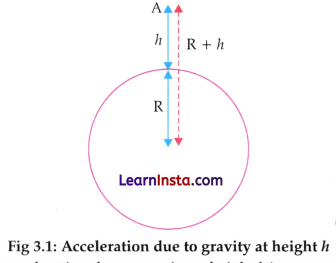
The acceleration due to gravity at height h is:
gh = \(\frac{G M}{R+h)^2}\)
Where,
G = Universal gravitational constant
M = Mass of the Earth
On Earth’s surface,
g = \(\frac{G M}{R^2}\)
Dividing both equations,
\(\frac{g_h}{g}=\frac{R^2}{(R+h)^2}\)
This clearly shows that,
gh < g
Derivation: Acceleration Due to Gravity Below the Surface of Earth
Now, consider a point A at depth d inside the Earth. Assuming the Earth has uniform density, let us determine the acceleration due to gravity at that interior point. Let:
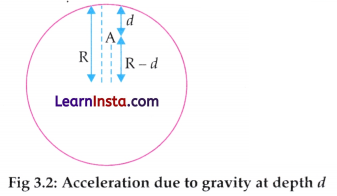
- Radius of Earth = R
- Depth below the surface = d
- Distance from the centre = (R~ d)
- Density of Earth = p (uniform)
If the density of the Earth is uniform, then the mass of the Earth can be calculated by
M = \(\frac{4}{3}\) πR3ρ
At depth d, the mass of Earth affecting gravity is having the radius (R – d), contributes to gravity. Therefore, at depth d, only the sphere of radius (R – d) centred at Earth’s core contributes to gravity; the outer shell of thickness d has no net effect.
Md = \(\frac{4}{3}\) π(R – d)3ρ
From Newton’s Law of Gravitation,
gd = \(\frac{\left(G M_d\right)}{(R-d)^2}\)
Substitute Md:
gd = \(\frac{G \frac{4}{3} \pi(R-d)^3 \rho}{(R-d)^2}\)
gd = \(\frac{4}{3}\)πGρ(R – d)
Comparing it with gravity at Earth’s surface, i.e., At Earth’s surface:
g = \(\frac{4}{3}\)πGρR
Dividing both equations:
\(\frac{g_d}{g}=\frac{R-d}{R}\)
Therefore,
gd = g\(\left(1-\frac{d}{R}\right)\)
We conclude from the above derivations that the acceleration due to gravity is maximum at the Earth’s surface and decreases as we move away from it, upwards or downwards. It will become zero at the centre of the Earth.
Example:
At what depth does g become l/10th of its surface value?
Given:
gd = \(\frac{g}{10}\)
Using the formula:
gd = g\(\left(1-\frac{d}{R}\right)\)
or, \(\frac{g_d}{g}\) = 1 – \(\frac{d}{R}\)
or, \(\frac{1}{10}\) = 1 – \(\frac{d}{R}\)
d = \(\frac{9 R}{10}\)
Turning Forces (Moment of Force/Torque)
Activity 3.3: Understanding the turning effect of force (moment of force/torque).
Materials Required: A door with a handle.
Procedure:
Look at the picture of a boy trying to enter his classroom. He pushes the door to open it.
Now, think carefully and answer the following questions:
(1) Where will the boy apply force to open the door easily?
(a) Near the handle
(b) Near the hinges
(c) At the centre of the door
(2) Why are door handles fixed far away from the hinges and not near them?

Answer:
(1) Option (a) is correct – The boy will apply force near the handle to open the door .
(2) Door handles are fixed far away from the hinges and not near them since the turning effect of a force depends on the distance from the hinges. The greater the distance, the greater is the turning effect and it is easier to open the door.
Now reflecting on the following points:
Question 1.
The boy. applies force in a straight direction, but the door rotates. Why does this happen?
Answer:
The door rotates because the applied force produces a turning effect (torque) about the hinges (pivot), not straight motion.
Question 2.
Even though the door is heavy, it rotates easily when pushed at the handle. Why does this happen?
Answer:
The door rotates easily because the force is applied at the handle whose distance from the pivot is maximum, so the torque produced is greatest.
Question 3.
How is it possible to rotate such a heavy object by applying force at just one end?
Answer:
A heavy object can be rotated by applying a force at one end because torque = force × distance from the pivot; a larger distance increases the turning effect even with less force.
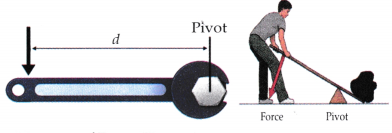
- Moment of Force (Torque)
𝜏 = F x d × sin θ
Where,
- F = magnitude of the force
- d = distance from the pivot to the point of application
- θ = angle between the force and the line joining the pivot to the point of application
Torque is maximum when θ = 90°, i.e., force is perpendicular to the lever arm, and torque is minimum (zero) when θ = 0° or 180°, i.e., force is directed towards or away from the pivot.
This turning effect of a force is called the moment of force.
The S.I. unit of torque is newton-metre (Nm).
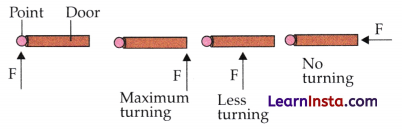
The angle at which force is applied to a door (and the resulting angle of the door itself) is crucial for controlling the turning, efficiency, and safety of the opening, motion. The fundamental principle is that turning is maximised when the force is applied perpendicular (at 90° angle) to the door surface, making it the most efficient way to open or close it.