These Class 7 Social Science Worksheet and Class 7 SST Chapter 4 New Beginnings Cities and States Worksheet with Answers are excellent for board exam practice.
Class 7 SST Chapter 4 New Beginnings Cities and States Worksheet
Class 7 New Beginnings Cities and States Worksheet
Worksheet On New Beginnings Cities and States Class 7 – New Beginnings Cities and States Worksheet Class 7
Multiple Choice Questions
Question 1.
In which part of India did the regional cultural gradually organise themselves during the 2nd millennium BCE?
(a) Northern India
(b) Eastern India
(c) Southern India
(d) Western India
Question 2.
How did the janapadas grow?
(a) As busy markets
(b) As urban centres
(c) As rural settlements
(d) As trade networks
Question 3.
Where were the matters concerning the clan discussed?
(a) In the court
(b) In the police station
(c) In assemblies or councils
(d) In ancient temples
Question 4.
Where was the Gandhara mahajanpada located?
(a) In southeast to Magadha
(b) In the northwest to Anga
(c) Far away from Godavari
(d) Close to Avanti
Question 5.
Which of the following is not considered a source of mahajanpada age?
(a) Babarnama
(b) Buddhist literature
(c) Jain literature
(d) Late Vedic texts
Question 6.
Who held the ultimate power in the janapadas, particularly monarchies?
(a) Assemblies
(b) Councils
(c) Rulers
(d) Ministers
Question 7.
What did the people of the Harappan civilisation master?
(a) Silver and gold
(b) Plastic and marbles
(c) Copper and bronze
(d) iron and aluminum
Question 8.
On what basis was the ancient Indian society categorised?
(a) Race
(b) Power
(c) Occupation
(d) Social status
Question 9.
What led to the extreme social discrimination during the mahajanapadas age?
(a) Skill in agriculture
(b) Military activities
(c) Wealth more than others
(d) Unequal treatments
Question 10.
What did the dakshinpatha connect?
(a) Kausambi to southern India
(b) Sisupalgarh to Avanti
(c) Vindhya Range to Ganga plains
(d) Magadha to Anga
Assertion and Reason Questions
There are two statements marked as Assertion (A) and Reason (R). Mark your answer as per the codes provided below:
Question 1.
Assertion (A): Human societies grew more complex with the rise of civilisation.
Reason (R): A society never organises itself in several groups.
Codes:
(a) Both (A) and (R) are true, and R is the correct explanation of (A).
(b) Both (A) and (R) are true, but (R) is not the correct explanation of (A).
(c) (A) is true, but (R) is false.
(d) (A) is false, but (R) is true.
Question 2.
Assertion (A) Many routes were opened up in mahajanpadas age.
Reason (R) The routes were only connected to south and fostered pilgrimage.
Codes:
(a) Both (A) and (R) are true, and R is the correct explanation of (A).
(b) Both (A) and (R) are true, but (R) is not the correct explanation of (A).
(c) (A) is true, but (R) is false.
(d) (A) is false, but (R) is true.

Fill in the Blanks with the Words given in the Box Below.
| hereditary, urbanization, sabha, eighth, advice |
1. Each janapada had an assembly or council called ___________ or samiti.
2. A good ruler was supposed to take the ___________ from those assemblies.
3. Around ___________ century BCE, some of the early states merged together.
4. The position of the king was ___________.
5. ___________does not happen without technologies.
State Whether the Following Statements are True or False
1. There is no evidence of occupation change in mahajanapadas age.
2. The Varna-jati system has had a deep impact on Indian society.
3. The Varna system was very flexible.
4. Sub-jatis do not have their own developed customs.
5. Two routes were widely used for trade during 1st millennium BCE.
6. Kshatriyas were expected to engage in preserving knowledge.
Match the Contents in Column A with those in Column B
| Column A | Column B |
| 1. Magadha | (A) Social categories |
| 2. Varna- jati | (B) Eastern India |
| 3. Buddhist literature | (C) Powerful territory |
| 4. Anga | (D) Samiti |
| 5. Council | (E) Urban references |
Choose the correct option:
(a) 1-C, 2-B, 3-A, 4-D, 5-E
(b) 1-B, 2-A, 3-C, 4-D, 5-E
(c) 1-E, 2-A, 3-C, 4-B, 5-D
(d) 1-C, 2-A, 3-E, 4-B, 5-D
Very Short Answer Type Questions
Question 1.
Where was the second urbanisation concentrated during the 1st millennium BCE?
Answer:
__________________________________
__________________________________
__________________________________
Question 2.
What were mahajanapadas?
Answer:
__________________________________
__________________________________
__________________________________
Question 3.
What were the key duties of a ruler during the mahajanapada age?
Answer:
__________________________________
__________________________________
__________________________________
Question 4.
Which type of weapons were made using iron?
Answer:
__________________________________
__________________________________
__________________________________
Question 5.
Which category of ancient society became rigid over time?
Answer:
__________________________________
__________________________________
__________________________________
Short Answer Type Questions
Question 1.
What were sabha and samiti?
Answer:
__________________________________
__________________________________
__________________________________
Question 2.
How were the kings elected during the 1st millennium BCE?
Answer:
__________________________________
__________________________________
__________________________________
Question 3.
Mention a few different occupations in the Harappan civilisation.
Answer:
__________________________________
__________________________________
__________________________________
Question 4.
Describe some authentic sources of information about the newly emerging urban centres.
Answer:
__________________________________
__________________________________
__________________________________
Long Answer Type Questions
Question 1.
Do you think, the geographical features of the Gangetic plains contributed to the economic development of mahajanpadas? How?
Answer:
__________________________________
__________________________________
__________________________________
Question 2.
What major technological shifts occurred during the Second Urbanisation, and how do you think they benefited the civilisation?
Answer:
__________________________________
__________________________________
__________________________________
Question 3.
How was the governance system of Vajji and Malla different from that of other janapadas?
Answer:
__________________________________
__________________________________
__________________________________
Case Based Questions
Read the following excerpt and answer the questions that follow:
The raja was not expected to rule independently or arbitrarily; a good ruler was supposed to take the advice from those assemblies, apart from the ministers and administrators. Indeed, according to some texts, an incompetent ruler could be removed by the assembly. Of course, while such mentions are significant, it does not mean that this was an established law; let us remember that the data we have for such remote periods is incomplete.
(<a) How was a raja not expected to rule?
(b) Who had the authority to dethrone the ruler?
(c) What were assemblies?
(d) What conclusions can be drawn from the data provided by the ancient texts?
(e) According to the given text, who held the ultimate power in the kingdom?
Answer:
__________________________________
__________________________________
__________________________________
Skill Based Questions
Question 1.
Study the administrative systems of Magadha and Vajji. Compare your findings and list the major differences or features you identified during your research.
Answer:
__________________________________
__________________________________
__________________________________
Question 2.
Apart from iron metallurgy, can you mention other innovations from the 1st millennium BCE? If yes, list them and share your thought in class.
Answer:
__________________________________
__________________________________
__________________________________
Competency Based Question
Question 1.
You have read about inequalities or discrimination during the late Vedic period. Discuss a few forms of inequality that existed in ancient Indian society?
Answer:
__________________________________
__________________________________
__________________________________
Picture Based Questions
Observe the given picture and answer the questions that follow:
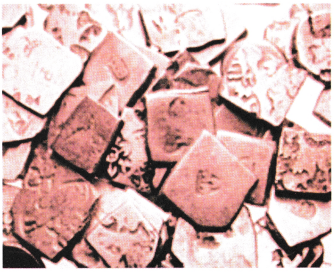
(a) Identify this picture.
(b) What are they made of?
(c) What are the symbols, punched on these coins?
(d) Mention the initial usage of these coins.
(e) Into which periods can these coins be classified?
Answer:
__________________________________
__________________________________
__________________________________
Map Work
Mark the following on the political map of India.
(a) Avanti
(b) Panchala
(c) Godavari river
(d) Ashmika
(e) Kashi
