These Class 8 Social Science Worksheet and Class 8 SST Chapter 1 Natural Resources and Their Use Worksheet with Answers are excellent for board exam practice.
Class 8 SST Chapter 1 Natural Resources and Their Use Worksheet
Class 8 Natural Resources and Their Use Worksheet
Worksheet On Natural Resources and Their Use Class 8 – Natural Resources and Their Use Worksheet Class 8
Multiple Choice Questions
Question 1.
Which of the following is a natural resource?
(a) Plastic
(b) Water
(c) Concrete
(d) Glass
Question 2.
Which of the following is a natural resource used for energy?
(a) Copper
(b) Marble
(c) Coal
(d) Gold
Question 3.
How much oxygen does a mature tree produce per day?
(a) 175 litres
(b) 275 litres
(c) 350 litres
(d) 450 litres
Question 4.
Which of the following is an example of a natural resource mentioned in the text?
(a) Timber
(b) Computers
(c) Cars
(d) Roads
Question 5.
Which two countries launched the International Solar Alliance (ISA) in 2015?
(a) India and France
(b) India and the USA
(c) India and China
(d) India and Germany
Question 6.
Which of the following is NOT a required condition for something to be considered a resource?
(a) Technological accessibility
(b) Economic feasibility
(c) Cultural acceptability
(d) Being part of sacred groves

Question 7.
What happens when a tree falls in a forest?
(a) It is burned
(b) It decomposes and enriches the soil
(c) It is removed for timber
(d) It turns into a resource
Question 8.
Where do natural resources like coal and petroleum come from?
(a) Human-made processes
(b) Formed naturally over millions of years
(c) Manufactured in factories
(d) Developed through scientific research
Question 9.
What is essential for sustaining life on Earth?
(a) Overuse of natural resources
(b) Ignoring environmental impact
(c) Respect for nature and responsible resource use
(d) Focusing on non-renewable resources
Question 10.
What was the result of modern farming in Punjab?
(a) Groundwater pollution from chemicals
(b) More fertile soil
(c) Improved groundwater levels
(d) Reduced water usage
Assertion and Reason Questions
There are two statements marked as Assertion (A) and Reason (R). Mark your answer as per the codes provided below:
Question 1.
Assertion (A): Trees are considered natural resources when humans use their wood to make furniture.
Reason (R): Something in Nature becomes a resource only if it is useful, accessible, and acceptable for use in that society.
Codes:
(a) Both (A) and (R) are true, and (R) is the correct explanation of (A).
(b) Both (A) and (R) are true, but (R) is not the correct explanation of (A).
(c) (A) is true, but (R) is false.
(d) (A) is false, but (R) is true.
Question 2.
Assertion (A): Petroleum is classified as a renewable resource.
Reason (R): Petroleum takes millions of years to form in Nature.
Codes:
(a) Both (A) and (R) are true, and (R) is the correct explanation of (A).
(b) Both (A) and (R) are true, but (R) is not the correct explanation of (A).
(c) (A) is true, but (R) is false.
(d) (A) is false, but (R) is true.
Fill in the Blanks with the Words given in the Box Below:
| irrigation, evenly, pre-planting, furniture |
1. The Bhadla Solar Park is a symbol of India’s __________ ambitions.
2. Vrikshayurveda provides methods for seed collection, preservation, and __________ treatments.
3. Many farmers in our country extract ground water for __________ purposes.
4. Trees become a resource when their wood is turned into __________
5. Natural resources are not __________ distributed on Earth.
State Whether the following Statements are True or False
1. Industries near natural resources don’t create local jobs.
2. Resource development sometimes displaces tribal communities.
3. Natural resources always bring positive effects.
4. Sustainable materials are more polluting than cement.
5. India has avoided the ‘natural resource curse’ by developing industries that add value to its resources.
Match the Contents in Column A with those in Column B
| Column A | Column B |
| A. Paradox of plenty | (i) Returning to original condition |
| B. Regeneration | (ii) Leads to groundwater becoming unavailable |
| C. Over- extraction of groundwater | (iii) Resources don’t guarantee prosperity |
| D. Non- renewable resources | (iv) Nature creating new life |
| E. Restoration | (v) Cannot be replaced easily |
Choose the correct option:
(a) A – (i), B – (iv), C – (ii), D – (v), E – (iii)
(b) A – (v), B – (iv, C – (i), D – (iii), E – (ii)
(c) A – (iii), B – (iv), C – (ii), D -(v), E – (i)
(d) A – (iv), B – (v), C – (iii), D – (i), E – (ii)
Very Short Answer Type Questions
Question 1.
What is an example of an ecosystem service provided by trees?
Answer:
_______________________________
_______________________________
_______________________________
Question 2.
How do forests benefit humans?
Answer:
_______________________________
_______________________________
_______________________________
Question 3.
When was Vrikshayurveda formalised and by whom?
Answer:
_______________________________
_______________________________
_______________________________
Question 4.
What happened to the tuna population?
Answer:
_______________________________
_______________________________
_______________________________
Question 5.
What are the three factors that determine whether something is considered a resource?
Answer:
_______________________________
_______________________________
_______________________________
Short Answer Type Questions
Question 1.
What does the uneven distribution of resources affect?
Answer:
_______________________________
_______________________________
_______________________________
Question 2.
What was the traditional practice regarding fishing?
Answer:
_______________________________
_______________________________
_______________________________
Question 3.
What is one environmental concern related to cement production?
Answer:
_______________________________
_______________________________
_______________________________
Question 4.
Why is soil ploughing important according to Vrikshayurveda?
Answer:
_______________________________
_______________________________
_______________________________
Long Answer Type Questions
Question 1.
What are renewable resources, how do they differ from non-renewable ones, ft and how can we ensure their availability? Give two examples.
Answer:
_______________________________
_______________________________
_______________________________
Question 2.
What are the different categories of natural resources and how are they used?
Answer:
_______________________________
_______________________________
_______________________________
Question 3.
What is the ‘natural resource curse’ and how can it be avoided?
Answer:
_______________________________
_______________________________
_______________________________
Case Based Questions
Read the given excerpt and answer the questions that follow:
We cannot imagine life without cement. Our houses, schools and hospitals and other buildings, bridges, roads and airports, all require cement. The production of cement has been listed as one of the most polluting industries. The process of production releases fine dust that enters our lungs and those of animals damaging them, settles on leaves of plants decreasing their yields, and causes soil and water pollution too. The Central Pollution Control Board has created guidelines for cement factories to ensure that the pollution is minimised or eliminated. In addition, there is
a move towards creating alternative materials that reduce pollution. These include the use of traditional materials like stone and mud, new plant-based materials and recycled materials from waste plastic.
(a) Why is cement important?
(b) How does cement dust affect human, animal, and plant health?
(c) What has the Central Pollution Control Board done about pollution from cement factories?
(d) What traditional and new materials are being used as alternatives to cement?
(e) How do alternative materials benefit the environment?
Answer:
_______________________________
_______________________________
_______________________________
Skill Based Question
Question 1.
Discuss the environmental and economic benefits of countries collaborating through the International Solar Alliance.
Answer:
_______________________________
_______________________________
_______________________________
Competency Based Question
Question 1.
Why is Sikkim considered a global model for sustainable agriculture?
Answer:
_______________________________
_______________________________
_______________________________
Picture Based Questions
Look at the given picture below and answer the questions that follow.
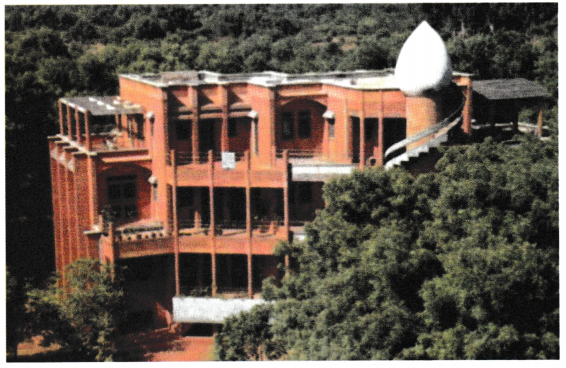
(a) What building is shown in the above picture?
(b) Where is it located?
(c) Which organisation is responsible for constructing the building?
(d) What international recognition does this building hold?
(e) Why is the building called modern even though it’s made of mud?
Answer:
_______________________________
_______________________________
_______________________________
Map Based Questions
Question 1.
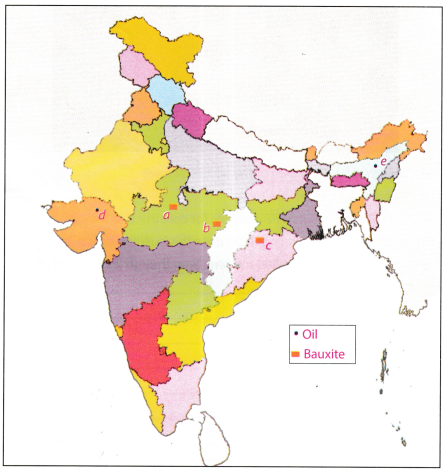
On the given political map of India, five locations are marked with their minerals (Oil or Bauxite). Write the correct place name for each.
(a) __________
(b) __________
(c) __________
(d) __________
(e) __________