Students can use Our Wondrous World Class 4 Solutions Chapter 1 Living Together Class 4 Questions and Answers as a quick reference guide.
Class 4 EVS Chapter 1 Living Together Question Answer
Living Together Class 4 EVS Question Answer
Our Wondrous World Class 4 EVS Chapter 1 Question Answer – Class 4 EVS Living Together Question Answer
Discuss (Page 5)
Question 1.
Why do you think it is important to have places like parks, schools, hospitals, and bus stops in your locality?
Answer:
These places are essential because they serve the community’s needs:
- Parks provide space for recreation, exercise and social interaction.
- Schools provide education to children and prepare them for the future.
- Hospitals offer medical care and ensure public health.
- Bus stops enable transportation, connecting people to work, schools and other services.

Question 2.
How would life be different if one or more of these places in your locality did not exist?
Answer:
Life would become difficult if these places in our locality did not exist, as:
- without parks, people would lack open spaces for play and relaxation.
- without schools, children would miss education and social development.
- without hospitals, treating illnesses or emergencies would be harder.
- without bus stops, commuting would be more difficult leading to greater isolation of communities.
Question 3.
What can you do to keep these places clean and safe?
Answer:
To keep these places clean and safe we should avoid littering and use trash bins.
- Participate in cleanliness drives (like Swachh Bharat Abhiyan).
- Report broken equipment or hazards to concerned authorities.
- Educate others about respecting public spaces.
Discuss (Page 10)
Question 1.
It is important for communities to come together in times of need. What do you think about this statement?
Answer:
This statement is true because:
- Collective effort solves problems faster (e.g., building the bamboo bridge in Kanker).
- Sharing resources (skills, materials) reduce individual burdens.
- Strengthens bonds and creates a sense of unity.
Question 2.
Do people in your locality come together and support each other? Can you remember one such occasion?
Answer:
Yes, in my opinion people should come together in their locality in times of need. Coming together strengthens support, boosts morale, and helps communities overcome challenges more effectively.
Discuss (Page 13)
Question 1.
What are some of the ways by which we can take care of nature and our neighbourhood? List a few.
Answer:
Some ways by which we can take care of nature and our neighbourhood are:
- Tree plantation (like in Van Mahotsav)
- Waste management and recycling
- Conservation of water and electricity
- Keep public spaces clean.
Question 2.
How does helping others and working together make our community better?
Answer:
Helping others and working together builds trust, unity and a stronger, more supportive community.
Write (Page 4)
Look at the picture of Chandan’s village.
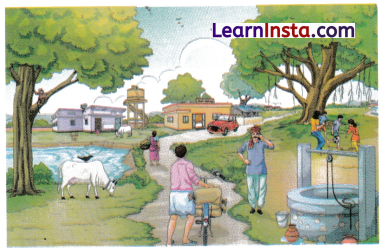
What do you see in the picture? Describe below.
Answer:
The picture clearly show the following things:
A residential house with a DTH antenna, a water tank, a post office, huts, a banyan tree, children playing football, a well, villagers going for work, a man walking and talking over a cell phone, cows grazing grass and a car.
Write (Page 11)
Think about your family or community. How do you work together to help each other while preparing for a festival or any other occasion?
Answer:
1. During festivals:
- Family members clean the house and decorate together.
- Neighbours share food or resources (e.g., sweets, decorations).
- Children help with small tasks like making rangoli or lighting lamps.
2. Community events (e.g., Van Mahotsav):
- Planting trees as a group.
- Cooking and sharing meals (like the community feast).
- Assigning roles (e.g., cleaning, repairing benches).
Activity 1 (Page 4)
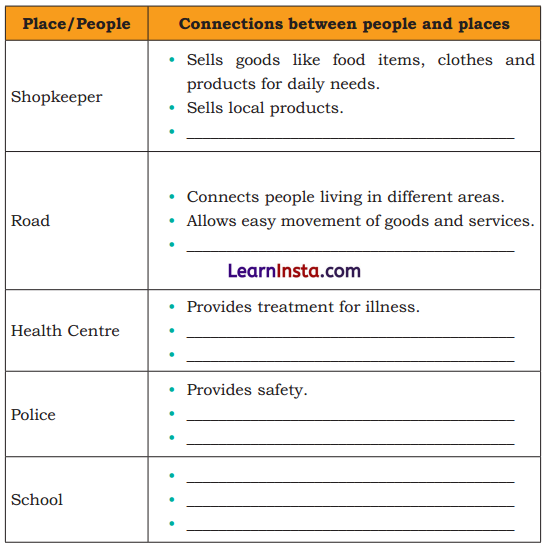
Explore your locality; observe the people and places around you. Write your observations about how the people and places you see are connected to each other in the table given below.
Answer:
| Place/ People | Connections between people and places |
| Shopkeeper | • Sells goods like food items, clothes and products for daily needs. • Sells local products. • Knows customers by name and their preferences. |
| Road | • Connects people living in different areas. • Allows easy movement of goods and services. • Used for walking, cycling and transportation. |
| Health Centre | • Provides treatment for illness. • Offers preventive care like vaccinations. • Has infrastructure that can serve communities. |
| Police | • Provides safety. • Helps during emergencies. • Maintains law and order in the area. |
| School | • Provides education to children. • Hosts community events. • Teachers guide students for their bright future and successful career. |
Activity 2 (Page 6)
Let us create a colourful poster to help Chandan and his friends invite people from their neighbourhood to participate in the Van Mahotsav.
Answer:
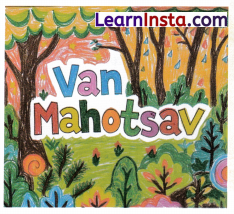
All are welcome to the Van Mahotsav being organised by the Green India Club on 5th September at Bharat Vatika at 9:00 AM.
Free saplings will be provided by the club. Participate with family and friends.
Activity 3 (Pages 7-8)
Question 1.
Identify the people who help in maintaining your locality What are their occupations?
Answer
- Sanitation workers – Keep streets and drains clean.
- Electricians – Maintain streetlights.
- Plumbers – Fix water supply issues.
- Gardeners – Take care of public parks.
- Security guards – Ensure neighbourhood safety.
Question 2.
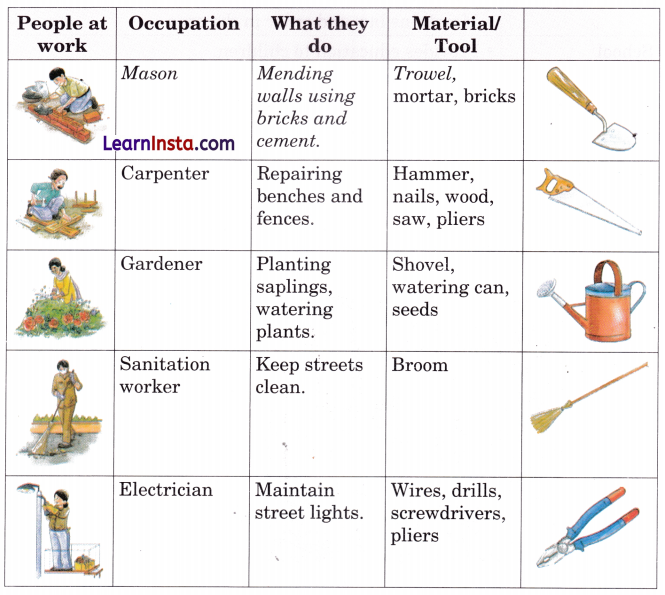
Look at the table below. List different kinds of work required for developing and maintaining the park. Also mention the material, tools and skills required. An example is given here.

Answer
Question 3.
Find out from your family members or neighbours about their work. What questions would you ask them? Here are some examples:
(a) What do you like the most about your work?
(b) What types of tools or things do you use?
(c) What challenges do you face?
Answer:
The following questions can be asked:
- What do you do in your job every day?
- What tools or equipment do you use?
- Are you happy with your job?
- Do your colleagues help you in your work?
- How does your work help our community?
Let us Reflect (Pages 13-16)
Our School, Our Team!
Question 1.
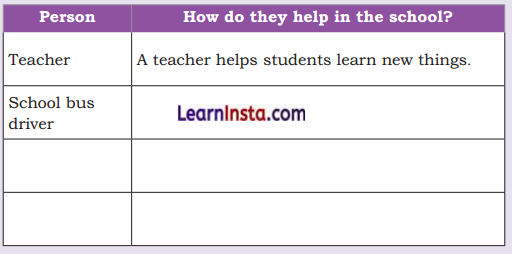
Write the different role people play in your school-teachers, students, caretakers, bus drivers, etc.
Answer:
| Person | How do they help in the school? |
| Teacher | A teacher helps students learn new things. |
| School bus driver | Safely transport students to and from school. |
| Student | Learn, participate in activities, follow rules. |
| Caretakers | Clean classrooms and maintain school hygiene. |
| Principal | Manage school operations and set policies. |
| Librarian | Maintain books and help students with resources. |
| Security guard | Ensure safety of students and school property. |
(a) Why is it important for everyone to work as a team in a school?
Answer:
It is important for everyone to work as a team in a school to:
- ensure smooth daily operations (e.g., teachers teach, caretakers maintain hygiene).
- create a supportive learning environment.
- teach students values like cooperation and responsibilities.
- make school activities (events, projects) more successful.
(b) What is your role as a member of your school community?
Answer:
As a member of our school community my role is to:
- attend classes regularly and complete work
- respect teachers and classmates
- keep school premises clean
- participate in school events and activities
- help classmates in their study
Question 2.
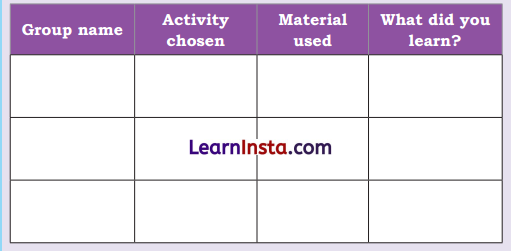
Form small groups of 4-5 students. Choose one fun activity to perform from the list below:
(a) Tree plantation
(b) Cleanliness drive
(c) Making artefacts with materials from nature (something useful like a leaf-plate or a decorative item like a garland). After the activity, fill out this table:
Answer:
| Group name | Activity chosen | Material used | What did you learn? |
| Green Team | Tree
plantation |
Saplings, shovels, watering cans | How to plant trees properly and take care of them |
| Clean Squad | Cleanliness drive | Gloves, trash bags, brooms | Importance of keeping public spaces clean |
| Nature Craft | Leaf-plate making | Leaves, twine, scissors | How to create useful items from natural materials |
Question 3.
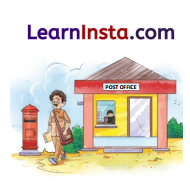
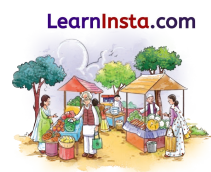
Match the riddles with their solutions hidden in the pictures.
(a) I am a place where people wait, To catch a ride, and not be late.
Buses come and buses go, To places high and low.

Answer:
Bus stop
(b) I keep letters far and near, With stamps and parcels waiting here.
Write a note and drop it in, What am I? Can you guess and win?
Answer:
Post office
(c) I am full of colours, lights, sounds of feet, A place where people shop and meet. Fruits, vegetables and other goods are found, What am I, busy all around?
Answer:
Market
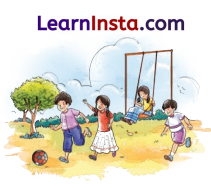
(d) I am a place where you run and play, With swings and slides to enjoy your day. Laughter here is a common sound, What is my name? Have you found?
Answer:
Playground
Question 4.
Choose a public place of your interest, and create a similar riddle about it for your friends to solve.
My Riddle:
I am a house of knowledge and fun,
With books and tales for everyone.
Silently, in rows we sit,
What am I?
Answer:
I am a Library
Question 5.
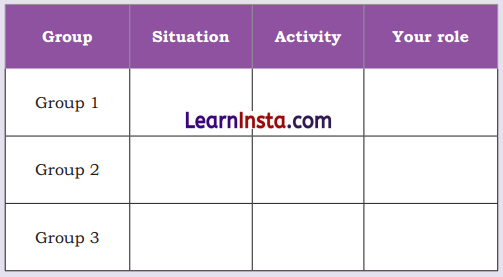
Create three groups in the class. Each group would think about a situation in their locality that needs to be improved. Identify activities that can make a difference to the situation. This could be related to cleaning, helping others, organising an event, etc. Complete the table below.
Answer:
| Group | Situation | Activity | Your role |
| Group 1 | Dirty park | Weekly cleaning drive | Collect trash, educate others |
| Group 2 | No streetlights | Petition local council | Survey area, write letters to concerned authorities |
| Group 3 | Water shortage | Rainwater harvesting project | Help install collection systems |
After completing the table, discuss and answer the following questions:
(a) Do you think working together can make your activities more useful? Give reasons.
(b) How will your involvement in these activities help the community?
Answer:
(a) Yes, working together makes activities more useful because it combines different ideas, skills and efforts, leading to better and faster results.
(b) Being involved in such activities helps the community by solving common problems, promoting unity, and encouraging responsible behaviour among members.
Question 6.
Ask your family about any one special skill or craft (for example-basket making, wall painting, pottery) that is famous in your region.
Answer:
(Suggestive answer. Students to write their own choices.) Traditional Craft in My Region (Tamil Nadu)
Skill/Craft: Kolam/Rangoli
It’s special because:
- Welcomes guests and brings good luck.
- Keeps our floor clean (rice flour feeds ants/birds).
- Makes festivals like Pongal/Diwali colourful and joyful.