Practicing Class 8 Science MCQ and Class 8 Science Chapter 10 Light: Mirrors and Lenses MCQ Questions Online Test with Answers daily helps in time management.
Class 8 Light: Mirrors and Lenses MCQ with Answers
MCQ on Light: Mirrors and Lenses Class 8
Class 8 Science Chapter 10 Light: Mirrors and Lenses MCQ Questions with Answers
Question 1.
Which mirror gives a wider field of view?
(a) Plane mirror
(b) Concave mirror
(c) Convex mirror
(d) None of these
Answer:
(c) Convex mirror

Question 2.
An erect and enlarged image can be formed by (NCERT Exemplar)
(a) only a convex mirror.
(b) only a concave mirror.
(c) only a plane mirror.
(d) both convex and concave mirrors.
Answer:
(b) only a concave mirror.
Question 3.
What image is formed by a plane mirror?
(a) Enlarged
(b) Diminished
(c) Same size, erect
(d) Inverted
Answer:
(c) Same size, erect
Question 4.
You are provided with a convex mirror, a concave mirror, a convex lens and a concave lens. You can get an inverted image from (NCERT Exemplar)
(a) both concave lens and convex lens.
(b) both concave mirror and convex mirror.
(c) both concave mirror and convex lens.
(d) both convex mirror and concave lens.
Answer:
(c) both concave mirror and convex lens.
Question 5.
Which device uses a concave mirror to produce a parallel beam of light?
(a) Magnifying glass
(b) Lamp
(c) Torch
(d) Microscope
Answer:
(c) Torch
Question 6.
An image formed by a lens is erect. Such an image could be formed by a (NCERT Exemplar)
(a) convex lens provided the image is smaller than object.
(b) concave lens provided the image is smaller than object.
(c) concave lens provided the image is larger than object.
(d) concave lens provided the image is of the same size.
Answer:
(b) concave lens provided the image is smaller than object
Question 7.
What happens to light when it passes through a convex lens?
(a) It spreads out.
(b) It bends away from the center.
(c) It converges at a point.
(d) It disappears.
Answer:
(c) It converges at a point.
Question 8.
What happens when parallel rays fall on a convex mirror?
(a) They converge.
(b) They stay parallel.
(c) They diverge.
(d) They are absorbed.
Answer:
(c) They diverge.
Question 9.
In which of the following devices is a convex lens used?
(a) Headlight
(b) Microscope
(c) Spectacles for myopia
(d) Surveillance mirror
Answer:
(b) Microscope
Question 10.
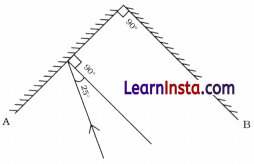
Two mirrors A and B are placed at right angles to each other as shown in given figure.
A ray of light incident on mirror A at an angle of 25° falls on mirror B after reflection. The angle of reflection for the ray reflected from mirror B would be
(a) 25°
(b) 50°
(c) 65°
(d) 115°
Answer:
(c) 65°
Light: Mirrors and Lenses Class 8 Assertion-Reason Type Questions
Use the following key to choose the appropriate answer.
(a) Both A and R are true and R is the correct explanation of A.
(b) Both A and R are true but R is not the correct explanation of A.
(c) A is true but R is false.
(d) A is false but R is true.
Question 1.
Assertion (A): Concave mirrors are used in car headlights.
Reason (R): Concave mirrors form real, focused beams of light.
Answer:
(a) Both A and R are true and R is the correct explanation of A.
Question 2.
Assertion (A): Convex mirrors are widely used as rear-view mirrors in vehicles.
Reason (R): Convex mirrors always form erect and diminished images and provide a wider field of view.
Answer:
(a) Both A and R are true and R is the correct explanation of A.
Question3.
Assertion (A): The angle of incidence is always equal to the angle of reflection.
Reason (R): This law applies only to plane mirrors, not spherical mirrors.
Answer:
(c) A is true but R is false
Question 4.
Assertion (A): The incident ray, the reflected ray, and the normal at the point of incidence lie in the same plane.
Reason (R): Angle of incidence is not equal to angle of reflection.
Answer:
(c) A is true but R is false
Question 5.
Assertion (A): A concave lens can be used to focus the sunlight on the piece of paper.
Reason (R): Concave lenses diverge the light rays.
Answer:
(d) A is false but R is true
Light: Mirrors and Lenses Class 8 Fill in the blanks
Question 1.
Lenses are made from ……….. materials like glass or plastic.
Answer:
transparent
Question 2.
………. occurs in all types of mirrors.
Answer:
Lateral inversion
Question 3.
The path along which light travels is called a………. of light.
Answer:
ray
Question 4.
The reflected ray, ……….. ray and normal all lie in the same plane.
Answer:
incident
Question 5.
The reflecting surface of a concave mirror curves ………..
Answer:
inward
Light: Mirrors and Lenses Class 8 True or False
Question 1.
The angle of incidence is equal to the angle of reflection.
Answer:
True
Question 2.
A flat glass sheet bends light the same way as a lens.
Answer:
False
Question 3.
Eyeglasses have convex or concave lenses.
Answer:
True
Question 4.
The convex lens is also called a diverging lens.
Answer:
False
Question 5.
Convex mirrors always form inverted images.
Answer:
False
Light: Mirrors and Lenses Class 8 Match the following
Question 1.
| Column A | Column B |
| (i) Convex mirror | (a) Converging lens |
| (ii) Concave mirror | (b) Diverging lens |
| (iii) Convex lens | (c) Used in dentist’s tools |
| (iv) Concave lens | (d) Used as a side-view |
Answer:
| Column A | Column B |
| (i) Convex mirror | (d) Used as a side-view |
| (ii) Concave mirror | (c) Used in dentist’s tools |
| (iii) Convex lens | (a) Converging lens |
| (iv) Concave lens | (b) Diverging lens |