Practicing Class 7 Maths MCQ and Class 7 Maths Chapter 1 Large Numbers Around Us MCQ Questions Online Test with Answers daily helps in time management.
MCQ on Large Numbers Around Us Class 7
Large Numbers Around Us MCQ Class 7
Class 7 Maths MCQ Chapter 1 Large Numbers Around Us
Multiple Choice Questions
Question 1.
How many zeroes are there in one lakh?
(a) 4
(b) 5
(c) 6
(d) 7
Answer:
(b) 5
Question 2.
Which of the following is greater?
(a) 10 million
(b) 10 lakh
(c) 10 crore
(d) 10 thousand
Answer:
(c) 10 crore
Question 3.
How many lakhs make a crore?
(a) 10
(b) 100
(c) 1000
(d) 10000
Answer:
(b) 100

Question 4.
75,000 is how much less than 1,00,000?
(a) 20,000
(b) 25,000
(c) 30,000
(d) 35,000
Answer:
(b) 25,000
Question 5.
Which number is the greatest?
(a) 9 crore
(b) 90 million
(c) 900 lakhs
(d) 9 billion
Answer:
(d) 9 billion
Question 6.
What is the rounded value of 72,467 when rounded to the nearest ten thousand?
(a) 70,000
(b) 72,000
(c) 75,000
(d) 80,000
Answer:
(a) 70,000
Question 7.
The population of a city is 5,67,890. What is the population when rounded to the nearest lakh?
(a) 5,00,000
(b) 6,00,000
(c) 5,50,000
(d) 6,50,000
Answer:
(b) 6,00,000
Question 8.
If the cost of a car is ₹ 8,65,432, what is its rounded value to the nearest lakh?
(a) ₹ 8,60,000
(b) ₹ 8,50,000
(c) ₹ 9,00,000
(d) ₹ 8,00,000
Answer:
(c) ₹ 9,00,000
Question 9.
The rounded value of ₹ 21,78,543 to the nearest ten lakh is
(a) ₹ 20,00,000
(b) ₹ 22,00,000
(c) ₹ 23,00,000
(d) ₹ 21,00,000
Answer:
(d) ₹ 21,00,000
Question 10.
A factory produces 67,89,987 units in a year. Rounded to the nearest ten lakhs, the number of units produced is
(a) 70,00,000
(b) 60,00,000
(c) 68,00,000
(d) 65,00,000
Answer:
(c) 68,00,000
Question 11.
If 125 = 1000 ÷ 8 then 64 × 125 = ?
(a) 8000
(b) 8200
(c) 6400
(d) 7500
Answer:
(a) 8000
Question 12.
Which is a correct multiplication shortcut?
(a) 180 × 50 = 180 × 100 ÷ 5
(b) 176 × 25 = 176 × 100 ÷ 4
(c) 192 × 5 = 192 × 2 ÷ 10
(d) 205 × 10 = 205 ÷ 5 × 25
Answer:
(b) 176 × 25 = 176 × 100 ÷ 4
Question 13.
What is the value of 666 × 661?
(a) 441226
(b) 440226
(c) 442226
(d) 446226
Answer:
(b) 440226
Question 14.
A 3-digit number multiplied by another 3-digit number can result in a product with how many digits?
(a) Always 5 digits
(b) Always 6 digits
(c) Either 5 or 6 digits
(d) Between 4 and 6 digits
Answer:
(c) Either 5 or 6 digits
Question 15.
The product of two 2-digit numbers lies between
(a) 10 and 1000
(b) 100 and 999
(c) 100 and 9999
(d) 10 and 999
Answer:
(c) 100 and 9999
Question 16.
How many zeroes are there in ten lakh?
(a) 4
(b) 5
(c) 6
(d) 7
Answer:
(c) 6
Question 17.
If a person eats 3 varieties of rice per day for 100 years, how many total varieties will they eat?
(a) 73,000
(b) 36,500
(c) 2,00,000
(d) 1,09,500
Answer:
(b) 36,500
Question 18.
Which of the following is equal to 20 lakh?
(a) 2 million
(b) 200 thousand
(c) 200 million
(d) 20 million
Answer:
(a) 2 million
Question 19.
What is the name of 500,000 in the American system?
(a) Five million
(b) Five crore
(c) Five hundred thousand
(d) Fifty million
Answer:
(c) Five hundred thousand
Question 20.
What is the rounded value of ₹ 45,234 to the nearest thousand?
(a) ₹ 40,000
(b) ₹ 45,000
(c) ₹ 50,000
(d) ₹ 48,000
Answer:
(b) ₹ 45,000
Question 21.
The product of 201 × 201 equals
(a) 40,401
(b) 40,100
(c) 41,100
(d) 42,000
Answer:
(a) 40,401
Assertion-Reason Based Questions
Study the Assertion (A) and Reason (R) statements given below and choose the correct alternative.
Question 1.
Assertion (A): 1 crore equals 10 million.
Reason (R): 1 crore is 1,00,00,000, and 10 million is also 1,00,00,000.
(a) Both A and R are true, and R is the correct explanation of A.
(b) Both A and R are true, but R is not the correct explanation of A.
(c) A is true but R is false.
(d) A is false, but R is true.
Answer:
(a) Both A and R are true, and R is the correct explanation of A.
Question 2.
Assertion (A): 1 lakh has 6 zeroes.
Reason (R): 1 lakh = 1,00,000.
(a) Both A and R are true, and R is the correct explanation of A.
(b) Both A and R are true, but R is not the correct explanation of A.
(c) A is true but R is false.
(d) A is false, but R is true.
Answer:
(d) A is false, but R is true.
Question 3.
Assertion (A): In the American system, commas are placed after every three digits.
Reason (R): It helps in reading numbers easily.
(a) Both A and R are true, and R is the correct explanation of A.
(b) Both A and R are true, but R is not the correct explanation of A.
(c) A is true but R is false.
(d) A is false, but R is true.
Answer:
(a) Both A and R are true, and R is the correct explanation of A.
Question 4.
Assertion (A): When rounding to the nearest thousand, numbers from 500 to 999 are rounded up.
Reason (R): Rounding up is done when the digit in the place being rounded to is 5 or greater.
(a) Both A and R are true, and R is the correct explanation of A.
(b) Both A and R are true, but R is not the correct explanation of A.
(c) A is true but R is false.
(d) A is false, but R is true.
Answer:
(a) Both A and R are true, and R is the correct explanation of A.
Question 5.
Assertion (A): Rounding down is used when the last digit is less than 5.
Reason (R): Rounding up results in a larger number than the actual number.
(a) Both A and R are true, and R is the correct explanation of A.
(b) Both A and R are true, but R is not the correct explanation of A.
(c) A is true but R is false.
(d) A is false, but R is true.
Answer:
(b) Both A and R are true, but R is not the correct explanation of A.
Question 6.
Assertion (A): Estimation facilitates simpler calculations.
Reason (R): Estimation uses the exact value of the numbers.
(a) Both A and R are true, and R is the correct explanation of A.
(b) Both A and R are true, but R is not the correct explanation of A.
(c) A is true but R is false.
(d) A is false, but R is true.
Answer:
(c) A is true but R is false.
Question 7.
Assertion (A): Multiplying by 50 is the same as multiplying by 100 and dividing by 2.
Reason (R): Multiplying by 100 increases the value hundred times and dividing by 2 halves it, resulting in multiplying by 50.
(a) Both A and R are true, and R is the correct explanation of A.
(b) Both A and R are true, but R is not the correct explanation of A.
(c) A is true but R is false.
(d) A is false, but R is true.
Answer:
(a) Both A and R are true, and R is the correct explanation of A.
Question 8.
Assertion (A): Multiplying a 3-digit number by a 2-digit number will always result in a 5-digit or 6-digit number.
Reason (R): The product of two 3-digit numbers will either be a 5-digit or a 6-digit number.
(a) Both A and R are true, and R is the correct explanation of A.
(b) Both A and R are true, but R is not the correct explanation of A.
(c) A is true but R is false.
(d) A is false, but R is true.
Answer:
(d) A is false, but R is true.
Question 9.
Assertion (A): The product of 101 × 101 equals 10201.
Reason (R): The square of a number can be calculated by multiplying the number by itself.
(a) Both A and R are true, and R is the correct explanation of A.
(b) Both A and R are true, but R is not the correct explanation of A.
(c) A is true but R is false.
(d) A is false, but R is true.
Answer:
(a) Both A and R are true, and R is the correct explanation of A.
Fill in the blanks.
1. The smallest number that has 5 digits and starts with 1 is ____________
Answer: 10000
2. The number name of 1,00,000 is ____________
Answer: one lakh
3. A person watches 2 movies every day. In 50 years (ignore leap years), they will have watched ____________ movies.
Answer: 36,500 movies
4. In the Indian system, commas are placed after ____________ digits from the right and then after every ____________ digits.
Answer: three, two
5. One crore is equal to ____________ million.
Answer: ten
6. One million is equal to ____________ lakh.
Answer: ten
7. The population of Chintamani in 2011 was about ____________
Answer: 76,068
8. The number 10,00,000 is read as ____________
Answer: ten lakh
9. The place value of 5 in 5,04,085 is ____________
Answer: five lakh
10. The numeral for thirty-eight lakh sixty-seven thousand forty is ____________
Answer: 38,67,040
11. The cost of an item is ₹ 399. When rounded to the nearest hundred, the price is ____________
Answer: ₹ 400
12. The nearest thousand for the numbers 6,10,84,361 is ____________
Answer: 6,10,84,000
13. The nearest crore for the number 6,79,65,352 is ____________
Answer: 7 crore
14. When rounding down, a number is approximated to be ____________ than the actual value.
Answer: less
15. When estimating the difference of 23,45,678 – 7,89,234, the difference is close to ____________ and is less than ____________
Answer: 15,00,000 and less than 16,00,000
16. A school has 1,23,578 students. If rounded to the nearest ten thousand, the number of students is ____________
Answer: 1,20,000
17. A city’s population is 9,03,267. The nearest ten lakh is ____________
Answer: 10 lakh
18. Multiplying a number by 5 is the same as dividing by ____________ and then multiplying by 10.
Answer: 2
19. Multiplying a number by 25 is the same as dividing by 4 and then multiplying by ____________
Answer: 100
20. 4 × 1420 × 50 can be solved by first multiplying 4 × 50 to get ____________ and then multiplying by 1420.
Answer: 200
21. 72 × 125 can be calculated by dividing 72 by 8 and then multiplying by ____________
Answer: 1000
22. 125 × 15 × 8 × 25 simplifies to ____________ × 1000.
Answer: 375
23. 111 × 111 equals ____________
Answer: 12321
24. The product of two 2-digit numbers will always be a ____________ or ____________ -digit number.
Answer:
3, 4
Compare and write ‘<‘, ‘>’ or ‘=’.
1. 1,500 thousand ____________ 15 million.
Answer: <
2. 200 lakhs ____________ 2 crore.
Answer: =
3. 40 thousand ____________ 4 lakhs.
Answer: <
4. 50 billion ____________ 500 crore.
Answer: >
5. 1,000 thousand ____________ 10 million.
Answer: <
6. 300 lakhs ____________ 3 crore.
Answer: =
7. 5,000 crore ____________ 500 billion.
Answer: <
8. 7 lakhs ____________ 75 thousand.
Answer: >
State whether the following statements are True or False.
1. 1 lakh = 100,000.
Answer: True
2. If a person eats 1 variety of rice every day, they will need exactly 100 years to taste one lakh varieties (assuming 365 days a year).
Answer: False
3. 10,000 is called ten thousand in both Indian and American systems.
Answer: True
4. In the American system, commas are placed every two digits.
Answer: False
5. 1 crore = 100 lakhs.
Answer: True
6. 1 million has 6 zeroes.
Answer: True
7. Estimating numbers can be helpful in everyday situations, where exact values are not necessary.
Answer: True
8. Rounding up is used when the estimated number is less than the actual number.
Answer: False
9. Rounding 3,87,69,957 to the nearest lakh gives 3,88,00,000.
Answer: True
10. When estimating a number, we always round it to the nearest crore.
Answer: False
11. If the population of a town is 76,068, saying that it is about 76,000 is an example of rounding down.
Answer: True
12. It is useful to estimate values when exact numbers are crucial for the task.
Answer: False
13. Multiplying by 50 is the same as multiplying by 100 and dividing by 2.
Answer: True
14. Multiplying by 125 is the same as multiplying by 1000 and dividing by 8.
Answer: True
15. 2-digit × 1-digit multiplication can result in a 2-digit or 3-digit product.
Answer: True
16. The number of digits in a product depends only on the number of digits in the bigger number.
Answer: False
17. Multiplying a 3-digit number by another 3-digit number can give a 4-digit number.
Answer: False
18. The pattern in 3 × 5, 33 × 35, 333 × 335 always shows repeated ‘1’ and ‘5’.
Answer: True
Match the columns
Question 1.
| Column I | Column II |
| (i) 1 lakh | (a) 100,000,000 |
| (ii) 1 crore | (b) 1,000,000 |
| (iii) 1 million | (c) 10,00,000 |
| (iv) 10 lakhs | (d) 1,00,000 |
| (v) 100 million | (e) 1,00,00,000 |
Answer:
| Column I | Column II |
| (i) 1 lakh | (d) 1,00,000 |
| (ii) 1 crore | (e) 1,00,00,000 |
| (iii) 1 million | (b) 1,000,000 |
| (iv) 10 lakhs | (c) 10,00,000 |
| (v) 100 million | (a) 100,000,000 |
Case-Based Questions
(A) In a quiz show, two contestants were asked to compare the populations of countries using the Indian and International systems of numeration. The populations were given as
| Country | Population |
| Country A | 1350000000 |
| Country B | 68900000 |
Answer the following questions.
Question 1.
The population of Country A in the Indian system is
(a) 1,350,000,000
(b) 13,50,000,000
(c) 13,50,00,00,00
(d) 1,35,00,00,000
Answer:
(d) 1,35,00,00,000
Question 2.
Write the population of Country B in the International system.
Answer:
Sixty-eight million nine hundred thousand
Question 3.
Which country has a higher population and by how much?
Answer:
Country A: 12,81,10,00,00
Question 4.
Round off the population of both countries to the nearest crore and compare again.
Answer:
Country A: 1,35,00,00,000
Country B: 7,00,00,000, 1280,000,000
(B) A teacher gave students a number pattern involving the multiplication of special numbers. She wrote the following examples on the board
9 × 1 = 9
99 × 2 = 198
999 × 3 = 2997
9999 × 4 = 39996
She asked the class to carefully observe the results and answer the following questions.
Question 1.
Complete the next multiplication in the same pattern.
99999 × 5 = ____________
Answer:
499995
Question 2.
What is common between the numbers being multiplied (left-hand side)? Describe the pattern.
Answer:
Do yourself
Question 3.
Predict the result of 999999 × 6 by observing the pattern and not by multiplying. Explain how you guessed.
Answer:
5999994
Question 4.
If we multiply a number like 9,99,999 by a number that increases by 1 each time (1, 2, 3,…), what pattern will we get?
Answer:
Do yourself
Complete the following table.
Question 1.
| Number | Number Name |
| 1,00,000 | |
| 10,00,000 | |
| 1,00,00,000 | |
| 1,000,000 | |
| 10,000,000 |
Answer:
| Number | Number Name |
| 1,00,000 | One lakh |
| 10,00,000 | Ten lakh |
| 1,00,00,000 | One crore |
| 1,000,000 | One million |
| 10,000,000 | Ten million |
Question 2.
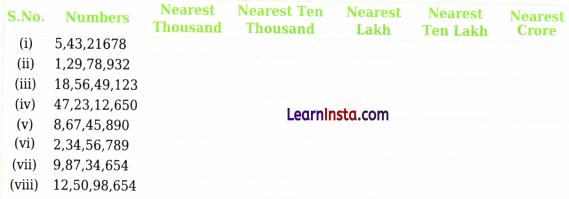
Answer:

Question 3.
| Multiplication Type | Maximum Number of Digits in Product |
| 1-digit × 1-digit | |
| 2-digit × 1-digit | |
| 2-digit × 2-digit | |
| 3-digit × 1-digit | |
| 4-digit × 3-digit | |
| 4-digit × 4-digit | |
| 7-digit × 6-digit | |
| 15-digit × 14-digit |
Answer:
| Multiplication Type | Maximum Number of Digits in Product |
| 1-digit × 1-digit | 2 |
| 2-digit × 1-digit | 3 |
| 2-digit × 2-digit | 4 |
| 3-digit × 1-digit | 4 |
| 4-digit × 3-digit | 7 |
| 4-digit × 4-digit | 8 |
| 7-digit × 6-digit | 13 |
| 15-digit × 14-digit | 29 |
Very Short Answer Type Questions
Question 1.
How many zeroes are there in one million?
Answer:
6 zeroes
Question 2.
Write the name of 2,71,04,060 in the Indian system.
Answer:
Two crore seventy-one lakh four thousand sixty
Question 3.
Round ₹ 5,87,34,243 to the nearest lakh.
Answer:
₹ 5,87,00,000
Question 4.
What is the approximate value of 12,34,567 – 3,45,678 when estimated?
Answer:
9,00,000
Question 5.
What is the value of 148 × 40 × 5 × 20 when simplified?
Answer:
5,92,000
Short Answer Type Questions
Question 1.
Write the name of 8,00,000 in both Indian and American systems.
Answer:
Indian: Eight lakh
American: Eight hundred thousand
Question 2.
Find how many more zeroes there are in one hundred million than in ten thousand.
Answer:
4
Question 3.
What is the product of 153 × 1250 using the multiplication shortcut method?
Answer:
191250
Question 4.
What is the approximate sum of ₹ 4,56,789 and ₹ 2,34,567 when rounded to the nearest lakh?
Answer:
₹ 7,00,000
Question 5.
Without actual multiplication, find the product of 11111 × 11111.
Answer:
123454321
Question 6.
The number 84,37,19,026 is written in the Indian number system.
(a) Write the name of the numeral.
(b) Rewrite the number in the International system with commas.
(c) How many millions are there in this number?
Answer:
(a) Eighty-four crore thirty-seven lakh nineteen thousand twenty-six
(b) 843,719,026
(c) 843 million
Question 7.
Estimate the result of the following using rounding.
(a) Round 8,74,592 to the nearest lakh.
(b) Round 2,36,948 to the nearest lakh.
(c) Use the rounded numbers to estimate their sum and compare it with the actual sum.
Answer:
(a) 9,00,000
(b) 2,00,000
(c) 11,00,000
Question 8.
Observe the pattern and answer the following
(a) Find the product of the following
3 × 5
33 × 35
333 × 335
(b) What do you observe in the answers? Try to describe the pattern in words or using numbers.
(c) Using your observation, predict the value of 3333 × 3335 without doing full multiplication. Then, verify your answer by actual calculation.
Answer:
(a) 3 × 5 = 15
33 × 35 = 1155
333 × 335 = 111555
(b) Do yourself
(c) 11,115,555
Long Answer Type Questions
Question 1.
The number 12,56,98,765 represents the population of a country.
(a) Write the number in words using the Indian system.
(b) Convert the number to the International system.
(c) How many crores are there in the given number?
(d) Round the number to the nearest crore and state the estimated population.
(e) Compare the rounded number with the actual number. What is the difference?
Answer:
(a) Twelve crore fifty-six lakh ninety-eight thousand seven hundred sixty-five
(b) 125,698,765
(c) 12crores
(d) 13,00,00,000
(e) 43,01,235
Question 2.
Multiply the following and observe the pattern
4 × 6 = 24
44 × 46 = 2024
444 × 446 = ____________
4444 × 4446 = ____________
(a) Describe the pattern you observe in the products.
(b) Predict the value of 44444 × 44446 without performing the full multiplication.
(c) Verify your prediction by actually calculating the product and comparing the results.
Answer:
(a) 444 × 446 = 198024
4444 × 4446 = 1978024
(b) 44444 × 44446 = 1,97,5358024
(c) Do yourself