Including Kaushal Bodh Class 8 Solutions Project 6 and Class 8 Vocational Education Chapter 6 Creating Advertisements Question Answer in your preparation can make learning more organized.
Class 8 Vocational Education Chapter 6 Question Answer
Kaushal Bodh Class 8 Chapter 6 Question Answer
What did I learn from others? [Page No. 160]
Question 1.
What are the three things you learnt about what small business owners in the community think about advertising?
Answer:
The following are three things I learnt about what small business owners in the community think about advertising
- Small business owners believe advertising helps them attract more customers and increase sales by making people aware of their products and services.
- They think word-of-mouth is important but limited, so modern advertising helps them reach a wider audience.
- They feel advertising should be truthful and highlight the unique features of their products to build trust with customers.
Question 2.
Did you apply any learning from other subjects to this project? If yes, briefly describe what and how.
Answer:
Yes, I applied learning from art and language subjects. From art, I used skills to design posters with colours, visuals and layout.
From language, I used writing skills to create clear taglines and messages that attract and inform people effectively.
Think and Answer [Page No. 161]
Question 1.
Did you enjoy doing this project?
Answer:
Yes, I really enjoyed doing this project. It was very different from regular classwork because we actually went outside the school and did real work. The most fun part was visiting the small bakery near our school and interviewing the owner. She told us how she learned baking from her grandmother and uses the same old recipes even today. That gave us a beautiful story to use in our advertisement.
Question 2.
What did you like doing?
Answer:
I liked the designing part the most, especially making the digital poster. I had never used Canva before this project and it was really easy and fun to use. I also enjoyed the group discussions when we were trying to come up with the tagline.
Everyone had different ideas and we could not agree for almost 30 minutes, but it was fun! In the end, we came up with ‘Baked Fresh, Baked with Love’ — and I think it is the best one we could have made.
Question 3.
what would you do differently next time?
Answer:
Next time, I would plan the advertisement earlier so we have more time to try two different formats — one poster and one short video reel — and compare them.
I would also learn basic video editing on my phone before the project starts, so that making a video advertisement does not feel too difficult.
Question 4.
Since advertisements are a powerful way of persuading people to do something, what are the responsibilities of the persons making advertisements and what are the rights of the audience?
Answer:
Advertisements are very powerful because they reach millions of people and influence what they buy, what they eat, and even what they think about themselves.
The responsibilities of advertisers and rights of audience are as follows Responsibilities of advertisers
(i) They should only say true things about their product. For example, if a cream does not actually remove dark spots in 7 days, they should not claim it does.
(ii) They should not copy images, music, or text from others without permission as it is plagiarism.
Rights of the audience
(i) We have the right to accurate information. We should not be fooled by fake claims.
(ii) We have the right to complain. If an advertisement is misleading, we can report it to ASCI — the Advertising Standards Council of India.

Question 5.
Examples of jobs related to this work are marketing, graphic designing, public relations, and social media management. What are the other kinds of work related to advertising?
Answer:
Some other important jobs related to advertising are as follows
(i) Copywriter: The person who writes the taglines, slogans and scripts for advertisements.
(ii) Photographer/Videographer: Takes the photos and records the videos used in advertisements.
(iii) Jingle Composer: Creates the catchy music and songs used in audio advertisements.
(iv) Voice Artist: Records the voiceovers and narrations.
(v) Brand Manager: Makes sure all advertisements look and sound consistent across TV, print and social media.
Creating Advertisements Class 8 Question Answer
Activity 1: Understanding types of advertisements
Purpose
This activity will help students to observe and identify different types of advertisements encountered in daily life and understand how they influence and communicate messages.
Pre-Planning / Preparation
- Observe your surroundings over one day and note every advertisement you come across.
- Carry a notebook to record the type of advertisement, the medium used and the product/service being advertised.
- Look around your classroom, home, school bus, marketplace, films and television!
Steps to Follow
- Read the comic strip showing Ruchi’s day and identify every advertisement she encounters.
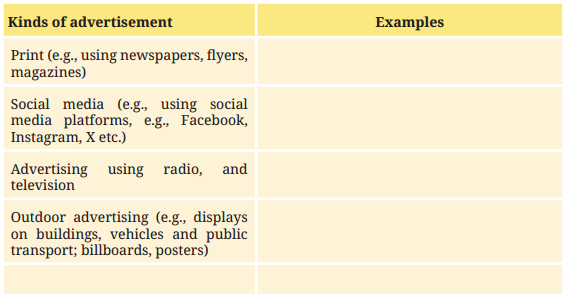
- Categorise each advertisement into print, social media, radio/television or outdoor advertising.
- Add your own examples from your daily life for each category in table.
- Count the total number of advertisements you saw or heard in one day. Write your observation.
Record of examples of different categories of advertisements
Question 1.
How many advertisements could you identify in Ruchi’s day? Name any four with their type.
Answer:
I can identify many advertisements in Ruchi’s day. The four with their types are as follows
(i) A newspaper advertisement — Print
(ii) A television commercial — TV
(iii) A roadside billboard — Outdoor
(iv) An Instagram promotion — Social Media These examples show how advertisements appear in different forms throughout the day and use various mediums to reach people effectively.
Question 2.
Are you more influenced by advertisements on social media or on television? Giive one reason.
Answer:
I am more influenced by advertisements on social media because they appear frequently and are personalised according to my interests. They are also more interactive and visually engaging, which makes them more appealing and easier to remember.
Question 3.
Why do you think some advert isements become so memorable that we start associating a product with its jingle?
Answer:
Some advertisements become memorable because they use catchy jingles, strong visuals and emotional appeal. Repetition also plays an important role. When we hear or see the same message many times, we start associating the product with its jingle.
Question 4.
Which type of advertisement: do you notice the most in your daily life and why?
Answer:
I notice social media advertisements the most because I spend a lot of time on my phone. These ads appear frequently while scrolling and are designed to match my interests, making them more noticeable and engaging compared to other types of advertisements.
Question 5.
How do outdoor advertisements help in attracting people’s attention?
Answer:
Outdoor advertisements attract attention through large size, bright colours, and simple messages. They are placed in busy areas like roads and markets, so many people see them quickly while passing by, making them effective for spreading awareness.
Kaushal Bodh Class 8 Creating Advertisements Question Answer
Activity 2: Elements comprising advertisements
Purpose
This activity will help students to explore and identify the essential elements (logo, tagline, visuals, jingles, emotional connect, call to action) that make up an effective advertisement.
Pre-Planning / Preparation
- Select 2-3 advertisements from television, social media or print that you like or remember well.
- Bring printouts or screenshots of these advertisements to class if possible.
- Think about
- Why do you like these advertisements?
- What is special about them?
Observation-Logo and Taglines/Slogans
1. Which logo and tagline/slogan do you like and why?
______________________________________________
2. How many words does a tagline/slogan have?
______________________________________________
3. Write your favourite product’s tagline/slogan in the space below. Why do you tike this tagline/slogan?
______________________________________________
4. Draw the logo in the space below-whatever you like or remember.

Observation — Visuals
5. Which visual elements can you identify (e.g., human or animal figures, shapes, colour scheme, logo design, font used, change in light in case of a video, shadows)?
______________________________________________
6. Do the visuals convey a ‘mood’? For example, happy, excited, adventurous, etc. If yes, how (e.g., location, expression of people, backdrop, colours)?
______________________________________________
7. Draw the visual elements from your favourite advertisement. What do you find interesting about these elements?

Observation — Audio and Audio-Video advertisements: Music and jingles, and duration
8. How long was the advertisement (note the time it starts and when it ends)?
______________________________________________
9. Was the time sufficient for you to understand the message of the advertisement?
______________________________________________
10. How would you describe the music and the jingles? For example, do they make you feel good, is it catchy and upbeat, or is it dramatic and makes you want to know what comes next?
______________________________________________
11. Does the advertisement have any dialogue? What do you think is the purpose of the dialogue?
______________________________________________
12. Write the jingles and play the music using the desk, pencil boxes, pencils and any other‘instruments’ you find.
______________________________________________
Observation — Connect to Emotions
13. What is the ‘story’ in these advertisements? For example, are they about families, about people helping each other, or are they about friends? Do they introduce an interesting story about people? Do they make you aspire for something?
______________________________________________
Observation — Call to Action
14. What is the call to action given by these advertisements? How is this call to action conveyed to you? Do both advertisements use the same or different strategies?
______________________________________________
Question 1.
In the advertisement above, identify the elements discussed so far; logo and tagline/slogan, visuals, connect to emotion, and call to action. Do you agree with the labelling? If not, discuss why?
Answer:
The elements of the advertisement can be identified as follows
(i) Logo and Tagline/Slogan: The logo represents the brand, and the tagline gives a short, memorable message.
(ii) Visuals: Images, colours and design make the advertisement attractive and eye-catching.
(iii) Connect to Emotion: The story or expressions create feelings like happiness, pride or concern.
(iv) Call to Action: It tells the audience what to do next.
Yes, I agree with the labelling because all elements are correctly identified and clearly shown.
Question 2.
Which advertisement did you select and what product or service did it promote?
Answer:
I selected a television advertisement that promoted a soft drink brand. It showed friends enjoying drinks together and highlighted fun and refreshment as its main message.
Question 3.
What differences did you notice between print and video advertisements in terms of presentation?
Answer:
I noticed the following differences between print and video advertisements in terms of presentation
Question 4.
How do logos and taglines help in identifying a brand quickly?
Answer:
Logos and taglines help identify a brand quickly by creating a unique identity that people can easily recognise and remember even without reading full details.
Question 5.
Which advertisement element (logo, visuals, music or slogan) was most memorable for you and why?
Answer:
The visuals were most memorable for me because they were colourful, attractive, and clearly showed the message, making the advertisement easy to recall.
Activity 3: Meeting an expert
Purpose
This activity will help students to learn about advertisements from an expert in advertising or marketing, such as a shopkeeper, billboard designer, business school teacher or advertising professional.
Pre-Planning / Preparation
- Identify an expert in your neighbourhood — a shopkeeper who distributes pamphlets, a person who designs billboards or someone who works in advertising.
- Prepare a list of questions before the visit. Add or remove questions based on who you are meeting.
- Visit with a teacher or parent. Greet the expert politely and explain the purpose of your visit.
Questions to Ask the Expert
1. What, in your opinion, makes an advertisement interesting and easy to remember?
______________________________________________
2. Why is so much money spent on advertisements? What is the effect of advertisements on audiences? Please give some examples.
______________________________________________
3. How is the medium for advertising chosen (e.g., print, radio, television, social media)?
______________________________________________
4. What are the disadvantages or issues with advertisements?
______________________________________________
What did the expert say makes an advertisement interesting and easy to remember?
Answer:
The expert said that an advertisement becomes interesting and easy to remember when it has a catchy tagline, attractive visuals, and a strong emotional connection. Simple messages and repeated exposure also help people recall it easily.
Question 2.
Why is so much money spent on advertisements? What is the effect of advertisements on audiences? Please give some example.
Answer:
A lot of money is spent on advertisements because they help businesses reach a large number of people. They increase awareness, attract customers and improve sales, which helps the business grow and compete in the market.
Question 3.
How is the medium for advertising chosen?
Answer:
The medium is chosen based on the target audience, budget and purpose of the advertisement.
For example, social media is used for young audiences, while newspapers or posters are used for local or older audiences.
Question 4.
What are the main disadvantages or issues with advertisements?
Answer:
The main disadvantages of advertisements are as follows
(i) They can sometimes be misleading by making false or exaggerated claims about products.
(ii) They may create unnecessary wants and influence people to buy things they do not need.
(iii) They can be expensive, especially for small businesses.
(iv) They may promote stereotypes or unrealistic expectations in society.
Question 5.
How do advertisements influence people’s buying decisions?
Answer:
Advertisements influence people’s buying decisions by creating interest and awareness about a product. They highlight benefits, attractive offers, and emotional appeal, which makes people feel the product is useful or necessary. Repeated ads also build trust and familiarity, encouraging people to choose that product over others available in the market.
Activity 4: Identification of client
Purpose
This activity will help students to identify a small local business as the ‘client’ for whom an advertisement will be designed, and to sign a simple working contract with the business owner.
Pre-Planning / Preparation
- Speak to classmates, teachers and neighbours to identify local small businesses near school — bakers, tailors, diya sellers, toy makers, bamboo product makers, hairdressers, fruit/vegetable sellers, etc.
- Decide which group will approach which business. Make sure no two groups pick the same business.
- Prepare a questionnaire before meeting the business owner. Always visit with a teacher or known adult.
Steps to Follow
- Prepare a list of small businesses near your school. Record each one in your notebook.
- Before meeting the owner, greet them politely and explain what you are trying to do. Request 20-30 minutes of their time. Introduce all group members.
- Ask the business owner if they are willing to participate. Note the name of the business, what it sells, and why you selected it.
Questions to Ask Experts
1. What is the name of your chosen business and what do they sell?
______________________________________________
2. Mention 2-3 reasons why you have selected this business.
______________________________________________
3. Has the selected business accepted the proposal for the marketing campaign.
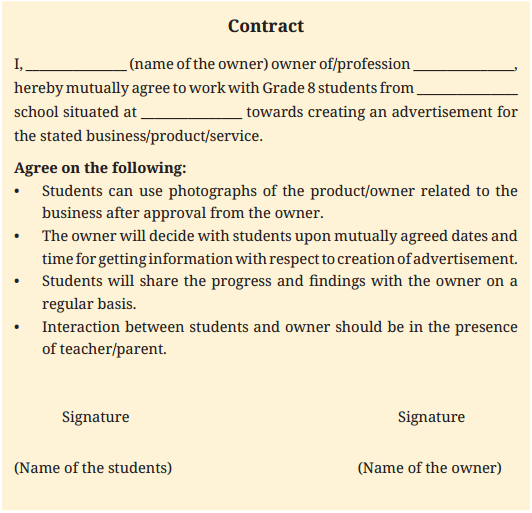
If they agree, write a simple contract. Both the owner and all group members must sign. The contract states that students can use product photographs, will share progress regularly, and interactions will happen in the presence of a te acheror parent.
______________________________________________
Question 1.
What small business did your group select? Give 2-3 reasons why y ou chose this business.
Answer:
Our group selected a local bakery as our small business. The reasons are as follows
(i) It is well-known and popular in our neighbourhood, so it has many customers.
(ii) It offers fresh and unique products that attract people.
(iii) It was easily accessible, which helped us interact with the owner and observe the business closely.
Question 2.
Why is it important to sign a contract with the business owner before starting?
Answer:
It is important to sign a contract to ensure clear understanding and agreement between students and the owner. It gives permission to use information and photos, ensures regular communication, and maintains safety by involving a teacher or parent.
Question 3.
Why is it important to identify a local business before creating an advertisement?
Answer:
Identifying a local business helps students understand the real needs of a client. It allows them to create an advertisement that matches the business product or service.
It also gives practical experience of working with real people and understanding how advertisements are designed for specific purposes.
Question 4.
What is the purpose of making a contract with the business owner?
Answer:
The purpose of making a contract with the business owner is it ensures clear understanding between students and the business owner. It mentions rules, permissions, and responsibilities.
It also confirms that students can use photos and share ideas safely. This helps avoid confusion and builds trust while working together on the advertisement project.
Question 5.
Why should students interact with the business owner in the presence of a teacher or parent?
Answer:
Students should interact with the business owner in the presence of a teacher or parent for safety and guidance. It ensures proper communication and respectful behaviour.
Adults can also help if any problem arises and make sure the project is done correctly and responsibly.
Activity 5: Understanding the small business
Purpose
This activity will help students to learn in depth about the selected small business including its products, unique features, target audience and background story to design an effective advertisement
Pre-Planning / Preparation
- Prepare your interview questions in advance. Use the product/service and target audience questions given in your textbook (pages 153-154).
- Always visit with a teacher or parent. Greet the owner respectfully. Introduce all group members before beginning.
- Carry a notebook to record answers. Take photographs only after getting the owner’s permission.
Product/Service Related Questions to Ask the Business Owner
1. What is the nature of the products/services you are offering?
2. Since how long have you been doing this work?
3. What is special about your small business or its product/ service? What makes it unique?
(a) Is it the price that makes it unique?
(b) Is it the materials you use? …
(c) Does the product last longer than other products from other shops?
(d) How does it compare to products/services offered by others?
(e) Does the owner provide delivery?
(f) Does the environment of the shop or office (e.g., cleanliness) make it different from others?
(g) Do you offer after sales service?
(h) Any other?
4. Which is the most selling product/service?
5. What is the price range of the product/service?
Customer (target audience) Profile-related Questions
1. Who usually buys this product/avails of the service? Specify the following
(a) Age
(b) Location (distance from the shop/business)
(c) What are their areas of work?
(d) Have they ever given feedback on the product/service? If yes, what improvements have you made?
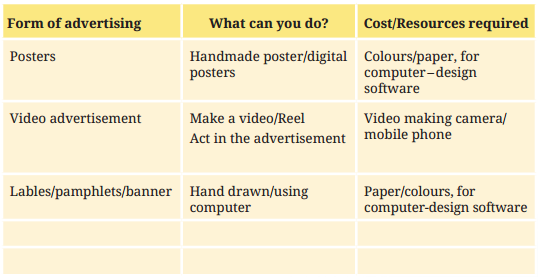
Based on the above, decide the form of advertisement. Use the examples in Table, make your own choices.
Factors Affecting Decision on the Form of Advertisement
Question 1.
What is the ‘Unique Selling Point’ (USP) of the business you selected? Why is it important to identify this before making an advertisement?
Answer:
The Unique Selling Point (USP) of our selected bakery is that it offers fresh, homemade products made with traditional recipes at affordable prices.
It is important to identify USP before making an advertisement because of the following reasons
- It helps highlight what makes the business different from others.
- It creates a clear and focused message.
- It makes the advertisement more effective and attractive to customers.
Question 2.
Why is it important to know the target audience before designing an advertisement?
Answer:
It is important to know the target audience before designing an advertisement because of the following reasons
- It helps choose the right language and tone for better understanding.
- It helps select suitable visuals and design to attract attention.
- It ensures the advertisement reaches the right people.
- It makes the advertisement more relevant, effective and meaningful for customers.
Question 3.
What type of product or service does the selected business offer?
Answer:
The selected business offers products or services such as food items, clothing, handmade goods, or daily-use items depending on the type of business chosen by the group.
Question 4.
Which product or service is the most popular in the business and why?
Answer:
The most popular product or service is the one that is frequently purchased by customers because of its good quality, reasonable price, and high demand in the local area.
Question 5.
Which form of advertisement did you choose for the business and what resources are required for it?
Answer:
We chose a poster (or video advertisement) as the form of advertisement.
It requires materials such as paper, colours, or a mobile phone and simple design tools to create the advertisement.
Activity 6: Designing the advertisement
Purpose
This activity will help students to design a complete advertisement for the selected small business by using all key elements such as logo, tagline, visuals, emotional connect, jingle and call to action in one or more mediums.
Pre-Planning / Preparation
- Review all information collected from the business owner in Activity 5.
- Discuss with your group
- What is the key message?
- Who is the audience?
- Which medium will you use?
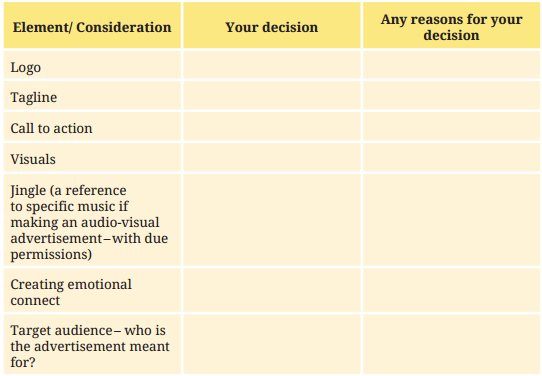
- Fill in Table (design decisions table) before starting to make the advertisement.
Record of Design Decisions for the Advertisement
Steps — Making a Poster Advertisement
The following questions steps will help you think through the advertisement.
1. What will be the title of the poster? Write a title, which will immediately grab the attention of the viewers.
______________________________________________
2. What will be the visual elements in the poster? List the visuals that would support the message.
______________________________________________
3. If you are using photographs, where wilt you get them from? Do you need to attribute them to someone?
______________________________________________
4. How will you establish an emotional connect?
______________________________________________
5. What will be the colours and design elements in your poster? Think how you can make your poster eye-catching by adding relevant colour and design elements.
______________________________________________
6. Considering the above criteria, sketch the layout of the poster in the space below.
______________________________________________
Steps – Making Digital Advertisements
- Hand-made posters require drawing and colouring manually, which takes more time and effort.
- Digital posters are quicker to create, edit and improve using tools like MS PowerPoint or Canva.
Steps – Making Animated Advertisement
The following questions steps will help you think through the advertisement.
1. Music and Sound
What background music or sound effects will you include to make your advertisement appealing?
______________________________________________
2. Scriptwriting
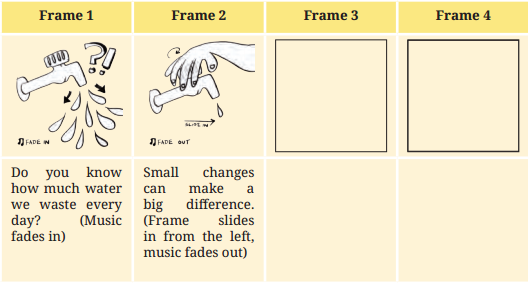
Write the dialogue, voiceover, or narration for your advertisement. If there is no dialogue, explain what will happen in each part. (For example, “Do you know we waste gallons of water daily? Imagine the impact on our future.”)
______________________________________________
3. Storyboard
Draw a rough sketch of the keyframes of your advertisement in Table. Note the action or text that will appear in each frame. Some examples are indicated in Table; these are simply examples – please choose your own theme.

4. Design and animation
(a) Which elements will you use?
- Text
- Images/Illustrations
- Backgrounds
- Animations
- Jingles
- Music/Sound effects
- Any other element ______________________________________________
(b) What type of animation will you apply to the text or images? (e.g., fade in, zoom, slide)
(c) Will you use the animation to develop an emotional connect? If yes, how?
Record key frames of an advertisement
Question 1.
What medium did your group choose for the advertisement — poster, video or pamphlet? Give two reasons for your choice.
Answer:
I have chosen a poster advertisement because of the following reasons
(i) It is simple and easy to design using basic materials.
(ii) It is cost-effective and can be easily displayed in local areas to reach many people quickly and effectively.
Question 2.
What is a storyboard and why is it needed before making a video advertisement?
Answer:
A storyboard is a rough visual plan that shows the key scenes of a video advertisement in sequence. It includes drawings and notes about action, text and sound.
It is needed because it helps plan the advertisement clearly, saves time during filming, and ensures all ideas are organised before creating the final video.
Question 3.
What key message did your group decide to communicate through the advertisement?
Answer:
Our group decided to communicate the key message by highlighting the main benefits and unique features of the product or service to attract customers and create interest in the business.
Question 4.
Which elements (logo, visuals, jingle, etc.) did you include in your advertisement and why?
Answer:
We included elements such as logo, tagline, visuals, and call to action because these make the advertisement attractive, easy to understand, and help people remember the product or service.
Question 5.
How did you create an emotional connection in your advertisement?
Answer:
We created an emotional connection by using relatable situations, appealing visuals, and simple messages that connect with people’s needs, feelings, and daily life experiences.
Activity 7: Review
Purpose
This activity will help students review their advertisement for creativity, clarity and visual appeal and ethics and understand the importance of feedback from others especially the business owner.
Pre-Planning
- Keep the completed advertisement ready in its final or near final form.
- Review the criterion (creativity, clarity, visual appeal and ethics) beforehand.
- Be ready to give and receive constructive feedback within the group.
- Arrange a suitable time to present the advertisement to the business owner.
Review Criteria
- Creativity Is the advertisement unique, original and engaging?
- Clarity of Message Is the tagline and call to action easy to understand? Does it clearly communicate the product’s benefits?
- Visual Appeal Are the visuals attractive and aligned with the theme?
- Ethical Standards Is the advertisement truthful? Does it avoid stereotypes and false claims?
Steps to Follow
- Share the advertisement within the group first and give each other feedback based on the review criteria above.
- Make improvements based on the feedback before showing it to the business owner.
- Present the final advertisement to the business owner.
- Ask the owner, if they “Would use this advertisement for their business? If yes, why? If not, why not?”
- Record the owner’s response in your notebook.
Question 1.
What feedback did the business owner give on your advertisement? Would they use it?
Answer:
The business owner appreciated our advertisement for its creativity, clear message and attractive design. They said the tagline and visuals were easy to understand and suitable for customers.
Yes, they would use it for their business because it clearly shows the product benefits and attracts attention effectively.
Question 2.
What did you learn from the review process? What changes did you make after feedback?
Answer:
I learnt that feedback helps improve the quality of an advertisement by making it more clear, attractive and effective.
I made the following changes in my advertisement after feedback
(i) Improved the tagline to make it clearer and more impactful.
(ii) Adjusted colours and visuals to make the design more attractive and readable.
(iii) Reorganised the layout to make the advertisement more neat, balanced and easy to understand.
Question 3.
Which review criterion (creativity, clarity, visual appeal, or ethics) was the strongest in your advertisement?
Answer:
The strongest criterion in our advertisement was visual appeal because the colours, images, and layout were attractive and clearly matched the theme of the product.
Question 4.
What suggestions did your group members give to improve the advertisement?
Answer:
My group members gave the following suggestions to improve the advertisement
- Make the tagline shorter and more catchy so that it is easier to remember.
- Improve the visuals by using brighter colours and clearer images to attract attention.
- Add a stronger call to action so that people know what to do after seeing the advertisement.
- Simplify the message so that it is easy for everyone to understand quickly.
Question 5.
Why is it important to review an advertisement before presenting it to the business owner?
Answer:
it is important to review an advertisement before presenting it to the business owner to correct mistakes, improve quality, and ensure the message is clear and effective.