Including Kaushal Bodh Class 8 Solutions Project 5 and Class 8 Vocational Education Chapter 5 Water Audit for Water Management Question Answer in your preparation can make learning more organized.
Class 8 Vocational Education Chapter 5 Question Answer
Kaushal Bodh Class 8 Chapter 5 Question Answer
What did I learn from others? [Page No. 133]
Identify what you learned during field trips, online and offline interactions with experts, family and friends, community members, and other sources.
Question 1.
Name any one thing that you found surprising where use of water is concerned.
Answer:
I found it surprising that a large amount of water is wasted due to leaking taps and careless use, and that even small leaks can waste many litres of water every day.
Question 2.
Write any three things you learnt that will help you save water in your life.
Answer:
The three things that help me to save water in my life are
- Fix leaking taps and pipes to prevent wastage.
- Reuse greyWater for gardening and cleaning.
- Use water carefully by turning off taps when not in use.
Think and Answer [Page No. 134]
Question 1.
Did you enjoy doing this project?
Answer:
I really enjoyed doing this project. It was very interesting to go out and collect real data from families in my neighbourhood.
The most exciting part was measuring the water flow rate from taps using a bucket and a stopwatch. I also enjoyed fixing a leaking tap with the help of my teacher.
This project made me realise how much water we waste every day without even noticing.
Question 2.
What did you like most, and what would you do differently next time?
Answer:
I liked visiting families and asking them questions about their water use the most. It felt like being a real investigator!
Next time, I would survey more families to get better data. I would also try to set-up a simple greywater system at home to reuse water from washing vegetables for my garden.
Question 3.
Using a map, trace the path of the river closest to your locality. Look at the adjoining districts the river path passes through in your state. Identify those dependent on the river.
Which areas are drought-prone or have surplus rain? Are there any dams on the river? How do you think the river impacts people’s lives?
Answer:
The river closest to my locality is the Yamuna. It starts from the Yamunotri glacier in Uttarakhand and flows through Delhi, Uttar Pradesh and joins the Ganga at Prayagraj.
The upper regions like Uttarakhand receive heavy rainfall and the river has good water. But areas in the lower stretches, especially parts of Uttar Pradesh, face water shortage in summer.
There is the Tajewala Barrage dam (now Hathnikund Barrage) on the Yamuna in Haryana. It controls the water flow and supplies water to Delhi and surrounding areas.
The river is very important for people’s lives. Farmers use it to irrigate their fields. Cities use the river water for drinking after treatment. Many people also depend on the river for fishing.

Question 4.
Examples of jobs related to the work you did are environmental scientist, environmental engineer, industry professional, social worker, auditor, etc. What other jobs are related to the project? Look around, speak to people and write your answer.
Answer:
After doing this project, I think the following jobs are also related
(i) Plumber fixes leaking taps and water pipes, just like we learned in Activity 6.
(ii) Water supply officer manages how water is supplied to our locality. We even interviewed one during Activity 2.
(iii) Data analyst collects and analyses data like we did using spreadsheets.
(iv) NGO worker creates awareness in villages about water saving.
(v) Hydrogeologist studies groundwater levels and helps plan borewells.
(vi) Urban planner designs new cities keeping water needs in mind.
Water Audit for Water Management Class 8 Question Answer
Activity 1: Water measurement methods
Purpose
This activity will help students to understand how to measure water using common household utensils and calculate the water flow rate from taps. It also helps in estimating daily water usage and developing awareness about water conservation.
Pre-Planning / Preparation
- Bring a bucket, mug, glass, bottle and stopwatch (or mobile timer).
- Identify taps, showers, or pipes available at your home or school.
- Calculate the capacity and flow of any utensil or water tap.
- Calculate the capacity of big water tanks, calculate the volume then convert into litres.
- Search online ‘How to measure water flow rate at home’.
Observation Task
Record the Capacity/Water Flow for Each Utensil/Equipment
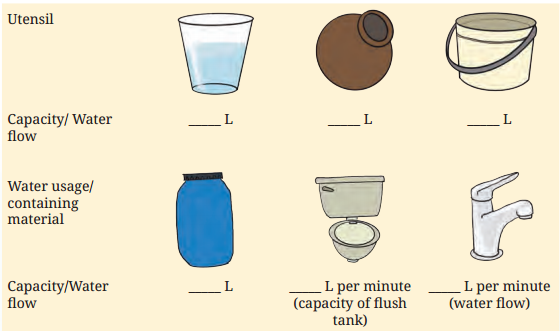
Question 1.
What is the water storage capacity of the water tank in your locality?
Answer:
The water storage capacity of water tank in my locality is about 5000 litres (5m)3. This was calculated by measuring its length, width and height then finding its volume.
Question 2.
How much water is supplied daily to your locality?
Answer:
From my locality about 400 people receives nearly 22,000 litres of water per day.
This is roughly 55 litres per person per day, which matches the Jal Jeevan Mission standard for rural areas.
The water comes from a nearby borewell and is stored in an overhead tank before being supplied through pipes.
Question 3.
How many people use this water?
Answer:
About 400 people use this water.
They use it daily for drinking, cooking, bathing and washing clothes, and each person receives about 55 litres per day.
Question 4.
How can you calculate the total amount of water used by a tap in one day?
Answer:
Measure the amount of water flowing from the tap in one minute. Multiply it by the total number of minutes the tap is used in a day. This gives the total water used.
Question 5.
Why is it important to measure the water flow rate of taps and showers?
Answer:
Measuring the water flow rate helps us know how much water is being used. It helps avoid wastage and encourages saving water for future use.
Kaushal Bodh Class 8 Water Audit for Water Management Question Answer
Activity 2: Interview with an offial of the water supply department
Purpose
This activity will help students to understand the water supply system of their locality by visiting the Gram Panchayat, Municipal Corporation or water supply office.
Pre-Planning and Steps
- Visit the Gram Panchayat, Municipal Corporation, or water supply office with your class.
- Prepare a list of questions before the visit.
- Record answers in your notebook. Draw a simple neighbourhood map showing water sources.
Observation
Questions to ask during the interview
1. What is the source of water for our locality?
____________________________________
2. How much water does each household receive per day? What is the amount of water allotted per day per person?
____________________________________
3. Do you face any challenge in supplying sufficient water to all? What are those challenges?
____________________________________
4. How does rainwater contribute to water availability in your area? What efforts have been made to store rainwater for later use?
____________________________________
5. Are there any seasonal changes in water availability in the locality?
____________________________________
6. Any suggestions for water management by individuals?
____________________________________
7. Create a simple neighborhood map showing water sources, like wells, tanks or water delivery points. Ask the official for help if needed.

Question 1.
How is water quality checked before supplying it to households?
Answer:
Water quality is checked through regular testing at treatment plants and laboratories. Officials test for impurities, harmful bacteria, and chemical levels to ensure safety.
Methods like filtration, chlorination, and purification are used to make water suitable for drinking. Regular monitoring helps prevent waterborne diseases and ensures that clean and safe water reaches every household in the locality.
Question 2.
What steps are taken if there is a shortage of water supply in the area?
Answer:
The following steps are taken if there is a shortage of water supply in the area
- Water is supplied at fixed times to ensure equal distribution.
- Water tankers are arranged to provide additional supply.
- Alternative sources like borewells or wells are used.
- People are advised to reduce wastage and use water carefully.
Question 3.
How are water pipelines maintained to prevent leakage or wastage?
Answer:
Water pipelines are maintained to prevent leakage or wastage through the following measures
- Regular inspection and monitoring to detect leaks early.
- Immediate repair or replacement of damaged pipes and joints.
- Use of good quality materials and proper installation techniques.
- Periodic maintenance and cleaning to ensure smooth water flow.
Question 4.
How can people help in reducing water wastage in the locality?
Answer:
People can help reduce water wastage by fixing leaking taps, using water carefully, reusing greywater, avoiding unnecessary use, and spreading awareness about conservation. Simple habits at home and in the community can significantly save water.
Question 5.
What methods are used to ensure equal distribution of water to all areas?
Answer:
The following methods are used to ensure equal distribution of water to all areas
- Proper planning and scheduling of water supply so each area receives water at fixed times.
- Maintaining pipelines and using storage tanks to regulate pressure and ensure fair distribution to all households.
Activity 3: Estimating average consumption in a household
Purpose
This activity will help students to estimate the average water consumption per person per day by collecting data from families in the locality.
Pre-Planning / Preparation
- Collect data from a minimum of 10 families. Groups of 5 students can together cover 50 families.
- Record data in a notebook first; then enter it into a computer spreadsheet for analysis.
- Use spreadsheet formulae to analyse data and present it as graphs and pie charts.
- If no computer is available, use a notebook and calculator.
- All data must be converted and recorded in litres only.
- Average per person = Total water T Number of members (divide column G by column C in Excel).
- The accuracy of analysis depends on the integrity of primary data — it must be accurate, reliable and consistent.
Form to collect data on water usage from a family
| S.No. | Particulars | tails (to be filled by …………) |
| l. | Name of the family | |
| 2. | Number of people in the family | |
| 3. | How much water is stored in the house in a day (e.g., one tank of 1,000 L capacity, one earthen pot of 5 L capacity, one copper vessel of 15 L)? | |
| 4. | How much water does the family consume per day for washing clothes (e.g., water used in a washing machine, number of buckets used)? | |
| 5. | How much water does the family consume per day for washing utensils (e.g., water flow of the tap and average time spent on washing utensils, buckets used)? | |
| 6. | How much water does the family consume for drinking and cooking (e.g., amount of water stored in bottles and average number of bottles used)? | |
| 7. | How much water does the family consume for bathing (e.g., buckets used the water flow of tap or shower and time used for bathing)? | |
| 8. | Do they face any water shortage? How do they manage in case of water shortage? | |
| 9. | Do they have any machines/appliance that consume water? How much water is consumed by each of these appliances (e.g., washing machine/RO filter)? Note: Not to be repeated if covered in questions related to washing clothes and drinking water. |
|
| 10. | Any other use of water (e.g., for washing vehicles, in the garden)? | |
| 11. | Do they have any other source of water (e.g., well/borewell/ purchased water)? | |
| 12. | What do they do with the water if the stored water is not consumed on the same day? Do they recycle it or throw it away? | |
| 13. | Do they receive a water bill? If yes, how much is it generally? | |
| 14. | Is there any other observation concerning water availability and usage? |
Steps (Data Calculation and Analysis)
- The family will provide estimates; calculate water usage using the capacity of buckets, mugs, bottles, etc.
- Measure or estimate water flow from taps, showers, and pipes, especially for gardening.
- If water is taken from an overhead tank, estimate usage based on daily habits (e.g., bathing, washing clothes).
- Tabulate the collected data in a notebook or spreadsheet.
- Categorise data based on activities like washing clothes, RO use, car washing, etc.
- Ensure data is accurate, reliable, and consistent for correct analysis.
- Use only numerical data for calculations; non-numerical data cannot be analysed.
Observation Task
Using formula in Excel to analyse data
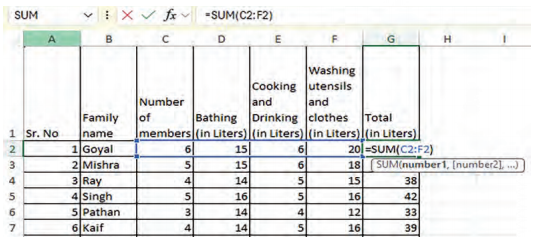
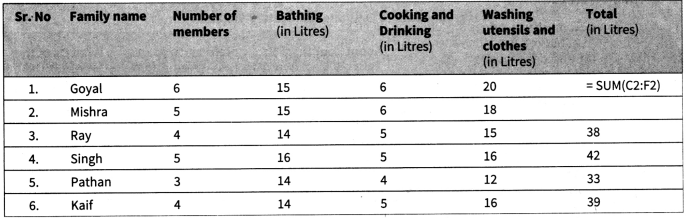
Question 1.
Find out the average consumption per person from your data.
Answer:
The average consumption per person is found by dividing the total water used by a family per day by the number of members in that family, and then taking the average of all families. In my survey of 10 families, the average water consumption came out to be about 95 litres per person per day.
Question 2.
Are there any families consuming more water than average? If yes, what is the reason?
Answer:
Yes, one family in my survey was using about 180 litres per person per day — much more than the average of 95 litres.
When I asked them the reason, I found out that they have a washing machine and also water a large garden every day.
They also said they leave the tap running while brushing their teeth. I politely suggested some water-saving tips like turning off the tap while brushing.
Question 3.
What are the main activities in a household that consume the most water?
Answer:
The main activities in a household that consume the most water are bathing, washing clothes, and washing utensils. Activities like cleaning, gardening, and vehicle washing also use a significant amount of water daily.
Question 4.
How does the number of family members affect total water consumption?
Answer:
The number of family members affects total water consumption in the following ways
- More members increase water use for daily activities like bathing, cooking, and cleaning.
- Larger families require more water for drinking and washing clothes.
- Increased usage of appliances leads to higher water consumption.
- More people can also lead to higher chances of water wastage if not managed properly.
Question 5.
What steps can families take to reduce their daily water usage?
Answer:
Families can take the following steps to reduce their daily water usage
- Fix leaking taps and pipes to prevent water loss.
- Use water carefully while bathing, washing, and cleaning.
- Reuse greywater for gardening and other purposes.
- Turn off taps when not in use and avoid unnecessary wastage.
Activity 4: Rainwater availability in your district/town/ village/ward (secondary data collection)
Purpose
This activity will help students to estimate the rainwater available in a geographical area using secondary data collected from reliable government sources.
Pre-Planning / Preparation
- Search for population, area, and rainfall data of your district from government websites.
- Use keywords ‘Rainfall + Year + district name’, ‘Population + district + census’, ‘NITI Aayog + water report’, ‘Ministry of Statistics + Government of India + Water’.
- Always note the year and source of the data for correct referencing.
Steps to Follow
- Find the population of your district/town/village from a government source.
- Find the area (in km2) of your district from government data.
- Find the annual rainfall (in mm) and convert to metres (divide by 1,000).
Recording data to estimate rainwater availability
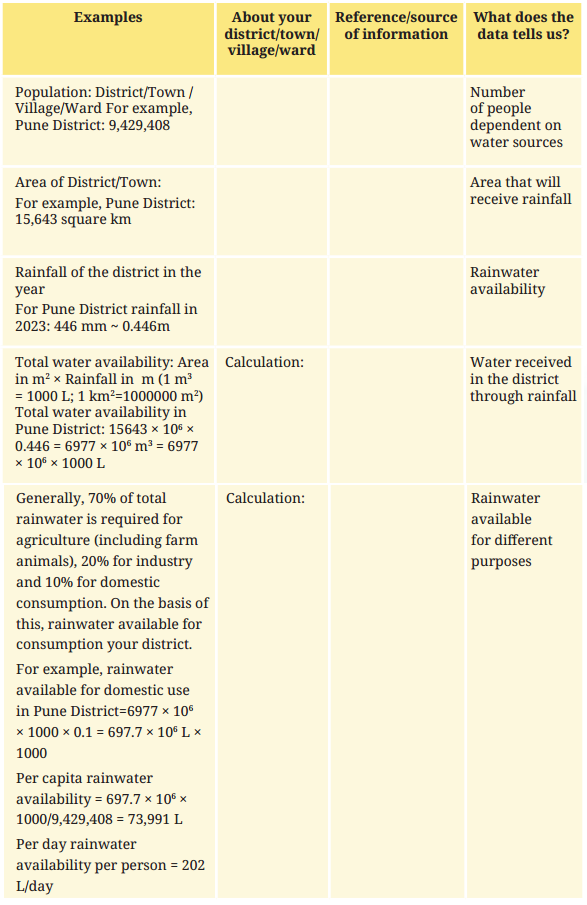
Question 1.
What is the total rainwater available in your district per year?
Answer:
The total rainwater available in my district per year is approximately 3,200 × 109 litres. This is calculated by using district area and annual rainfall, showing the total water received through rain in a year.
Question 2.
How much water is available per person per day in your district?
Answer:
The per person water availability in my district is approximately 584 litres per day. It is calculated by taking 10% of total rainwater for domestic use and dividing it by population and 365 days.
Question 3.
Why is it important to mention the year and source when using secondary data?
Answer:
It is important because data keeps changing every year. For example, the population of a district grows, and the rainfall is different each year.
If I use old data without mentioning the year, the reader will not know if the information is still correct. They also cannot check if it is true.
By writing the source (like ‘District Census 2011, Government of India’) and the year, I am showing that the information is from a trusted place and is not just made up by me.
Question 4.
How does rainfall variation affect water availability in a region?
Answer:
Rainfall variation affects water availability by increasing supply during high rainfall periods and causing shortages during low rainfall. Uneven distribution can lead to floods or droughts, impacting agriculture, drinking water supply, and overall water resources.
Question 5.
Why is rainwater important for agriculture and daily life?
Answer:
Rainwater is important for agriculture as it supports crop growth and soil moisture. It is essential for daily life as it replenishes water sources, provides drinking water, and helps maintain groundwater levels for regular use.
Activity 5: Compare and analyse the data
Purpose
This activity will help students to compare average water consumption (primary data) with water availability (secondary data) and prescribed usage norms.
Pre-Planning / Preparation
- Compare your primary data (average consumption from Activity 3) with secondary data (water available per person per day).
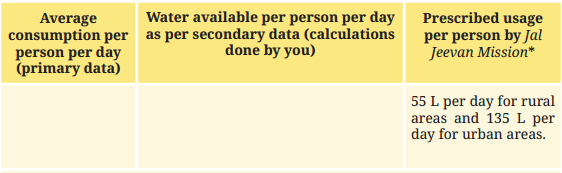
- Also compare with prescribed usage by Jal Jeevan Mission: 55 L/day for rural areas and 135 L/day for urban areas.
- Search online by following keywords
- Population + name of district + census
- Rainfall + year + name of district
- Water availability per person + name of district
- Ministry of Stastics +Govt, of India + Water
- NitiAayog +Water Report
Observation Task
Average Consumption vs. Prescribed Consumption
Question 1.
Is the average consumption in your locality more or less than the prescribed usage by Jal Jeevan Mission?
Answer:
The Jal Jeevan Mission says that each person in a rural area should get 55 litres per day, and in an urban area, 135 litres per day.
From my survey (Activity 3), I found that the average consumption in my locality is about 95 litres per person per day.
Since my locality is rural, 95 litres is more than the prescribed 55 litres. This means people in my area are using more water than needed. This is a sign that we should try to save water.
Question 2.
Is the water being consumed more or less than the water available per person per day in your district?
Answer:
The water being consumed is much less than the water available per person per day in my district. The average consumption is about 95 litres per day, while the theoretical availability is about 584 litres per person per day.
Question 3.
List any two ways to increase water availability in your locality.
Answer:
The two ways to increase water availability in my locality are as follows
(i) Rainwater Harvesting: We can collect the rainwater from our school rooftop in a big tank and use it for gardening or toilet flushing. This way we save the rainwater instead of letting it flow into drains.
(ii) Fixing Leaking Taps: In our school survey, we found two dripping taps that together wasted about 60 litres per day. By fixing them, we immediately increased the effective water available to the school.
Question 4.
What can be done if water consumption is higher than availability?
Answer:
If water consumption is higher than availability, people should reduce usage, fix leakages, reuse water, and adopt conservation methods like rainwater harvesting. Awareness and proper management can help balance demand and supply.
Question 5.
Why is it important to follow prescribed water usage norms?
Answer:
It is important to follow prescribed water usage norms because of the following reasons
- It helps ensure fair distribution of water to all people.
- It prevents overuse and wastage of limited water resources.
- It supports sustainable use of water for future needs.
- It helps maintain balance between water availability and consumption.
Activity 6: Identify wastage points and amount of wastewater
Purpose
This activity will help students to inspect and record areas where water is wasted, and take steps to fix the problem.
Pre-Planning/Preparation
- Carry a bucket, stopwatch (or mobile timer) and notebook.
- Inspect taps, pipelines and overhead tanks in school or at home.
- Look for dripping taps, wet patches under pipes, overflowing tanks.
- Identify wastage points — dripping taps, leaking pipes, overflowing tanks.
- Place a bucket under the wastage point and start the stopwatch.
- Stop the stopwatch when the wastage ends (or after a fixed time like 1 minute).
Measure the collected water; calculate the volume using
| Volume = Flow rate × Time |
- Record the location and type of problem in your notebook.
- Reduce Water Use Install aerators or flow caps on taps, or simply open the tap partially to restrict flow.
Fix a Leaking Tap
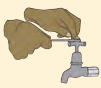
Step 1. Using a spanner, take of the tap’s cover to remove the handle. You will probably fid this under the hot or cold sign.

Step 2. Undo the screw and remove the handle. If the tap has a metal cover, unscrew it by hand, or use a wrench or tap spanner.
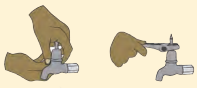
Step 3. Unscrew the tap bonnet, and completely remove the headgear. You should see a large body washer, o-ring and jumper valve. The jumper valve should fall out.
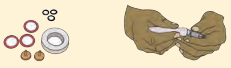
Step 4. Replace the body washer, the o-ring and the jumper valve with new parts. Apply a tap lubricant to the spindle and valve for better sealing and smoother tap operation.
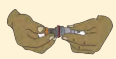
Step 5. Refit the bonnet and spindle. Be careful not to over-tighten the nuts.

Step 6. Put the tap back together, turn it off and turn the water back on. Now, check the tap to make sure it is no longer leaking. Now, you can step back and admire the proper job done, knowing you are not wasting a drop.
Question 1.
List the wastage points you found. How much water is being wasted daily (estimated in litres)?
Answer:
During our inspection, we found the following wastage points in our school
(i) One dripping tap near the drinking water area – we collected 0.5 litres in 10 minutes. So daily wastage = 0.5 × 6 × 24 = 72 litres per day.
(ii) One leaking pipe joint below the washroom sink – collected about 1 litre in 10 minutes. Daily wastage = 1 × 6 × 24 = 144 litres per day.
Total estimated daily wastage = 72 + 144 = 216 litres per day. This is a huge amount just from two leaks.
Question 2.
What steps did you take to fix the wastage? What was the result?
Answer:
To fix the wastage followed the following steps
- Then we removed the tap handle using a spanner, unscrewed the bonnet, and replaced the old body washer and O-ring with new ones.
- We also applied a little tap lubricant and put everything back.
- After turning the water back on, the tap stopped dripping completely.
- For the leaking pipe, we called the school plumber who tightened the joint using plumber tape.
Result We saved around 216 litres per day — that is more than 6,500 litres every month just from two simple repairs.
Question 3.
How does an aerator or flow cap help reduce water consumption?
Answer:
An aerator is a small mesh device that fits at the end of a tap. It mixes air into the water, so the water comes out as many small streams instead of one big stream. This uses much less water but still feels the same when washing hands.
A flow cap is placed inside the tap to limit how much water can come out at one time.
Without these devices, a tap can flow at 12 litres per minute. With an aerator, it flows at only 4-6 litres per minute. So we can save more than 50% of the water without any discomfort.
Question 4.
Why is it important to fix water leaks immediately?
Answer:
It is important to fix water leaks immediately because it prevents wastage of water, reduces water bills, and avoids damage to pipes and surroundings. It also helps conserve water for future use.
Question 5.
How can regular inspection help in reducing water wastage?
Answer:
Regular inspection helps in identifying leaks, dripping taps, or damaged pipes early. Timely repairs prevent water loss, ensure efficient water use, and help maintain proper functioning of the water supply system.
Activity 7: Reusing water
Purpose
This activity will help students understand how wastewater (greywater) can be reused after simple treatment and encourage the use of water conservation methods in daily life.
Pre-Planning / Preparation
- Identify sources of greywater at home or school (kitchen, bathroom, washing area).
- Collect materials like a bucket, container, pipes, and simple filtering materials if needed.
- Observe areas where wastewater is generated and can be reused.
- Learn about simple greywater recycling methods like kitchen water reuse or reed bed systems.
- Search online using keywords: ‘DIY + grey water system’, ‘Grey water system treatment + design’
Observation Task
- Identify and record different sources of greywater in your home or school.
- Observe how wastewater is currently disposed of or reused.
- Reuse water from washing vegetables or cooking for watering plants (ensure it is not too soapy).
- Study or visit a greywater recycling system such as a reed bed system.
- Note how sedimentation tanks and plant roots help in filtering wastewater.
- Record your observations on how greywater reuse can reduce water wastage.
Question 1.
What initiative have you taken to reduce water usage?
Answer:
At home, I started keeping a bucket near the kitchen sink to collect the water used for washing vegetables. Earlier this water used to go straight into the drain.
Now I use this collected water to water the plants on Our balcony every evening. My mother also joined me in this activity.
At school, I put up a small handwritten poster near the water taps saying ‘Please turn off the tap tightly after use.’
Question 2.
Write down details of the activity you carried out.
Answer:
The details of the activity that I’ve carried out are as follows
- I set-up a simple vegetable washing water reuse system at home.
- I placed a large bucket (10 litre capacity) under the kitchen sink. Whenever, vegetables or fruits were washed, the water collected in the bucket.
- Every evening, I used this water to water 4 potted plants and the garden near my house.
- I observed that the plants grew well and did not need any extra watering. The water was not too soapy or dirty, so it was safe for the plants.
Question 3.
Amount of water saved per day (estimated).
Answer:
From my observations over one week, I estimated the following savings
- Vegetable washing water reused: about 8 litres per day.
- Turning off the tap while brushing teeth: saves about 6 litres per brushing × 2 times = 12 litres per day.
- Total water saved per day = 8 + 12 = about 20 litres per day.
- Over a month, this is 20 × 30 = 600 litres! I was very surprised to see how much water we can save with just small habits.
Question 4.
What are the benefits of reusing greywater in daily life?
Answer:
The benefits of reusing greywater In daily life are as follows
- It reduces water wastage by reusing used water.
- It saves fresh water for essential purposes like drinking.
- It helps lower water consumption and utility bills.
- It supports activities like gardening; ..cleaning, and groundwater recharge.
Question 5.
How does a reed bed system help in cleaning wastewater?
Answer:
A reed bed system helps in cleaning wastewater in the following ways
- It allows wastewater to settle in a sedimentation tank, removing solid particles.
- Water then passes through plant roots, which absorb pollutants and nutrients.
- Microorganisms in the soil break down organic waste.
- The filtered water becomes cleaner and suitable for reuse.
Activity 8: Estimate future water requirement
Purpose
This activity will help students to use primary and secondary data to predict future water needs in different scenarios.
Pre-Planning
- Revise your primary data from earlier activities.
- Refer to secondary data for water availability in your locality.
- Keep a notebook, calculator or spreadsheet ready for calculation.
- Understand the formulae for calculating total consumption.
- Ensure all data is recorded in litres for uniformity.
Scenario 1; Housing Society
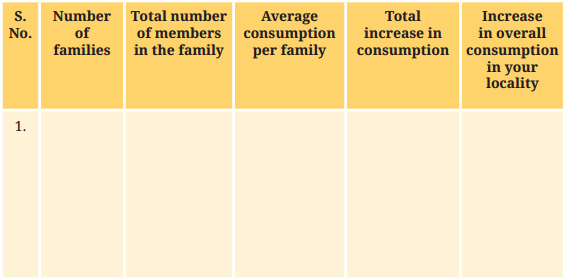
1. What is the increase in the demand for water if a housing society of 100 homes is constructed near your village? You can estimate four people per family.
Record of data on increased demand in scenario 1
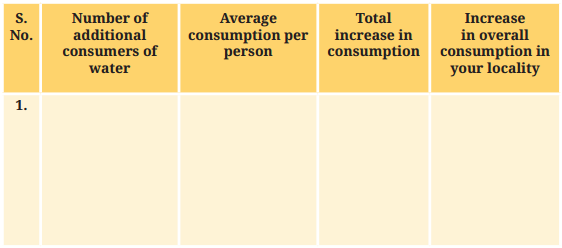
2. What will be their water requirement if a college hostel has one thousand students?
Record of data on increased demand in scenario 2
Question 1.
What is the total water requirement for the 100-home housing society?
Answer:
The total water requirement for the 100 home housing society is 38,000 Litres per day. It is calculated by taking 100 families with 4 members each 400 people and multiplying by the average consumption of 95 litres per person per day.
Question 2.
What is the total daily water requirement for the college hostel of 1,000 students?
Answer:
The total daily water requirement for the college hostel of 1000 students is 95,000 litres per day. It is calculated using the average consumption of 95 litres per person per day multiplied by 1000 students.
Question 3.
How does knowing future water demand help in planning water supply?
Answer:
Knowing future demand is very important. For example, if a new housing society of 400 people is planned, the water authority must arrange 38,000 extra litres per day before the people move in-not after.
If they plan in advance, they can build bigger storage tanks, lay new pipelines, or dig a new bore-well in time.
Without planning, there will be water shortages as soon as the new people arrive. This will cause problems for both the new and old residents.
So knowing the future demand helps everyone get enough water without any crisis.
Question 4.
Why is it important to estimate water needs before constructing new buildings?
Answer:
It is important to estimate water needs before constructing new buildings to ensure adequate water supply, avoid future shortages, plan proper storage systems, and support sustainable use of available water resources.
Question 5.
How can proper planning help in managing future water shortages?
Answer:
Proper planning helps manage water shortages by ensuring efficient use, promoting conservation methods like rainwater harvesting, reducing wastage, and balancing water demand with available resources for long-term sustainability.