Students can use Kaushal Bodh Class 7 Solutions Project 5 and Class 7 Vocational Education Chapter 5 Storytime with Puppets Question Answer to understand textbook activities more clearly.
Class 7 Vocational Education Chapter 5 Question Answer
Class 7 Kaushal Bodh Chapter 5 Question Answer
What did I learn from others? [Page No. 136]
Question 1.
You might have taken help and guidance from your community or friends. It could be for making puppets, sound and light show, for costumes or for setting up the stage. Please write down the three most important things you learnt.
Answer:
The three most important things I learnt are as follows
- I learnt how to make different types of puppets using simple and waste materials.
- I learnt how to plan and set up a stage with backdrop, props, sound, and lighting.
- I learnt teamwork, coordination, and how to perform a puppet show effectively.
Think and Answer [Page No. 137]
Question 1.
What did you enjoy doing most in this project?
Answer:
I enjoyed creating and designing the puppets the most because it allowed me to use my creativity to bring characters to life. Choosing colors, adding facial expressions, and planning how each puppet would move was exciting. I also enjoyed performing with the puppets during the show because seeing them interact on stage and hearing the audience laugh or respond made the whole experience fun and memorable.
Question 2.
What challenges did you face while writing the script, making the puppets, or putting on the show?
Answer:
I faced the following challenges while writing the script, making the puppets, or putting on the show
- Writing the script was challenging because I had to make the story simple, interesting and suitable for puppets.
- Making the puppets was difficult because shaping, painting, and attaching parts required precision and patience.
- Performing the show was tricky because coordinating puppet movements, props, lighting, and sound together needed teamwork and practice.
Question 3.
What would you do differently next time to make the show even better?
Answer:
Next time, I would plan more rehearsals to improve coordination and timing of the puppets. I would also use better lighting, sound effects, and more expressive puppet movements to make the performance more engaging. Additionally, I would spend extra time designing detailed costumes and props for the puppets to make the visuals more appealing. Collecting audience feedback earlier could also help adjust the script and performance for greater impact.
Question 4.
Compare your puppet show with a film, TV show, cartoon or animation. What are the similarities and differences between them?
Answer:
My puppet show is similar to a film, TV show, cartoon or animation because all of them tell a story using characters, dialogues, actions, visuals and sound to engage the audience.
Similarities
- All use a script or storyline to organise events.
- Characters show emotions and interact with each other.
Differences
- Puppet shows are performed live with handmade puppets, while films, TV shows and animations are recorded and edited digitally.
- Puppetry relies on audience imagination and live interaction, whereas animations use detailed graphics and special effects.
Question 5.
Identify a few jobs related to the work you did in this project. Examples: script writer, puppet maker, costume designer, voice actor, light and sound technician. Look around, speak to people, and write your answer.
Answer:
Jobs related to this work are as follows:
- Script Writer: Writes story, scenes and dialogues for puppet show.
- Puppet Maker: Creates puppets using cloth, paper, or waste materials.
- Costume Designer: Designs clothes and appearance for puppet characters.
- Light Technician: Manages lighting effects to enhance stage performance.
- Sound Technician: Adds music and sound effects for dramatic impact.
- Voice Artist: Gives voices to puppets with expressions and modulation.
- Stage Manager: Coordinates stage setup, props, and performance flow smoothly.

Storytime with Puppets Class 7 Question Answer
Activity 1: What makes stories work?
Purpose of the Activity
This activity helps you identify the key elements that make storytelling effective — so you can apply them to your own puppet show.
Pre-Activity Reflection (In Class)
- Think of the stories you have heard from various people, or seen on stage or in a film.
- Remember the story you most enjoyed — the one you wanted to hear again and again.
- Think about what made that story special.
Response Questions
Answer the following questions about your most memorable story
1. Who told the story?
____________________________________________________
2. How did they tell the story? Did they recite it, or keep changing their voice, did they use any props, modulate their voice, use actions and expressions as they told the story?
____________________________________________________
3. What did you like most about the way they told the story?
____________________________________________________
4. Discuss your responses with peers. Did you notice similar elements that make storytelling interesting? On the basis of discussion what would you do to make a story exciting for listeners.
____________________________________________________
Question 1.
Name three things a storyteller can do to hold the audience’s attention.
Answer:
The three things a storyteller can do to hold the audience’s attention are
- Voice modulation: Changing voice tone to show emotions clearly.
- Use of expressions: Showing feelings through face and body movements.
- Use of props: Using objects to make the story more interesting.
Question 2.
Is it possible to tell a story without words? Give an example.
Answer:
Yes, a story can be told without words. For example, a silent puppet show or mime performance can show emotions and actions without speaking.
Question 3.
Why do you think puppets are an especially powerful way to tell stories?
Answer:
Puppets are powerful because they make character:; come alive, show emotions visually, and help the audience connect with the story in an engaging and creative way.
Question 4.
How do different ways of telling a story make it more interesting for the audience?
Answer:
Different ways of telling a story make it more interesting by adding variety and excitement. When a storyteller changes voice, uses expressions, actions, and props, the audience can understand characters better.
These methods keep the listeners engaged and make the story more lively, clear, and enjoyable to watch or hear.
Question 5.
Why is it important for a storyteller to keep the audience engaged throughout the story?
Answer:
It is important for a storyteller to keep the audience engaged throughout the story because
- It helps the audience stay focused and not lose interest.
- It makes the story easier to understand and follow.
- It creates curiosity and excitement about what will happen next.
- It makes the storytelling more enjoyable and memorable.
Kaushal Bodh Class 7 Storytime with Puppets Question Answer
Activity 2: Watching a puppet show
Purpose of the Activity
This activity helps students watch and analyse a puppet show. It helps them understand how puppets, their movements, voices and stage elements bring a story to life, and how these techniques can make storytelling engaging for an audience.
Pre-Activity Preparation
- Find out if a puppet show is happening near your school. If not, you can invite a puppeteer to perform at school.
- If a live show isn’t possible, watch a puppet show video online using keywords: ‘puppet show + [your language].’
Observation Tasks
While watching the puppet show, carefully observe
- What types of puppets were used and what do you think they were made of?
- How did the puppeteer move the puppet — hands, strings or sticks?
- Did the puppeteer look at the puppet or at the audience?
- How were different voices used for different characters?
- What backdrops, props, sound effects or lighting were used?
- What was the most exciting or funny scene — and why?
Observation Record
Answer the following questions after watching the show
1. What was the name of the puppet show? Where did you watch it?
____________________________________________________
2. What kind of puppets were used (e.g., king, lion, bird)? What do you think the puppets were made of?
____________________________________________________
3. What was the puppeteer doing? How was he/she moving the puppet? Did the puppeteer interact with the audience or with puppet? If yes how?
____________________________________________________
4. What was the most interesting scene in the puppet show? Why did you find it interesting?
____________________________________________________
5. Were elements like sound, light, backdrop or anything else used to make the show interesting?
____________________________________________________
Question 1.
Name two ways a puppeteer can make a puppet come alive.
Answer:
A puppeteer can make a puppet show alive through the following ways
- A puppet come alive by moving it realistically with hands, strings or sticks.
- A puppet come alive by giving it different voices and expressions for each character.
Question 2.
What stage elements (like props, sound or lighting) make a puppet show more interesting?
Answer:
Props, backdrops, sound effects, music, and lighting make a puppet show more engaging and help set the mood for different scenes.
Question 3.
Why do you think puppets are an effective way to tell stories?
Answer:
Puppets are an effective way to tell stories because they visually represent characters, show emotions clearly and keep the audience, especially children, entertained while conveying the story creatively.
Question 4.
What things should you observe while watching a puppet show?
Answer:
The following things I should observed while watching a puppet show
- Types of puppets used and what they are made of.
- How the puppets are moved (hands, strings, or sticks).
- Use of different voices for different characters.
- Use of backdrops, props, sound effects, and lighting.
Question 5.
Why is it important to notice the puppeteer’s movements during the performance?
Answer:
It is important to notice the puppeteer’s movements during the performance because they help bring the puppets to life. The movements show how the story is being acted out, make the characters clear, and help the audience understand the emotions and actions in the story better.
Activity 3: Selecting/writing a story
Purpose of the Activity
This activity helps students select or create a story for a puppet show. It teaches them to identify characters, setting, plot and message to make the story engaging and easy to present.
Where Can You Find a Story?
- School Library: Read folktales, fables, historical stories or textbook stories.
- Other Subjects: A story or poem from language class or a historical event from social science.
- Family: Ask grandparents or community elders for local folk stories.
- Social Issues: Design a puppet show around themes like Swachh Bharat, polio vaccination or citizens’ rights and responsibilities.
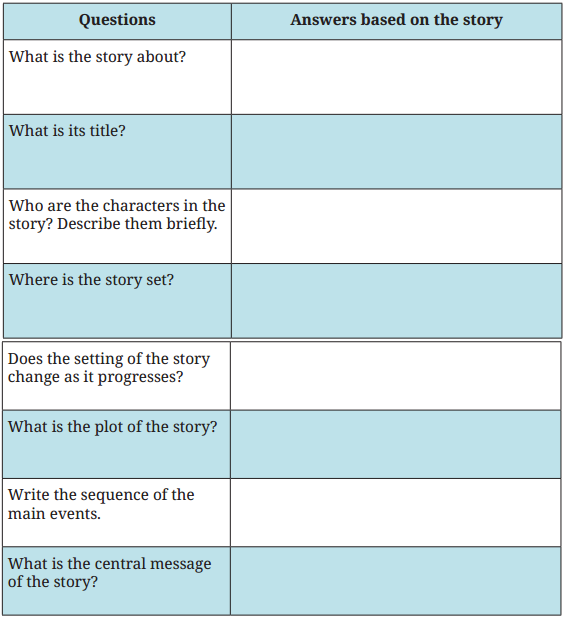
Key Elements of Your Selected Story
Question 1.
Which story did you select and why?
Answer:
I selected ‘The Fox and the Crow’ because it has clear characters, a simple plot and a moral lesson that can be easily shown through puppets.
Question 2.
What key elements of a story should you identify before creating a puppet show?
Answer:
Before creating a puppet show, I should identify the story’s characters, setting, main events (plot) and central message. This helps make the story clear and engaging for the audience.
Question 3.
Why is it important to choose a story with a clear message for a puppet show?
Answer:
It is important to choose a story with a clear message for a puppet show because it helps the audience understand the main idea easily. A clear message makes the story meaningful, keeps the performance focused, and helps convey a lesson or value effectively through the puppet show.
Question 4.
What role does the plot play in making a puppet show interesting?
Answer:
The plot plays the following role in making a puppet show interesting
- It gives a clear sequence of events for the story.
- It helps build curiosity and keeps the audience engaged.
- It connects all characters and scenes in a meaningful way.
- It makes the story easy to follow and understand.
Question 5.
How can family or elders help you in selecting a story?
Answer:
Family or elders can help you in selecting a story by sharing traditional folk tales and personal experiences. They can suggest meaningful stories with good morals, explain difficult parts of stories, and guide you in choosing a story that is interesting, suitable, and easy to present in a puppet show.
Activity 4: Writing a script for the puppet show
Purpose of the Activity
This activity helps students transform a story into a puppet show script. It teaches them to plan dialogues, character emotions, puppet movements, props, and special effects to bring the story to life on stage.
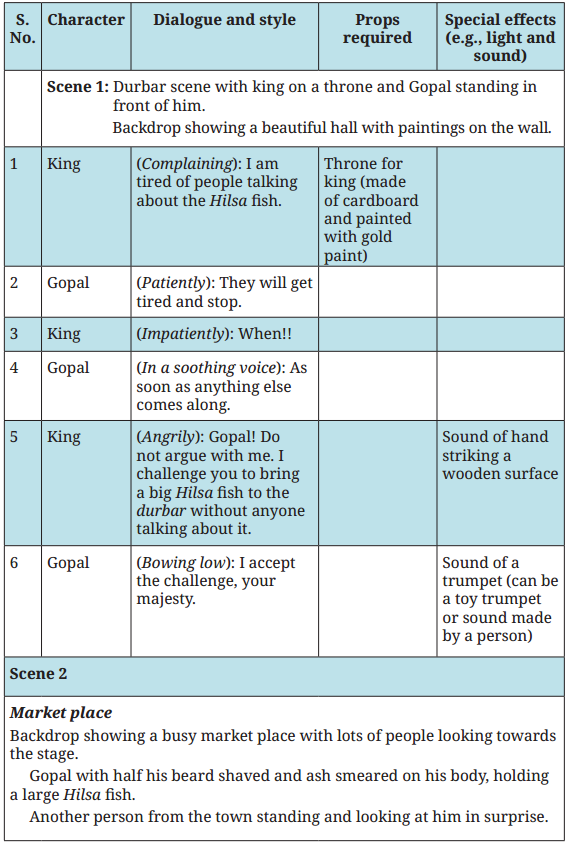
Script for Gopal and the Hilsa Fish
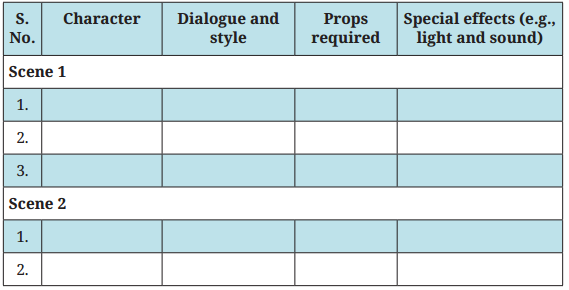
Template to write your own script
Question 1.
What details should you include for each scene in a puppet show script?
Answer:
Each scene should include the location and backdrop, characters present, their dialogues and how they speak, the props needed, any special effects like lights or sounds and notes on puppet movements.
Question 2.
Why is it important to show how puppets move and how characters speak in the script?
Answer:
Showing puppet movements and character speech ensures the story is performed clearly and expressively. It helps the puppeteer convey emotions, actions and the plot accurately to the audience.
Question 3.
How do props, backdrops and special effects help bring a puppet show to life?
Answer:
Props, backdrops, and effects create a visual and sensory experience, making the setting realistic, emphasising important moments, and keeping the audience engaged and entertained.
Question 4.
Why is it important to include dialogue and its style in a puppet show script?
Answer:
It is important to include dialogue and its style in a puppet show script because it helps show how each character should speak, such as happily, angrily, or sadly.
This makes the emotions clear, improves expression, and helps the puppeteer perform the story in a more engaging and realistic way.
Question 5.
How do puppet movement notes help the puppeteer during the performance?
Answer:
Puppet movement notes help the puppeteer during the performance in the following ways
- They guide how each puppet should be moved on stage.
- They help in show correct actions and positions for characters.
- They make the story clear by matching movements with dialogues.
- They ensure smooth and well-organised performance without confusion.
Activity 5: Character sketch
Purpose of the Activity
This activity helps students plan how their puppets will look and behave. It shows how to give each puppet a personality, expressions, and movements for the story.
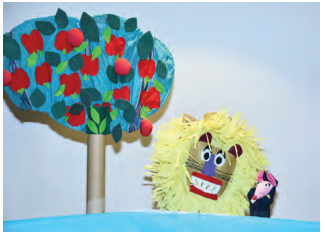
Figure : A scene from a story about a scared lion and his mouse friend. The lion is made of paper and the mouse is a sock puppet.
Things to Think About for Each Character
- Is the character tall or short? Thin or stout?
- Is the character cheerful or grumpy? Brave or timid? Outgoing or shy?
- ‘What kind of voice suits this character? (deep and commanding, high-pitched and playful, soft and gentle?)
- How does the character move? (jumping when excited, slouching when sad, walking proudly?)
- What kind of clothes or appearance does the character have?
Using Graph Paper to Draw Your Puppet
- To draw a large, accurate puppet, use tracing paper and graph paper.
- Draw the character on tracing paper, paste it on graph paper, then draw a proportional grid on chart paper.
- Copy each section of the figure onto the chart paper.
- This makes it easy to scale up a small drawing into a large puppet cutout.
These questions will help you plan how to make the Puppets
1. Which puppets will you make? Draw them in the space below.

2. What are their main characteristics?
____________________________________________________
____________________________________________________
Question 1.
What is a character sketch, and why is it important for making puppets?
Answer:
A character sketch is a detailed description of a character’s appearance, personality, voice, and movements.
It is important because it helps design puppets that clearly show the character’s traits and emotions on stage.
Question 2.
What details about a puppet should you imagine before creating it?
Answer:
Before creating a puppet, imagine its height, body shape, facial expressions, personality, voice, movements and clothing or accessories. These details help make the puppet realistic and expressive.
Question 3.
what are the main characteristics of each puppet?
Answer:
The main characteristics include physical traits (tall, short, thin, stout), personality (cheerful, grumpy, brave, timid), typical movements (jumping, slouching, walking proudly) and the type of voice it uses.
Question 4.
How does a character sketch help in deciding a puppet’s voice and movement?
Answer:
A character sketch helps in deciding a puppet’s voice and movement in the following ways
- It tells what type of voice suits the character (deep, soft, high-pitched, etc.).
- It shows the character’s personality, which guides how it should speak.
- It helps decide the puppet’s movements like walkingjumping, or slouching.
- It makes the actions match the character’s emotions and behaviour.
Question 5.
Why is it important to give each puppet a different personality in a puppet show?
Answer:
It is important to give each puppet a different personality in a puppet show because
- It helps the audience easily identify and understand each character.
- It makes the story more interesting and engaging.
- It shows clear differences between characters and their roles.
- It brings variety and makes the performance more lively.
Activity 6: Making puppets
Purpose of the Activity
This activity helps students make puppets using materials around them. They learn to design puppet heads, bodies and expressions. Students also plan how their puppets will move to bring the story to life.
Types of Puppets You Can Make
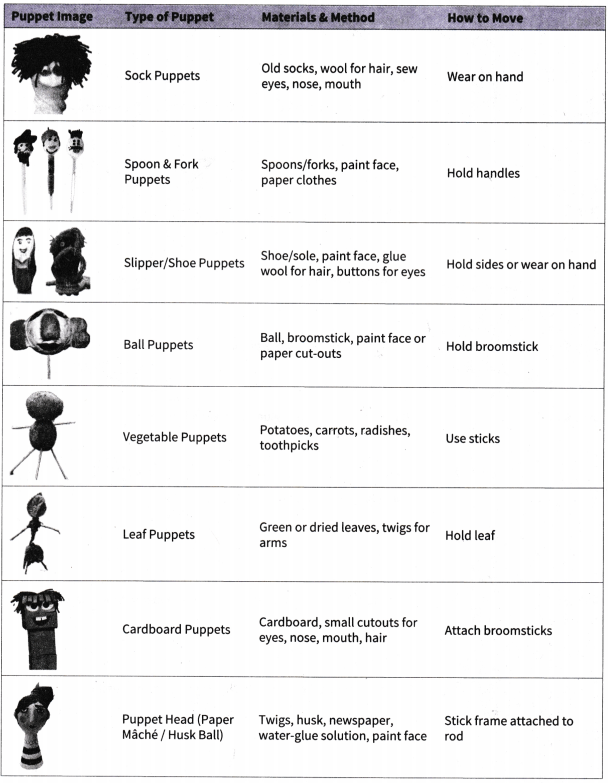
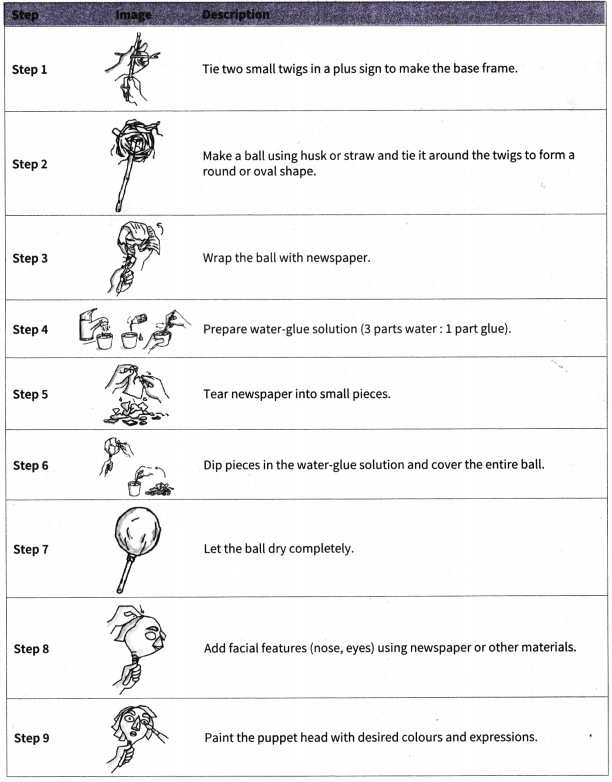
Process of Making Ball Puppet
Materials Required: Twigs, husks, newspapers, thread, cloth and water-glue solution.
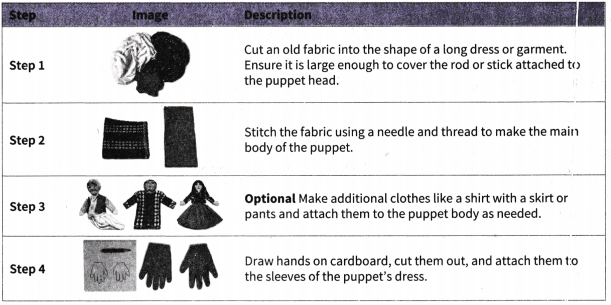
Procedure (Step-by-Step): Making a Puppet Body
Materials Required: Old fabric, thread, needle, cardboard, paper, glue, scissors.
Making Puppet Body
Puppet Movement Techniques
- Attach a string to the back of the neck or to the hands to make the puppet gesture.
- Make the puppet laugh by opening its jaw with your fingers.
- Make the puppet fly by holding the stick attached to its body and moving it through the air.
- Wear the puppet over your hand (for sock, shoe or glove puppets) for direct hand movement.
For more expressive characters, make more than one puppet for the same character — one smiling, one frowning, one surprised
Planning Your Puppets
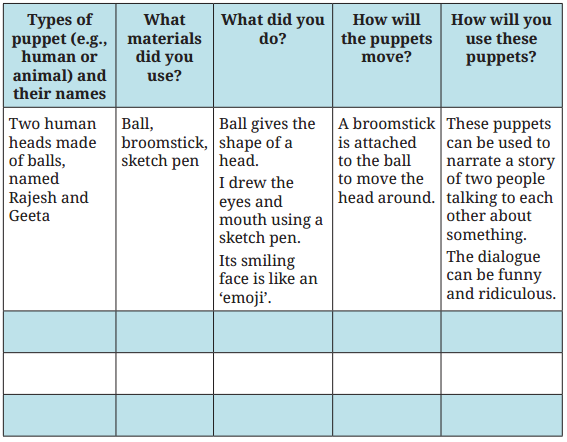
Question 1.
How will you make your puppet move?
Answer:
I will make the puppet move by using a broomstick attached to its body to control its gestures, or by attaching strings to the hands and neck. For sock or glove puppets, I will wear them on my hand to move them directly. I can also open the jaw with my fingers to show expressions.
Question 2.
Did you get the puppets right the first time, or did you need to make improvements? If yes, explain what you changed and why.
Answer:
I needed to make improvements. At first, the puppet’s head was too loose on the stick, so I tied it more securely and adjusted the facial features to make the expressions clearer. I also reshaped the body fabric to fit properly and added cardboard hands to make movements more realistic.
Question 3.
Which materials did you find easiest to use while making your puppet? Why?
Answer:
The easiest materials to use while making my puppet were cardboard and old cloth because they are easy to cut, shape, and attach.
They are also light in weight and easily available at home, which made the puppet-making process simple, quick, and less messy.
Question 4.
What type of puppet did you enjoy making the most and what made it interesting?
Answer:
I enjoyed making the ball puppet the most because it was fun to create the round head using husk and newspaper.
It was interesting to shape it step by step and then paint it with different expressions. It also allowed me to be creative while designing its face and features.
Question 5.
How will you make sure your puppet looks expressive (happy, sad, surprised)?
Answer:
I will make my puppet look expressive by carefully designing its facial features like eyes, eyebrows, and mouth. I will use colours and shapes to show emotions clearly, such as a smiling mouth for happiness or raised eyebrows for surprise. I can also change expressions using different puppets for different moods.
Activity 7: Puppet show
Purpose of the Activity
This activity helps students organise and perform a puppet show. It teaches them how to coordinate different elements such as puppets, stage, backdrop, props, voice, sound, music and lighting to present a story effectively to an audience.

Figure : A bedsheet covering a table is used as a stage. The bedsheet will hide the puppeteer, who can move the puppets using their hands or sticks attached to the puppets’ bodies.
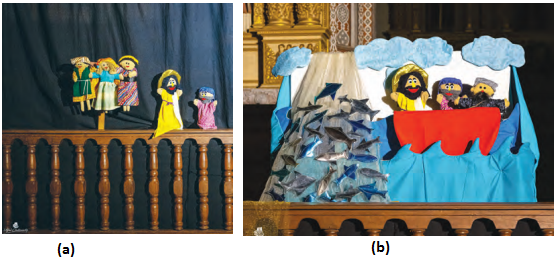
Figure : (a) A bedsheet can also be used as a curtain to cover the puppeteer. In case the puppeteer uses strings, the sheet can be tied to a string behind the table like a curtain.
(b) A frame used as a stage for a puppet show. The frame should ideally be a rectangle (just like watching a fim in the theatre). It can be made with different materials, but take care that the size of the ‘window’ is large enough for the puppets and their movement to be clearly visible.
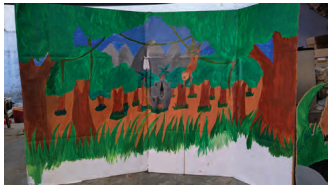
Figure : Background showing a jungle with animals
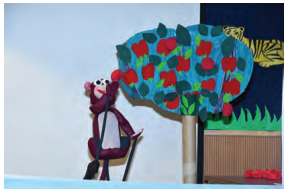
Figure: A tree used as a prop to show that a monkey is plucking an apple from the tree. The monkey’s hand is moved using the stick attached to it.

Figure : Making music
Pre-Planning
- Stage prepared using table and cloth for visibility.
- Backdrop designed to match different story scenes.
- Roles assigned for puppeteers, sound, light, and props.
- Puppets, props, and effects prepared before the show.
Observation Task
- Stage setup helped hide puppeteers and show puppets clearly.
- Backdrop changes made story scenes easy to understand.
- Sound and music made the puppet show more exciting.
- Lighting highlighted scenes and improved overall performance quality.
- Voice modulation showed different emotions of each character.
- Team coordination helped the show run smoothly.
Question 1.
Where will you do the puppet show?
Answer:
I will set up the stage using a table covered with a bedsheet. The puppeteers will hide underneath, and the puppets will appear above the table so the audience can see them clearly.
Question 2.
Where will you keep the puppets during the show?
Answer:
Unused puppets will be kept behind the stage or under the table, hidden from the audience, so they can be easily brought in when needed.
Question 3.
Briefly describe the backdrop(s) you have prepared
Answer:
The backdrop is painted on a bedsheet and shows the main setting of the story — a forest with trees, a market, and a house. It can be changed easily by sliding it on a string to match different scenes.
Question 4.
Briefly describe the props you have prepared
Answer:
I have prepared lightweight props like a cardboard throne, a paper fish, a small sword and a broomstick for the puppets to hold. These props help show the story clearly and are easy for the puppeteers to manage on stage.
Question 5.
How will you use voice modulation for different characters?
Answer:
I will use voice modulation for different characters to make them unique and clear. For example, I will use a deep voice for strong characters and a high-pitched voice for small or playful characters. I will also change my tone to show emotions tike happiness, fear, or excitement.
Activity 8: Putting up a puppet show
Purpose of th.R Activity
This activity helps students perform a complete puppet show, applying all their preparation—script, puppets, stage, props, music and lights—while learning teamwork, coordination, and how to engage an audience effectively.
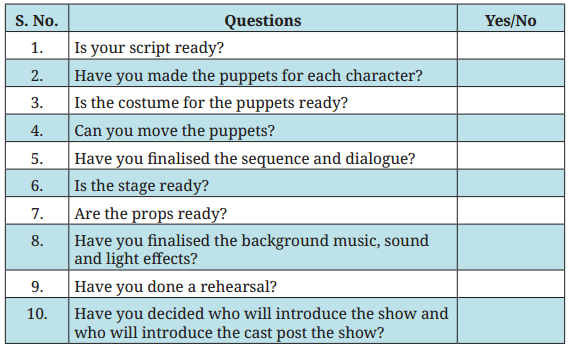
Pre-Show Checklist
Conducting Puppet Show
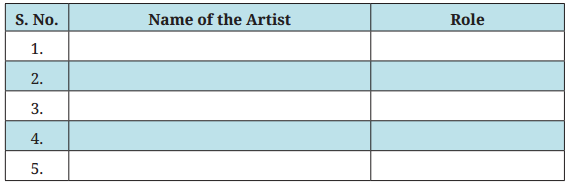
Organise the show during the Kaushal Mela. After the performance, the cast should take a bow to acknowledge the audience. A team member should introduce the performers, acknowledging the story’s author and all contributors.
Cast of the puppet show
Audience Feedback
After the show, get feedback from the audience. Ask them
1. Which part of the show did you like the most?
____________________________________________________
2. What are your suggestions to make the show better?
____________________________________________________
Question 1.
What should you check before starting a puppet show?
Answer:
Before starting, I will check that the script is ready, all puppets and costumes are prepared, the stage and props are set, dialogues and sequence are finalised, puppets move smoothly, and sound, music and lighting are working properly.
Question 2.
Why is it important to acknowledge the story’s author and your team after the show?
Answer:
It is important to acknowledge the story’s author and team members after the show because it shows respect for their work, encourages teamwork, and gives credit to everyone who contributed to making the show successful.
Question 3.
How can you gather feedback from the audience to improve your performance?
Answer:
I can gather feedback by asking the audience which parts they liked most and what suggestions they have for improvement. Listening carefully to their opinions helps make future performances better and more engaging
Question 4.
How does teamwork help in performing a successful puppet show?
Answer:
Teamwork helps in performing a successful puppet show in the following ways
- It ensures all roles like puppeteer, sound, and lights are well coordinated.
- It helps in smooth scene changes without confusion or delay.
- It improves communication among team members during the performance.
- It makes the show more organised, creative, and effective.
Question 5.
Why is rehearsal important before the final puppet show performance?
Answer:
Rehearsal is important before the final puppet show performance because it helps the team practice their roles and improve coordination.
It allows puppeteers to learn timing, movements, and dialogues properly. Rehearsal also helps in identifying and correcting mistakes, ensuring a smooth and confident final performance.