Students can use Kaushal Bodh Class 7 Solutions Project 1 and Class 7 Vocational Education Chapter 1 Plant Nursery Question Answer to understand textbook activities more clearly.
Class 7 Vocational Education Chapter 1 Question Answer
Class 7 Kaushal Bodh Chapter 1 Question Answer
What did I learn from others? [Page No. 23]
Question 1.
Write about three most useful things you learnt from the visit to the plant nursery/interaction with the expert.
Answer:
Three most useful things I learnt from the interaction with the expert are
- Different methods of plant propagation such as seeds, stem cuttings and other techniques used to grow new plants.
- The importance of providing proper conditions like water, sunlight, nutrients, temperature and humidity for healthy plant growth.
- The use of different tools, materials and management practices to maintain a plant nursery effectively.
Question 2.
Describe three things you learned while making the plant nursery with your peer?
Answer:
Three things I learned while making the plant nursery with my peers are
- Preparing soil beds, sowing seeds properly and using seedling trays for growing plants.
- Using nursery tools and materials safely and correctly during different activities.
- Working together in a team, planning tasks and taking regular care of plants for healthy growth.
Think and Answer [Page No. 24]
Question 1.
What did you enjoy doing?
Answer:
I enjoyed the seed germination test the most observing tiny seeds sprouting after 3-5 days inside the rolled germination paper was very interesting and exciting.
I also enjoyed setting up the shade-net and seeing the nursery take shape.
Question 2.
What were the challenges you faced?
Answer:
I faced several challenges during the activity such as ensuring that seeds germinated properly, protecting young plants from pests and extreme weather, maintaining the right amount of water and sunlight, and handling gardening tools safely.
Limited space and managing multiple plants at once also made the work challenging.
Question 3.
What will you do differently next time?
Answer:
Next time, I will plan the nursery layout more carefully, monitor water and sunlight more regularly, and use proper protective measures for plants. I will also keep better records of plant growth and germination rates, and try to manage time efficiently for all activities.
Question 4.
Identify few examples of jobs related to the work you did in this project. For example, gardener, botanist, forest offir, farmer, agriculture scientist. Look around, speak to people and write your answer.
Answer:
Jobs related to this work include nursery manager, horticulturist, gardener, landscape designer, agricultural extension worker and seed conservationist.
These professionals propagate plants, maintain nurseries, advise on plant care, and help produce healthy crops and ornamental plants for homes and farms.
Plant Nursery Class 7 Question Answer
Activity 1: Visit to a nearby plant nursery
Purpose of the Activity
This activity will help students to plan their own school nursery effectively. By visiting the nursery, they will observe how essential factors such as air, sunlight, water, humidity, temperature and nutrition are maintained for plants at different stages of growth.
During the Visit — Observation Tasks
- Types of plants grown and propagation methods used.
- How essential factors (air, sunlight, water, humidity, temperature, nutrition) are maintained.
- Nursery tools and equipment used.
- Management practices such as watering, pest control, nutrient supply.
- Protective measures like shade-nets and fencing.
Details of Visit (s) and Interaction with the Expert
1. Date of visit ____________________________________________
2. Nameof nursery visited : ____________________________________________
3. Type of nursery (e.g., vegetable, fruit, flowering plants, ornamental plants) ____________________________________________
4. Types of plants grown (e.g., vegetable, flowering, fruit, etc.) ____________________________________________
5. Nursery tools and equipment used ____________________________________________
6. Management practices, such as watering, pest control, application of nutrients, etc ____________________________________________
Information for developing the plant nursery
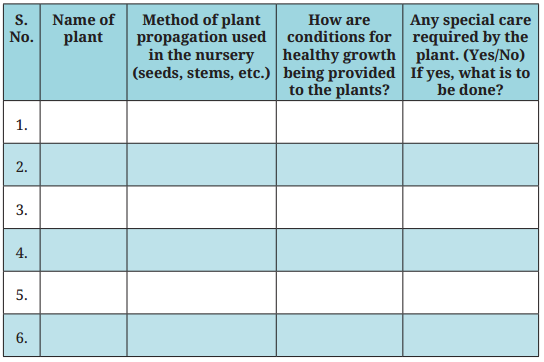
What do I have to do?
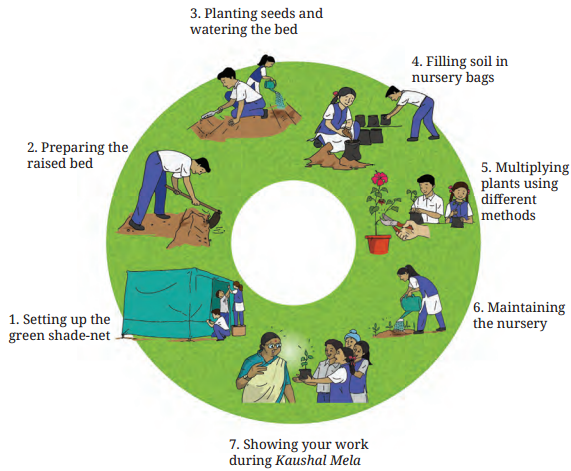
Plant seeds in beds and seedling trays, grow new plants using stem cuttings and prepare nursery bags for transplanting seedlings. These plants can be used within the school or shared with others.
Steps for Growing Plants in a Plant Nursery
Question 1.
Which plants are generally grown in the nursery?
Answer:
In the nursery, many kinds of plants are grown such as vegetable plants, fruit plants, flowering plants and ornamental plants. Common examples include tomato, brinjal, onion, rose and marigold. These plants are grown in nurseries because they require proper care during their early stages of growth.
Question 2.
What methods of plant propagation are used in the nursery?
Answer:
The methods of plant propagation used in the nursery are as follows
- Plants are grown from seeds, which is a common method used for vegetables and flowering plants.
- Plants are also propagated through stem cuttings and tubers, where peirts of the parent plant are used to grow new plants.
Question 3.
Are the same plants grown throughout the year or are there seasonal variations?
Answer:
The same plants are not grown throughout the year. There are seasonal variations as different plants grow better in winter while others grow well in summer or rainy seasons. Therefore, nurseries grow plants according to the suitable season and climate conditions.
Question 4.
How do you ensure that plants receive the right amount and duration of sunlight?
Answer:
The plants are placed in areas where they receive adequate sunlight. Shade nets or covers are used to control excessive sunlight. The plants are also arranged properly so that each plant receives enough light for healthy growth without being damaged by strong sunlight.

Question 5.
What methods do you use to provide shade for plants?
Answer:
Methods used to provide shade for plants are
- Green shade-nets are used, which are fixed on bamboo or wooden pole structures to reduce direct sunlight.
- In some cases, natural materials like tree branches or old cloth are also used to protect young plants from excessive heat.
Question 6.
What measures do you take to maintain ideal temperature for plants?
Answer:
Measures taken to maintain ideal temperature for plants are as follows
- Shade-nets are used to reduce excessive sunlight and protect plants from extreme heat.
- Proper watering and good air circulation are maintained to keep the soil moist and provide a suitable temperature for plant growth.
Question 7.
How do you make sure that plants receive the right amount of water?
Answer:
Plants are watered regularly using watering cans or irrigation systems. The soil moisture is checked frequently to avoid over-watering or dryness. Proper drainage in nursery beds ensures that extra water flows away and the roots do not get damaged.
Question 8.
How is optimal humidity maintained?
Answer:
Optimal humidity is maintained by regular watering and maintaining moist soil. Shade nets also help reduce evaporation and retain moisture. In some nurseries, water is sprinkled around the plants to increase moisture in the surrounding air.
Question 9.
Is there anything else that plants need for healthy growth?
Answer:
Yes, plants also require nutrients, protection from pests and proper soil conditions. Compost or manure is added to the soil to provide nutrients. Plants also need proper care, regular monitoring and protection from harmful insects or diseases.
Question 10.
How do you prevent damage to plants from external factors?
Answer:
Damage to plants is prevented by installing protective fencing around the nursery area. Pathways are created between plant beds to avoid stepping on plants. Shade nets and careful monitoring also protect plants from pests, animals and harsh weather conditions.
Question 11.
How are plants transported from the nursery to home gardens or farms?
Answer:
Plants are usually transported in nursery bags, pots or seedling trays. These containers protect the roots and soil during transportation. The plants are carefully handled and moved to gardens, homes or farms where they are transplanted into the soil.
Kaushal Bodh Class 7 Plant Nursery Question Answer
Activity 2: Planning and laying out plant nursery
Purpose of the Activity
This activity helps students to find a suitable place, calculate the area and design the layout of the nursery before any physical work begins. Planning is an important skill — farmers and gardeners always plan carefully before starting their work.
Figure: Planning the layout of the plant nursery
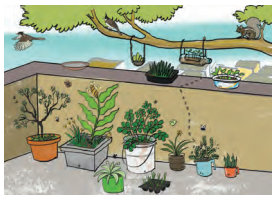
Figure : Different ways of utilising space for plants
Observation & Planning Tasks
- Inspect available space in school. The selected area should preferably get at least 2-3 hours of sunlight. A150-200 square feet area should be sufficient.
- If land is not available, utilise any unused space such as pathway or parking areas or develop the nursery in pots.
- Decide between raised beds, seedling trays, pots or a combination of these.
- Measure the selected area and calculate its total area.
- Draw a rough sketch of the nursery showing beds, pathways, water source, shade-net position.
- Select suitable plants according to the season and local environmental conditions
Draw a layout or sketch of the nursery with dimensions (length, width). Show as many details as you can — pathways, source of water, layout of beds and so on.

Question 1.
What is the available space for the nursery?
Answer:
The available space for the nursery is about 150-200 square feet. This area is sufficient to grow different types of plants and arrange nursery beds, seedling trays and pathways. The space should also allow easy movement for watering, weeding and plant care.
Question 2.
What factors were considered while choosing the location?
Answer:
The location was chosen based on factors such as availability of sunlight, proper drainage and easy access to water. The place should receive at least 2-3 hours of sunlight daily and should not allow waterlogging so that plants grow properly.
Question 3.
Why is planning important before setting up a plant nursery?
Answer:
Planning is important before setting up a plant nursery because it helps in selecting a suitable location, arranging proper space and ensuring availability of sunlight, water and nutrients.
It also helps in organising beds, pathways and resources efficiently, which leads to healthy plant growth and better management of the nursery.
Question 4.
What are the different methods used to set up a nursery in limited space?
Answer:
Different methods used to set up a nursery in limited space include using pots, seedling trays and nursery bags. Vertical gardening can also be used to save space.
Unused areas like pathways, terraces or balconies can be utilised to grow plants efficiently in a small area.
Question 5.
What details should be included in the layout of a plant nursery ?
Answer:
The following details should be included in the layout of a plant nursery
- Arrangement of plant beds, pathways, and water source for proper planning and easy movement.
- Position of shade-net, spacing between plants, and distribution of different nursery sections for healthy growth and management.
Activity 3: Preparing land and setting up shade-net
Purpose of the Activity
This activity helps students understand how to prepare the nursery land and install a shade-net to protect young plants from strong sunlight and heat. Proper land preparation improves seed germination and supports healthy growth of seedlings. It also teaches students the importance of protecting plants and preparing the nursery carefully before planting.
Procedure (Steps to Follow)
1. First remove unwanted plants, debris, rocks, etc., to clean the selected area.
2. Mark the nursery boundary with lime powder. Mark important components like pathways, plant beds and so on.
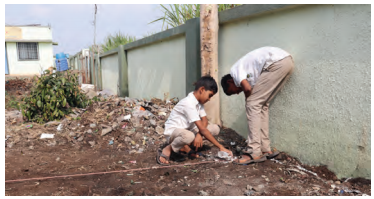
Figure: Marking the nursery boundary with lime powder
3. On the basis of the area and your design, fix green shade-net on the nursery using bamboo or wooden poles.
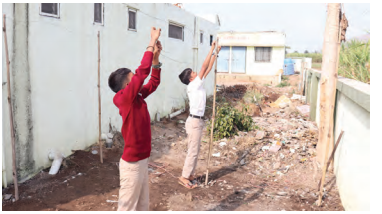
Figure: Fixing the poles at the boundary of the plant nursery
4. Choose a shade-net with appropriate shading percentage (50% or 75%), based on plant need. In case a green shade-net is not available, you can use tree branches or old cloth (sarees) to provide shade. If you are building the nursery on a terrace or concrete floor, then you can use metal tin boxes, or a plastic drum filled with sand to fix poles for the shade-net.
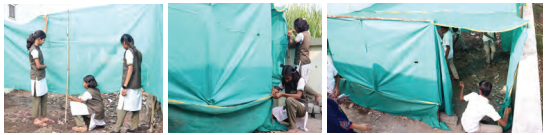
Figure: Installing the green shade-net
5. Use discarded pipes/rods, bamboo or fallen branches to make a protective fence for your plant nursery to
prevent entry of animals and human beings.
Question 1.
What kind of shade-net or clothes did you use to provide shade to the plants?
Answer:
A green shade-net was used to provide shade to the plants in the nursery. It reduces the intensity of sunlight and protects young plants from excessive heat. In case shade-nets are not available, old cloth or tree branches can also be used.
Question 2.
Which materials did you use to fix the shade-net?
Answer:
Bamboo poles or wooden poles were used to fix the shade-net around the nursery area. These poles were placed firmly into the ground to support the shade-net structure and create a protective environment for growing plants.
Question 3.
Why is it important to clean the selected area before setting up a nursery?
Answer:
It is important to clean the selected area before setting up a nursery because removing unwanted plants, rocks and debris helps prepare a clean and suitable space for planting. This improves soil quality, supports proper seed germination and ensures healthy growth of young plants without disturbance.
Question 4.
What is the purpose of marking the nursery boundary with lime powder?
Answer:
The purpose of marking the nursery boundary with lime powder is to clearly define the area of the nursery. It helps in planning the layout properly by marking plant beds, pathways and other sections, ensuring organised use of space and easy management of the nursery.
Question 5.
Why is a protective fence needed around a plant nursery?
Answer:
A protective fence is needed around a plant nursery to prevent damage from animals, insects and unauthorised entry of people. It helps protect young plants from being trampled or eaten and ensures their safe and healthy growth in a controlled environment.
Activity 4: Germinating seeds
Purpose of the Activity
This activity helps students understand that not all seeds germinate after sowing. By learning about the seed germination rate, students can estimate how many seeds will grow into plants and how many seeds are needed for planting in a nursery. It also helps them understand the importance of testing seeds before sowing.
Materials Required
- Cereal or pulses seeds
- Geometry scale and pencil
- Rubber bands and plastic tray
- Water
- Seed germination paper for germination test (45 cm × 28 cm) — or cardboard sheet if not available.
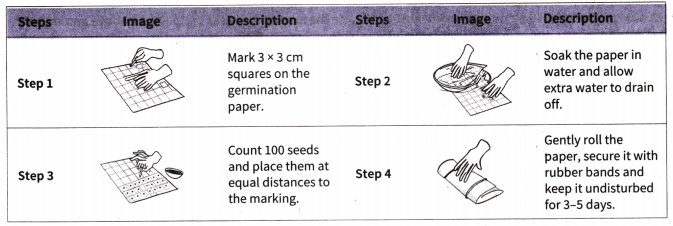
Step 5: Count the number of germinated seeds.
Step 6: Calculate germination percentage using the formula
Germination % = (Number of seeds germinated Total number of seeds placed / sown) × 100
Question 1.
Which seed did you use for conducting seed germination test?
Answer:
Seeds of pulses such as green gram (moong) or gram (chana) were used for the germination test. These seeds germinate quickly and help in easily observing the process of sprouting and calculating the germination rate.
Question 2.
How many seeds were used for the germination test?
Answer:
A total of 100 seeds were used for the germination test. Counting 100 seeds makes it easier to calculate the germination percentage and determine how many seeds will successfully grow into plants.
Question 3.
How many days did it take for the seeds to germinate?
Answer:
The seeds took about 3-5 days to germinate. During this period, the seeds absorbed water and began to sprout. Small roots and shoots started emerging, showing the beginning of plant growth.
Question 4.
How many seeds germinated?
Answer:
Out of the 100 seeds used in the test, about 85-90 seeds germinated successfully. The germinated seeds produced small sprouts which indicated healthy seed growth under suitable conditions of moisture and temperature.
Question 5.
What was the germination rate?
Answer:
If 90 seeds out of 100 germinated, the germination rate is 90%. Germination rate helps in estimating how many seeds should be planted in the nursery to obtain the required number of plants.
Activity 5: Raising plants in the nursery
Purpose of the Activity
This activity helps students learn how to raise plants in a nursery using seeds or cuttings. Planting materials contain reserve food such as carbohydrates, proteins, vitamins and other nutrients that support germination and early growth. It also helps students understand that more seeds should be sown than the number of plants required because not all seeds germinate successfully.
Method 1 Sowing Seeds on Raised-Bed Nursery
Nursery beds need to be free from weeds and stones. Raised-beds ensure that extra water drains out from the root zone and roots get air for respiration.
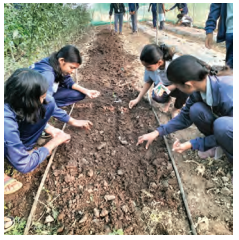
Figure : A raised-bed with protective fence
Step 1: Making raised beds for vegetable or flower seedlings
- Dig and loosen the soil.
- Remove bigger stones and pebbles.
- Mix compost and soil (in a ratio of about 40:60) and raise the marked bed area by 15-20 cm above ground level.
- The length of the bed could be 3-5 m and width 1-1.5 m.
- You can maintain a distance of 0.30-0.40 m between two beds for human movement required for watering, weeding and soon.
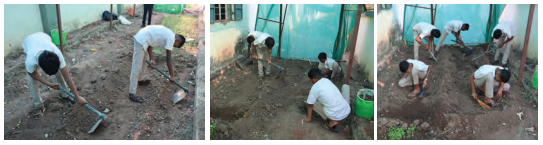
Figure: Students digging the soil and levelling for raised-bed preparation
Step 2: Sowing seeds on raised-beds in a nursery
- If seeds are very small, mix them with fine sand or soil. It will help in the easy sowing of seeds.
- Sow the seeds gently on the raised-bed. Put soil on the seeds and water them using a watering can to keep the soil moist.
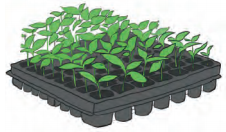
Figure: Seedling tray with saplings growing in them
Method 2: Sowing Seeds in Plug or Seedling Trays
- It is very useful if only limited space is available and also if we want to produce seedlings on a large scale.
- Use trays with appropriate sized cells — small cells for delicate seedlings while larger ones for bigger seedlings.
- Cocopeat is generally used in seedling trays as a growing media.
- In case seedling trays are not available, you can use coconut shells, old teacups or similar waste materials.
- For Sowing Seeds in a Seedling Tray
- Soak cocopeat in water — 1 kg cocopeat can absorb 5-8 litres of water.
- After all the water is soaked, fill the trays with the soaked cocopeat gently.
- Sow seeds (1-2 seeds per hole) and cover the tray with tarpaulin sheet or gunny bags.
- Keep the covered tray(s) aside for 2-3 days.
- Once the seeds start germinating, the tray should be placed in a shade-net nursery for further growth.
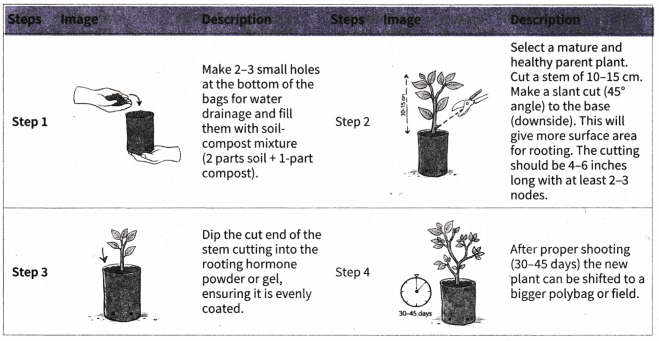
Method 3: Raising Plants Using Stem Cutting
- Plants can also be propagated using stem cuttings. You can use the stem of
- hardwood (e.g., rose, bougainvillea)
- semi-hardwood (e.g., dieffenbachia, croton)
- softwood (e.g., duranta, alternanthera) as planting material
Materials Nursery bags (5 × 4 inches) or used old milk-pouches (500 ml).
Raising plant using stem cutting
Question 1.
Which seeds did you sow in the raised-bed?
Answer:
Seeds of vegetable plants such as tomato, brinjal or marigold were sown in the raised-bed. Raised beds provide better drainage, aeration and soil conditions which help the seeds germinate properly and grow into healthy seedlings.
Question 2.
What have you done to provide optimal conditions for growth of seedlings?
Answer:
Optimal conditions were provided by preparing raised beds, mixing soil with compost, watering regularly and protecting plants with shade-nets. These measures ensured proper moisture, nutrients, air circulation and protection from strong sunlight.
Question 3.
Which method did you use for sowing the seeds?
Answer:
The seeds were sown using the raised-bed method and seedling tray method. Raised beds helped in proper drainage and aeration while seedling trays allowed seedlings to grow separately with sufficient space and nutrients.
Question 4.
What steps have you taken to provide optimal conditions for the growth of seedlings?
Answer:
The steps taken to provide optimal conditions for the growth of seedlings are as follows
- Seeds are sown in seedling trays or raised beds using suitable growing media like cocopeat or soil-compost mix.
- The soil is kept moist by regular watering using a watering can.
- Seedlings are protected from excessive sunlight and heat by using shade-nets.
- Proper air circulation and drainage are ensured for healthy root growth.
- Trays are kept in a controlled nursery environment after germination.
Question 5.
Which kind of plants did you use for propagation using cuttings?
Answer:
Plants such as rose and bougainvillea were used for propagation through stem cuttings. These plants grow easily from cuttings and develop new roots when placed in soil or nursery bags under suitable moisture and temperature conditions.
Question 6.
What have you done to ensure conditions for growth?
Answer:
To ensure proper conditions for the growth of seedlings, I have prepared suitable growing beds or seedling trays using a soil-compost mixture or cocopeat. I regularly watered the seeds to maintain the required moisture for germination.
After sowing, I protected the seedlings from excessive sunlight and heat by using a shade-net. I also ensured proper drainage and air circulation so that the roots could grow healthily.
Activity 6: Watching plants grow
Purpose of the Activity
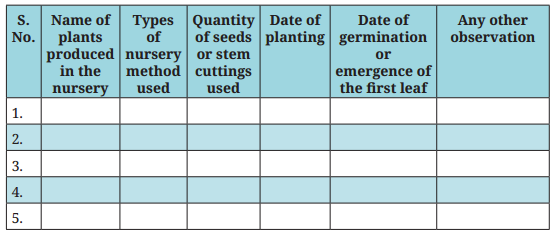
This activity helps students learn the importance of maintaining records for a plant nursery. It also teaches them that planting alone is not enough; plants must be properly cared for until they grow strong and are ready for transplantation. Students understand how to protect delicate young plants and transplant them at the right time and in a suitable environment.
Table: Maintaining Record for the Plant Nursery
Skills Developed
- Observation and recording
- Measurement skills
- Patience and regularity
- Scientific documentation
- Analytical thinking
Question 1.
How can you identify that a seedling needs water?
Answer:
A seedling needs water when the soil around it becomes dry and loses moisture. The leaves may start drooping and the soil surface looks dry or cracked. By touching the soil and observing the plant condition, we can understand when watering is required.
Question 2.
What is the best time for watering nursery plants?
Answer:
The best time for watering nursery plants is early in the morning or in the evening. At these times the temperature is lower, so water does not evaporate quickly and the plants can absorb enough moisture for proper growth.
Question 3.
What changes did you observe in the plants from germination to the emergence of the first leaf?
Answer:
During germination, the seed first swells and a small root emerges from it. After that a tiny shoot grows upward. Gradually the seedling becomes stronger and the first green leaf appears, which helps the plant start making its own food.
Question 4.
Were there any plants that did not grow well? What might have been the reason?
Answer:
Yes, some plants may not grow well due to poor seed quality, lack of water, insufficient sunlight, pests or unsuitable soil conditions. Improper temperature or excess water can also affect germination and prevent the plants from growing properly.
Question 5.
Why is it important to maintain a record of plant growth in a nursery?
Answer:it is important to maintain a record of plant growth in a nursery because it helps in tracking the progress of each plant from planting to growth. Records help identify successful methods, detect problems early, and improve future plant care and management for better germination and healthy development.
Activity 7: Calculating the cost
Purpose of the Activity
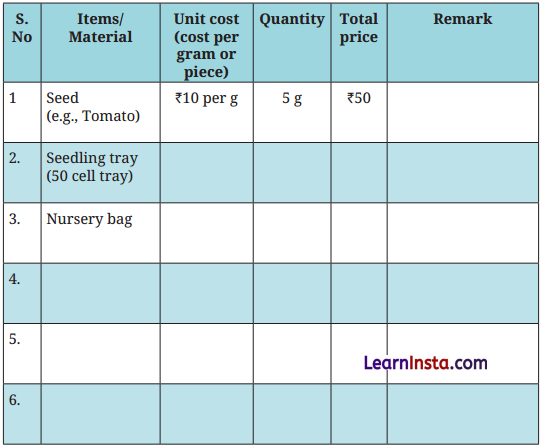
This activity helps students record the cost of items and materials used in the nursery. It also enables them to calculate the selling price of plants. It also helps students learn the basic economics involved in running a plant nursery as a livelihood.
Table : Calculating the cost of items and materials
Estimating Price of Plants from School Nursery

Question 1.
Why is it important to record the cost of materials used in a plant nursery?
Answer:
It is important to record the cost of materials used in a plant nursery because it helps in keeping track of expenses, calculating the total investment and understanding the cost of each plant. It also helps in deciding the selling price and managing the nursery in a proper and organised way.
Question 2.
How can you calculate the total cost of items used in the nursery?
Answer:
The total cost of items used in the nursery can be calculated by multiplying the unit cost of each item by its quantity used, and then adding all the individual costs together. Finally, the sum of all items gives the total cost of the nursery materials.
Question 3.
Why do we estimate the selling price of plants grown in a nursery?
Answer:
We estimate the selling price of plants grown in a nursery to determine a suitable price that covers all costs and provides profit. It also helps in planning the nursery as a business, avoiding losses, and understanding the basic economics of production and sale.
Question 4.
What factors are considered while deciding the market price of a plant?
Answer:
While deciding the market price of a plant, the following factors are considered:
- Cost of seeds, soil, pots and other materials used in growing the plant.
- Cost of labour and effort involved in preparing and maintainingthe nursery.
- Type, size and health of the plant (healthy and well-grown plants have higher value).
- Demand and availability of the plant in the local market.
Question 5.
How does calculating cost and profit help in running a plant nursery?
Answer:
Calculating cost and profit helps in running a plant nursery by showing how much money is spent on materials and how much is earned from selling plants.
It helps in fixing proper selling prices, avoiding losses and managing the nursery in an organised and profitable way.