To prepare effectively, include Kaushal Bodh Book Class 6 Solutions Project 6 and Class 6 Kaushal Bodh Chapter 6 Cooking without Fire Question Answer in your daily study routine.
Class 6 Vocational Education Chapter 6 Question Answer
Kaushal Bodh Class 6 Chapter 6 Question Answer Cooking without Fire
What did I learn from others? [Page No. 151]
Question 1.
Did you get recipes other than the ones in your Activity Book? Yes/No
Answer:
Yes, I found some additional no-fire recipes like sandwiches, sprouts chaat, and fruit-based dishes apart from those given in the Activity Book.
Question 2.
Did you ask someone to help with the recipes in your Activity Book? Yes/No
Answer:
Yes, I asked my teacher and family members for help in understanding and preparing the recipes given in the Activity Book.
Question 3.
Did you face any issue while working in team? How did you resolve it?
Answer:
Yes, we faced some difficulty in dividing tasks and managing time. We resolved it by discussing calmly, assigning clear roles to each member, and helping each other to complete the work efficiently.
Question 4.
Did you learn measurement of ingredients from others? Yes/No
Answer:
Yes, I learned how to measure ingredients correctly using cups, teaspoons, and tablespoons by observing and taking guidance from my teacher and classmates.
Think and Answer [Page No. 152]
Question 1.
What did you enjoy doing during the activity?
Answer:
I enjoyed the process of preparing dishes like bhel puri and fruit chaat, as it was fun to cut, mix and assemble ingredients.
Presenting the food attractively and sharing it with classmate s was especially enjoyable.
Question 2.
What would you like to do differently?
Answer:
I would like to try new recipes not given in the book and experiment with different seasonings and garnishes to make the dishes look and taste even better.
Question 3.
Do you think you can prepare an entire balanced meal without using fire? Yes/No. Give reasons
Answer:
Yes, it is possible to prepare a balanced meal without fire.
A meal that includes sprouts (protein), salad (vitamins and minerals), fruit chaat (carbohydrates and vitamins), curd-based raita (calcium) and buttermilk (probiotics) can provide all essential nutrients.
Question 4.
What jobs are related to the project? Look around, speak to people and write your answer. A few examples of jobs related to work you just did are cook at home, chef in hotel and different forms.
Answer:
Jobs related to this project include; cook at home, chef in a hotel or restaurant, catering professional, food stylist or food artist, nutritionist or dietitian, food technologist and kitchen porter.

Project 6 Cooking without Fire Class 6 Question Answer
Activity 1: Reading recipes
Purpose of the Activity
This activity will help students learn how to read, understand and follow a recipe correctly, including identifying ingredients and the steps to prepare a dish without using fire.
Pre-Activity Discussion
- Think about your favourite dish. If you had to explain to someone howto make it, where would you start?
- Have you ever tried to make something by following written instructions? What was easy or difficult about it?
- Why do you think recipes list ingredients in a specific order?
- Look at the pictures of the dishes. Can you guess which ones might be made just by mixing and which ones by assembling.
Procedure (Steps to Follow)
- Read the entire recipe from start to end before doing anything.
- Check that all the ingredients are available in the right quantity.
- Gather all the equipment and utensils needed.
- Follow each step in the order it is listed.
- Look up any unfamiliar word in a dictionary or ask the teacher.
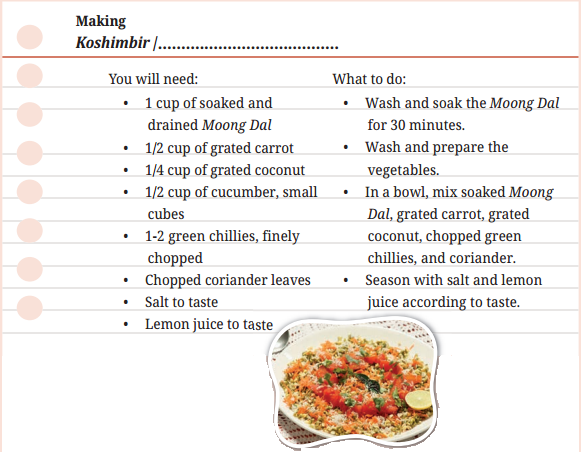
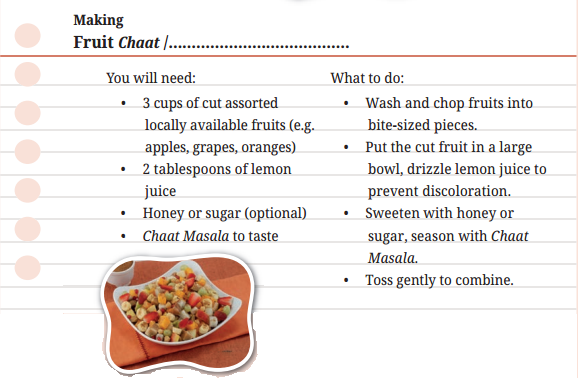
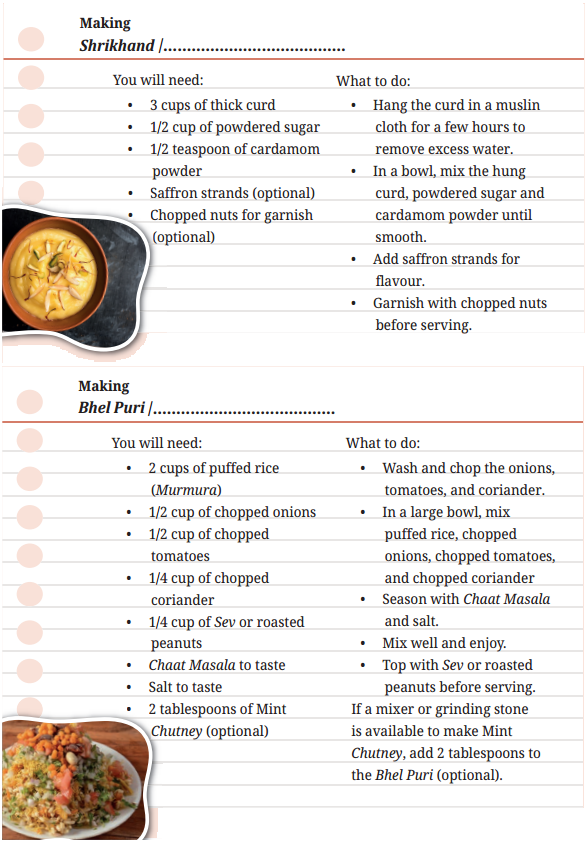
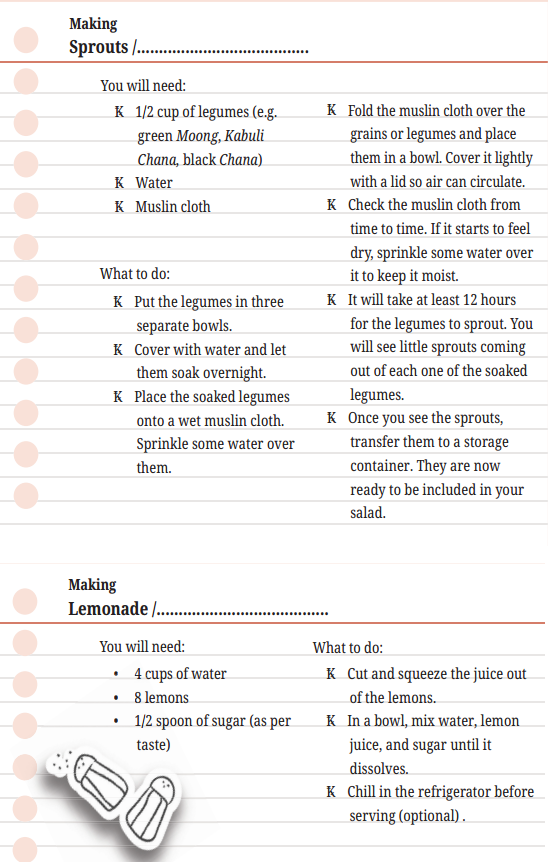
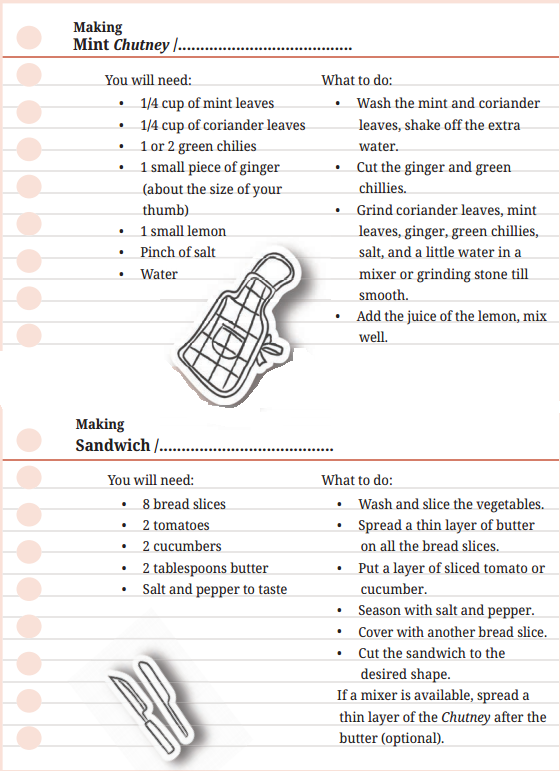
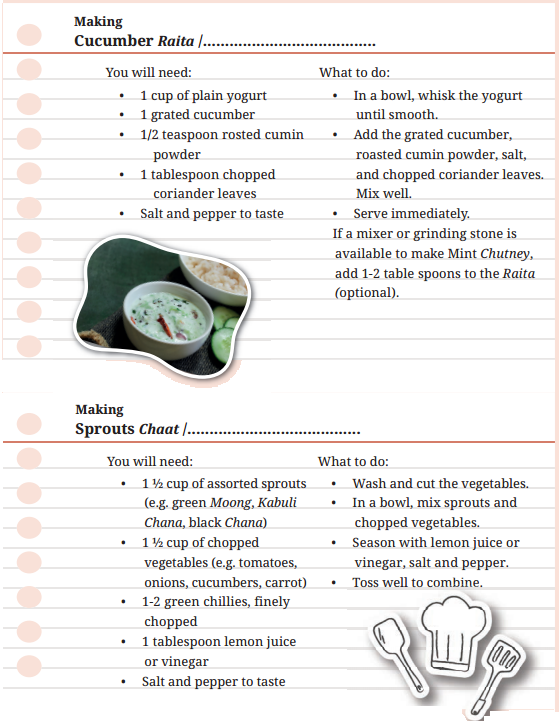
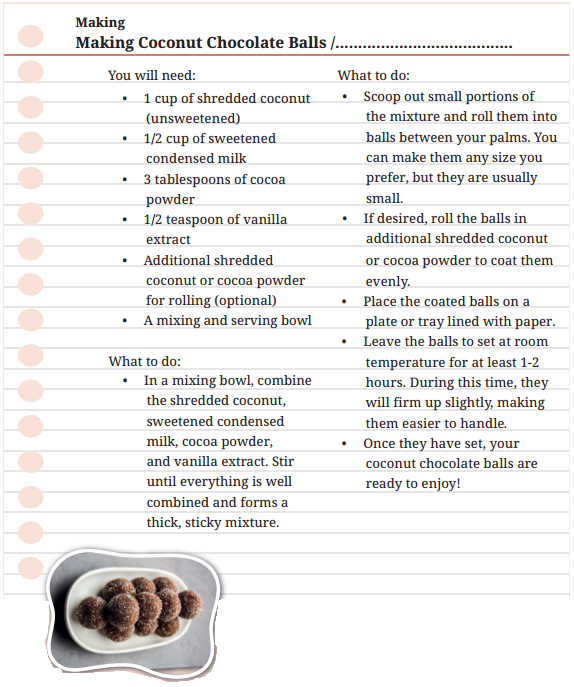
The space provided against the name in each recipe is for you to write any other name(s) you use for the dish.
Question 1.
What is a recipe and what does it contain?
Answer:
A recipe is a set of written instructions that explains how to prepare a dish. It contains
- A list of ingredients along with their required quantities.
- Step-by-step instructions for preparing the dish.
Question 2.
Why should you read the entire recipe before starting to cook?
Answer:
Before starting to cook, you should always read the entire recipe because
- It helps you in understanding the steps involved and the complete process.
- It ensures all the ingredients are available in the correct quantities.
Question 3.
Name three dishes you can prepare without using fire.
Answer:
The three dishes that can be prepared without fire are
(i) Salad
(ii) Fruit chaat
(iii) Bhel puri
Question 4.
What does ‘garnish’ mean? Give one example.
Answer:
Garnish means decorating a dish with small amounts of edible items to make it look attractive and appealing.
For example, adding chopped mint leaves on top of a glass of buttermilk or placing sev and peanuts decoratively on bhel puri are examples of garnishing.
Question 5.
What are the three cooking methods (techniques) used in no-fire cooking?
Answer:
The three cooking methods (techniques) used in no-fire cooking are
(i) Mixing: Combining different ingredients together, such as in a salad or a beverage.
(ii) Spreading: Applying a soft substance over a surface. For example, spreading butte, or cheese on bread or chutney in a chapatti roll.
(iii) Assembling: Putting different ingredients together to prepare a dish, such as making bhel puri or sprouts chaat.
Question 6.
Why do raw vegetables have more nutritional value than cooked vegetables?
Answer:
Raw vegetables have more nutritional value because they are not exposed to heat during preparation. Heat can break down essential nutrients, especially water-soluble vitamins like Vitamin C and IB-complex.
When vegetables are eaten raw, they retain their maximum nutritional content, including vitamins, minerals and natural enzymes, which are all beneficial for maintaining a healthy body and mind.
Kaushal Bodh Class 6 Cooking without Fire Question Answer
Activity 2: Deciding on dishes to be prepared
Purpose of the Activity
This activity will help students to conduct a survey to find out food preferences and use the data to decide which dishes will be prepared during the project activities.
Pre-Activity Discussion
- If you-were planning a party for your friends, how would you decide what food to make?
- What is a survey and where have you seen it being used before? (e.g., elections, favourite TV shows, etc.)
- How can asking people questions help us make better decisions as a group?
- If we have to pick only 5 dishes from a list of 20, what is a fair way to choose?
Conduct a survey of students in the school to find out what they like to eat. Some questions you may ask are as follows - What is your favourite dish?
- Which dishes do you like that can be prepared without fire?
Preferences of food items mentioned by students during the survey
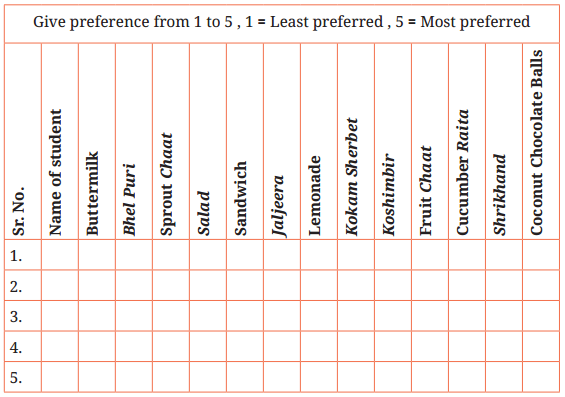
On the basis of the survey, list the dishes that will be prepared as part of the activity in the school.
1. ____________________
2. ____________________
3. ____________________
4. ____________________
5. ____________________
Question 1.
Why did we conduct a survey before deciding on the menu?
Answer:
A survey was conducted before deciding the menu because
- It ensures that the choices and preferences of all students are considered fairly.
- It makes the activity more inclusive and democratic, so everyone gets an equal say.
- It increases participation and enthusiasm as students cook d ishes they actually enjoy.
- It helps in planning the correct quantities of ingredients needed.
Question 2.
Which dish got the highest preference in your class survey?
Answer:
In the class survey, bhel puri got the highest preference as most: students rated it 5, making it the most popular dish of the group cooking activity.
Question 3.
What is the rating scale used in the survey? What do 1 and 5 mean?
Answer:
The rating scale used in the survey is from 1 to 5. A rating of 1 means ‘Least Preferred’ — the student does not like that dish very much.
A rating of 5 means ‘Most Preferred’ — the student likes that dish the most. The higher the total score of a dish, the more popular it is among the students.
Question 4.
If a dish got very low ratings, should it be included in the menu? Why or why not?
Answer:
No, a dish with very low ratings; should generally not be included in the menu, becsiuse
- A low rating means most students do not prefer that dish, so including it would waste ingredients and effort.
- The purpose of the survey is to ensure that dishes enjoyed by the majority of students are prepared.
- However, if the dish is nutritionally important or provides variety, it may be considered as a small addition alongside more popular choices.
Question 5.
How does a survey help in making fair group decisions?
Answer:
A survey helps in making fair group decisions by collecting opinions from all participants. It ensures that everyone’s preferences are considered equally, reduces bias, and helps choose options based on majority choice rather than individual opinions, making the decision more balanced and fair.
Activity 3: Measure your food ingredients
Purpose of the Activity
This activity will help students to understand standard and non-standard units of measurement and to learn howto accurately measure food ingredients using cups, teaspoons, tablespoons and a kitchen weighing scale.
Pre-Activity Discussion
- In your house, how does the person who cooks know how much salt or sugar to put in a dish?
- If you didn’t have a measuring cup, what could you use to measure water for a drink?
- Why do you think scientists and doctors use very precise measurements, while cooking at home can sometimes be ‘a little bit of this, a little bit of that’?
- Look at a teaspoon and a tablespoon. Which one do you think holds more? By how much?
Procedure
- Take the same quantity of any ingredient (liquid or solid).
- Measure it using a kitchen weighing scale and record the weight in grams or volume in litres/ml.
- Then measure the same quantity using a cup, a tablespoon and a teaspoon.
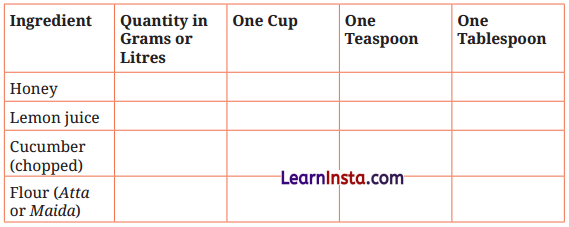
Note: A teaspoon = ~5 ml, a tablespoon = ~15 ml, one cup = ~250 ml.
Record your observations in the table given below
Estimation of quantity of ingredient for conversion
Question 1.
What is the difference between standard and non-standard units of measurement?
Answer:
The difference between standard and non- standard units of measurement is as follows
| Basis | Standard Units | Non-Standard Units |
| Meaning | Fixed and universally accepted units of measurement | Informal units that may vary from person to person |
| Example | Grams, kilograms, litres, millilitres (e.g., 10 g flour, 250 ml water) | Cup, tablespoon, pinch (e.g., one cup of cucumber, a pinch of salt) |
Question 2.
How many ml does a tablespoon hold approximately?
Answer:
A-tablespoon holds approximately 15 ml of liquid. This is three times the volume of a teaspoon, which holds approximately 5 ml.
Question 3.
If you need 500 ml of water but don’t have a measuring cup, how many cups would that be?
Answer:
If one cup holds approximately 250 ml of liquid, then for 500 ml of water, we would need 2 cups (500 ml -r 250 ml = 2 cups). So, two standard cups of water would give us approximately 500 ml.
Question 4.
What is a Bar Code and how can it be useful while buying food?
Answer:
A Bar Code is a pattern of thick and thin black lines printed on food packets and product packaging. It stores important information about the product digitally.
While buying food, we can use mobile applications like Google Lens to scan the Bar Code and instantly access details such as; the list of ingredients, the nutritional value of the product, the expiry date and other related information. This helps us make informed choices about the food we buy and consume.
Question 5.
Why is it important to measure ingredients accurately while cooking?
Answer:
It is important to measure ingredients accurately while cooking because it ensures the correct taste, texture, and quality of the dish.
Proper measurement also helps maintain consistency in recipes and prevents the food from becoming too salty, sweet, or unbalanced.
Activity 4: Handling tools with care and safety
Purpose of the Activity
This activity will help students to learn how to safely handle, use and clean kitchen tools and equipment to ensure safety and hygiene while cooking.
Pre-Activity Discussion
- What is the first thing you should do before touching any food or tool in the kitchen?
- Look at a knife. If you had to explain to a younger student howto use it safely, what would you tell them?
- Why do you think most kitchens have separate boards for cutting vegetables and cutting meat?
- What does a clean kitchen tell you about the person who cooks there?
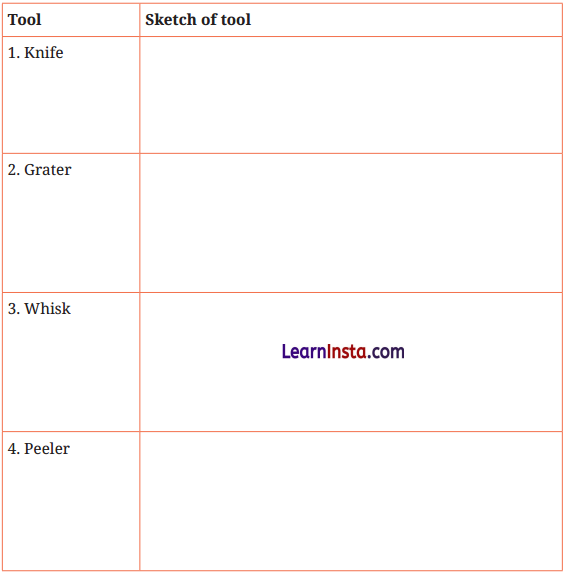
Draw a Sketch of Kitchen Tools
Question 1.
Name four kitchen tools and state one safety tip for each.
Answer:
The four kitchen tools and one safety tip for each are
(i) Knife Always use a chopping board while cutting and cut away from your body, keeping fingers curled away from the blade.
(ii) Grater Hold the grater firmly on a flat surface and grate downwards carefully to avoid injuring your fingers.
(iii) Whisk Use it only in a bowl large enough to prevent splashing; hold the bowl firmly with your other hand.
(iv) Peeler Always peel away from your body and keep fingers clear of the blade to prevent cuts.
Question 2.
Why should we use a chopping board while cutting?
Answer:
We should use a chopping board while cutting because it provides a stable and safe surface for the knife, which prevents the knife from slipping and causing injuries. It also protects the kitchen counter or table from scratch marks and cuts.
Using a chopping board makes cutting more controlled and accurate and it is easier to transfer chopped ingredients to a bowl or plate from a flat board.
Question 3.
What does cross-contamination mean in the kitchen?
Answer:
Cross-contamination in the kitchen means the transfer of harmful bacteria or germs from one food item or surface to another.
For example, if the same knife or chopping board is used to cut raw meat and then used to cut vegetables without washing in between, bacteria from the meat can transfer to the vegetables.
To prevent cross-contamination, all kitchen tools should be washed and cleaned properly after each use and separate boards should be used for different types of food.
Question 4.
Why is it important to dean tools after each use?
Answer:
It is important to clean tools after each use because
- It prevents cross-contamination — bacteria from one food do not transfer to the next dish.
- It maintains hygiene in the kitchen, ensuring that the food prepared is safe to eat.
- Clean tools are ready for use the next time without requiring extra preparation.
- It prevents the growth of harmful bacteria and keeps the kitchen environment clean and sanitary.
Question 5.
How can careful handling of kitchen tools prevent accidents in the kitchen?
Answer:
Careful handling of kitchen tools helps prevent accidents by reducing the risk of cuts, burns, and slips.
Using tools properly, staying attentive, and following safety rules ensure safe cooking and protect both the user and others in the kitchen.
Activity 5: Storing food
Purpose of the Activity
This activity will help students to understand and identify the correct storage methods for different food ingredients to maintain their freshness and prevent spoilage.
Pre-Activity Discussion
- Why does your family keep milk in the fridge, but not a bag of rice?
- What happens to a banana if you leave it outside for a week? What happens to an apple?
- Imagine you bought vegetables on Sunday but won’t cook them until Friday. How would you keep them fresh?
- Why do you think our grandparents stored spices in metal tins, not plastic bags?
Procedure
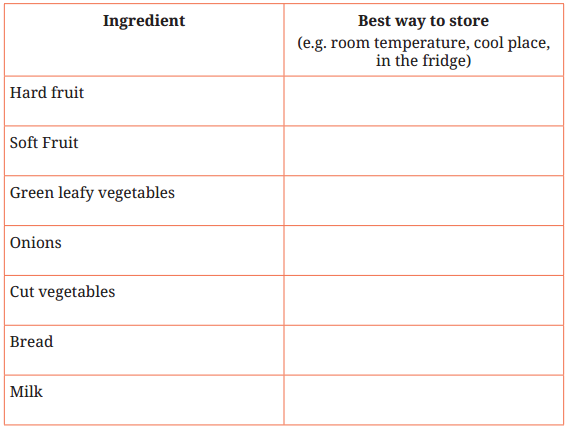
- Study the list of ingredients given in table.
- Think about the best way to store each ingredient.
- Fill in the table with the storage method — e.g., room temperature, cool place or in the fridge.
- Discuss your answers with classmates and the teacher.
Storing conditions for different ingredients
Question 1.
Why should grains and legumes be stored in airtight containers?
Answer:
Grains and legumes should be stored in airtight containers to protect them from moisture and pests such as insects and rodents. Moisture can cause grains and legumes to become damp, leading to fungal growth and spoilage.
Pests can contaminate the food and make it unsafe to eat. Airtight containers also help preserve the freshness and nutritional quality of grains and legumes for a longer period.
Question 2.
What happens to food if it is not stored properly?
Answer:
If food is not stored properly, the following can happen
- Food spoils quickly and loses its freshness, taste and nutritional value.
- Bacteria and fungi grow on improperly stored food, making it unsafe to eat.
- Food may develop unpleasant smells, changed colours and altered textures.
- Pests and insects may contaminate the food.
- This leads to wastage of food and money.
Question 3.
Why should spices and herbs be stored away from heat and light?
Answer:
Spices and herbs should be stored away from heat and light because heat and sunlight can cause them lose their natural aroma, flavour and colour over time. Exposure to light can cause oxidation, which degrades the quality of spices and herbs.
Storing them in airtight containers in a cool, dark place preserves their taste and potency for a much longer duration, ensuring the dishes they are added to have the right flavour.
Question 4.
Where would you store cut vegetables? Give a reason.
Answer:
Cut vegetables should be stored in airtight containers and placed in the refrigerator. This is because once vegetables are cut, they are exposed to air, which causes them to dry out, lose nutrients and discolour quickly.
The refrigerator’s cool temperature slows down bacterial growth and oxidation, keeping the cut vegetables fresh and safe to eat for a longer period. Airtight containers also prevent odours from other foods in the fridge from affecting the vegetables.
Question 5.
How does proper food storage help in reducing food wastage?
Answer:
Proper food storage helps reduce food wastage by keeping food fresh for a longer time and preventing spoilage.
When food is stored correctly, it stays safe to eat, maintains its quality, and does not get wasted due to decay or contamination.
Activity 6: Handling and disposing of kitchen waste
Purpose of the Activity
This activity will help students to understand the correct methods of segregating, disposing of and recycling kitchen waste in an environmentally friendly manner.
Pre-Activity Discussion
- After you finish eating a fruit, where does the peel go? What happens to it after the garbage truck takes it away?
- Look at two types of waste; a banana peel and a plastic wrapper. Do they both disappear in the same way? Why or why not?
- If you had a magic machine that could turn your kitchen waste into something useful, what would you want it to make?
- Why do some dustbins have different colours or sections?
Procedure
- Set up two dustbins — one for wet/organic waste and one for dry waste.
- After the cooking activity, sort all waste into the correct bins.
- Organic/Wet waste (vegetable peels, fruit seeds) goes into the wet bin.
- Plastic containers, wrappers, paper and bottles go into the dry bin.
- Check recyclable items (look for recycling symbols) and keep them separately.
Answer the following questions.
1. Where did you dispose of the segregated waste?
______________________________________________
2. What did you do with plastic containers after using them?
______________________________________________
3. What did you do to reduce the amount of waste produced in the kitchen?
______________________________________________
4. What kind of waste can be used for composting?
______________________________________________
5. What can we do with leftover food instead of throwing it away?
______________________________________________
Question 1.
What is segregation of waste? Why is it important?
Answer:
Segregation of waste means separating different types of waste into different categories before disposal. In the kitchen, waste is typically separated into
- Wet/Organic Waste: Vegetable peels, fruit seeds, food scraps.
- Dry Waste: Plastic containers, wrappers, paper, bottles.
- Recyclable Items: Clean plastics, glass, cardboard with recycling symbols.
Segregation is important because it makes waste disposal more environment friendly. Organic waste can be composted to create natural fertiliser. Recyclable materials can be reused. It reduces the amount of waste going to landfills and helps protect the environment.
Question 2.
What is composting? How is it useful?
Answer:
Composting is the process of converting organic waste (such as vegetable peels, fruit scraps, leftover food and garden waste) into nutrient-rich material called compost or manure. This is done by collecting organic waste and allowing it to decompose naturally over time.
Composting is useful because it reduces the amount of kitchen waste that goes to landfills. The compost produced is an excellent natural fertiliser for plants and gardens, improving soil quality.
It is an eco-friendly and cost-effective way to manage kitchen waste and promote sustainable living.
Question 3.
Which types of waste can be recycled?
Answer:
The following types of waste can be recycled
- Empty plastic containers, bottles and food trays that have recycling symbols on them.
- Clean cardboard boxes and cartons.
- Newspapers, magazines and paper packaging.
- Glass bottles and jars.
These items should be cleaned before placing them in the recycling bin to ensure they can be properly processed and reused to make new products.
Question 4.
How does proper waste disposal help protect the environment?
Answer:
Proper waste disposal helps protect the environment in the following ways
- It reduces pollution by preventing harmful waste from contaminating soil, water, and air, keeping surroundings clean and safe for living beings.
- It promotes recycling and composting, which conserve natural resources and reduce the amount of waste sent to landfills.
Question 5.
why should wet and dry waste be kept separate?
Answer:
Wet and dry waste should be kept separate to make disposal and recycling easier. Wet waste can be composted to make manure, while dry waste can be recycled. Mixing them makes recycling difficult and can cause bad smell and pollution.
Activity 7: Beverage making
Purpose of the Activity
This activity will help students to learn how to prepare beverages like lemonade, buttermilk, jaljeera or kokam sherbet using proper measurements, hygiene and teamwork.
Pre-Activity Discussion
- Think about your favourite summer drink. What makes it refreshing?
- When you mix lemon juice, sugar and water, what happens to the sugar? Can you see it after you stir?
- If you were to serve a drink to a guest, what could you do to make it look special?
- How will your group decide who does what? (e.g., who will squeeze the lemons, who will add the sugar?) Beverages include any drink besides water. Examples include lemonade, buttermilk, jaljeera and kokam sherbet.
Answer the following questions.
1. What beverage did you prepare?
______________________________________________
2. List the ingredients and their quantities used for making the beverages. Estimate the number of people you could serve with the ingredients used.
______________________________________________
3. Taste the beverages made by other groups. Did you notice any difference in taste? Yes/No.
______________________________________________
4. Provide and receive suggestions from other groups. Did you implement any suggestions? If yes, how did you incorporate them (e.g., adjusting ingredient quantities)?
______________________________________________
5. Describe the amount of waste generated (e.g., half a bag, one bag, or another description of quantity).
______________________________________________
Question 1.
Name four beverages that can be prepared without fire.
Answer:
The four beverages that can be prepared without fire are
(i) Lemonade made from lemon juice, water and sugar.
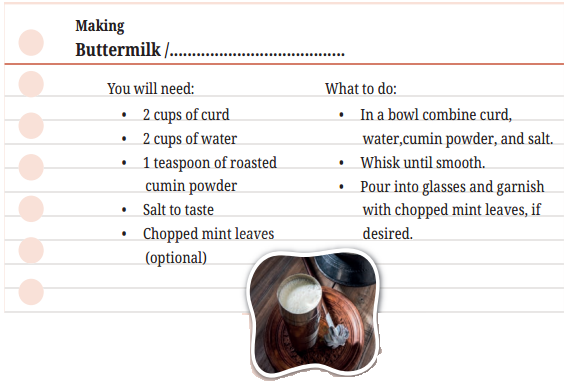
(ii) Buttermilk made from curd, water, cumin powder and salt.
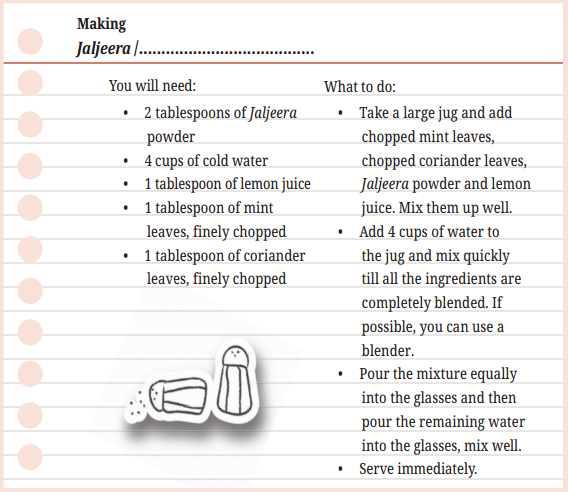
(iii) Jaljeera made from jaljeera powder, mint leaves, coriander leaves, lemon juice and water.
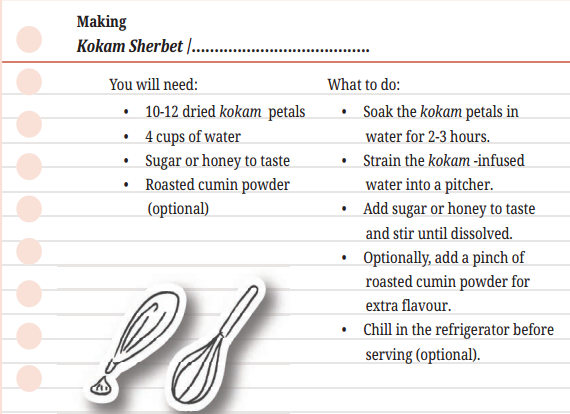
(iv) Kokam Sherbet made from dried kokam petals soaked in water, with sugar or honey.
Question 2.
What ingredients are needed to make jaljeera?
Answer:
The ingredients that are needed to make jaljeera are
- 2 tablespoons of jaljeera powder
- 4 cups of cold water
- 1 tablespoon of lemon juice
- 1 tablespoon of mint leaves, finely chopped
- 1 tablespoon of coriander leaves, finely chopped
These are combined and mixed well. The mixture is served immediately for best taste.
Question 3.
How should you present a glass of buttermilk attractively?
Answer:
To present a glass of buttermilk attractively, you should
- Pour the whisked buttermilk into a clean, clear glass so the colour is visible.
- Garnish with chopped fresh mint leaves on top for a pop of green colour.
- You can also sprinkle a pinch of roasted cumin powder on top for visual appeal.
- Serve the glass on a small plate or saucer, which makes it look neat and presentable.
Question 4.
Why is it useful to give and receive feedback about the dishes you make?
Answer:
It is useful to give and receive feedback because
- Feedback from others helps you identify areas where the dish can be improved in taste, texture, or presentation.
- Others may notice things you missed, such as the need for more seasoning or a better garnish.
Question 5.
Why is hygiene important while preparing beverages?
Answer:
Hygiene is important while preparing beverages to prevent contamination and keep the drink safe to consume.
Clean hands, utensils, and ingredients help avoid germs, ensure good taste, and protect people from falling sick.
Activity 8: Make dishes that require cutting and mixing
Purpose of the Activity
This activity will help students to prepare dishes that involve cutting fruits and vegetables and mixing them with seasonings such as salad and fruit chaat using safe techniques.
Pre-Activity Discussion
- Why do you think some people eat a salad before their main meal?
- Look at the different coloured fruits and vegetables. Why might it be good to use a mix of colours in a dish?
- What do you notice about the smell of a freshly cut cucumber or tomato?
- If you are working in a team and one person is slow at cutting, how can the rest of the team help?
After preparing the beverages, the next step is to make dishes that involve cutting and mixing. This includes cutting ready-to-eat fruits and vegetables and combining them with ingredients like salt, lime juice or others to prepare a tasty dish. Examples of such dishes include salad and fruit chaat.
After completing the activity, answer the given questions based on your experience.
1. What did you make today?
______________________________________________
2. How did you decide what ingredients to use?
______________________________________________
3. What was the most challenging part of making this dish?
______________________________________________
4. Did you learn any new skill while preparing it?
______________________________________________
5. Did you add your idea to the recipe? If so, what did you change?
______________________________________________
6. Did you work with anyone else while making this dish? How did you divide tasks?
______________________________________________
7. What was the best part of working together?
______________________________________________
8. What did you learn from making this dish?
______________________________________________
9. What quantity of waste was generated from the activity?
______________________________________________
Question 1.
Name two dishes that are made by cutting and mixing ingredients.
Answer:
The two dishes that are made by cutting and mixing ingredients are
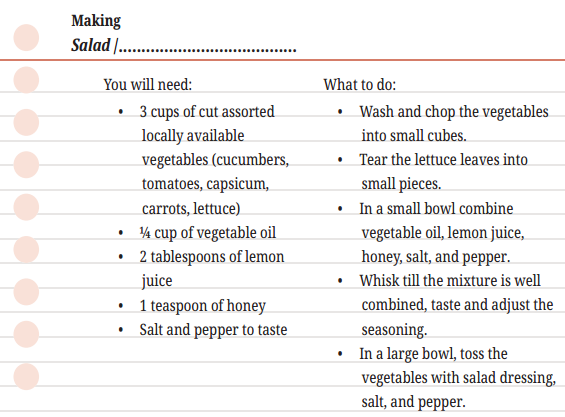
(i) Salad Where vegetables tike cucumbers, tomatoes, capsicum and carrots are washed, chopped and mixed with a dressing of oil, lemon juice, honey, salt and pepper.
(ii) Fruit Chaat Where assorted fruits are washed, chopped into bite-sized pieces and mixed with lemon juice, chaat masala, and optional honey or sugar.
Question 2.
Why is lemon juice added to fruit chaat?
Answer:
Lemon juice is added to fruit chaat for two important reasons
- First, it prevents the cut fruits from turning brown (discoloration) by acting as a natural antioxidant.
- Second, it adds a tangy and refreshing flavour to the chaat, which balances the sweetness of the fruits and enhances the overall taste. Additionally, lemon juice acts as a mild natural preservative, keeping the chaat fresh for a little longer.
Question 3.
What seasoning is commonly used in both salad and fruit chaat?
Answer:
Salt and lemon juice are common seasonings used in both salad and fruit chaat. Additionally, chaat masala is specifically mentioned in the fruit chaat recipe as a key seasoning that gives it a tangy, spicy and flavourful taste. Pepper is used in the salad dressing. Both dishes use lemon juice as a primary seasoning for taste and freshness.
Question 4.
Why is teamwork important while cooking?
Answer:
Teamwork is important while cooking because
- Cooking involves many tasks simultaneously — cutting, mixing, measuring and cleaning — which can be done faster when divided among team members.
- Different people can take on tasks they are good at, making the process more efficient and enjoyable.
Question 5.
Why is it important to cut fruits and vegetables safely?
Answer:
It is important to cut fruits and vegetables safely to prevent injuries like cuts and ensure hygiene. Proper cutting techniques also help in preparing food neatly and efficiently, making the dish safe and presentable.
Activity 9: Make dishes that require cutting and assembling
Purpose of the Activity
This activity will help students to assemble dishes by putting together ready-to-eat food items — such as koshimbir, sprouts chaat, bhel purl, coconut chocolate balls, cucumber raita and sandwiches.
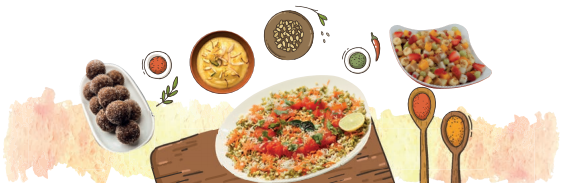
Figure : Make sure the food tastes good before serving it in the Mela!
Pre-Activity Discussion
- Think about a sandwich. What are the layers and why do you think they are put in that order? Preparing a Dish b
- Why do you think bhel pun is mixed together only when someone is ready to eat it, Cutting and Mixing not made hours before?
- Look at a coconut chocolate ball recipe. Why do you think it needs to ‘set’ for 1-2 hours? What is happening during that time?
- If you were creating a new assembled’ dish, what ingredients would you put together?
Assembling means combining small portions of ready-to-eat food items to create a new dish with a little effort.
Examples of such dishes include koshimbir, sprouts chaat, bhel purl, coconut chocolate balls, cucumber raita and sandwiches.
Answer the following questions after you have finished cooking.
1. What did you make?
______________________________________________
2. List the ingredients and the quantity of each used to make the dishes.
______________________________________________
3. How many people could you serve with the quantity of ingredients you used?
______________________________________________
4. Go around and taste the dishes that other groups have made. Do you find any difference in taste? Yes/No. Give and take suggestions from them.
______________________________________________
5. Did you implement any of those suggestions? If yes, how?
______________________________________________
6. How much waste was produced (half a bag, one bag or any other way you would like to describe the quantity)?
______________________________________________
Question 1.
What does ‘assembling’ a dish mean? Give two examples.
Answer:
Assembling a dish means combining small portions of ready-to-eat food items together to create a new dish with minimal effort. It is different from mixing because the individual components retain their identity and texture.
The two examples of assembled dishes are
(i) Sandwich Where butter is spread on bread slices and sliced vegetables like tomatoes and cucumbers are layered on top, then covered with another bread slice and cut to shape.
(ii) Bhel Puri Where puffed rice, chopped onions, tomatoes, coriander and sev are put together in a bowl, seasoned and mixed just before serving.
Question 2.
Name the ingredients needed to make bhel puri.
Answer:
The ingredients that are needed to make bhel puri are
- 2 cups of puffed rice (Murmura)
- 1/2 cup of chopped onions
- 1/2 cup of chopped tomatoes
- 1/4 cup of chopped coriander
- 1/4 cup of sev or roasted peanuts
- Chaat masala to taste
- Salt to taste
- 2 tablespoons of mint chutney (optional)
Question 3.
What makes shrikhand a special no-fire dessert?
Answer:
Shrikhand is a special no-fire dessert because it is made from hung curd (curd from which the excess water has been drained by keeping it in a muslin cloth for a few hours). It requires no cooking or heating at all.
Question 4.
Why should coconut chocolate balls be left to set for 1-2 hours?
Answer:
Coconut chocolate balls should be left to set for 1-2 hours because the mixture of shredded coconut, condensed milk, cocoa powder and vanilla extract needs time to firm up after being shaped into balls. During the setting time, the balls become more solid and easier to handle without losing their shape.
Question 5.
Why is it important to assemble dishes just before serving?
Answer:
It is important to assemble dishes just before serving to maintain freshness, taste, and texture. This prevents ingredients from becoming soggy or losing their flavour, making the dish more enjoyable to eat.
Activity 10: Organise a food Mela
Purpose of the Activity
This activity will help students to plan, organise and host a small food mela where students exhibit the dishes they
Pre-Activity Discussion
- Have you ever been to a fair or a food stall? What made you stop and try that particular food?
- Imagine you are a visitor at our food mela. What would make you want to visit a particular stall?
- If you are running a food stall, what are the most important things you must remember to keep your customers safe and happy? Make sure the lood tastes good
- After the mela is over and everyone has gone home, what work still needs to be belore serving In the metal done?
A food mela can be organised to showcase the dishes that have been Learnt. With the help of the teacher and peers a small-scale food mela can be planned and conducted.
After organising the food mela, answer the following questions.
1. What do you think is special about your food item?
______________________________________________
2. Make a poster or an invitation card or write a social media message to invite visitors.
______________________________________________
3. How will you attract people to try the food items?
______________________________________________
4. How will you maintain cleanliness and hygiene in and around your stall?
______________________________________________
5. How will you clean up after the event?
______________________________________________
Question 1.
Name three ways to attract visitors to your food stall.
Answer:
The three ways to attract visitors to your food stall are
(i) Attractive Display and Presentation: Arrange the food items neatly with colourful garnishes and labels showing the names of the dishes.
(ii) A Colourful Poster or Invitation Card: Display a well-designed poster near the stall with the names of the dishes and an inviting message like ‘Try delicious food made without fire!’
(iii) Friendly Approach: Greet visitors warmly, offer . small samples to taste and explain the ingredients and health benefits of the dishes to draw them in.
Question 2.
Why is cleanliness important at a food stall?
Answer:
Cleanliness is important at a food stall because of the following reasons
- It ensures that the food served is safe and hygienic for visitors to eat, protecting them from food-borne illnesses.
- A clean stall gives a positive first impression and makes visitors more confident about trying the food.
- It reflects the values of the students — a clean, well-organised stall shows responsibility and professionalism.
- Maintaining hygiene prevents cross-contamination between different dishes.
Question 3.
What is the importance of teamwork during the food Mela?
Answer:
Teamwork is important during the food Mela because of the following reasons
- Managing a food stall involves many tasks simultaneously. For e.g., arranging the stall, serving food, interacting with visitors, maintaining cleanliness and managing waste, which require multiple people working together.
- Different team members can take on different roles based on their strengths, making the event run smoothly.
Question 4.
How does proper planning help in organising a successful event?
Answer:
Proper planning helps in organising a successful event by ensuring that tasks are managed efficiently, resources are used wisely, and responsibilities are clearly divided. It helps avoid confusion, saves time, and makes the event smooth and enjoyable for everyone.
Question 5.
Why is it important to clean the area after the mela is over?
Answer:
It is important to clean the area after the mela is over to maintain hygiene and keep the surroundings neat. Proper cleaning prevents the spread of germs, avoids bad smell, and ensures the place remains safe and pleasant for everyone.