To prepare effectively, include Kaushal Bodh Book Class 6 Solutions Project 5 and Class 6 Kaushal Bodh Chapter 5 School Museum Question Answer in your daily study routine.
Class 6 Vocational Education Chapter 5 Question Answer
Kaushal Bodh Class 6 Chapter 5 Question Answer School Museum
What did I learn from others? [Page No. 122 – 123]
Question 1.
If you were able to visit a museum, then
Find out how artefacts in museums are stored and cared for. Write down at least three methods that museums use to preserve artefacts.
Answer:
Three methods used by museums to preserve artefacts are as follows
- Artefacts are kept in controlled environments with proper temperature and humidity to prevent damage.
- They are stored in sealed glass cases to protect them from dust and pollution.
- They are handled carefully using gloves and proper tools to avoid direct contact and damage.
Question 2.
If you have invited someone who can answer your questions, e.g., someone who works in a museum, a historian, or an archaeologist, to discuss historical artefacts with your class then write at least 3 things that you learnt.
Listen to a talk show or short documentary on artefacts and how they help us understand the lives of people in ancient times.
Write at least three things that you learnt.
Answer:
Three things that I learnt are as follows
- Artefacts help us understand how people lived in ancient times, including their lifestyle, work and traditions.
- Experts like historians, archaeologists and museum workers help us learn the correct history of artefacts.
- Artefacts are preserved in museums so that they can be studied and shared with future generations.
Question 3.
Write down any three examples of feedback from visitors.
Answer:
Three examples of feedback from visitors are as follows
- The exhibition was very interesting and helped us learn about old artefacts.
- The labels were clear, but more pictures could be added for better understanding.
- The arrangement of artefacts was good, but some displays could be made more visible.
Question 4.
What did you learn from this feedback?
Answer:
I learned that feedback helps us understand what went well in the exhibition and what can be improved.
It shows that clear labels, good arrangement and visual materials are important, and it helps us make future exhibitions better and more interesting.
Think and Answer [Page 124]
Question 1.
What did you enjoy doing?
Answer:
I enjoyed visiting the museum (or taking a virtual tour) and collecting artefacts from home. Identifying the history behind old objects and presenting them to visitors was very satisfying. Creating labels and setting up the exhibition was also exciting.
Question 2.
What were the challenges you faced?
Answer:
The challenges I faced were as follows
- Finding artefacts at home that were old and in good condition.
- Researching the exact history or age of some objects.
- Deciding which five artefacts to select from many interesting ones.
- Creating clear and informative labels within a short description.
Question 3.
What would you like to do differently?
Answer:
Next time, I would like to
- Plan the exhibition layout in advance.
- Invite a local historian to speak about the artefacts.
- Create a digital catalogue of all artefacts, not just the five selected.
- Use Bhashini or Google Translate to present information in multiple languages for all visitors.
Question 4.
How do museums help us in learning about our heritage and history?
Question 5.
What jobs are related to the project? Look around, speak to people and write your answer. A few examples of jobs related to the work you just did, are archaeologist, historian, museum curator, and tour guide.
Project 5 School Museum Class 6 Question Answer
Activity 1: Visiting a Museum
Purpose of the Activity
This activity helps us understand the purpose and layout of museums and how they preserve history and culture. By visiting a museum (physic ally or virtually), students develop observation skills and learn how artefacts are described and displayed for the public.
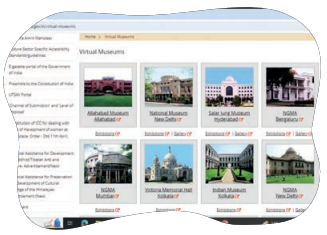
Figure: Screen grab of website maintained by the Ministry of Culture, Government of India
Pre-Visit Preparation for the School Museum
- Visiting a museum provides useful guidance for setting up a school museum.
- If a visit is not possible, information can be gathered by asking friends or others about their museum visits or by exploring the museum websites and observing their exhibits.
- Some museums also offer virtual exhibitions.
Pre-Activity Discussion
- Discuss what a museum is and what kinds of artefacts are usually found there.
- Talk about the museums you or your family members may have visited.
- Learn about the role of a curator— the person who selects and looks after artefacts in a museum.
- Discuss what ‘virtual exhibitions’ are and how are they differ from in-person visits?
Observation Task (During the Visit)
While exploring; a museum, pay attention to
- The layout of the museum and the arrangement of key exhibits.
- Observing the exhibits carefully, reading the information panels and checking for any interactive activities (e.g., lighting up parts of exhibits, moving components or quizzes).
- If possible, discuss observations with an expert (such as a curator, the person in charge of the artefacts ora local historian) and clarify any questions.
Based on the above observation, respond to the following questions.
1. What was the most interesting exhibit you saw in the museum?
______________________________________________________
2. Why did you find it interesting?
______________________________________________________
3. Describe any one exhibit that has significance in our lives even today.
______________________________________________________

Question 1.
What is the difference between an artefact and an ordinary object?
Answer:
The differences between an artefact and an ordinary object are as follows
| Artefact | Ordinary Object |
| It is old, unique, or has cultural and historical significance. | It is commonly used in daily life and recently made. |
| It is made or used by humans in the past and helps us understand history and traditions. | It has no special link to history or cultural heritage. |
Question 2.
Name any two types of museums and what they display.
Answer:
The two types of museums are
(i) History Museum: Displays artefacts, tools, manuscripts and objects that show how people lived in the past.
(ii) Science Museum: Displays scientific models, experiments, inventions and objects like fossils or technological tools to explain concepts and discoveries.
Question 3.
What is the role of a museum curator?
Answer:
The role of a museum curator is as follows
- They select, organise and take care of artefacts in a museum.
- They research the history and significance of objects, plan exhibitions, create labels and presentations and ensure artefacts are preserved and displayed safely.
Question 4.
How does visiting a museum help in understanding history and culture?
Answer:
Visiting a museum helps in understanding history and culture by showing artefacts, artworks and objects used by people in the past. These exhibits give information about their lifestyle, traditions, work and beliefs. By observing and reading about these items, we learn how societies have changed over time and gain a better understanding of our cultural heritage.
Question 5.
What things should you observe carefully while visiting a museum?
Answer:
We should observe the following things carefully while visiting a museum
- The layout of the museum and how the exhibits are arranged.
- The artefacts displayed and their details.
- The information written on display panels.
- The way artefacts are preserved and presented.
Kaushal Bodh Class 6 School Museum Question Answer
Activity 2: Learn the history of your family and area
Purpose of the Activity
This activity helps us connect with our own local history, family traditions and cultural roots. It encourages inquiry, oral history gathering and appreciation of one’s heritage before they begin collecting artefacts for the museum.
Pre-Activity Discussion
- Discuss how local history and family stories can be sources of cultural knowledge.
- Talk about traditions, customs or stories that have been passed down in your family.
- Discuss the difference between oral history (stories passed down through speech) and written history.
- Identify any historical landmarks or institutions in your area.
It is important to learn about the local area and understand the family’s connection to it. The questions below can help with this exploration.
1. Did your village/town/city ever have a different name?
______________________________________________________
2. Do you know when it was founded or established? If yes, write the year.
______________________________________________________
3. Where did your family originally come from?
______________________________________________________
4. Do you have any family traditions or customs that have been passed down through generations?
______________________________________________________
5. Are there any local stories or traditions related to the village/town/city? (e.g., any story about the area, any connection with history, any time of the year when many people come to visit, etc.) Write about the story or the tradition related to your village/town/city.
______________________________________________________
6. Are there historical movements or landmarks/buildings in your village/city/town? If yes, write a short note about any one of them.
______________________________________________________
7. Is there any old institution or monument that you have visited? If yes, what is it famous for?
______________________________________________________
8. What are the oldest artefacts in your house? Write their names here.
______________________________________________________
Question 1.
What is meant by ‘oral history’? Give one example.
Answer:
Oral history refers to stories, traditions and knowledge that are passed down through speeches from one generation to another, rather than through written records. For example, a grandmother telling the story of how an old radio was the first one in the village and was brought as a wedding gift is oral history.
Question 2.
Why is it important to learn about the history of our local area?
Answer:
It is important to learn about the history of our local area because it helps us understand how the community developed, its traditions and cultural practices. Knowing local history also connects us to our ancestors, landmarks and historical events, giving a sense of identity and pride.
It allows students to appreciate heritage, preserve artefacts and share meaningful stories with others in the community.
Question 3.
Name one historical landmark in your city/town and explain its significance.
Answer:
A historical landmark is a place that has important cultural or historical value and helps us understand the past, one such landmark is the Red Fort in Delhi. It was built by Emperor Shah Jahan in 1648 and served as the residence of Mughal emperors. It is also where India’s Prime Minister addresses the nation every year on Independence Day, making it a powerful symbol of India’s freedom and history.
Question 4.
How can family traditions help us understand our cultural roots?
Answer:
Family traditions help us understand our cultural roots by showing the customs, beliefs and practices followed by our ancestors. They connect us to our past, preserve our heritage and help us learn about our identity, values and way of life.
Question 5.
What is the difference between oral history and written history?
Answer:
The difference between oral and written history is as follows
| Oral History | Written History |
| Passed through speaking and listening; based on memories, stories and traditions. | Recorded in books, documents or manuscripts; based on written evidence. |
| May change over time and vary from person to person. | Remains fixed and can be referred to for accurate information. |
Activity 3: Identify artefacts and learn about them
Purpose of the Activity
This activity helps us identify, document and learn about artefacts from their own homes. It develops research skills, attention to detail and an appreciation for the historical and cultural significance of everyday objects.
Pre-Activity Discussion
- Discuss what makes an object an ‘artefact’ such as its age, rarity, cultural significance or history.
- Talk about examples of artefacts from different categories like household items, tools, currencies, textiles, documents.
- Discuss how to photograph artefacts properly by taking pictures from multiple angles so viewers can see them clearly.
- Understand howto research the history of an object using elders, books or the internet safely.
Identify at least 5 artefacts in your home and write about them in the table given below
Writing about the artefacts

Note: If you plan to bring photographs into the classroom, make sure you take them from different angles so that anyone looking at the photographs can see the artefact as if it were in front of them.
Question 1.
What types of artefacts can be found in a home? Give three examples.
Answer:
Artefacts that can be found at home include old coins, traditional brass or copper vessels, handwoven clothes or shawls, old photographs, stamps, ancient books or manuscripts, a gramophone or old radio and traditional lamps (diyas).
Three Examples Old coins, a brass water pot (lota) and an old family photograph.
Question 2.
Why is it important to know the age and history of an artefact?
Answer:
It is important to know the age and history of an artefact because it helps us understand its origin, purpose and cultural significance. Knowing when and how it was used reveals information about the people, traditions and lifestyle of that time, allowing us to connect the artefact to historical events and social practices, making history more meaningful and relatable.
Question 3.
How can Google Lens help you learn more about an artefact?
Answer:
Google Lens can help learn more about an artefact by identifying it instantly when the camera is
pointed at the object. It provides information about its history, use and cultural significance and can also show related images, articles or similar artefacts, making research faster and more accurate without needing books or experts.
Question 4.
How can elders and books help you learn about an artefact?
Answer:
Elders can help us learn about an artefact by sharing stories, memories and uses related to it.
Books provide written information about its history, origin and cultural importance. Together, they help us understand the artefact better and learn its background and significance.
Question 5.
Why is it important to observe artefacts carefully before documenting them?
Answer:
It is important to observe artefacts carefully before documenting them because it helps us note correct details such as their shape, material, use and condition. Careful observation ensures accurate information is recorded and helps us better understand the artefact’s importance and history.
Activity 4: Selecting artefacts for the museum
Purpose of the Activity
This activity helps us make thoughtful, collaborative decisions about which artefacts best represent local history and culture. It develops critical thinking, teamwork and the ability to justify choices using logical reasoning.

Figure: Old travelling iron from the 1950s that worked on electricity

Figure: Old railway lanterns

Figure: Mobile phone from the year 1998
Pre-Activity Discussion
- Discuss criteria for selecting artefacts such as historical significance, age, uniqueness, cultural relevance and condition.
- Understand how museums curate collections, since not all objects can be displayed and careful selection is required.
- Discuss how to present reasons for selecting or rejecting an artefact respectfully.
- Remember all artefacts are important and even if an artefact is not included in the final exhibition, it will still help in learning local history and culture.
Selecting Artefacts for the Exhibition
Within the group, select five artefacts that should be part of the museum exhibition. The final set of exhibits will be decided together with all peers.
Guidelines for Selection
While selecting artefacts, students should
- Choose artefacts based on their historical, cultural or personal significance.
- Ensure that each artefact reflects change over time or local heritage.
- Discuss and justify their choice within the group.
- Provide clear reasons for selecting certain artefacts and not selecting others. Some examples of artefacts include
- Old traveling iron from the 1950s that worked on electricity
The following questions will help you finalise the artefacts
1. How will you select the final five artefacts for the exhibition? What factors will you keep in mind while choosing the artefact?
______________________________________________________
2. Draw a picture or paste a photograph of each object you have selected and write a short description of its history and/or usage in the table below.
Recording Details of Identified Artefacts

Question 1.
What criteria would you use to select an artefact for a school museum?
Answer:
The criteria I would use for selecting an artefact include
- Its historical significance (how old and important it is).
- Its uniqueness (how rare or unusual it is).
- Its condition (whether it can be safely displayed), the story behind it (whether it has an interesting history or family connection).
- Variety (ensuring different types of artefacts are represented in the exhibition).
Question 2.
How is OCR (Optical Character Recognition) useful for studying old documents?
Answer:
OCR (Optical Character Recognition) is useful for studying old documents because it reads and converts printed or handwritten text from images into editable digital text.
This makes it easier to read faded or difficult-to-read documents, copy information and translate content. OCR helps students and researchers access historical records quickly without damaging fragile originals, preserving the information for study and presentations.
Question 3.
If two artefacts are equally interesting, how would you decide which one to include?
Answer:
If two artefacts are equally interesting, we would compare them on other factors such as; which one is in better condition for safe display, which one has a more unique or rare story, which one represents a category not already covered by other selected artefacts and which one would be more engaging or understandable for visitors.
Question 4.
Why should artefacts be selected based on their historical or cultural importance?
Answer:
Artefacts should be selected based on their historical or cultural importance because they help us understand the past, traditions and way of life of people. Such artefacts represent local heritage and make the museum meaningful by showing how society has changed over time.
Question 5.
How does discussing artefacts in a group help in making better selection decisions?
Answer:
Discussing artefacts in a group helps in making better selection decisions in the following ways
- It allows different ideas and opinions to be shared, helping everyone understand the importance of each artefact.
- It helps in comparing artefacts and choosing the most suitable ones through discussion and agreement.
Activity 5: Keeping the artefacts safe
Purpose of the Activity
This activity teaches the importance of proper handling and preservation of artefacts. Heritage objects require special care and that different materials need different preservation methods.

Figure: Telegram and stamps from the 1960s

Figure: Brass pot for making tea (Samovar) from Kashmir
Pre-Activity Discussion
- Discuss why artefacts need special care as they are often old, fragile and irreplaceable.
- Talk about different materials artefacts are made of (metal, wood, fabric, paper) and why each needs different care.
- Discuss factors that can damage artefacts such as moisture, dust, sunlight, rough handling and incorrect storage.
- Understand how professional museums preserve artefacts (controlled temperature, sealed cases, gloves, etc.). Select any two artefacts and respond to the following question
1. What will you do to ensure the artefacts are safe and in good condition?
______________________________________________________
Question 1.
Why should you avoid touching artefacts with bare hands?
Answer:
I should avoid touching artefacts with bare hands because oils, dirt and moisture from hands can damage them. Many artefacts are fragile or made of sensitive materials, so touching can cause stains, corrosion or wear, reducing their historical and cultural value. Handling artefacts carefully helps preserve them for future generations.
Question 2.
Describe the correct way to store an old photograph.
Answer:
An old photograph should be kept flat inside a clean envelope or acid-free folder. It should be stored away from direct sunlight and moisture, as these can fade or damage the image. It should be handled only by the edges to avoid fingerprints on the surface and it should not be folded or bent in anyway.
Question 3.
What is the difference between brass artefact and cloth artefact?
Answer:
The difference between brass artefact and cloth artefacts is as follows
| Brass Artefact | Cloth Artefact |
| Made of metal (brass) and is strong and long-tasting. | Made of fabric and is soft and delicate. |
| Needs polishing and protection from moisture to prevent tarnishing. | Needs careful handling and should be kept away from tears, sharp objects and direct sunlight. |
Question 4.
What are any two factors that can damage artefacts?
Question 5.
How do museums protect artefacts from getting damaged?
Activity 6: Preparing presentation on artefacts
Purpose of the Activity
This activity helps communicate the history and significance of artefacts to an audience. It develops presentation skills, creativity and the ability to tell stories about cultural objects in engaging ways.

Figure: An old handmade fan (Pankha) made of recycled wool and cloth that was used before electricity reached all homes
Pre-Activity Discussion
- Discuss different ways to present information; posters, slides, videos, blogs, oral descriptions.
- Talk about what makes a good presentation including clear language, visual aids, engaging storytelling.
- Discuss how to find folk stories or historical information about an artefact.
- Understand the importance of practising your presentation before showing it to visitors.
Every artefact has a story and it is important to share this with visitors to the museum.
Present the story in different ways, such as
- Research a folk story related to the artefact or create your own story.
- Make a video, especially for objects that cannot be brought to school, such as interviews with people who know the history of the item.
- Prepare a slide presentation.
- Write a blog post or a Wikipedia-style article.
- Use charts and coloured pens to create posters describing the artefact.
Think and respond to the following questions
1. What kind of presentation will you make? (e.g., digital slide presentation, poster, video, etc.)
______________________________________________________
2. Why did you choose this/these kind of presentation(s)?
______________________________________________________
3. What are the specifications of your presentation (e.g., size of poster, duration of video, etc.)?
______________________________________________________
Practice giving an oral description of the artefact in your group before showcasing it to visitors.
Question 1.
What type of presentation would work best for an artefact that cannot be brought to school? Why?
Answer:
A video presentation would work best for an artefact that cannot be brought to school. A video can show the object from multiple angles, include an interview with a family member who knows its history and give visitors a realistic sense of the artefact without it being physically present. It is also engaging and easy for all visitors to understand.
Question 2.
How does Bhashini Anuvaad help in sharing information about artefacts in local languages?
Answer:
Bhashini Anuvaad helps in sharing information about artefacts in local languages by translating spoken or written descriptions into different Indian languages.
It allows students to create audio or text presentations that visitors can understand in their preferred language, making the museum exhibition inclusive and accessible to people from diverse linguistic backgrounds.
Question 3.
What should you include in a poster describing an artefact?
Answer:
A poster describing an artefact should include
- Name of the artefact
- Approximate age
- Owned or made it
- Used and historical background
- Present relevance (if still used)
- Photograph or sketch
- The information should be written in clear, large font with an appealing visual layout so visitors can read it quickly and easily.
Question 4.
Why is it important to practise your presentation before showing it to visitors?
Answer:
It is important to practise your presentation before showing it to visitors because it helps improve confidence, fluency and clarity.
Practice also helps in correcting mistakes, organising ideas properly and ensuring that the information about the artefact is explained clearly and effectively.
Question 5.
How do posters, videos and slides help in explaining artefacts better?
Answer:
Posters, videos and slides help in explaining artefacts better by making the information clear and interesting. They use pictures, colours and visuals along with text or speech, which makes it easier to understand details about the artefact and keeps the audience engaged.
Activity 7: Organising an exhibition of artefacts
Purpose of the Activity
This activity helps plan and execute a public exhibition of artefacts. It develops project management, teamwork, communication skills and the ability to receive and use feedback constructively.
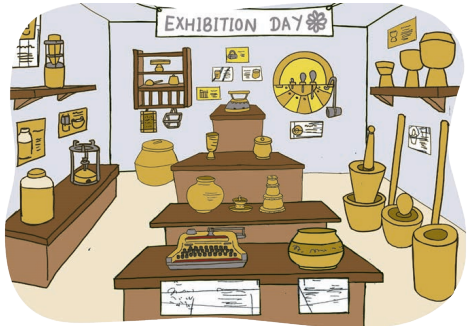
Figure: Display of collected artefacts
Pre-Activity Discussion
- Discuss the purpose of an exhibition such as sharing knowledge, celebrating heritage and engaging the community.
- Talk about the roles needed such as setup crew, greeters, demonstrators, label writers, feedback collectors.
- Discuss how to write good exhibition labels that are brief, informative and engaging.
- Understand the importance of collecting feedback to improve future exhibitions.
Procedure (Steps to Follow)
- Organise an artefact exhibition in your school with your classmates under the guidance of your teacher. Choose a suitable date and place in the school that has enough space for exhibits and visitors.
- Work in groups to select five artefacts for the museum. Write short and simple descriptions for each artefact on labels. Decide whether the labels will be placed on boards or kept near the artefacts.
- Arrange tables, stands and display boards neatly. Make sure all artefacts are safe, visible and properly labelled.
- Make posters, flyers and social media posts to tell others about the exhibition.
- Invite parents, friends, teachers and community members to visit the exhibition.
- Conduct the exhibition and collect feedback from visitors to know what went well and what can be improved.
Draw a sketch to show the layout of how the artefacts will be exhibited.
Keep a visitor’s book for feedback and comments related to your presentation, about the artefacts on display and any other feedback.
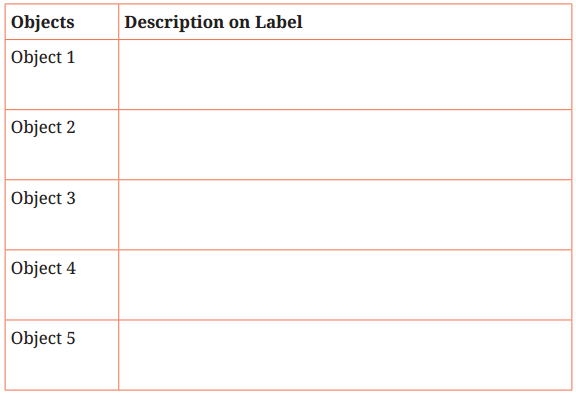
Labels to describe objects briefly
Draw a sketch to show the layout of how the artefacts will be exhibited.

Question 1.
What is the purpose of an exhibition label?
Answer:
The purpose of an exhibition label is to provide visitors with important information about an artefact, such as its name, history, use and cultural significance.
Labels help people understand and appreciate the artefact without needing to ask questions, making the exhibition more educational and engaging.
Question 2.
Why is it important to collect feedback from visitors after an exhibition?
Answer:
Collecting feedback from visitors after an exhibition is important because it helps understand what visitors liked, learned or found confusing.
Feedback shows how effective the displays and presentations were and provides ideas for improving future exhibitions, making them more engaging, educational and enjoyable for everyone.
Question 3.
Name three roles that students can play during a school museum exhibition.
Answer:
Three roles that students can play during a school museum exhibition are
(i) Curator: Selecting, organising and caring for artefacts.
(ii) Presenter/Guide: Explaining the history, use and significance of artefacts to visitors.
(iii) Designer/Decorator: Creating labels, posters and displays to make the exhibition attractive and informative.
Question 4.
Why is it important to arrange artefacts neatly in an exhibition?
Answer:
It is important to arrange artefacts neatly in an exhibition because it makes them easy to see and understand.
A proper arrangement also helps keep the artefacts safe and creates a clean and organised display for visitors.
Question 5.
How does an exhibition help people learn about history and culture?
Answer:
An exhibition helps people learn about history and culture by showing artefacts, pictures and information about the past. It allows visitors to see how people lived, their traditions and their way of life, making learning easy and interesting.