To prepare effectively, include Kaushal Bodh Book Class 6 Solutions Project 2 and Class 6 Kaushal Bodh Chapter 2 Biodiversity Register Question Answer in your daily study routine.
Class 6 Vocational Education Chapter 2 Question Answer
Kaushal Bodh Class 6 Chapter 2 Question Answer Biodiversity Register
What did I learn from others? [Page No. 50]
Question 1.
You discussed with experts all the measures that can be taken to preserve biodiversity in the area. What do you think will work?
Answer:
The measures that can be taken to preserve biodiversity in the area are
- Protecting natural habitats such as forests, ponds, and fields so that plants and animals can live and grow safely.
- Planting more native trees and plants to maintain ecological balance and support local species.
- Reducing the use of harmful chemicals like pesticides and weedicides in farming to protect soil, water, and living organisms.
- Creating awareness among people about the importance of biodiversity and encouraging community participation in conservation activities.
I think that a combination of all these measures will work together. Protecting habitats along with community awareness will be most effective because it ensures long-term care and responsible behaviour towards nature.
Interaction with members of the community [Page No. 51]
Question 1.
You might have spoken to a farmer in a rural area, a nursery worker or a gardener in the city or a community member in the rural or urban area. Write about how the biodiversity changed over the years in the area, let us say in the last 10 or 20 years.
Answer:
Over the last 10-20 years, biodiversity in the area has changed noticeably based on interactions with community members such as farmers, gardeners and nursery workers. Earlier, many native plants, birds and insects were commonly seen in fields, gardens and open spaces. However, with increasing construction, urbanisation and use of chemicals in farming, the number of natural habitats has reduced.
Some species of birds and insects have become less common, while a few adaptable species have increased. Seasonal plants and wild herbs that were once easily found are now rare in many places. Community members also shared that water bodies and green areas have reduced in size, affecting overall biodiversity.

Think and Answer [Page No. 53]
Question 1.
What did you enjoy doing?
Answer:
I enjoyed observing different plants, insects, birds and animals in my surroundings and identifying new species. Visiting different places and making sketches or taking photographs made the activity interesting and engaging.
Question 2.
What were the challenges you faced?
Answer:
The main challenges I faced were
- Finding the scientific names of many plants and insects.
- Some living things were too smalt to see clearly.
- Visiting the same place in different seasons.
- Filling all columns in the register.
Question 3.
What will you do differently next time?
Answer:
I will do the following things differently next time
- I will carry a magnifying glass every time.
- I will start my visits earlier in the school year so I can cover more seasons.
- I will prepare my questions for the expert in advance.
- I will involve more group members to cover different observation spots at the same time.
Question 4.
What according to you is the importance of the biodiversity register?
Answer:
The biodiversity register is important for the following reasons
- It helps us document all the living things in an area so that nothing is forgotten.
- It tells us when plants and animals are disappearing so we can protect them.
- It preserves local and traditional knowledge about plants — their uses, growing seasons and medicinal value.
- It helps scientists, farmers and the government plan better for protecting nature.
- It connects us with our environment and makes us more responsible towards it.
Question 7.
What other jobs are related to the project? Look around, speak to people and write your answer. A few examples of jobs related to the activity that you did are forest officer, scientist, and conservationist.
Answer:
Jobs related to this project include forest officer, conservationist, wildlife biologist, botanist, agricultural scientist, zoologist, horticulturist, environmentalist, nursery worker, farmer, park ranger, researcher and teacher. These people work to study, protect, and preserve biodiversity for future generations.
Project 2 Biodiversity Register Class 6 Question Answer
Activity 1: What is Around Us?
Purpose of the Activity
This activity helps students in observe the variety of living things around them and identifying the places where they are found. The given information can be used to plan field visits for preparing biodiversity register.
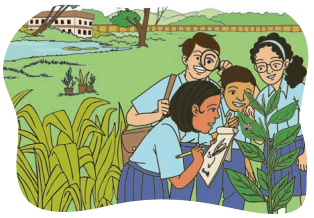
Figure: Recording observations of living things around us
Pre-Activity Discussion
- Discuss what is meant by ‘living things’ and list examples.
- Talk about different habitats or ‘homes’ of living things (e.g., trees, ponds, soil and air).
- Discuss why it is important to record observations carefully.
- Understand that the same living thing may have different names in different languages.
Procedure (Steps to follow)
- Look carefully around your school, home and nearby areas.
- Observe the living things — plants, insects, birds, animals and worms.
- Note their names in as many languages as you know (local, Hindi, English).
- Write down the places where you find them — near water, in a field, in a park, etc.
- You may make a sketch or paste a photograph if you want.
Identifying Locations Where You can Observe a Variety of Living Things
| Living Things | Names (in different languages) | Places Where Found |
| Insects | ||
| Birds | ||
| Animals | ||
| Worms | ||
| Plants |
Question 1.
Name three living things you found near your school. Where exactly did you see them?
Answer:
The three living things found near the school are
- Neem Tree Found in the school garden and along the boundary wall.
- Sparrow Spotted on the school rooftop and near the water tap.
- Earthworm Found in the moist soil of the garden bed after watering.
Question 2.
Did you find any living thing that surprised you? Describe it.
Answer:
Yes, I was surprised to find a small lizard hiding under a stone near the school garden. It was brown in colour and blended with the ground, making it hard to notice. I had not expected to find a reptile on the school campus. It showed that even small spaces can support wildlife.
Question 3.
Why do you think some areas have more living things than others?
Answer:
Some areas have more living things than others because they provide better conditions for survival. Areas with more water, shade, plants and nutrients attract more organisms. For example, a garden or pond has more biodiversity than a cemented playground because it offers food, shelter and moisture for many species.
Question 4.
In which places did you find insects and worms? Describe their habitats.
Answer:
Insects and worms are commonly found in moist and natural environments.
Insects can be seen in gardens, on plants, near water sources and around lights. Worms are usually found in soil, especially in damp areas like gardens and compost pits, where they help in breaking down organic matter.
Question 5.
Why is it useful to write the names of living things in different languages?
Answer:
It is useful to write the names of living things in different languages because
- It helps people from different regions and language backgrounds identify and understand the same living things easily.
- It improves communication and learning by connecting local knowledge with common scientific and national understanding of biodiversity.
Kaushal Bodh Class 6 Biodiversity Register Question Answer
Activity 2: Purpose of the Activity
This activity helps students in gaining knowledge about biodiversity through interaction with experts. It develops understanding about local plants, animals, conservation practices and traditional knowledge, and provides useful guidance for preparing a biodiversity register.
Pre-Activity Discussion
- Discuss who can be considered a biodiversity expert (e.g., farmers, forest officers, elders).
- Differentiate between native (local) and introduced plants.
- Learn about the role of traditional medicine and the knowledge of practitioners like Vaidyas.
- Understand how experts can help us identify changes in the local environment over time.
Procedure (Steps to follow)
Experts can be invited to speak about biodiversity, such as a forest officer, farmer, or conservationist.
Note You can also invite an Ayurvedic practitioner (Vaid or Vaidya), who can tell you about traditional medicinal plants used in your region.
Questions to Ask the Experts
1. Where can different kinds of plants be found in the locality?
2. How can it be known whether plants are native or brought from other places?
3. Are there any plants that are no longer found in the locality?
4. Which plants should be grown more to support biodiversity?
5. Are there any plants that should not be grown because they harm biodiversity?
6. What suggestions can help in preparing a biodiversity register?
Question 1.
Who was the expert you met? What is their , profession?
Answer:
I met a local forest officer. His profession is to manage and protect the nearby forest reserve. He works for the Forest Department and has years of experience studying plants, trees and wildlife in our region.
Question 2.
What is the most interesting fact you learnt from the expert?
Answer:
The most interesting fact I learnt was that some plants that look like weeds are actually used in Ayurvedic medicine. The expert told us that many local plants have important healing properties, but people are cutting them down without knowing their value.
This made us realise the importance of recording all plants, even the ones we think are useless.
Question 3.
Name two plants that the expert mentioned that are useful for medicine or food.
Answer:
The two plants that the expert mentioned that are useful for medicine or food are
- Tulsi (Ocimum tenuiflorum): Used in Ayurvedic medicine for treating coughs, colds and infections.
- Neem (Azadirachta indica): Its leaves and bark are used in medicine for treating skin diseases, and as a natural pesticide in farming.
Question 4.
Did the expert mention any plant that has disappeared from your area? Why did it disappear?
Answer:
Yes, the expert mentioned that a wild berry plant, locally known as ‘Karonda’, is no longer found in the area. It disappeared mainly because the land it grew on was cleared for construction.
Changes in land use and the cutting of native vegetation have caused several such plants to disappear from our region.
Question 5.
How did the expert’s knowledge help you understand biodiversity in your local area ?
Answer:
The expert’s knowledge helped me understand biodiversity in my local area by explaining different types of plants and animals found nearby. I also learned how to identify native and introduced plants and understood the importance of protecting useful species and preserving the natural balance of the environment.
Activity 3: Identify Places to Survey
Purpose of the Activity
This activity helps in identifying suitable locations for surveying biodiversity. It develops the ability to observe different habitats, recognise the variety of living organisms present and understand how biodiversity varies from one place to another.
Procedure (Steps to follow)
Decide which places to visit for recording biodiversity. Types of places you can visit are
- Near school
- Near water bodies
- Around the home
- Farms, gardens or nurseries
- Near a religious place
- Near a market
The selected locations should be easily accessible so that they can be visited again to verify observations or collect additional information.
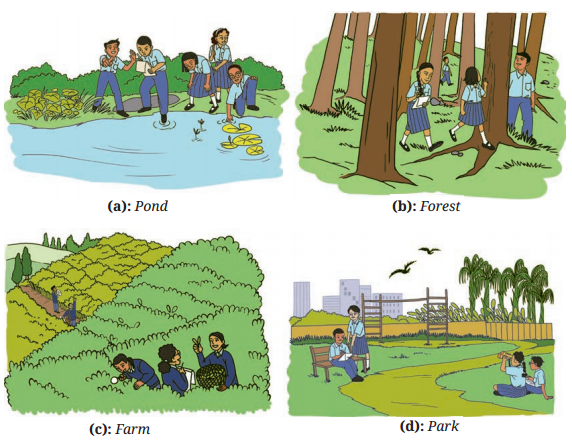
Use these Questions to Plan your Survey
1. What types of habitats are there near you? (Forest, wetland, farm, urban park, etc.)
2. Have you noticed places where plants grow in large numbers?
3. What types of birds, mammals and insects have you seen around you?
4. Are there any special efforts to protect plants or animals in certain areas?
Question 1.
What is the purpose of identifying places before starting a biodiversity survey?
Answer:
The purpose of identifying places before starting a biodiversity survey is to select suitable and easily accessible locations where different types of living organisms can be observed. It also helps in planning the survey properly so that biodiversity can be recorded accurately from a variety of habitats.
Question 2.
Name any two places where you can easily observe biodiversity.
Answer:
Two places where I can easily observe biodiversity are
- Around the home
- Near water bodies
Question 3.
Why is it important to select places that can be visited again?
Answer:
It is important to select places that can be visited again so that observations can be checked and verified. It also helps in collecting additional information over time and allows students to study changes in biodiversity in the same location.
Question 4.
What types of living organisms can be commonly seen near water bodies or gardens?
Answer:
Near water bodies or gardens, a variety of living organisms can be commonly seen. These include aquatic plants, insects like dragonflies and butterflies, birds such as herons and sparrows, and small animals like frogs, fish and earthworms, all of them depend on these habitats for food and shelter.
Question 5.
How does biodiversity vary from one place to another in your surroundings?
Answer:
Biodiversity varies from one place to another in my surroundings because different areas provide different habitats and conditions. For example, gardens have more plants and insects, water bodies have fish and aquatic plants, while urban areas mainly have birds and small animals that can adapt to human activity.
Activity 4: Scheduling Visits for Observing Biodiversity
Purpose of the Activity
This activity helps in planning and organising visits to different locations for observing biodiversity. It ensures that observations are made systematically at different times, allowing changes in living organisms across seasons to be recorded accurately.
Pre-Actìvity Discussion
- Discuss how the environment changes with the seasons (e.g., summer, monsoon, winter).
- Talk about how these seasonal changes might affect the plants and animals we see (e.g., migratory birds, flowering/fruiting seasons).
- Understand why a single visit is not enough to understand the biodiversity of a place.
- Discuss the equipment needed for a field visit and its purpose (e.g., notebook for recording, camera for evidence).
Procedure (Steps to follow)
- Form groups of a maximum of 5 students.
- Consult local experts, biologists, or conservationists for advice.
- Plan visits at different times of the school year — this helps you see seasonal changes in biodiversity.
- Carry all necessary equipment: binoculars, magnifying lens, camera, field guides, notebook.
| Schedule of Visits | ||
| Visit | Number & Place | Date & Season |
| Visit 1: | ||
| Visit 2: | ||
| Visit 3: | ||
| Visit 4: | ||
| Visit 5: | ||
| Visit 6: | ||
Question 1.
How many visits did you plan in total?
Answer:
We planned a total of 6 visits
- 2 visits to the school garden
- 2 visits to the nearby pond
- 2 visits to the agricultural field
The visits were scheduled at different times of the school year — once during the monsoon season and once during the winter season — so that we could observe seasonal changes in biodiversity.
Question 2.
Why is it important to visit the same place in different seasons?
Answer:
It is important to visit the same place in different seasons because living things change their behaviour, appearance and availability with the seasons. Some plants only flower or fruit in a specific season.
Certain insects and birds appear only in certain months. By visiting in different seasons, we get a more complete and accurate picture of the biodiversity of an area.
Question 3.
Which equipment will you carry on your visit and why?
Answer:
I will carry a notebook, camera, and magnifying glass to record observations, take photos, and observe small organisms closely.
Question 4.
How does seasonal change affect the types of plants and animals seen in a place?
Answer:
Seasonal changes affect the types of plants and animals seen in a place because different organisms appear or become active in different seasons.
In some seasons, plants may flower or bear fruit, while in others they may dry or shed leaves. Similarly, some birds migrate, and certain insects and animals are seen only during specific seasons.
Question 5.
Why is it useful to take advice from experts while planning biodiversity visits?
Answer:
It is useful to take advice from experts while planning biodiversity visits because they provide accurate information about local plants, animals and habitats.
They also help in selecting suitable places and timings for observation, ensuring safety during field visits, and improving the quality of data collected for the biodiversity study.
Activity 5. Filling in the Biodiversity Register
Purpose of the Activity
This activity helps in recording and organising information about different types of plants and pests found in various locations. It develops observation, data collection and documentation skills.
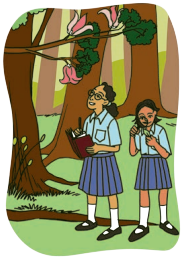
Figure: Observing with the naked eye and a magnifying lens
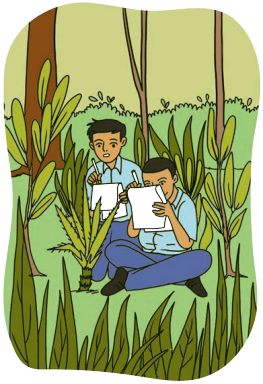
Figure: Recording observations
Pre-Activity Discussion
- Define and give examples for the five categories
- Crop plants
- Fruit plants
- Fodder plants
- Weed plants
- Pests
- Differentiate between a weed and a crop, and a pest and a helpful insect.
- Discuss the importance of using local and scientific names for accurate identification.
- Understand how information like season, weather, and location is important context for the observation.
Procedure (Steps to follow)
Observe and record biodiversity in five categories: crop plants, fruit plants, fodder plants, weed plants, and pests. Fill the tables carefully during or after each visit.
Tips for Filling the Register
- Share observations with group members-someone may notice what you missed.
- Add new information every time you revisit a place.
- Make sketches or take photos of unknown plants and insects to identify them later.
- If you cannot find information for a column, ask your teacher before leaving it blank.
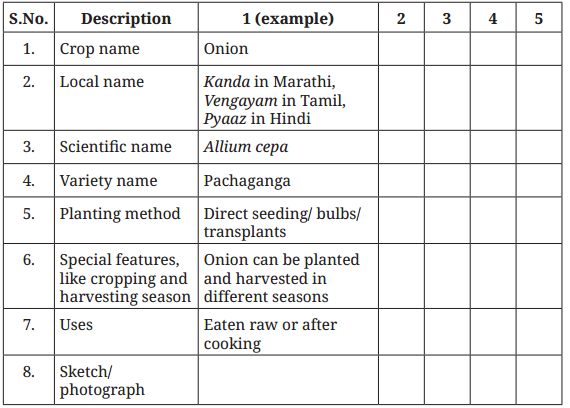
I. Observation of Biodiversity in Crop Plants
Record the details of crop plants you observe during your visit.
1. Date ___________
2. Location ___________
3. Habitat Type ___________
4. Weather condition ___________
5. Observation ___________
Description of Crops
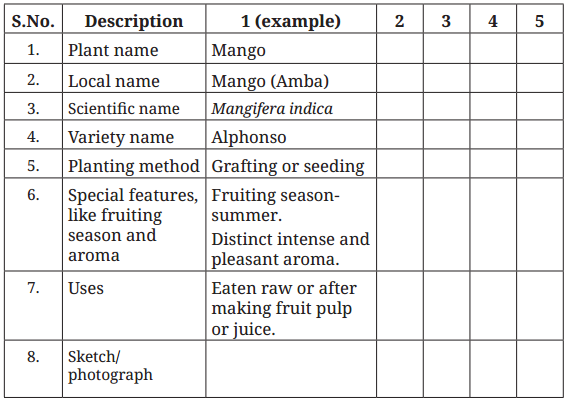
II. Observation of Biodiversity in Fruit Plants
1. Date
2. Location
3. Habitat Type
4. Weather condition
5. Observation
Description of fruit plants
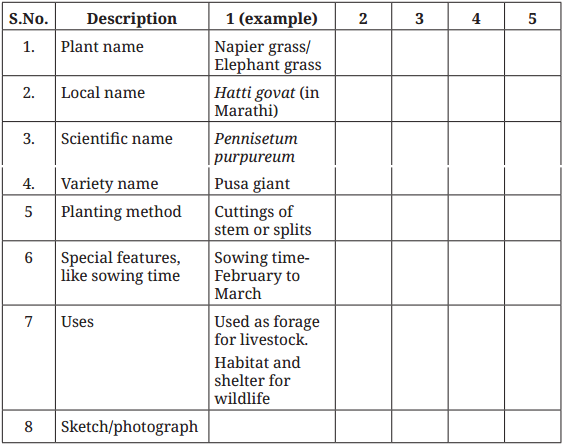
III. Observation of Biodiversity in Fodder Plants
They also serve as habitat and shelter for wildlife.
1. Date ___________
2. Location ___________
3. Habitat Type ___________
4. Weather condition ___________.
5. Observation ___________
Description of Fodder Plants
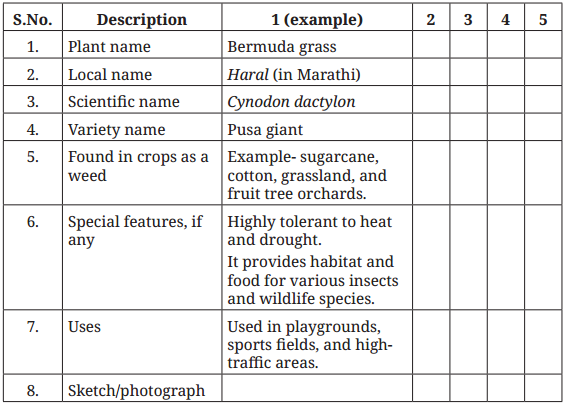
IV. Observation of Biodiversity in Weed Plants
1. Date ___________
2. Location ___________
3. Habitat Type ___________
4. Weather condition ___________
5. Observation ___________
Description of weed plants
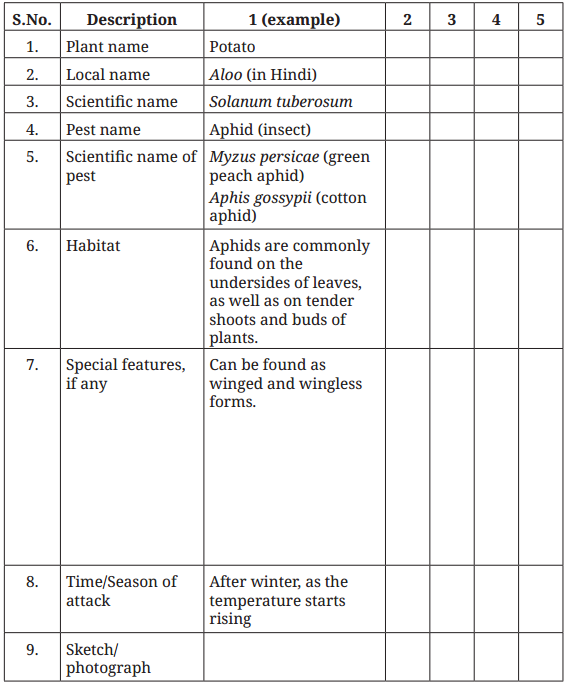
V. Observation of Biodiversity in Pests
1. Date of Observation
2. Location
3. Habitat Type
4. Weather Condition
5. Observations
Description of pests
Question 1.
Name any two crop plants you observed. What are they used for?
Answer:
The two crop plants that I observed are
- Onion (Allium cepa): Used in cooking both raw and cooked in almost every Indian dish.
- Tomato (Solanum lycopersicum): Used in cooking curries, sauces and salads; also eaten raw.
Question 2.
What is the difference between a weed and a pest?
Answer:
The difference between weed and pest is as follows
| Weed | Pest |
| Weeds are unwanted plants that grow in fields or gardens and compete with crops for water, sunlight and nutrients. | Pests are insects, birds or animals that damage plants by feeding on their leaves, stems, roots or fruits. |
| Example Bermuda grass (Cynodon dactylon) grows in crop fields like sugarcane and cotton fields. | Example Aphids (Myzus persicae) attack potato plants by feeding on their leaves. |
Question 3.
Name any one fruit plant with its scientific name and Gl tag (if any).
Answer:
Mango (Mangifera indica). The Alphonso variety of mango has been awarded the Geographical Indication (Gl) tag, which confirms that it comes from specific regions of Maharashtra — particularly Ratnagiri and Sindhudurg.
Question 4.
In which season did you observe the most variety of living things? Why?
Answer:
We observed the greatest variety of living things during the monsoon season (June-August). This is because rainfall brings moisture to the soil, encouraging more plants to grow, and more insects and frogs become active.
Birds also appear in greater numbers as they find more food. The whole ecosystem becomes more active during this season.
Question 5.
Were any weeds useful to animals or insects? Give an example.
Answer:
Yes, Bermuda grass (Cynodon dactylon), which is a weed found in sugarcane and cotton fields, provides habitat and food for various insects and wildlife species.
Despite being a weed in crops, it supports biodiversity by sheltering small insects and birds. It is also used in playgrounds and sports fields due to its tolerance to heavy foot traffic.
Activity 6: Identifying the Unknown
Purpose of the Activity
This activity helps in completing missing or unclear information in the biodiversity register. It develops research and identification skills by using different sources such as experts, books and digital tools.
Pre-Activity Discussion
- Discuss what to do when we don’t know the name of a plant or insect we observed.
- List different sources of information available to us (people, books, internet).
- Introduce the concept of AI tools like Google Lens and explain how they can help identify objects from images.
- Understand that it’s okay to have unknown things and that finding answers is part of the learning process.
Sources of Information
Missing or incomplete details can be completed by consulting experts or knowledgeable people, referring to library books, and using AI tools such as Google Lens to identify plants, insects and pests.
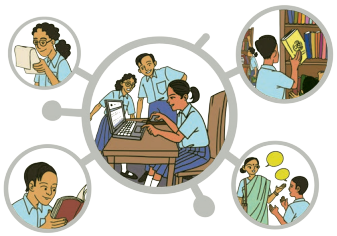
Figure: Use multiple sources of information to find the information you need
Question 1.
Name one plant or insect you identified using Google Lens or another app. What information did you find?
Answer:
identified a small pink flowering plant near the pond using Google Lens. It turned out to be Portulaca grandiflora, commonly known as ‘Moss Rose’ or‘Table Rose’.
The app provided its scientific name to me and it belongs to the Portulacaceae family, and mentioned that it is often used as a ground cover in gardens. I was able to add this information to my biodiversity register.
Question 2.
Which source of information did you find most useful — expert, book, internet or AI? Why?
Answer:
I found the AI tool (Google Lens) most useful because it gave instant results from just a photograph. I did not need to know the name of the plant or insect in advance — the app identified it from the image.
This was very helpful in the field where I could not carry many books. However, the expert’s knowledge was most valuable for understanding the local uses and medicinal value of plants.
Question 3.
Were there any living things you could not identify? What will you do to find out more?
Answer:
Yes. I found a small brown beetle near the pond that I could not identify, even with Google Lens. To find out more, I will
- Photograph it clearly and show it to a biology teacher.
- Visit the school library to look through insect identification books.
- Ask a local entomologist or naturalist.
- • Upload the photo to a nature observation website where experts can help with identification.
Question 4.
Why is it important to use more than one source of information when identifying unknown plants or insects?
Answer:
it is important to use more than one source of information when identifying unknown plants or insects because different sources may provide different levels of accuracy and detail.
By comparing information from experts, books, the internet and AI tools, we can confirm the correct identity and reduce the chances of mistakes in our biodiversity register.
Question 5.
How can identifying unknown living things help improve your biodiversity register?
Answer:
Identifying unknown living things helps improve the biodiversity register by making the information more complete and accurate. It ensures that all observed plants, insects and animals are properly named and recorded, which improves the quality of data and helps in better understanding of local biodiversity.
Activity 7: Presentation of the Biodiversity Register
Purpose of the Activity
This activity helps in organising and presenting the information collected about biodiversity. It develops skills of analysis, summarisation and presentation, and helps in understanding the variety and distribution of living things across different places.
Pre-Activity Discussion
- Discuss why it is important to share our findings with others.
- Talk about different ways to present information (charts, models, talks, posters) and what makes a presentation effective.
- Understand that a good summary includes only the most important information.
- Discuss how to look for patterns in our observations, such as comparing biodiversity between two different places.
Procedure (Steps to follow)
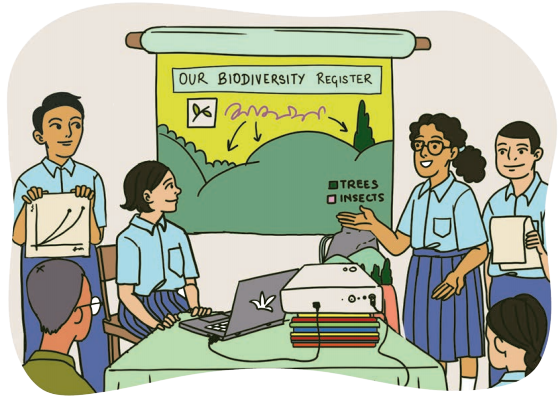
- Prepare a presentation on the biodiversity of the places visited using the information collected.
- Charts, diagrams, models or other creative methods may be used.
- The presentation should be based only on observations and gathered information.
- Highlight the variations in places and living organisms, which reflect biodiversity.
- Presentation can be in two parts
Part 1: Summary of What You Have Gathered
Combine all your information from the different tables to create a summary. Imagine you have to explain the biodiversity of your area to a visitor. Answer these questions to build your summary
1. What are the different plants that grow in the areas around you?
2. Which plants grow in all seasons, and which are seasonal?
3. Can all crops and fruits be harvested in the same season?
4. Do all plants flower in the same season?
5. Are the plants useful to us? If yes, how?
6. Is the same fodder available throughout the year or only during some seasons?
7. Are all plants affected by weeds?
8. Are some weeds useful? Please name some weeds and describe their use.
9. Are all plants affected by some sort of pests?
10. Are plants affected by some pests more in some seasons than others?
11. What information did you gather from people in the community (e.g., use of plants as medicine, as fodder, sacred plants, etc.)?
Part 2: Go Beyond the Information You Have Gathered
Think of different ways to present the collected information for a better understanding of biodiversity. The presentation should include a combination of diagrams and explanations, using creative and interesting methods. Some guiding questions are given below, but try and think of others.
1. Did you observe more living things in one place compared to others?
2. How many varieties of plants and pests did you see in the places you visited?
3. Did you find the same kinds of insects, pests, or worms in more than one place?
4. Did you use any Al tool for this activity? If yes, which ones and how?
5. Did you use any other sources to gather information?
Add any conclusion or reflection you would like to present based on your observations.
Question 1.
Which place had the most variety of living things? Why do you think so?
Answer:
The area near the pond had the most variety of living things. We observed water plants, land plants, insects like dragonflies and butterflies, frogs, fish and several birds.
Ponds provide water, food, and shelter for both aquatic and land-based organisms. The moist soil around the pond also supports more plant variety than dry areas.
Question 2.
Did the number or type of living things change between seasons? Give an example.
Answer:
Yes, the number and type of living things changed between seasons. During the monsoon season, we saw many more frogs, dragonflies and flowering plants near the pond.
During winter, we noticed different migratory birds that were not present in summer.
Also, some crop plants like onions were only seen during the winter season, while others like tomatoes grew during the summer.
Question 3.
What measures can be taken to protect the biodiversity in your area?
Answer:
Measures can be taken to protect the biodiversity in an area are as follows
- Stop cutting trees and native plants unnecessarily.
- Avoid throwing garbage in or near the pond, as it pollutes the water and harms aquatic life.
- Use organic pesticides instead of chemical ones, which harm beneficial insects like bees.
- Plant more native trees and flowering plants to attract birds and insects.
- Spread awareness among community members about the importance of protecting local plants and animals.
- Join or support local conservation groups and participate in tree plantation drives.
Question 4.
What did you learn from your interaction with local experts or community members?
Answer:
From the expert (forest officer), we learnt that some plants that look like weeds have medicinal value, and that habitat destruction is the main reason for biodiversity loss in our area.
From a local farmer, we learnt that crop varieties grown 20 years ago are no longer available because farmers switched to hybrid seeds.
Question 5.
What challenges did you face while collecting and presenting biodiversity information.
Answer:
Faced the following challenges while collecting and presenting biodiversity information
- It was difficult to identify some plants and insects correctly because their names and features were not known, so I had to use books, experts and apps for help.
- Recording all details carefully and organising them in the correct format for the register took time and effort.