Each of our Ganita Manjari Class 9 Worksheet and Class 9 Maths Chapter 2 Introduction to Linear Polynomials Worksheet with Answers focuses on conceptual clarity.
Class 9 Introduction to Linear Polynomials Worksheet
Ganita Manjari Class 9 Chapter 1 Worksheet
Multiple Choice Questions
Question 1.
Which of the following is a linear polynomial?
(a) x2 + 2x + 1
(b) x3 – 1
(c) 3x + 7
(d) x2 – 4
Answer:
(c) 3x + 7
A linear polynomial is a polynomial of degree 1, i.e. the highest power of the variable is 1.
The given expression is 3x + 7.
Here, the degree is 1 so 3x + 7 is linear polynomial.
Question 2.
The length of a rectangle is 8 cm more than three times its width. If the perimeter of the rectangle is 64 cm, then the width of the rectangle is
(a) 5 cm
(b) 6 cm
(c) 7 cm
(d) 8 cm
Answer:
(b) 6 cm
Let the width of a rectangle be x cm.
Then, the length of a rectangle = 3x + 8.
Given, perimeter of rectangle = 64
∴ 2(l + b) = 64
⇒ 2[(3x + 8) + x] = 64
⇒ 2(4x + 8) =64
⇒ 8x + 16 =64
⇒ 8x = 48
⇒ x = 6
Hence, the width of a rectangle is 6 cm.

Question 3.
What is the coefficient of x2 in the polynomial P(x) = 7 -5x2 + 4x3?
(a) 7
(b) -5
(c) 4
(d) 0
Answer:
(b) -5
Given, P(x) = 7 – 5x2 + 4x3
The coefficient of x2 is the numerical factor that multiplies x2.
Here, the term containing x2 is -5x2.
Therefore, the coefficient of x2 is -5
Question 4.
Let P(x) = 4x4 -3x3 + 2x2 -5x + 7.
Find P(2) – P(-1).
(a) 18
(b) 20
(c) 24
(d) 28
Answer:
(c) 24
Given, P(x) = 4x4 – 3x3 + 2x2 — 5x + 7
On putting x = 2, P(2)
= 4(2)4 – 3(2)3 + 2(2)2 – 5(2) + 7
= 4 x 16 -3 × 8 -2 × 4 – 10 + 7
= 64 – 24 + 8 – 10 + 7 = 45
On putting x = 1,
P(1) = 4(-1)4 – 3(-1)3 + 2(-1)2 -5(-1) + 7
= 4 + 3 + 2 + 5 + 7 = 21
Now, P(2) – P(1) = 45 – 21 = 24
Question 5.
A sports academy charges a one-time registration fee of ₹ 500 and ₹ 120 for every training session attended.
| Number of Session (s) | 1 | 23 | 3 | 4 |
| Amount Paid (₹) | 620 | 740 | 860 | 980 |
If the total amount paid is represented by the linear polynomial P(s), then P(10) is
(a) ₹ 1200
(b) ₹ 1500
(c) ₹ 1700
(d) ₹ 2000
Answer:
(c) ₹ 1700
Given, the fixed cost or registration fee = ₹ 500
and the variable cost = ₹ 120
If s be the number of training session, then the
total cost = 500 + 120s
For s = 10, P(l0) = 500 + 120 × 10
= 500 + 1200 = ₹ 1700
Question 6.
A fitness center charges a fixed monthly membership fee and an additional cost for every personal training session attended.
A member noticed that when they attended 5 sessions, their bill was ₹ 2000. When they attended 8 sessions, their total bill was ₹ 2,900.
If the total monthly bill y depends on the number of sessions x according to the linear y = ax + b, what are the values of a (cost per session) and b (fixed fee)?
(a) a = ₹ 300 and b = ₹ 500
(b) a = ₹ 250 and b = ₹ 750
(c) a = ₹ 300 and b = ₹ 400
(d) a = ₹ 450 and b = ₹ 250
Answer:
(a) a = ₹ 300 and b = ₹ 500
Let the cost per training session be ₹ a and the fixed monthly membership fee be ₹ b.
According to the given information.
For 5 session, 5a + b = 2000 ….. (i)
For 8 session, 8a + b = 2900 …..(ii)
On subtracting Eq. (i) from Eq. (ii), we get
8a + b – (5a + b) = 2900 – 2000
⇒ 3a = 900
⇒ a = \(\frac{900}{3}\) = 300
On substituting a = 300 in Eq. (i), we get
5(300) + b = 2000
⇒ 1500 + b = 2000
⇒ b = 2000 – 1500 = ₹ 500
Therefore, the cost per session is ₹ 300 and the fixed monthly membership fee is ₹ 500.
Question 7.
The digits of a two digit number differ by 2. If the digits are interchanged and the resulting number is added to the original number, the sum is 88. Find the original number.
(a) 31
(b) 42
(c) 53
(d) 64
Answer:
(b) 42
Let the tens digit be x and the units digit be y.
∴ Original number = 10x + y
When the digits are interchanged, the number becomes 10y + x
According to given information.
x – y = 2 …(i)
and (10x + y) + (10y + x) = 88
⇒ 1(x + y) = 88
⇒ x + y = 8 … (ii)
On adding the Eq.s (i) and (ii), we get
2x = 10
⇒ x = 5
On putting the value of x = 5 in Eq. (i), we get
x – y = 2
⇒ 5 – y = 2
⇒ y = 3
Hence, the original number is
= 10x + y = 10 × 5 + 3 = 53
Question 8.
If the graphs of 3x – 4 = 12 is transformed by shifting it 2 units to the right, the new equation becomes.
(a) 3x – 4y = 6
(b) 3x – 4y = 18
(c) 3x – 4y = 12
(d) 3x – 4y = 20
Answer:
(b) Given equation is
3x – 4y = 12
When the graph is shifted 2 units to the right, x
is replace d by(x-2).
⇒ 3(x-2) – 4y = 12
⇒ 3x – 6 – 4y = 12
⇒ 3x – 4y = 18
Hence, the new equation is 3x – 4y = 18
Question 9.
If the point (a2, a) lies on the line x – 2y – 8 = 0, the possible values of a are.
(a) {4,2}
(b) {4, -2}
(c) {-4,2}
(d) {-4,-2}
Answer:
(b) {4, -2}
Given point (a2, a) lies on the line is x – 2y – 8 = O
Since the point lies on the line.
∴ x = a2, y = a
On substituting the above values, we get
a2 – 2a – 8 = 0
⇒ a2 – 4a + 2a – 8 = 0
= a(a – 4) + 2(a – 4)= 0
= (a – 4)(a + 2) = 0
a = 4 or a = -2
Hence, the possible values of a are {4, —2}.
Question 10.
If the lines ax + by = c and bx + ay = d intersect on the X-axis, the relationship between the coefficients is
(a) ad = be
(b) ac = bd
(c) a2 = b2
(d) ab = cd
Answer:
(a) Given lines are
ax + by = c …(i)
and
bx + ay = d …(ii)
Since the lines intersect on the X-axis, the y-coordinate of the point of intersection is 0. So, let the point of intersection be (x, 0). On substituting y = 0 in the Eq. (i), we get
ax + b(0) = c
⇒ ax = c
⇒ x = \(\frac{c}{a}\)
On substituting y = 0 in the Eq. (ii), we get
bx + a(0) = c
⇒ ax = c
⇒ x = \(\frac{c}{a}\)
On substituting y = 0 in the Eq. (ii), we get
bx + a(0)= d
⇒ bx = d
⇒ x = \(\frac{d}{b}\)
From Eqs. (i) and (ii), we get
\(\frac{c}{a}=\frac{d}{b}\)
⇒ ad = bc
Question 11.
Which of the following linear relationships a straight line that passes directly through the origin (0, 0)?
(a) y = 2x + 3
(b) y = – 5x
(c) y = x – 1
(d) y = 4
Answer:
(b) y = – 5x
A linear relationship is given by y = ax + b, where b is the y-intercept.
If a line passes through the origin (0, 0), its y-intercept must be zero, i.e. b = 0.
So, from the options, only y = -5x has b = 0.
On substituting x = 0 gives y = -5(0) = 0,
satisfying the origin.
Question 12.
Consider two linear relationships line 1, y = 4x + 7 and line 2, y = 4x – 3.
What is the geometric relationship between these two lines when visualised?
(a) They intersect at exactly one point (7, – 3).
(b) They are perpendicular to each other.
(c) They are parallel lines and will never intersect.
(d) They represent the exact same overlapping line.
Answer:
(c) They are parallel lines and will never intersect.
Given, two linear relationships
Line 1 : y = 4x + 7 and line 2 : y = 4x – 3
On comparing both equations with the standard linear form y = ax + b.
For line 1: slope (a1) = 4, y-intercept (b1) = 7
For line 2: Slope (a2) = 4, y-intercept (b2) = -3
Since, both lines share the identical slope (a1 = a2 = 4) but have different y-intercepts (b1 ≠ b1) they maintain a constant distance from each other. Geometrically, lines with equal slopes are parallel and never meet.
Assertion-Reason Questions
Direction (Question Nos 1-6) Select the correct option from (a), (b), (c), (d) as given below.
(a) Both A and R are true and R is the correct explanation of A.
(b) Both A and R are true but R is not the correct explanation of A.
(c) A is true, but R is false.
(d) A is falsem, but R is true.
Question 1.
Assertion (A) (3x – 2)(x + 4) is a polynomial of degree 2.
Reason (R) The degree of a polynomial is obtained by adding the degrees of the factors when two non-zero polynomials are multiplied.
Answer:
(a) Both A and R are true and R is the correct explanation of A.
We have (3x – 2)(x + 4) = 3x2 + 12x – 2x – 8
= 3x2 + 10x – 8
Here, the highest power of x is 2.
Hence, Assertion (A) is true.
Also, deg (3x – 2) = 1, deg (x + 4) = 1
and deg (3x – 2)(x + 4) = 1 + 1 = 2
Hence, both Assertion (A) and Reason (R) are true and Reason (R) is the correct explanation of Assertion (A).
Question 2.
A stationery shop charges of fixed packing fee of ₹ 30 and ₹ 12 per notebook purchased. Let x be the number of notebooks.
Assertion (A) The total cost can be represented by the linear polynomial P(x) = 12x + 30.
Reason (R) The value of the polynomial for 15 notebook is ₹ 210.
Answer:
(a) Both A and R are true and R is the correct explanation of A.
Given, fixed charge = ₹ 30
and charge per notebook = ₹ 12
Therefore, P(x) = 12x + 30
So Assertion (A) is true.
Now, P(15) = 12(15) + 30 = 180 + 30 = ₹ 210
Hence, Reason (R) is also true.
Hence, both assertion (A) and reason (R) are true and reason (R) is the correct explanation of assertion (A).
Question 3.
A taxi service charges according to the pattern shown below.
| Distance (km) | 1 | 2 | 3 | 4 | 5 |
| Fare (₹) | 35 | 45 | 55 | 65 | 75 |
The fare for x km is represented by F(x) = 10x + 25.
Assertion (A) The fare for travelling 12 km is ₹ 145.
Reason (R) F(x) = 10x + 25 is a polynomial with exactly two terms and degree 1.
Answer:
(b) Both A and R are true but R is not the correct explanation of A.
Assertion (A) Given, the fare for x km is represented by f(x) = 10x + 25.
On substituting x = 12, we get
∴ F(12)= 10(12) + 25
= 120 + 25 = 145
Hence, Assertion (A) is true.
Also, F(x) = 10x + 25
Is a polynomial exactly two terms (10x and 25) and degree 1.
Therefore, Reason (R) is true.
Question 4.
Assertion (A) The linear equation x – 5 = 0 is parallel to the Y-axis.
Reason (R) For a line to be parallel to the Y-axis, the x-coordinate must be constant for all values of y.
Answer:
(a) Both A and R are true and R is the correct explanation of A.
Assertion (A) Given equation is x – 5 = 0.
⇒ x = 5
Here, the value of x is always constant but y can take any value.
So, the line x = 5 is parallel to the Y-axis.
Clearly reason is also true.
Hence, both Assertion and Reason are true, and Reason is the correct explanation of Assertion.
Question 5.
Assertion (A) The graph of the linear relationship y = 4x passes through the origin (0, 0).
Reason (R) A linear relationship is represented by straight line y = ax + b. When the y-intercept b = 0, the line always passes through the origin.
Answer:
(a) Both A and R are true and R is the correct explanation of A.
Assertion (A) Given, the equation of line is y = 4x.
On substituting x = 0. and y = 0 we get
LHS = y = 0
RHS = 4x = 4(0) = 0
∵ LHS = RHS, the point (0, 0) satisfies the equation.
∴ The line passes through the origin assertion (A) is true.
Clearly, reason is also true.
Hence, both assertion (A) and reason (R) are true and reason (R) is the correct explanation of assertion (A).
Question 6.
Assertion (A) The point (0, – 2) is the y-intercept of the line y = x – 2.
Reason (R) The y-intercept is the point where the line crosses the Y-axis, i.e., where x = 0,
Answer:
(a) Both A and R are true and R is the correct explanation of A.
Given line is y = x – 2
For y-intercept, the line crosses the Y-axis, so
x = 0
On substituting x = 0 in the equation, we get
y = 0 – 2
⇒ y = -2
So, the y-intercept is (0,2)
Hence, both Assertion and Reason are true, and Reason is the correct explanation of Assertion.
Class 9 Maths Introduction to Linear Polynomials Worksheet
Worksheet On Introduction to Linear Polynomials Class 9
Very Short Answer Questions
Question 1.
Determine the coefficient of the term independent of x in the polynomial
P(x) = 7x5 – 4X3 + 9X2 – 11
Answer:
The term independent of x is the constant term.
Here, the constant term is -11.
Question 2.
A polynomial has exactly three non-zero terms. Its highest degree is 2, its constant term is -5, the
coefficient of x2 is 2, and the coefficient of x is -4. Classify the polynomial according to the number of terms and basd on its degree.
Answer:
Given a polynomial has exactly three non-zero terms with degree 2.
Here, the coefficient of x2 = 2, then the term
= 2x2 the coefficient of x = -4, then the term
= – 4x and costant term = – 5
∴ The polynomial = 2x2 – 4x – 5
Since, the polynomial consists of exactly three non-zero terms, its is classified as a trinomial. Based on degree, the name of polynomial is quadratic polynomial.
Question 3.
Find the coefficient of x3 in (2x + x2)\(\left(x^2+\frac{1}{x}\right)\)
Answer:
We Have, \(\left(2 x+x^2\right)\left(x^2+\frac{1}{x}\right)\)
= 2x × x2 +2x × \(\frac{1}{x}\) + x2 × x2 + x2 × \(\frac{1}{x}\)
= 2x3 + 2 + x4 + x
= x4 + 2x3 + x + 2
Hence, the coefficient x3 is 2
Question 4.
The difference between two positive integers is 42. The ratio of the two integers is 5 : 8. Find the two integers.
Answer:
Let the two integers be 5x and 8x.
According to the given condition.
8x – 5x = 42
⇒ 3x = 42
⇒ x = 14
Hence, 5x = 5 x 14 = 70
8x = 8 × 14 = 112
Therefore, the two integers are 70 and 112.
Question 5.
For the polynomial P(x) = \(\frac{2 x^4+5 x^2-3}{4}+\frac{3}{2} x^3-x^5\) find the degree of the polynomial.
Answer:
Given, P(x) = \(\frac{2 x^4+5 x^2-3}{4}+\frac{3}{2} x^3-x^5\)
= \(\frac{1}{2} x^4+\frac{5}{4} x^2-\frac{3}{4}+\frac{3}{2} x^3-x^5\)
Rearranging the terms in descending powers of x.
P(x) = \(-x^5+\frac{1}{2} x^4+\frac{3}{2} x^3+\frac{5}{4} x^2-\frac{3}{4}\)
Here, the highest power of x is 5.
Therefore, the degree of the polynomial is 5.
Question 6.
Determine whether the point (2, -3) lies on the graph of x – 2y = 8. Provide a brief justification.
Answer:
The given point is (2,-3) and the equation of the graph is
x – 2y = 8
On substituting x = 2 and y = -3, we get
x – 2y = 2 – 2(-3) = 2 + 6 = 8
Since LHS = RHS, the point satisfies the equation.
Hence, the point (2, -3) lies on the graph of x – 2y = 8.
Question 7.
Find the slope and y-intercept of the 3y – x = 6.
Answer:
The given equation is 3y – x = 6
⇒ 3y = x + 6
⇒ y = \(\frac{x}{3}+\frac{6}{3}\)
⇒ y = \(\frac{1}{3}\) x + 2 …..(i)
On comparing Eq. (i) with y = mx + c, we get
slope, m = \(\frac{1}{3}\) and y-intercept c = 2
Question 8.
Consider the linear equation x = -2. Describe its graph and its intersection with the line y = 3.
Answer:
Consider the linear equation x = -2
Here, the value of x is always -2, but y can have any value.
So, its graph is a vertical line parallel to the Y-axis.
Now, the line y = 3
is a horizontal line parallel to the X-axis.
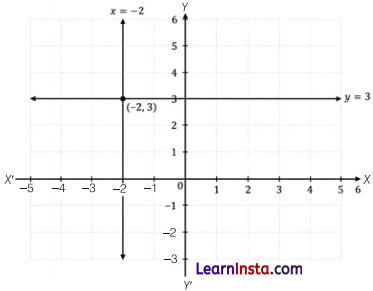
So, the point of intersection is (-2,3).
Question 9.
Write the general form of a linear equation in two variables that is parallel to the line ax + by + C = 0.
Answer:
Given line is ax + by + c = 0
We known that, a line parallel to this line must have the same coefficients of x and y, but a different constant term.
So, the general form of the parallel line of the given line is ax + by + k = 0,
where k is a constant.
Here, k ≠ c
Hence, the required general form of parallel line is
ax + by + k = 0, k ≠ c
Question 10.
Determine the number of solutions for the linear equation 2x + 3y = 7, if x and y must be positive integers.
Answer:
Given linear equation is 2x + 3y = 17
Here, x and y must be positive integers.
Check possible positive values of y.
For y = 1, 2x + 3(1) = 7
⇒ 2x + 3 = 7
⇒ 2x = 4
⇒ x = 2
So, (2,1) is positive integral solution.
For y = 2, 2x + 3(2) = 7
⇒ 2x + 6 = 7
⇒ 2x = 1
⇒ x = \(\frac{1}{2}\)
which is not an integer
If y = 3, then 3y = 9, which is already great than 7.
∵ x must be a positive integer (x ≥ 1), 2x will be at least 2.
∴ any y ≥ 3 will result in no positive integer solution for x.
Hence, the only positive integral solution is (2,1) Therefore, the number of solutions is 1.
Question 11.
If the graph of 3x + 2y = 12 intersects the Y-axis, find the coordinates of the point of intersection.
Answer:
Given equation is 3x + 2y = 12
Since, the graph intersects the Y-axis, so x = 0

On substituting x = 0 in the equation, we get
3(0) + 2y = 12
⇒ 2y = 12
⇒ y = 6
So, the point of intersection is (0, 6).
Hence, the graph intersects the Y-axis at (0, 6).
Short Answer Questions
Question 1.
For the polynomial Q(x) = \(\frac{4 x^4+9 x-5}{3}-\frac{7}{2} x^2+\frac{7 x^5}{2 x^3}\) find
(i) the coefficient of x
(ii) the number of terms.
Answer:
Given, Q(x) = \(\frac{4 x^4+9 x-5}{3}-\frac{7}{2} x^2+\frac{7 x^5}{2 x^3}\)
= [/latex]\frac{4}{3} x^4+3 x-\frac{5}{3}-\frac{7}{2} x^2+\frac{7}{2} x^2}[/latex]
Rearranging the terms in descending powers of x.
∴ Q(x) = \(\frac{4}{3} x^4+3 x-\frac{5}{3}\)
(i) The coefficient of x is 3.
(ii) The total of term is 3.
Question 2.
A delivery service charges 60 for the first 4 km. For every additional kilometer after that, the cost
is 10 per km. What is the total charge for a 12 km delivery?
Answer:
Given, charge for the first 4 km = ₹ 60
and charge for every additional km = ₹ 10
∴ Remaining distance = 12 – 4 = 8 km
So, additional charge = 8 km × 10 = ₹ 80
Hence, the total charge for a 12 km delivery
= 60 + 80 = ₹ 140.
Question 3.
The polynomial is Q(x) = 9x4 -3x2 + 8. Find the value of (Degree) x (Number of terms) —
(Coefficient of x2).
Answer:
Given, the polynomila Q(x) = 9x4 -3x2 + 8
Here, the degree of polynomial Q(x) (i.e. the highest power of x) = 4
number of terms = 3
and coefficient of x2 = – 3
∴ The value of (Degree) × (Number of terms) – (coefficient of x2)
= 4 × 3 – (- 3) = 12 + 3 = 15
Question 4.
Classify the following polynomials and state their degrees.
(i) 2x + 7
(ii) x2 – 4
(iii) 8
(iv) x3 + 2x
Answer:
(i) We have, 2x + 7
Here, the highest power of x is 1, so its degree is 1.
∴ This is a linear polynomial.
(ii) We have, x2 – 4
Here, the highest power of x is 2, so its degree is 2.
∴ This is a quadratic polynomial
(iii) We have, 8
Here, the highest power of the variable is 0 (since, its a constant), so its degree is 0.
∴ This is a constant polynomial.
(iv) We have, x3 + 2x
Here, the highest power of x is 3, so its degree is 3.
∴ This is a cubic polynomial.
Question 5.
The present age of Aman’s father is four times the present age of Aman. After 5 years, the sum of their ages will be 75 years. Find their present ages.
Answer:
Let Aman’s present age be x years.
Then, his father’s present age = 4x years.
According to question, after 5 years.
⇒ (x + 5) + (4x + 5) = 75
⇒ 5x + 10 = 75
⇒ 5x = 65
⇒ x = 13
Therefore, Aman’s present age = 13 years
and his father’s present age = 4 x 13 = 52 years
Question 6.
The taxi fare in a city consists of a fixed charge of X 50 and a variable charge of ₹ 12 per kilometer travelled.
(i) Formulate a linear equation to represent the relationship between the total fare y(₹) and the distance x (in km).
Answer:
Given, fixed fare of the taxi = ₹ 50 and charge per kilometer = ₹ 12
Let total distance travelled = x
and total fare = ₹ y
∴ Total fare = Fixed free + (Rate per km × distance)
⇒ y = 50 + 12x or y = 12x + 50
This is the required linear equation.
(ii) Calculate the total fare for a journey of 15 km.
Answer:
∵ y = 12x + 50
On substituting x = 15 in the above equation,
we get
y = 12(15) + 50 = 180 + 50 = 230
Hence, the fare for a journey of 15 km is ₹ 230.
Question 7.
Consider the equation, 2x + y = 8.
Find three points on the graph and identify where the line cuts the coordinate axes.
Answer:
Given, the linear equation is 2x + y = 8 … (i)
The linear equation can be written as y = 8 – 2x.
When, x = 0 then from Eq. (i), we get
y = 8 – 2 × 0 = 8.
When, x = 2 then from Eq. (i) we get
y = 8-2 × 2 = 4
When, x = 4 then from Eq. (i), we get
y = 8 – 2 × 4 = 0 Thus, we get the table
| x | 0 | 2 | 4 |
| y | 8 | 4 | 0 |
Draw the coordinate axes XOX’ and YOY’ and plot the points A(0,8), B(2,4) and C(4,0) by taking a suitable scale.
On joining the points A 6 and C, we get a straight line AC.
Thus, the line AC represents the required graph of given linear equation in two variable.

Hence, the line cuts the coordinate axes at (4, 0) and (0, 8)
Question 8.
A plant is initially 18 cm tall and grows uniformly by 5 cm every week.
(i) Write a linear model for its height after t weeks.
Answer:
Given, the initial height of the plant = 18 cm
and rate of growth = 5 cm per week.
Let the total height of plant be h after t weeks.
∴ h(1) = 18 + 5t ……(i)
(ii) Find its height after 9 weeks.
Answer:
The height after 9 weeks, substitute t = 9
∴ h(9) = 18 + 5 × 9
= 18 + 45 = 63 cm
Hence, the height of the plant after 9 weeks will be 63 cm.
Question 9.
Find the equation of the line through (2, -1) and making an intercept of 4 on the Y-axis.
Answer:
Since, the y-intercept of the line is c = 4, its equation is
y = mx + 4 [∵ y = mx + C] …(i)
where m is slope.
As line (i) passes through (2, -1), we get
-1 = m.2 + 4
⇒ 2m = -1 – 4 = -5
⇒ m = \(-\frac{5}{2}\)
On putting m = \(-\frac{5}{2}\) in Eq. (i), we get
y =[/latex]\left(-\frac{5}{2}\right)[/latex]x + 4
⇒ 2y = -5x + 8
⇒ 5x + 2y – 8 = 0
Hence, the required equaiton of line is
5x + 2y = – 8 = 0
Question 10.
Find the slope and y-intercept of the line 3x – 4y + 8 = 0.
Answer:
Given equation of line is 3x – 4y + 8 = 0
⇒ 4y = 3x + 8
⇒ y = \(\frac{3}{4}\) x + 2
On comparing Eq. (i) with y = mx + c, we get
Slope, m = \(\frac{3}{4}\) and y-intercept, c = 2
Long Answer Questions
Question 1.
For what value of p, the expression \(x^{\left(p^2-1\right)}+2 x^{\frac{p}{2}}\) will be a cubic polynomial?
Answer:
Given expression is \(x^{\left(p^2-1\right)}+2 x^{p / 2}\)
For the expression to be a cubic polynomial, the highest power of x must be 3.
Here, the powers of x are p2 – 1 = 3 and \(\frac{p}{2}\)
Case I If p2 -1 = 3
⇒ p2 = 3 + 1 = 4
⇒ p = ±2
When p = -2, \(\frac{p}{2}=\frac{-2}{2}=-1\)
Since, the power -1 is not a non-negative integer, so the expression is not a polynomial for p = -2
When p = 2, \(\frac{P}{2}=\frac{2}{2}=1\) conditions of a cubic polynomial.
Thus, p = 2
Case II If \(\frac{p}{2}\) = 3
⇒ p = 6
Then, p2 – 1 = (6)2 – 1 = 35
Then, the highest power would be 35 not 3.
So, p = 6 is not a solution.
Hence, p = 2 is the only value for which the given expression will be a cubic polynomial.
Question 2.
A woman has ₹ 800 in her savings account. She deposits ₹ 200 every month. Determine the amount she will have at the end of each month starting from the second month. Also, form a linear expression for the total amount after n months.
Answer:
Given, initial amount in the savings account = ₹ 800
Amount deposited every month (m)
= ₹ 200 per month
From given information, the linear expression is y = 200n + 800,
where y is the total amount and n is the number of months.
At the end of the 2nd month (n = 2),
y = 200(2) + 800 = 400 + 800 = ₹ 1200
At the end of the 3rd month (n = 3),
y = 200(3) + 800
= 600 + 800 = ₹ 1400
At the end of the 4th month (n = 4)
y = 200(4) + 800
= 800 + 800 = ₹ 1600
Therefore, the linear expression representing the total saving after n months is y = mn + c where m is the monthly deposit and c is the initial amount.
Question 3.
Find p(a – 1) – 3p(a), if p(x) = x2 – 2x + 5.
Answer:
Given the expression, p(x) = x2 – 2x + 5
On putting x = a – 1 we get
p(a-1) = (a-1)2 – 2(a-1) + 5
= a2 – 2a + 1 – 2a + 2 + 5
= a2 -4a + 8
On putting x = a,we get
p(a)= a2 -2a + 5
⇒ 3p(a) = 3(a2 -2a + 5) = 3a2 – 6a + 15
Now, p(a-1) – 3p(a)
= (a2 – 4a + 8)-(3a2 – 6a + 15)
= a2 -4a + 8 – 3a2 +6a – 15
= – 2a2 + 2a – 7
Question 4.
A mobile phone is bought for ₹ 18000. Its value decreases by ₹ 1500 every year (t).
(i) Find the value (v) of the mobile phone after 5 years.
Answer:
According to given information
Initial value of a mobile phone = ₹ 18000
Rate of change m = ₹ 1500 per year (decrease)
Let v be the value of the mobile phone after t years.
Now, polynomial (linear) expression,
v = -1500f + 18000 …(i)
(i) After 5 years i.e. t = 5
∴ v = -1500(5) + 18000
= -7500 + 18000
= ₹ 10500
(ii) Make a table of values for t varying from 0 to 6 years and show how the value v depreciates with time.
Answer:
| f (years) | 0 | 1 | 2 | 3 | 4 | 5 | 6 |
| V(₹) | 18000 | 16500 | 15000 | 13500 | 12000 | 10500 | 90000 |
Hence, the price of a mobile phone after 9 years will be 900 whose decreased by 9000 (1800 – 900) from initial price.
(iii) Find an expression that relates v and t, and explain why it represents linear decay.
Answer:
Thus, the required expression is v = -1500t + 18000.
This represents linear decay because: the value decreases by the same fixed amount ₹ 1500 every year.
The expression is of the form v = mt + c, which is a linear polynomial in t.
Here, the slope m = -1500 is constant and negative, confirming a steady, uniform decrease.
Required expression v = -1500f + 18000
Question 5.
Arjun is reading a novel of 600 pages. Fie reads 20 pages everyday. Flow many pages will be left after 12 days? Express this as a linear pattern.
Answer:
Given, the total pages = 0
and rate of charge = -20 pages per day
Now, polynomial expression,
y = -20x + 600
Where, y is the remaining pages and x is the number of days.
After 12 days i.e. x = 12, the remaining pages are
y = -20(12) + 600.
= -240 + 600 = 360
Thus, the pages left after 12 days are 360.
Question 6.
The graph of a linear polynomial p(x) passes through the points (1, 3) and (2, 5).
(i) Find the polynomial p(x).
(ii) Find the coordinates, where the graph of p(x) cuts the T-axis.
(iii) Draw the graph of p(x) and verify your answers.
Answer:
Given linear polynomial can be written p(x) = ax + b.
Since, the graph passes through the points (1,3) and (2, 5).
For x = 1 and y = 3, a(1) + b = 3
⇒ a + b = 3 …(i)
For x = 2 and y = 5, a(2) + b = 5
⇒ 2a + b = 5 …(iii)
On subtracting Eq. (i) from Eq. (ii) we get
2a + b – a – b = 5 – 3
⇒ a = 2
On substituting the value of a in Eq. (i) we get
2 + b = 3
⇒ b = 1
Hence, p(x) = 2x + 1
When x = 0, then p(x) = 1, so the graph cuts Y-axis at (0, 1).
Now, to draw the graph, take some values.
When x = 0, then p(x) = 1
When x = 1 then p(x) = 3
When x = 2 then p(x) = 5
So, we have the following table.
| Time (min) | 0 | 1 | 2 |
| Volume (litre) | 1 | 3 | 5 |
Here, we have three points A(O, 1) B(1, 3) and C(2, 5).
Now, plot these points on the graph and join them by a straight line.

Thus, we get the straight line AC, which represents the graph of p(x) = 2x + 1. Also, from the graph, it is clear that it cuts Y-axis at (0, 1) hence the results are verified.
Question 7.
The volume of water in a tank during a leak-test is recorded at regular time intervals. Initially, at time t = 0 min, the volume is 40 litre. After that, the volume decreases uniformly every minute, The observations are recorded as follows.
| Time (min) | 0 | 1 | 2 | 3 | 4 |
| Volume (litre) | 40 | 35 | 30 | 25 | 20 |
Based on the above information, answer the following
(i) Find the change in volume per minute.
Answer:
From the table, the volume changes as follows:
35 – 40 = -5,
30 – 35 = -5
25 – 30 = – 5
20 – 25 = -5
Hence, the change in volume per minute is -5 litres (the volume decreases by 5 litres every minute).
(ii) Check whether the pattern is linear or not. Give reason.
Answer:
Since the change in volume for each one-minute interval is constant (always-5 litres), the pattern is linear because a linear polynomial changes by a fixed amount for every equal change in x.
(iii) Form a linear polynomial representing the volume after x minutes.
Answer:
Let the volume after x minutes be
V(x) = ax + b.
Since, at x = 0, V(x) = 40, we get
b = 40
Since the volume decreases by 5 litres every minute, we get
a = -5
Hence, V(x) = -5x + 40
(iv) Find the volume after 7 min, and draw the graph to verify your answer.
Answer:
When x = 7,
∴ V(7) = -5(7) + 40
= -35 + 40 = 5
Hence, the volume after 7 min is 5 litres.
Now, to draw the graph, take some values.
When x = 0, V(x)= 40
When x = 4, V(x) = 20
When x = 7, V(x) = 5
| x | 0 | 4 | 7 |
| V(x) | 40 | 20 | 5 |
Here, we have three points A(0, 40), B(4, 20) and C (7,5).

From the graph, it is clear that the straight line AC passes through (0, 40), (4, 20) and (7.5), which confirms that the volume after 7 min is 5 litres, hence the result is verified.
Case-Based Questions
Question 1.
A school library has 1500 books initially. Every month, 75 new books are added to the library, The total number of books after n months is represented by.
B(n) = 75n + 1500
Answer the following
(i) Classify 6 (n) according to its degree and number of terms.
Answer:
Given the polynomial
B(n) = 75n + 1500
Here, the highest power of n is 1.
Therefore, degree = 1
And number of terms = 2
Hence, B(n) is a linear polynomial and a binomial.
(ii) Find the number of books in the library after 18 months.
Answer:
Now, number of books after 18 months, i.e. n = 18
∴ 8(18) = 75(18) + 1500 = 1350 + 1500 = 2850
Therefore, the library will contain 2850 books after 18 months.
(iii) (a) Prepare a table showing the number of books after 0, 2, 4, 6 and 8 months. Determine whether the pattern is linear.
Answer:
(a) Prepare a table for n = 0,2,4,6,8 months.
| Months (n) | Calculation 75 n + 1500 | Total Books B (n) |
| 0 | 75(0) +1500 | 1500 |
| 2 | 75(2) + 1500 = 150 + 1500 | 1650 |
| 4 | 75(4) + 1500 = 300 + 1500 | 1800 |
| 6 | 75(6) + 1500 = 450 + 1500 | 1950 |
| 8 | 75(8) + 1500 = 600 + 1500 | 2100 |
Here1 1650 – 1500 150e 1800 – 1650 = 150.
1950 – 1800 = 150, and 2100 – 1950 = 150.
∴ The difference are constant.
Hence, the pattern is linear.
Or
(b) Prepare a table showing the number of books after 0,1, 3, 5 and 7 months. Determine whether the pattern is linear.
Answer:
| Months (n) | Calculation 75 (n) + 1500 | Total Books B (n) |
| 1 | 75(1) + 1500 | 1575 |
| 3 | 75(3) + 1500 = 225 + 1500 | 1725 |
| 5 | 75(5) + 1500 = 375 + 1500 | 1875 |
| 7 | 75(7) + 1500 = 525 + 1500 | 2025 |
Here,
1725 – 1575 = 150
1875 – 1725 = 150
2025 – 1875 = 150
∵ The difference are constant
Hence, the pattern is linear.
Question 2.
A school is setting up a temporary stadium for a sports event. In the first row, there are n seats. In each next row, the number of seats increases by 4. Thus, the second row has (n + 4) seats and the third row has (n + 8) seats.

Answer the following questions on the above information
(i) Find the equation of the total number of seats in three rows.
Answer:
According to given information the total seats
= n + (n + 4) + (n + 8) = 3n + 12
(ii) Write the type of obtained polynomial from part (i) on the basis of terms.
Answer:
Here, 3n + 12 has two terms (3n and 12), so it is a binomial.
(iii) (a) Find the degree of the expression for total number of seats.
Answer:
The highest power of n is 1, so the degree = 1.
Or
(b) Find the coefficient of n in the expression for total number of seats.
Answer:
The coefficient of n = 3
Question 3.
Riya decides to save money regularly in a piggy bank. She starts with an initial amount, and after that, she adds the same amount every week. The amount saved (₹ in) is recorded as follows.
| Week | 0 | 1 | 2 | 3 | 4 |
| Saving (₹) | 50 | 80 | 110 | 140 | 170 |
Based on the above information, answer the following.
(i) Find the change in savings per week.
Answer:
(i) From the table:
80 50 = 30, 110 – 80 = 30, 140 – 110 = 30, 170 – 140 = 30
Hence, the savings increase by 30 every week.
(ii) Form a linear polynomial representing the savings after x weeks.
Answer:
Let the savings after x weeks be S(x) = ax + b
Since at x = 0, S(x) = 50 we get b = 50.
Since the savings increase by 30 every week, we get a = 30.
Hence, S(x) = 30x + 50
(iii) (a) Find the slope and y-intercept of the line representing this relation.
Answer:
Comparing S(x) = 30x + 50 with y = mx + c, we get
m = 30 and c = 50
Hence, the slope of the line is 30 and y-intercept is 50.
Or
(b) Find the savings after 6 weeks, and draw the graph to verify your answer.
Answer:
When x = 6, then
S(6) = 30(6) + 50
= 180 + 50 = 230
Hence, the savings after 6 weeks are ₹ 230.
Now, to draw the graph, take some values.
| x | 0 | 2 | 6 |
| S(x) | 50 | 110 | 230 |
Here, we have three points A(0,50), B(2,110) and C(6,230).

From the graph, it is clear that the straight line AC passes through (0,50), (2, 110) and (6,230), which confirms that the savings after 6 weeks are ₹ 230, hence the result is verified.
Question 4.
A taxi service charges a fixed amount plus a fixed rate per kilometre travelled. Riya took a taxi twice last week and recorded the fare details as follows.
| Distance travelled (km) | 2 | 5 |
| Fare (₹) | 70 | 130 |
Based on the above information, answer the following.
(i) Form a linear equation representing the fare F for a distance of x km, taking the equation in the form F = mx + c.
Answer:
(i) Let the fare be given by F = mx + c, where x is the distance travelled.
Since, the graph passes through the points (2,70) and (5,130).
For x = 2, m(2) + c = 70
⇒ 2m + c = 70 ….(i)
For x = 5, m(5) + c = 130
⇒ 5m + c = 130 …(ii)
On subtracting Eq. (i) from Eq. (ii), we get
5m + c – 2m – c = 130 – 70
⇒ 3m = 60
⇒ m = 20
On substituting the value of m in Eq. (i), we get
2(20) + c = 70
⇒ 40 + c = 70
⇒ c = 30
Hence, F = 20x + 30
(ii) Find the slope and y-intercept of the line, and interpret what each represents.
Answer:
Comparing F = 2x + 30 with y = mx + c,
we get
m = 20 and c = 30
Hence, the slope of the line is 20 and y-intercept is 30. The slope represents the rate charged per kilometre, that is, ₹ 20/km and the y-intercept represents the fixed charge of ₹ 30 (the fare even before travelling any distance).
(iii) (a) Find the fare for a distance of 8 km.
Answer:
(a) When x = 8
F = 20(8) + 30 = 160 + 30 = 190
Hence, the fare for a distance of 8 km is 190.
Or
(b) Draw the graph of the linear equation.
Answer:
Now, to draw the graph, take some values.
| X | 0 | 2 | 8 |
| F | 30 | 70 | 190 |
Here, we have three points A(0,30), B(2,70) and C(8,190)

From the graph, it is clear that the straight line AC passes through (O, 30), (2, 70) and (8, 190),which confirms that the fare for a distance of 8 km is ₹ 190, hence the result is verified.