Students revise important topics using Class 7 Social Science Extra Questions and Class 7 SST Part 2 Chapter 7 Infrastructure: Engine of India’s Development Extra Questions before exams.
Infrastructure: Engine of India’s Development Class 7 Extra Question Answer
Extra Questions of Infrastructure: Engine of India’s Development Class 7 SST Chapter 7
Infrastructure: Engine of India’s Development Class 7 Very Short Question Answer
Question 1.
What is physical infrastructure?
Answer:
Physical infrastructure includes roads, railways, airports, ports, and communication systems. It helps a nation function smoothly.

Question 2.
Why are bridges important?
Answer:
Bridges connect regions separated by rivers or difficult terrains. They reduce travel time greatly.
Question 3.
What is the role of metro trains?
Answer:
Metro trains provide fast city transport. They also reduce traffic congestion.
Question 4.
Why is communication infrastructure necessary?
Answer:
It enables fast exchange of information. This supports education, business, and daily life.
Question 5.
What is the importance of airports?
Answer:
Airports connect countries and cities quickly. They support trade and tourism.
Question 6.
What are living root bridges?
Answer:
They are natural bridges made by Khasi tribes using tree roots. They last for centuries.
Question 7.
Why is waste management essential?
Answer:
Improper waste harms public spaces. Good systems keep cities clean.
Question 8.
How do ports help trade?
Answer:
Ports allow loading and unloading of cargo ships. They connect India globally.
Question 9.
Why is electrification of railways important?
Answer:
It reduces pollution from diesel engines. It also improves efficiency.
Question 10.
What is social infrastructure?
Answer:
It includes schools, hospitals, and parks. It improves quality of life.
Infrastructure: Engine of India’s Development Class 7 Short Question Answer
Question 1.
Explain why roads are important.
Answer:
Roads help people travel daily for school, work, and markets. They also allow trucks to carry goods across regions. Highways help connect cities efficiently. Good roads support economic growth.
Question 2.
Describe the Indian railway network.
Answer:
Railways cover most parts of India and carry millions of passengers every day. They help transport goods cheaply. The system is being electrified for cleaner energy. It is also one of the largest employers.
Question 3.
How do airports contribute to development?
Answer:
Airports connect India to the world. They help tourism and trade grow. They provide many direct and indirect jobs. They are also vital during disasters.
Question 4.
What is the role of communication infrastructure?
Answer:
It enables fast transfer of messages and data. Technologies like fibre cables and satellites make communication instant. Students in remote areas benefit from online learning. Businesses rely on it for digital services.
Question 5.
Explain the importance of ports.
Answer:
Ports support trade through shipping. Heavy goods like coal and cars move through ports. India has 12 major and 217 minor ports. They help the economy grow significantly.
Infrastructure: Engine of India’s Development Class 7 Long Question Answer
Question 1.
Describe the importance of physical infrastructure in the development of a country.
Answer:
Physical infrastructure forms the foundation on which all other economic activities operate. It allows smooth movement of goods, services, and people across regions. A strong network of roads, railways, airports, and ports boosts trade and connects remote areas. It also supports essential services like electricity, water supply, and communication. Good infrastructure improves quality of life and creates more job opportunities. Without it, economic growth and national progress slow down significantly.
Question 2.
Explain the Indian road network and its types.
Answer:
India has the world’s second-largest road network, connecting cities, towns, and villages. Local roads help children travel to school and farmers reach markets. State highways connect districts and are maintained by the state governments.
National highways and expressways are wider, faster roads linking major cities across states. These roads also connect to railways, airports, and ports for seamless movement. Bridges and tunnels further strengthen connectivity in difficult terrains like mountains and rivers.
Question 3.
Discuss the development and significance of the Indian Railways.
Answer:
Indian Railways began in 1853 during British rule to transport goods and troops. Over time, it transformed into India’s lifeline, carrying more than 20 million passengers daily. Railways consume less energy compared to road transport, making them environmentally efficient. India is also working toward 100% electrification to reduce pollution. Railways create millions of direct and indirect jobs and support local markets around stations. Today, India has the fourth-largest railway system in the world.
Question 4.
Explain how ports and shipping contribute to India’s economy.
Answer:
India’s 11,100km coastline connects the country to regions like Europe, Africa, and West Asia. Ports handle heavy cargo such as coal, vehicles, and cement through cost-effective shipping routes. India has 12 major ports and over 200 minor ones, supporting large-scale trade. The volume of cargo handled has increased significantly in the last decade. Ports generate employment in shipping, logistics, customs, warehousing, and transportation. They are essential for international trade and economic growth.
Question 5.
Describe the evolution of communication infrastructure in India.
Answer:
Communication in India evolved from pigeons and messengers to advanced digital systems. The telegraph, telephone, radio, television, and internet revolutionized information sharing. Today, fibre cables, mobile towers, satellites, and data centres make instant communication possible.
People can access online education, e-commerce, and digital payments easily. Modern communication also helps during emergencies through real-time alerts. With nearly 900 million internet users, India is among the world’s largest digital populations.
Question 6.
Explain the journey of Rishabh and how it shows the importance of infrastructure.
Answer:
Rishabh uses multiple modes of transport-car, metro, train, bus, and autorickshaw-to reach his hometown. Each mode depends on quality infrastructure like roads, bridges, stations, and traffic systems. He also uses mobile communication to update his mother, showing the role of digital infrastructure.
During his journey, he meets Satish, a farmer who relies on canals, pumps, roads, cold storage, and internet to sell his produce. Their conversation highlights how interconnected infrastructure supports daily life and livelihoods. Without these systems, movement of people and goods would be slow and unreliable.
Question 7.
Discuss the environmental challenges related to infrastructure development.
Answer:
Infrastructure projects sometimes disturb forests, rivers, and wildlife habitats. Poor waste management and air pollution can result from improperly planned development. Sustainable practices like using solar energy and eco-friendly materials help reduce environmental damage.
Alarm systems near railway tracks protect animals from accidents. Infrastructure must also consider climate risks such as floods, earthquakes, and droughts. Balancing development with environmental care is essential for long-term sustainability.
Question 8.
What does the Arthashastra reveal about ancient Indian infrastructure?
Answer:
The Arthashastra describes how ancient India built and maintained roads, waterways, and public spaces. It specifies different road widths depending on traffic and purpose. Roads connecting villages, forests, and royal highways were carefully regulated. The text also prescribes penalties for damaging public property like dams or parks. This shows that ancient India valued organized infrastructure. It highlights that maintaining public assets was considered a collective responsibility even in early times.
Question 9.
Explain the role of airports in India.
Answer:
Airports connect cities within India and across the world quickly. They support passenger travel as well as cargo transport for high-value goods. India handled nearly 376 million passengers in 2024-25, showing rapid growth in aviation.
Some airports, like Kempegowda International Airport, are designed with eco-friendly concepts. Airports create thousands of jobs in security, hospitality, maintenance, and logistics. They are vital for tourism, trade, medical emergencies, and disaster relief.
Question 10.
Why is collective responsibility important for maintaining infrastructure?
Answer:
Infrastructure can be damaged by littering, vandalism, and careless use. This reduces its efficiency and increases government maintenance costs. Citizens must report potholes, broken streetlights, or water leaks to local authorities. Communities should adopt responsible behavior to protect public spaces. Sustainable practices like reducing waste and conserving water also help. When citizens and government work together, infrastructure lasts longer and serves everyone better.
Infrastructure: Engine of India’s Development Class 7 Source Based Questions
Question 1.
Transportation infrastructure in India plays a vital role in connecting various regions of the country. Roads form the most widely used system, from small village roads to massive expressways. India has the second-largest road network globally, supporting millions of travelers every day. National highways like NH44 stretch across states, improving connectivity. Bridges like the Dhola Sadiya Bridge reduce travel time for remote regions.
Metro systems in 23 cities help ease urban traffic and provide fast travel. Railways form the backbone of long-distance transport. They carry more than 20 million passengers daily, making them one of the busiest railway systems in the world. Electrification of trains reduces pollution and saves energy. Air transport serves as the fastest link between cities and countries.
India now has more than 150 airports, with several designed using eco-friendly concepts. Airports also help in emergencies by transporting medicines and rescue teams. Shipping is another major mode, especially for international trade. India’s coastline supports 12 major ports that handle huge cargo volumes. These different transportation systems together promote economic growth and national connectivity.
(i) Why are highways important in India?
Answer:
Highways connect cities across states and reduce travel time.
(ii) How do metros help city transportation?
Answer:
Metros reduce road traffic and provide faster travel routes.
(iii) What role do ports play in trade?
Answer:
Ports handle heavy cargo and support international trade.
Question 2.
Communication infrastructure has transformed modern life in India. Earlier, messages were sent using pigeons, messengers, or handwritten letters. Today, communication happens instantly through mobile phones, internet, and satellites. Fibre-optic cables laid underground transmit data at rapid speeds. Mobile towers ensure connectivity even in remote villages. Satellites help in broadcasting, GPS navigation, and disaster management.
Students attend online classes and access digital libraries from anywhere. Businesses rely heavily on online meetings, e-commerce, and digital payments. Social media platforms allow people to connect globally. Government services have become digital through e-governance initiatives.
Apps like DigiLocker help store important documents securely. J.C. Bose played a key role in wireless communication development. His inventions proved that signals could travel through walls using microwaves. India now has one of the world’s cheapest mobile data rates. With nearly a billion internet users, India is a global digital leader.
(i) How does fibre-optic technology help communication?
Answer:
It transmits data quickly through light signals.
(ii) Name one contribution of J.C. Bose.
Answer:
He demonstrated wireless transmission using microwaves.
(iii) What is e-governance?
Answer:
Delivery of government services through digital platforms.
Question 3.
Infrastructure in India has grown rapidly, but maintaining it is a shared responsibility. Roads, bridges, parks, and public buildings often get damaged due to careless behavior. Littering, vandalism, or breaking public property increases repair costs. Citizens must help preserve public assets by using them responsibly. Reporting issues like potholes or broken streetlights helps authorities repair them quickly.
Sustainable infrastructure aims to reduce harm to the environment. Using solar energy for buildings decreases pollution. Designing public spaces for children, elderly, and disabled people ensures inclusivity. Alarm systems near railway tracks protect wildlife from accidents. Waste management systems prevent pollution and keep cities clean. Water conservation and recycling help reduce environmental stress.
Government policies encourage eco-friendly construction. Ancient texts like the Arthashastra also highlight rules for maintaining infrastructure. They show that protecting public spaces has always been a civic duty. A sustainable and responsible society must value and preserve its infrastructure for future generations.
(i) What is sustainable infrastructure?
Answer:
Infrastructure designed to reduce environmental harm.
(ii) Why should citizens report damage to public property?
Answer:
So authorities can repair it and prevent accidents.
(iii) How does solar energy help infrastructure?
Answer:
It reduces pollution by replacing fossil fuels.
Infrastructure: Engine of India’s Development Class 7 Picture Based Questions
Question 1.

(i) What feature of infrastructure shown in the picture helps senior citizens and persons with disabilities?
Answer:
The ramp and wheelchair-friendly transport system.
(ii) Mention one municipal service necessary for healthy and safe living as stated in the passage.
Answer:
Proper waste collection and disposal.
(iiii) Why is it important to design infrastructure that is inclusive and environment-friendly?
Answer:
Inclusive infrastructure helps children, elderly people, and persons with disabilities move safely and easily. Environment-friendly infrastructure using clean energy and eco-friendly materials reduces pollution and protects natural resources, ensuring healthy living for everyone
Question 2.
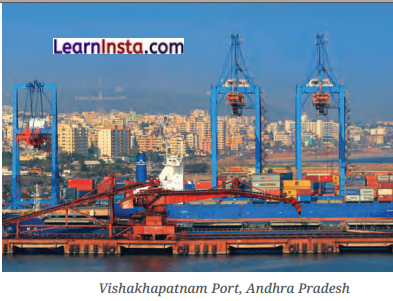
(i) Name the port shown in the picture.
Answer:
Vishakhapatnam Port, Andhra Pradesh.
(ii) Why is shipping considered the cheapest means of transport?
Answer:
Because it can carry heavy and bulky goods over long distances at a low cost.
(iii) Mention two ways in which ports contribute to India’s economy.
Answer:
Ports support international trade by helping in the import and export of goods. They also generate employment and support activities like transport, warehousing, shipbuilding, and tourism.
Class 7 Infrastructure: Engine of India’s Development Extra Questions for Practice
Multiple Choice Questions
Question 1.
Which system helps farmers get market price information quickly?
(a) Railways
(b) Roads
(c) Internet
(d) Ports
Question 2.
What is the longest National Highway of India?
(a) NH 27
(b) NH 1
(c) NH 44
(d) NH 48
Question 3.
Which energy source is mostly used by metro trains?
(a) Coal
(b) Diesel
(c) Petrol
(d) Electricity
Question 4.
Which one is an example of communication infrastructure?
(a) Canal
(b) Railway track
(c) Mobile tower
(d) Highway
Question 5.
Assertion (A): Air transport is very important during natural disasters.
Reason (R): Aeroplanes and helicopters can reach areas where roads and railways are damaged.
Options:
(a) Both (A) and (R) are true and (R) is the correct explanation of (A).
(b) Both (A) and (R) are true but (R) is not the correct explanation of (A).
(c) (A) is true but (R) is wrong.
(d) (A) is false but (R) is correct.
Very Short Answer Type Questions
Question 1.
Why is air transport important in emergencies?
Question 2.
How do ports help in international trade?
Question 3.
What is communication infrastructure?
Question 4.
How does infrastructure help farmers?
Question 5.
What are the advantages of metro trains?
Short Answer Type Questions
Question 1.
Describe the importance of shipping and ports.
Question 2.
How has communication infrastructure changed modern life?
Question 3.
Explain the importance of infrastructure in agriculture.
Question 4.
What problems arise due to poor maintenance of infrastructure?
Question 5.
Explain the role of air transport in India.
Long Answer Type Questions
Question 1.
Explain the meaning and importance of physical infrastructure in a country.
Question 2.
Describe the importance of transport infrastructure in economic development.
Question 3.
Explain the role of Indian Railways in national development.
Question 4.
Explain how communication infrastructure has transformed modern life.
Question 5.
Discuss the importance of metro rail system in modern cities.