Students revise important topics using Class 8 Social Science Extra Questions and Class 8 SST Part 2 Chapter 7 India’s Urban Landscape Extra Question Answer before exams.
India’s Urban Landscape Class 8 Extra Question Answer
Extra Questions of India’s Urban Landscape Class 8
India’s Urban Landscape Class 8 Very Short Question Answer
Question 1.
What is meant by a metropolitan area?
Answer:
A metropolitan area is a large city with a huge population and advanced transport networks.
Question 2.
Name one Indian city that became an IT hub.
Answer:
Bengaluru is an Indian city which became an IT hub.
Question 3.
Who appointed Vidyadhar Bhattacharya to design Jaipur?
Answer:
Maharaja Sawai Jai Singh II appointed him.

Question 4.
Name one town included in the National to design Jaipur Capital Region (NCR).
Answer:
Noida is one town included in NCR.
Question 5.
Which lake in Bengaluru was known for catching fire due to pollution?
Answer:
Bellandur Lake in Bengaluru was known for catching fire due to pollution.
Question 6.
What is meant by informal work in cities?
Answer:
Informal work refers to jobs without regular pay or legal protection.
Question 7.
Name one smaller Indian city famous for textile production.
Answer:
One smaller Indian city famous for textile production is Tirupur.
Question 8.
What is the main aim of urban redevelopment projects?
Answer:
The main aim is to improve infrastructure and living conditions.
Question 9.
Name one facility cities provide for cultural activities.
Answer:
Cities provide libraries for cultural activities.
Question 10.
What is meant by mixed-use development?
Answer:
Mixed-use development means homes, offices, and parks are built close together.
India’s Urban Landscape Class 8 Short Question Answer
Question 1.
Differentiate between urban and rural areas in India on the basis of population, occupation, governance and Infrastructure. (Competency Based Questions)
Answer:
Urban and rural areas differ from each other in terms of population, occupation, governance and the availability
of infrastructure, as shown below
| Basis | Urban Areas | Rural Areas |
| Population | Large and densely populated. | Smaller and less densely populated. |
| Occupation | People are engaged in business, industries, trade and services. | People mainly depend on agriculture and related activities. |
| Governance | Governed by elected urban local bodies such as Municipal Corporations and Municipal Councils. | Governed by Gram Panchayats. |
| Infrastructure | Well-developed transport, communication, healthcare, education, and other civic facilities. | Comparatively less developed transport, communication and public facilities. |
Question 2.
Describe how industrial development led to the growth of Sakchi into Jamshedpur.
Answer:
Industrial development led to the growth of Sakchi into Jamshedpur in the following ways
- Sakchi was selected for setting up Asia’s first steel plant due to its proximity to iron ore deposits.
- The Tata Group developed it into a planned township.
- Modern facilities such as housing, hospitals, roads, and civic amenities were built for workers.
- In 1919, Sakchi was renamed Jamshedpur.
- Industrial growth attracted workers from various regions, leading to rapid population growth and transformation into a major industrial city.
Question 3.
Explain how geographical location influences the growth of cities, giving suitable examples.
Answer:
The geographical location influences the growth of cities in the following ways
- Cities near rivers, coastlines or trade routes grow faster due to easy transport and trade.
- Mumbai developed as a major port along the Arabian Sea.
- Kolkata grew as a port city due to its strategic coastal location.
- Access to natural resources and trade routes supports economic activities and urban expansion.
Question 4.
Examine the role of the Bombay Stock Exchange in the economic growth of Mumbai.
Answer:
The role of the Bombay Stock Exchange in the economic growth of Mumbai are as follows
- It strengthened Mumbai’s position as India’s financial capital.
- It facilitated investment, trade and business expansion.
- It attracted traders, investors and entrepreneurs nationwide.
- Financial growth supported industries, banking and commerce, leading to job creation and infrastructure development.
Question 5.
How did educational institutions and technology industries contribute to the development of Bengaluru as an IT hub? (Competency Based Questions)
Answer:
Educational institutions and technology industries contribute to the development of Bengaluru as an IT hub in the following ways
- Bengaluru has reputed educational institutions producing skilled professionals.
- Close links between universities and technology industries promoted research and innovation.
- Software companies and start-ups formed industrial clusters.
- Advanced technologies like Artificial Intelligence were developed.
- These factors earned the city the title ‘Silicon Valley of India.’
Question 6.
Explain how tourism and pilgrimage support urban economies, with examples of any two cities.
Answer:
Tourism and pilgrimage support urban economies in the following ways
- Tourism and pilgrimage create jobs in hotels, transport services, restaurants, tour agencies, handicrafts, and local markets.
- Agra attracts tourists due to the famous Taj Mahal, boosting hospitality and tourism industries.
- Varanasi attracts pilgrims for religious purposes and spiritual tourism throughout the year.
- Visitors increase demand for goods, transport, food, souvenirs, and cultural experiences.
- This boosts income generation. improves infrastructure and supports sustainable local economic development.
Question 7.
Discuss any four major challenges faced by metropolitan cities in India today.
Answer:
Four major challenges faced by metropolitan cities in India today are as follows
- Rapid population growth leading to housing shortages, overcrowding, and expansion of slums and informal settlements.
- Traffic congestion, rising air pollution, and increased dependence on private vehicles.
- Water scarcity, poor sewage systems, and improper waste management creating health hazards.
- Urban heat island effect, loss of green spaces, and environmental degradation causing serious ecological concerns.
Question 8.
Why was the National Capital Region (NCR) created? Explain its importance in reducing pressure on Delhi.
Answer:
The National Capital Region (NCR) was created to reduce the increasing pressure on Delhi by promoting the planned development of nearby towns and cities. Its importance is as follows
- It distributes population and economic activities to nearby cities such as Noida, Gurugram, Ghaziabad, and Faridabad.
- It reduces overcrowding and eases pressure on Delhi’s infrastructure and public services.
- It creates employment opportunities in neighbouring towns, reducing migration to Delhi.
- It improves transport and regional connectivity across the NCR.
- It promotes balanced regional development and supports sustainable urban growth.
Question 9.
Describe the importance of lake revival initiatives in Bengaluru in solving urban environmental problems.
Answer:
Lake revival initiatives in Bengaluru play an important role in addressing urban environmental challenges. Their importance is as follows
- They help restore and conserve the city’s water bodies.
- They improve groundwater recharge and increase water availability.
- They reduce the risk of urban flooding during heavy rainfall.
- They enhance water quality and support aquatic biodiversity.
- They create green and recreational spaces for residents.
- They improve the urban environment and promote sustainable city development.
Question 10.
Explain how mixed-use development improves the quality of urban life.
Answer:
Mixed-use development improves the quality of urban life in the following ways
- Mixed-use development combines homes, offices, parks, shops, and cultural spaces in one area.
- It reduces travel time and traffic congestion.
- Encourages walking and cycling, improving health and reducing pollution.
- Provides easy access to daily services.
- Promotes community interaction and creates sustainable neighbourhoods.
Question 11.
Highlight the key planning features of Jaipur that make it a well-designed city.
Answer:
The key planning features of Jaipur that make it a well-designed city are as follows
- Jaipur was planned by Vidyadhar Bhattacharya in 1727.
- The city follows a grid pattern with rectangular blocks called chowkris.
- It has wide streets, open spaces, gardens, and nine public squares.
- The city was enclosed by walls with seven gates for protection.
- Buildings were made of pink sandstone, giving it the name ‘Pink City.’
- Proper sunlight, ventilation and water supply ensured climate-friendly planning.
India’s Urban Landscape Class 8 Long Question Answer
Question 1.
Explain the factors responsible for the growth of cities as centres of economic activities in India and the world.
Answer:
Factors responsible for the growth of cities as centres of economic activities are as follows
- Cities grow rapidly when they are located near rivers, seas and major trade roútes that support transport and commerce.
- Mumbai developed as a leading port city because of its location along the Arabian Sea.
- Kolkata expanded due to its favourable position on the Eastern coast.
- The availability of raw materials and agricultural produce encourages industrial development.
- Financial institutions such as the Bombay Stock Exchange strengthened trade and investment activities.
- Well-developed infrastructure, including roads, railways and communication networks, supports economic growth.
- Cities attract skilled labour, entrepreneurs and investors, which increases innovation and productivity.
- Government offices and administrative centres also contribute to economic expansion.
Question 2.
Describe in detail the process of urbanisation and the economic changes associated with it.
Answer:
The process of urbanisation and the economic changes associated with it are as follows
- Urbanisation is the gradual transformation of rural areas into towns and cities over time.
- People shift from agriculture to industries and service-based occupations.
- Small towns develop into larger urban centres as trade and population increase.
- Infrastructure such as schools, hospitals, factories and banks expands with growth.
- Metropolitan Cities emerge with high-rise buildings, malls and metro systems.
- Economic activities diversify into manufacturing, trade, banking and IT services.
- Urbanisation creates employment opportunities but also leads to challenges like congestion and pollution.
Question 3.
Trace the development of Mumbai as India’s financial and cultural capital.
Answer:
The development of Mumbai as India’s financial and cultural capital is as follows
- Mumbai began as a group of fishing villages and later developed into an important port city due to its coastal location.
- During British rule, trade and commerce expanded rapidly, attracting merchants and workers from different regions.
- The establishment of the Bombay Stock Exchange in 1875 made the city the financial hub of India.
- Textile mills created large-scale employment and encouraged migration.
- The growth of the 111m industry in the early 20th century turned Mumbai into the centre of Indian cinema.
- Infrastructure projects such as the Bandra-Worli Sea Link improved connectivity within the city.
- Today, Mumbai is a major centre of banking, media, entertainment and international trade.
Question 4.
Discuss the growth of technology cities such as Bengaluru and Hyderabad. What factors contributed to their success?
Answer:
Growth of technology cities such as Bengaluru and Hyderabad, and factors contributed to their success, are as follows
- Bengaluru became known as the Silicon Valley of India due to its strong IT and software industry.
- The presence of reputed educational and research institutions encouraged innovation and skilled workforce development.
- IT companies and start-ups formed clusters that promoted technological advancement.
- Government policies and global investments supported rapid growth.
- Hyderabad developed major technology parks and BPO centres.
- Both cities benefit from good infrastructure, international airports, and digital connectivity.
- These factors contributed to their success as leading technology hubs.
Question 5.
Explain the reasons for the growth of slums in cities and suggest measures to improve living conditions.
Answer:
The reasons for the growth of slums in cities are as follows
- They develop because migrants moving to cities cannot afford proper housing.
- Rapid urbanisation, unemployment and lack of planned housing increase slum growth.
- Slums are often located near railway tracks, industrial areas or city outskirts.
Measures to improve living conditions are as follows
- Government schemes such as Pradhan Mantri Awas Yojana aim to provide affordable housing.
- Improving sanitation, healthcare, and education facilities is necessary for better living conditions.
- Proper urban planning and community participation can help create inclusive cities.
Question 6.
Discuss the environmental challenges faced by urban areas. Suggest suitable solutions for sustainable urban development.
Answer:
Environmental challenges faced by urban areas are as follows
- Urban areas face challenges such as air pollution, traffic congestion, and waste generation.
- The National Capital Region frequently records very high Air Quality Index levels.
- Lakes such as Bellandur Lake have suffered pollution due to sewage and chemicals.
- Rapid construction reduces green spaces and increases urban heat.
Suitable solutions for sustainable urban development are as follows
- Promoting public transport, cycling and carpooling can reduce pollution.
- Rainwater harvesting and waste segregation improve sustainability.
- Protecting water bodies and increasing green cover are essential for balanced urban development.
Question 7.
“Cities are centres of cultural diversity.” Justify this statement with examples.
Answer:
Cities are centres of cultural diversity because of the following reasons
- Cities attract people from different regions, languages, and religions.
- Migrants bring their customs, traditions, foods, and festivals to urban areas.
- Kolkata is famous for its grand Durga Puja celebrations that reflect cultural richness.
- Mumbai reflects cultural fusion in food and lifestyle.
- Historic monuments such as the Victoria Memorial preserve heritage and history.
- Cultural centres, museums, theatres and festivals promote interaction and creativity.
- Therefore, cities become hubs of diversity and national integration.
Question 8.
Explain how the planning of Jaipur reflects the principles of sustainable and organIsed urban development.
Answer:
The planning of Jaipur is an excellent example of sustainable and organised urban development. It reflects thoughtful planning in the following ways
- The city was designed in a grid pattern with rectangular blocks called chowkris, ensuring systematic development.
- Wide roads, open spaces, gardens, and public squares provided better movement, ventilation, and public convenience.
- The layout followed the East-West and North-South directions, allowing better sunlight and air circulation.
- Markets were built with shaded porches, offering comfort to shoppers in the hot climate.
- The city was enclosed by protective walls and seven gates, ensuring security and planned entry points.
- Buildings were constructed using pink sandstone, giving
- Jaipur its distinctive identity as the ‘Pink City’.
- These planning features have helped Jaipur remain functional, sustainable, and aesthetically attractive even today.
Question 9.
Examine Singapore as a model of dynamic and sustainable urban planning.
Answer:
Singapore can be examined as a model of dynamic and sustainable urban planning in the following ways
- Singapore follows a long-term Concept Plan and regularly updates its Master Plan.
- The city promotes mixed-use development where homes, offices and parks are located close together.
- Areas such as Marina Bay Sands and Raffles Place are well connected by public transport.
- Singapore encourages walking. Cycling and reduced private car use.
- High-rise buildings include rooftop and vertical gardens to reduce heat.
- Efficient waste management and water recycling systems support sustainability.
- These features make Singapore a model of planned urban development.
Question 10.
Future cities must balance growth with sustainability and Inclusiveness.” Explain this statement with suitable examples from India. (Competency Based Questions)
Answer:
Future cities must balance growth with sustainability and inclusiveness due to the following reasons
- Future cities must promote economic growth while protecting the environment.
- Projects like the Sabarmati Riverfront combine ecological conservation with public recreation.
- The pedestrian-friendly development in Gangtok promotes clean and safe public spaces.
- Affordable housing and reliable public transport ensure inclusiveness.
- The use of ICT, renewable energy, and smart systems improves sustainability.
- Lake revival efforts in Bengaluru protect water resources.
- Balanced planning ensures cities remain liveable for present and future generations.
India’s Urban Landscape Class 8 Case Based Questions
Question 1.
Read the passage given below and answer the following questions.
Cities draw people from various regions. They create a mixture of cultures, languages, customs, traditions, food, and festivals that are shared in common spaces. For example, vada pav is a famous snack from Mumbai. It combines a Maharashtrian-style potato dumpling with pay (bread), which has Portuguese influence. This snack became popular among textile mill workers in Mumbai.
(i) Why do cities attract a variety of cultural practices and traditions?
Answer:
Cities attract people from different regions. which leads to a blend of various cultures, customs, languages, and traditions in shared spaces.
(ii) How can food in cities reflect cultural blending?
Answer:
Foods like vada pav combine elements from different cultures- Maharashtrian-style potato dumplings with bread influenced by Portuguese cuisine-showing how city life mixes traditions.
(iii) Why did vada pav become popular among the working class in Mumbai?
Answer:
Vada pay became popular because it was easy to make, carry, and eat, making it suitable for workers in textile mills who needed quick and convenient meals.
India’s Urban Landscape Class 8 Picture Based Questions
Question 1.
Answer the questions based on the picture given below.
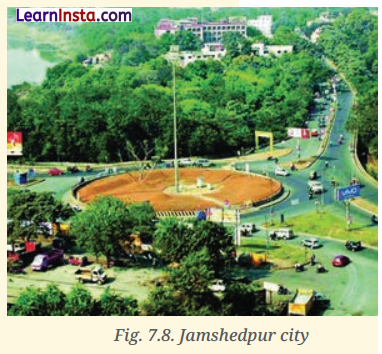
(i) Which industrial city, earlier known as Sakshi, is shown in the picture?
Answer:
The industrial city shown in the picture is Jamshedpur.
(ii) Why was Sakchi chosen as the site for the first steel plant in Asia?
Answer:
Sakchi was chosen because it was located close to rich iron ore deposits in the Chota Nagpur Plateau, which made it suitable for setting up a steel plant.
(iii) How did Sakchi develop into a modern industrial city?
Answer:
The Tata family planned the area as a township with modern facilities for workers. Dorabji Tata built a hospital even before steel production began. The village was renamed Jamshedpur in 1919 and developed with wide streets, gardens, houses and civic amenities. With planned development, more factories were set up, attracting people from within and outside the state for employment.
Class 8 India’s Urban Landscape Extra Questions for Practice
Objective Type Questions
Question 1.
Which of the following best describes an urban area?
(a) Area with scattered population and farming activities
(b) Area with dense population and diverse occupations
(c) Area with only agricultural land
(d) Area governed only by Gram Panchayats
Question 2.
Which factor contributed significantly to the development of Jamshedpur as an industrial city?
(a) Presence of fertile agricultural land
(b) Availability of iron ore deposits nearby
(c) Religious importance of the region
(d) Growth of tourism
Question 3.
Which of the following is an example of planned urban development?
(a) Expansion of slums near industries
(b) Development of Jaipur in a grid pattern
(c) Growth of settlements without planning
(d) Construction of houses along railway tracks
4. Which feature of Singapore’s urban planning
promotes sustainable development?
(a) Dependence on private vehicles
(b) Mixed-use development and vertical greenery
(c) Expansion of industrial areas only
(d) Removal of public parks
Question 5.
Which of the following best explains the importance of reviving urban lakes?
(a) They increase industrial production.
(b) They improve water availability and reduce flooding.
(c) They encourage construction activities.
(d) They increase traffic movement.
Question 6.
Which of the following facilities mainly promotes cultural interaction in cities?
(a) Museums and cultural centres
(b) Steel plants and factories
(c) Warehouses and ports
(d) Industrial estates
Question 7.
Which of the following is the primary objective of urban planning?
(a) Increasing population density
(b) Improving the quality of life of citizens
(c) Expanding industries without planning
(d) Encouraging migration to cities
Question 8.
Which of the following best reflects sustainable urban development?
(a) Conserving green spaces while meeting people’s needs
(b) Replacing parks with commercial buildings
(c) Increasing dependence on private vehicles
(d) Expanding cities without environmental planning
Subjective Type Questions
Question 1.
What is meant by mixed-use development?
Question 2.
Name one Indian city known as the Silicon Valley of India.
Question 3.
What is the main purpose of vertical gardens in cities?
Question 4.
Explain the factors that influence the location and growth of cities.
Question 5.
Describe the role of transport and communication in the economic development of cities.
Question 6.
Explain how cultural diversity makes cities centres of social and cultural exchange.
Question 7.
Discuss the importance of sustainable urban planning in addressing the challenges of modern cities.
Question 8.
Explain how cities contribute to the economic, cultural and technological development of a country.